Saturday, 8 January 2022
President rules out political-administrative division before elections
The TFF MENA Agri-Food-Tech Challenge 2022 for MENA region Entrepreneurs
Application Deadline: February 5th 2022
Innovators across the Middle East and Northern Africa (MENA) region are invited to share their innovative solutions to transform food systems.
The TFF 2022 MENA Agri-Food-Tech Challenge is powered by the global Thought For Food (TFF) Foundation, in partnership with the Food for Future Summit taking place 23-24 February during food and agriculture week at Expo 2020 Dubai.
Requirements
The TFF 2022 MENA Challenge call is open to all entrepreneurs from the MENA region who have a solution to create a healthier, more sustainable and resilient food system.
TFF welcome applications from all stages, including idea and prototype stage, as well as post seed-stage funding.
PERKS & PRIZES
A chance to win the Grand Prize of US$ 8,000 and the Runner-Up Prize of US$ 4,000.
A chance to attend the Food For Future Summit & Expo on 23- 24 February 2022 at Dubai Exhibition Centre
Higher Education Ministry announces Scholarships
Covid-19: Angola reports 2,789 recoveries, 989 new cases
Foreign minister hails Angola and South Korea cooperation
Friday, 7 January 2022
France detects new COVID-19 variant ‘IHU’, more infectious than Omicron: All we know about it
The new variant — B.1.640.2 — which has been detected in 12 patients near Marseille, contains 46 mutations, making it more resistant to vaccines and infectious
Even as the world battles the uptick in COVID-19 cases owing to the Omicron variant, scientists in France have found another variant.
The discovery of the variant, dubbed B.1.640.2, was announced in a paper posted on medRxiv.
Called IHU, as of now, the strain was discovered by academics based at the IHU Mediterranee Infection on 10 December.
Here’s what we know so far of this new COVID-19 variant:
• Researchers say that it contains 46 mutations — even more than Omicron — which makes it more resistant to vaccines and infectious.
• Some 12 cases have been spotted so far near Marseille, with the first linked to travel to the African country Cameroon.
• Tests show the strain carries the N501Y mutation — first seen on the Alpha variant — that experts believe can make it more transmissible
• According to the scientists, it also carries the E484K mutation, which could mean that the IHU variant will be more resistant to vaccines.
• It is yet to be spotted in other countries or labelled a variant under investigation by the World Health Organization.
Omicron dominant variant
Currently, Omicron is the dominant coronavirus variant in France, joining other European countries like the United Kingdom and Portugal with surging case numbers over the past few days.
France’s public health agency had recently said that “62.4 percent of tests showed a profile compatible with the Omicron variant”.
The Omicron variant of coronavirus has stoked average daily confirmed cases to more than 160,000 per day over the past week, with peaks above 200,000.
“The tidal wave has indeed arrived, it’s enormous, but we will not give in to panic,” Health Minister Olivier Veran was quoted as telling Parliament.
In an attempt to battle this surge, French MPs have proposed legislation that would require most people to be vaccinated against Covid-19 to enter public spaces such as bars, restaurants and long-distance public transport.
It is expected to come into force on 15 January after passing through the upper house Senate.
News agency AFP reported that the bill’s headline measure is aimed at getting France’s remaining five million unvaccinated people over 12 to accept a shot.
At present a health pass is required to access numerous everyday venues including bars, cafés, restaurants, cinemas, theatres, gyms, leisure centres and long distance train travel – but a recent negative test is accepted for the health pass.
The bill aims to replace the health pass with a vaccine pass – which would only allow people who are fully vaccinated to gain access to those venues.
……………………………………………………………
Ethiopia civil war: Tigray hospital running out of food for starving children
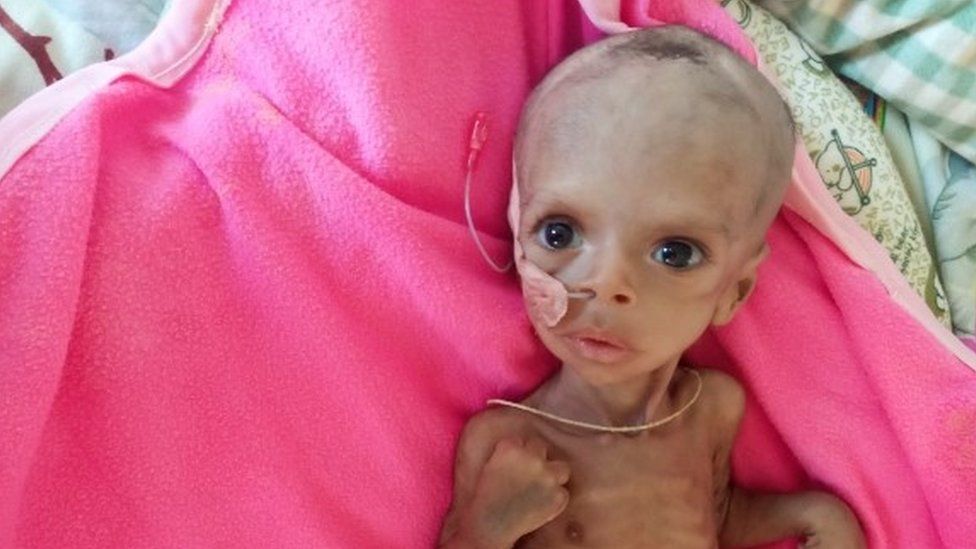
Three-month old Surafeal Mearig lies helpless at the biggest hospital in Ethiopia’s war-torn region of Tigray.
His eyes are wide open, and his ribs press against his thin-wrinkled skin. He is among many children suffering from malnutrition because of the 14-month civil war that has also spread to the neighbouring Afar and Amhara regions.
Surafeal’s paediatrician at the Ayder Referral Hospital in Tigray’s capital, Mekelle, told Reuters news agency that he weighs 2.3kg, one kilogramme less than he did at birth.
Warning: Some readers may find an image below distressing
According to medical notes published by the hospital’s staff, his mother’s milk has dried up and his parents, now both unemployed, cannot afford formula milk.
Crucially, staff at the hospital say they are running out of therapeutic foods to treat children like Surafeal.
“It is now six months since any supply has come here from Addis Ababa [the federal capital],” a doctor at the hospital told the BBC on condition of anonymity as he feared his family could be targeted.
“We’ve almost finished what we had since our last supply arrived in June. Everything is running out,” he added.
This week medical personnel at Ayder Hospital presented a report to international aid agencies asking for help.
Surafeal was one of the case studies they referred to.
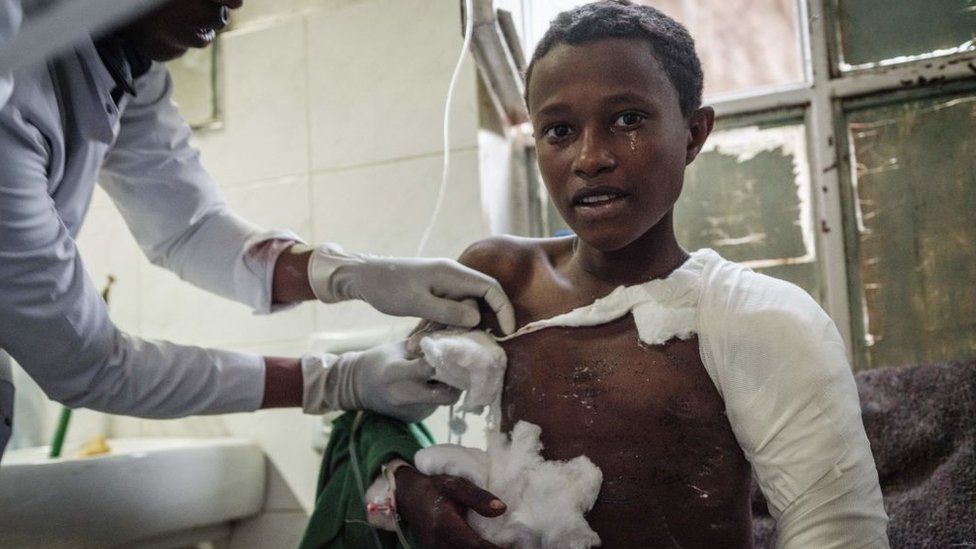
IMAGE SOURCE,REUTERSThe medics said more than 40% of children aged under five years who come to the hospital are malnourished – double the 2019 rate.
Bone thin, four-year-old Medhaniye also lies in a hospital bed, a feeding tube connected through his nose.
His medical report says he started suffering from malnutrition after soldiers attacked his family home slaughtering their ox, destroying and looting property.
The BBC is unable to independently verify the details in the doctors’ report as much of Tigray has been under a communications blackout since November 2020 when the conflict broke out between the Tigray People’s Liberation Front (TPLF), which is in control of much of the region, and the federal government. Journalists have also not been able to visit Tigray since July.
Stopping bleeding with bare hands
In their report the doctors blame a six-month “blockade” by federal forces and their allies for the severe shortage of medicines and equipment which they say are leading to avoidable deaths.
“Since the region was besieged, another 35 patients have lost their lives due to dialysis service absence,” the report says.
Doctors say they have been forced to stop bleeding with their bare hands, wash and reuse gloves or make their own disinfectant fluids.
In his response, government spokesman Legesse Tulu told the BBC the report seemed to “seeking to build a narrative” for the TPLF and “mimics” its claims of a blockade on Tigray.
“From the government side, there is no deliberate embargo in Tigray that damages our people,” he said.
But since the war began, aid agencies have complained about not being able to get much aid into Tigray.
IMAGE SOURCE,GETTY IMAGESAccording to the latest report by the United Nations Office for the Coordination of Humanitarian Affairs (Ocha) on 30 December, aid convoys have not reached Tigray since mid-December because of bureaucratic delays and insecurity.
The World Food Programme estimates that 100 trucks carrying aid need to reach Tigray each week to meet the needs of more than five million people but according to Ocha only 12% of the supplies needed have made it into the region.
In response to queries about aid deliveries Mr Legesse said: “Over 840 of the 1,100 vehicles providing food and medicine to Tigray have yet to be returned. They are suspected of being used by the TPLF to carry illegal recruits, soldiers and military supplies.”
The TPLF has denied claims it is hampering aid assistance, but its forces have also been accused of looting aid stores and health facilities in areas it occupied in Amhara and Afar.
The doctor at Ayder Hospital told the BBC that even the families of staff were being affected by the crisis.
“My child has appendicitis and cannot get treatment,” he said.
And as the shortages continue he says they will have no choice but to stop all surgery by next week.
“We don’t have supplies. That’s the point we’ve reached now, which is why we wanted to let the world know. Most hospitals are closing.”
More on the Tigray crisis:
……………………………………………………………
When Telecommunications Collapse: What Angola's Mobile Network Crisis Teaches Us About Governance, Justice, and National Security
The recent disruption of Angola's mobile networks has affected banking, digital payments, businesses, emergency communications, and mi...
-
Since the July 26 coup, Niger has become the latest hotbed of disinformation in the troubled Sahel region as West African powers grapple wit...
-
Angola vs Argentina | International Friendly Football Match 2025 | eFootball PES 21 Simulation 🔴AO VIVO! 🇦🇴🇦🇷 ARGENTINA VS ANGOLA 202...
-
Angolan President of Republic João Lourenço marked Saturday (26) the third year of his five-year in office, marked by the strong negative ...