Minister said the court ruling dishonoured South Korean soldiers by finding them responsible for the massacre of Vietnamese villagers.
South Korean Defence Minister Lee Jong-Sup told a parliamentary committee on Friday that his ministry is certain there were “absolutely no massacres committed by our troops” during the Vietnam War, and the court decision damaged the honour of South Korean soldiers.
“We cannot agree with the ruling … We will hold discussions with related agencies to determine our next legal step,” Lee said when asked about the recent ruling by the Seoul Central District Court.
The court ordered the government to pay 30 million won ($23,000) to 62-year-old Nguyen Thi Thanh, who survived a gunshot to her stomach but lost five family members — including her mother and two siblings — after South Korean marines swept through her village of Phong Nhi in central Vietnam on February 12, 1968.
Thanh said in court filings that she was just eight years old when the massacre took place and that she was shot in the stomach by a South Korean soldier requiring her to spend almost a year in hospital.
According to US military documents and survivors, more than 70 people were killed that day when South Korean marines allegedly fired at unarmed civilians while occupying Phong Nhi and nearby Phong Nhut. The rampage followed after at least one South Korean soldier was injured by nearby enemy gunfire.
South Korean troops of the White Horse Division with three Vietnamese prisoners during the war in Vietnam in 1966
The February 7 ruling marked the first time a South Korean court has found the government responsible for mass killings of Vietnamese civilians during the war and could potentially open the way for similar lawsuits.
South Korea, which was then ruled by anti-communist military leaders, sent more than 320,000 personnel to Vietnam, the largest foreign contingent fighting alongside US troops.
In awarding the compensation to Thanh, the court dismissed the government’s claims that there was no conclusive evidence that South Korean troops were responsible for the killings. Government lawyers had suggested that the culprits may have been Vietnamese Communist fighters disguised in South Korean uniforms.
The lawyers were also unsuccessful in arguing that civilian killings were unavoidable because the South Korean troops were dealing with rebels who often blended in with everyday Vietnamese villagers.
Lee repeated those government arguments during Friday’s parliamentary session, saying the situation at the time was “very complicated”.
Thanh’s lawyers had claimed there was no way to justify the killings when South Korean veterans who spoke about the shootings said they did not face any meaningful resistance or aggression from villagers, who were rounded up and shot from close range.
South Korea’s Justice Ministry, which represents the government in lawsuits, said it would closely examine the court ruling and discuss it with related agencies, including the defence ministry, before determining whether to appeal.
The government must appeal within two weeks of formally receiving a copy of the ruling, which according to Thanh’s lawyers was delivered on Friday.
The Korea Times newspaper published an editorial shortly after the court ruling in favour of Thanh in which it called on the government to admit to atrocities during the Vietnam War.
“Yes, many Korean soldiers were killed and wounded in Vietnam due to the government’s policy. Some still suffer from aftereffects, including side effects of the defoliant Agent Orange,” the newspaper wrote.
“However, killing unarmed civilians, including women and children, is a war crime that is unjustifiable under any circumstance. The executive branch must admit what it must admit ― and apologize and compensate.”
No one’s born violent - Everyday Activism Against Gender-Based Violence (GBV)
Angola
The first thing to understand about violence is that no individual is born violent. It is the circumstance that gives birth to it. Violence against women and girls is a human rights violation, and the immediate and long-term physical, sexual, and mental consequences for women and girls can be devastating, including death.
Every day a mother dies, a daughter dies, a neighbor dies, a student dies, a friend dies, a businesswoman dies. Not enough is done to prevent violence, and when it does occur, it often goes unpunished.
Hello good morning world!
we participated in the 16-day of activism against gender-based violence (an international initiative that takes place between 25 November and 10 December, starting with the International Day for the Elimination of Violence Against Women and ending with Human Rights Day), and also observed the International Day of Zero Tolerance for Female Genital Mutilation that took place on 6 February 2023.
The goal of our program is to end violence against women, to make people aware that violence is not the solution to the problems we face, and to make a call upon governments and partners to show their solidarity to women’s rights movements and activists and inviting everyone to join the global movement in ‘pushing forward’ against the push back, to end violence against women once and for all.
Violence against women and girls is a human rights violation, and the immediate and long-term physical, sexual, and mental consequences for women and girls can be devastating, including death.
Every day women die, girls die, children are mistreated and this problem of domestic abuse has worsened in times of quarantine during the covid-19 pandemic. Parents who lost their jobs vented anger on their children, frustrated husbands vented anger on their wives, family members abused minors. Many people lost their lives, many wives were mistreated.
It is an evil that we must fight in our society, because violence against women is a violation of human rights, women are limited in everything, they have practically no right to anything in some societies, they often have no right to health and quality education; concluding and summarizing, there are many things that we still need to fight, we also have many women suffering from extreme poverty.
Reason why, we are here to draw the attention of the general population, especially men, to show solidarity in favor of this cause, which is to end gender-based violence, violence against women and girls.
Let's join forces and fight this evil.(Every day a mother dies, a daughter dies, a neighbor dies, a student dies, a friend dies, a businesswoman dies).We are not doing well using violence. We must educate our population, our society above all, sensitize people, propose new legislation on combating violence against women and domestic violence. Keeping people in schools can also reduce the level of violence, eliminate delinquency in neighborhoods, many girls are sexually abused in neighborhoods, especially in the most dangerous places, we have fathers without judgment who rape their own daughters. In general, our society needs to be more civilized to fight this crime.
Interview with suzana (victim of domestic violence)
Lady good afternoon,
Good afternoon, Thank you.
What's your name?
My name is Suzana Dembo João
We are promoting 16 days of Activism Against Gender-Based Violence, Violence Against Women.
We would like to know. Have you ever been a victim of domestic violence?
Yes, I have been a victim of domestic violence.
Could you please tell us how you lived through that period?
Well the following happened to me:
At the beginning of the relationship everything was a sea of roses, but after a while things changed. We had only a 10-year union. It all started after 3 years of our union, when I had my second child, the man became very violent, very jealous, all for nothing it was a reason for jealousy.
I couldn't go out anymore, not even to say hello to the neighbors, the man was suspicious of everything. When he went to work, at work he was full of dark thoughts, he suspected that when his wife was at home she was having fun with other men. Even when I went out to visit my family, if I stayed a little longer with the family, it would be a reason for conflict.
He didn't know how to sit down to talk, he wasn't a man for conversation. He resolved all our conflicts at home with beatings, he beat me a lot. A little thing that happened at home was a reason for him to beat me up, when he imagined things that didn't exist he also ended all his anger at me. He was very brutal when he hit me, he would only stop until my face was inflamed.
Besides this kind of physical violence, has he ever committed another kind of violence? Even though you were living maritally, did he ever go so far as to sexually molest you?
Yes, he molested me sexually, too.
Whenever I had a family outing, he didn't feel right without molesting me first. He used to sexually violate me against my will. He would drag me into the bedroom to fulfill his sexual desires and would only let go until he was tired and satisfied. Over time he became so obsessed that he forced me to have anal intercourse. He raped me in the anus too.
When I tried to reject him he would beat me and force me, he even did it in front of our children. The children watched us when he forced me to have anal sex. He was a sadomasochist.
Ok, at that time were you studying?
Yes, I was studying, he was the one who enrolled me in school, paid the tuition, bought the school supplies and uniforms. But I stayed in school for 3 months only, after 3 months he changed his behavior.
He used to tell me that if I wanted to continue studying I should go to classes with the two children. I used to tell him that allowing me to study would be beneficial for both of us and for the family, because once I graduated I could get a job and help him with household expenses in the future.
He said that will never form his wife because it would be a waste of time. Being a graduated woman I would leave ungrateful, abandon him and find another man with more money than him.
Things started to get even more complicated. I studied at night because of my age, the last class ended at 8:00 pm, if I got home at 8:30 pm it was a big problem for him, he got to the point that made me drop out of school. I stayed at home to obey everything he used to order me.
Have you ever asked for help?
I tried.
I really tried to report him to the Organization of Angolan Women (OMA). But when I got there, I was out of money to open the process, they said that to open a complaint process one pays a fee. I had no money, I left la and never went back to OMA again.
Then I made the decision to separate from that person.
How long have you been separated from him?
It's been 8 or 10 years.
How many children did you have together?
2, we made a couple (a girl and a boy).
How is your life going now? Do you have a new relationship?
Thank God, I have a new husband, we've been together for 7 years, we have 3 little children together.
With my new husband I am more happier, he is a man who never hit me, no matter how wrong I am.
He is an understanding man, always has the patience to talk to me when we have problems. He is a good father to my children, a good husband and friend. I am very happy and I praise God for introducing me to this man.
What advice would you give to those women who are currently suffering from domestic and sexual violence and are unable to DENOUNCE it?
My sisters, listen to my advice: This problem of ours, habit and fear of hiding our aggressive husbands for being the father of our children, is a trap for ourselves. My sisters, a woman must not allow a man to make her suffer. When we get together with someone it is to be happy, do not allow these types of violence in your homes.
When the husband hits you for the first, second and third time, denounce him.
I wouldn't want anyone to go through what I went through. Even when I watch cases of violence against women, murdered by their husbands on television or on the radio, I get very shaken and depressed.
Be strong. No domestic violence!
Domestic violence is a crime. Report it. Hiding cases like these is a mistake, this is my advice to women.
Ok. Thank you very much!
No one’s born violent
The first thing to understand about violence is that no individual is born violent. It is the circumstance that gives birth to it.
“Educating women about their rights is not enough,” ending gender-based violence has to start with men. Domestic violence affects approximately one in every three women the world over, which is more than a quarter of all women in the world.“No man is born violent.” Violence is learned, and if it can be learned, it can be unlearned. Raising strong, ethical men starts with planning educational programs and community discussions.
This being said, not every violent person ends up a cold-blooded murderer. Sometimes, violence manifests itself in forms less severe, yet equally scarring. Incidents of brutality occurring in households or on the streets may not lead to homicide, but they just as well can destroy families and societies.
'BabyScream'' IBM RPA Anti-harassment chatbot to End Child Marriage. The tech show with Sofonie Dala
We designed an Anti-harassment chatbot named BabyScream to help victims of child marriage, domestic violence and sexual abuse, denounce harmful practices. The bot connects users with agent-defenders, allows victims to report harmful practices and denounce their aggressors.
Children are increasingly undergoing abuse, yes. Violence has increased within our communities. Cases of child marriage have increased; issues of children being murdered have also been heard of in many areas.
Violence against women and girls is defined as any act of gender-based violence that results in, or is likely to result in, physical, sexual or mental harm or suffering to women and girls, including threats of such acts, coercion or arbitrary deprivation of liberty, whether occurring in public or in private life.
David Malpass led lender through crises including the war in Ukraine but faced criticism over stance on climate change.
World Bank chief David Malpass has announced he will step down in June, nearly a year before the end of his term. Malpass, who was nominated to his five-year term by former United States President Donald Trump in 2019, said on Wednesday he had decided to pursue new challenges after having the “enormous honour and privilege” of leading the international lender.
“With developing countries facing unprecedented crises, I’m proud that the Bank Group has responded with speed, scale, innovation, and impact,” Malpass said in a statement posted on the lender’s website.
“The last four years have been some of the most meaningful of my career. Having made much progress, and after a good deal of thought, I’ve decided to pursue new challenges. I want to thank our staff and Boards of Directors for the privilege of working with them every day to strengthen the effectiveness of our operations in the most challenging of times.”
Malpass, a former chief economist of Bear Stearns who served in several Republican administrations, led the 189-nation agency during a series of crises including the COVID 19 pandemic and Russia’s invasion of Ukraine.
The World Bank, which was founded in 1944 to fund development projects around the world, is traditionally led by an American, while fellow lender the International Monetary Fund is typically led by a European.
The former US secretary of the Treasury for international affairs, however, attracted criticism over his stance on climate change, with former US vice president Al Gore labelling him a climate denier and climate activists calling for his resignation.
After declining to say if he believed human-generated emissions were warming the planet at a conference in September, Malpass later acknowledged fossil fuels were generating greenhouse gas emissions and insisted he is not a climate change denier.
The World Bank said in a statement on Wednesday it had “responded quickly” to global crises, mobilising a record $440bn to address challenges including climate change.
US Treasury Secretary Janet Yellen thanked Malpass for his service and said the US would soon nominate a replacement.
“The world has benefited from his strong support for Ukraine in the face of Russia’s illegal and unprovoked invasion, his vital work to assist the Afghan people, and his commitment to helping low-income countries achieve debt sustainability through debt reduction,” Yellen said in a statement.
“We will put forward a candidate to lead the World Bank and build on the Bank’s longstanding work… and who will carry forward the vital work we are undertaking to evolve the multilateral development banks.”
A Mozambican pastor has died after fasting for 40 days trying to reach the record reached by Jesus on the biblical Mount of Olives.
The death of Francisco Barajah, the pastor and founder of the Santa Trindade Evangelical Church in the central province of Manica, was confirmed on Wednesday.
He died while being treated at hospital in Beira where he was evacuated in critical condition.
After 25 days of fasting, he had lost a lot of weight to a point where he could not stand up, bathe or walk.
Days later, at the insistence of relatives and believers, he was taken to a hospital but attempts to get him back to health were unsuccessful.
Believers at his church and his neighbours have been unsurprised at the turn of events, due to his extreme weight loss and disfigured body frame in recent days.
Half of Nigeria’s population are women, but only 4 percent were elected in the 2019 election. Will the 2023 election be any different?
Ago-Iwoye, Nigeria – On June 8, 2022, millions of Nigerians were glued to their phones, televisions, and other devices, watching the presidential primaries of the ruling All Progressives Congress (APC).
Then something happened. Uju Ken Ohanenye, the only woman among the 23 aspirants, withdrew from the contest in favour of the eventual winner and national leader of the party, Bola Tinubu.
“I have decided to step aside for the lifesaver who is Asiwaju Bola Ahmed Tinubu,” the lawyer and entrepreneur who had previously told journalists that “the touch of a woman is lacking in the governance of this country”, said on national television.
For some Nigerians, it was a step back for gender equality in the country’s politics but also a timely reminder of the many hurdles women face in attaining leadership roles in this vast West African country.
“[Ohanenye] might have believed she was not going to win because of the financial and political limitations she would have to surpass,” said Antoinette Lecky, Lagos-based media personality and former projects lead at ElectHER, a nonprofit focused on getting more women into political leadership. “[But] it gave her a chance to publicise herself as a lot of people did not know who she was at the time.”
Half of Nigeria’s estimated 210 million people are women. But only one woman has ever occupied any of the top four positions in Nigerian governance – a five-month stint as speaker in 2007 – since the country’s independence from Britain in 1960. Only five percent of Nigeria’s federal lawmakers are women, one of the lowest representation rates globally.
And no woman has ever been elected governor.
On February 25, Nigeria’s presidential election will be held, and only one of the 18 candidates is female – Ojei Chichi of the Allied People’s Movement (APM). In the governorship races, there is only one woman across the 36 states – the APC’s Aisha Binani in Adamawa state.
Civil society leaders and other experts say women’s political participation in Nigeria is below global standards.
“There is … something sad about the idea that we haven’t had a woman governor in this country,” novelist Chimamanda Adichie said at a conference in January. “It’s wonderful that we are celebrating the possibility [of having one soon] but why has it taken so long?”
As the presidential and parliamentary elections at federal and state levels hold this February and March, only 1,524 – less than a 10th of the 15,336 candidates in the forthcoming – are women, according to data from Lagos-based geopolitical risk advisory consultancy SBM Intelligence.
“Over the years, I’ve witnessed a rise in the number of women serving in elected and appointed political positions, the world over. But that is not the case in Nigeria,” Leena Hoffmann, associate fellow, Africa Programme at London-based think tank Chatham House. “Cultural and societal beliefs have contributed to the poor representation of women in Nigerian politics, especially in Northern Nigeria.”
An “ingrained patriarchal structure” in Nigeria’s political landscape has led to “long-lasting layered institutionalised effects”, Lecky told Al Jazeera.
“They’ve told us that women are not supposed to run for political offices so we have women who won’t dream of it. We are taught to be submissive and modest,” she said.
Experts say a motley of factors, ranging from cultural and financial hindrances to violence against women, have severely limited the ability of women to occupy many offices in the political space.
In November, unknown assailants killed a female political leader in the northwest state of Kaduna. It was the ninth incident of violence against politically exposed women or women affiliated with politicians since the 2019 elections.
In a research conducted by Lagos-based Stand to End Rape (STER) between October 2021 and April 2022, about a fifth of the respondents said they often have to trade sexual favours as active and direct participants in the political space.
“Elections in Nigeria are monetised and transactional, and women are already socially disadvantaged considering that in Nigeria, the fastest way to be rich is to be in government,” Ayisha Osori, former head of the Open Society Initiative for West Africa and author of Love Does Not Win Elections.
“If women are not in politics then they cannot raise money and if they cannot raise money, then they cannot be in politics,” Osori, who previously ran for federal parliament, added.
A number of organisations like OSIWA, ElectHER and others are helping women get into politics through fundraising and supporting female candidates running for office by creating awareness and security.
The Agender35, an ElectHER initiative, uses documentaries to tell stories of political campaigns of women. Another of its programmes is a partnership with the National Assembly to teach young women about the business of being in parliament.
On its part, STER has partnered with Kasala, an emergency alert and tracking app, to help women seek emergency support services.
But there are still calls for more to be done as the leading parties are yet to hand major tickets to women in what remains a conservative society. Some suggest the drafting gender-inclusive policies in parliament and the political parties – and for women to be part of drafting these policies.
In March 2022, as Nigeria’s lower house of parliament considered proposals for the amendment of the constitution, it discarded three proposed bills favouring women; one stipulated the assignment of 35 percent of legislative seats to women, as well as 35 percent of political party leadership, for women.
Within hours of women-led protests in Lagos and at least three other states the week after parliament announced the rejection, it was forced to rescind the decision.
The bills are yet to be decided upon but activists say that even if they are passed, there is so much work to do to bring Nigerian women up to par.
“We should all canvas for gender inclusion so everyone can have an equal and fair chance at representation,” said Lecky. “We need more communal change on how individuals feel about women’s participation.”
Five people have been killed and 100 are missing after the storm battered the North Island, home to most of the population.
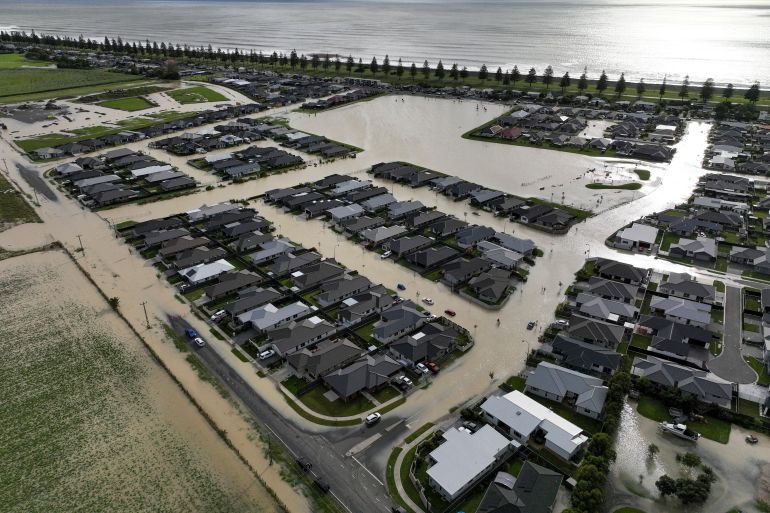
An overwhelmed New Zealand has said it is open to offers of international assistance as it battles with the aftermath of Cyclone Gabrielle, which caused widespread flooding and landslides in the country’s north and cut off some towns.
Five people have been confirmed dead after four days of strong winds and torrential rain. Authorities say 100 are missing and 10,500 more have been displaced.
Prime Minister Chris Hipkins on Thursday warned New Zealanders recovery would take time, with power not expected to be restored to some areas for weeks and the cleanup likely to take much longer.
“This is a traumatic event,” he said. “It’s a very big challenge to restore infrastructure as fast as we can but we have to acknowledge that we are in for a bumpy ride.”
After initially setting aside offers of help from the United States and other countries, Hipkins added: “We are accepting offers of international assistance.”
The New Zealand Defence Force has deployed two large ships and a C-130 Hercules transport plane to deliver thousands of litres of water along with personnel and several mobile water treatment plants to the most hard-hit regions.
It has also used helicopters to deliver supplies and rescue hundreds of people stranded on their rooftops.
On Thursday, Napier was cut off again after experts detected damage to the last bridge linking the town’s 65,000 people with the rest of the country.
The town of Napier was again cut off on Thursday amid concerns about the structural safety of the one remaining bridge to the rest of the country
Isolated residents have been told not to leave their homes unless “absolutely essential” and to restrict water use.
When residents do venture out, they wade through murky floodwaters to get supplies or huddle on the steps of a few buildings that still have WiFi, trying to get in touch with loved ones.
Hipkins said people’s inability to get in touch with family and friends was a real issue and the government was working on immediately increasing connectivity.
Earlier on Thursday, Finance Minister Grant Robertson said the country was financially able to meet the costs of rebuilding.
Parts of New Zealand’s North Island, where about 75 percent of the country’s 5 million residents live, are enduring their second big storm in as many weeks. Record rains last month triggered flash floods in Auckland and four people were killed.
Meteorological service MetService said Cyclone Gabrielle is now east of the country and continuing to track away from the North Island. However, it said thunderstorms might hit badly affected areas of Hawke’s Bay and Tairawhiti on Thursday.
DRC authorities have denied its soldiers entered a neutral zone and opened fire on Rwanda’s troops as tensions rise between the countries.
Rwanda’s army has said its troops briefly exchanged fire with soldiers from the Democratic Republic of the Congo at a border post, as tension continues to spike between the neighbours.
In a statement on Wednesday, Kigali said that 12 to 14 Congolese soldiers entered the neutral zone near the western district of Rusizi and opened fire at a Rwandan border post, in “an act of provocation”.
“Our security forces responded and [the Congolese] soldiers withdrew,” the statement said. “There were no casualties on the Rwanda side and the situation is calm.”
Meanwhile, Kinshasa has denied entering the neutral zone and said there were clashes between its military and a group of “bandits” near the border in Bukavu.
“In no case did the [army] cross the neutral zone, let alone open fire in the direction of Rwanda,” Theo Ngwabidje Kasi, governor of South Kivu province, said in a statement.
He said the accusations were “a lie” and described the incident as an “altercation” involving an exchange of fire between the Congolese security forces and “bandits,” who sustained one dead and one wounded.
“Rwanda’s tendency to want to portray itself as a victim and stoke tensions by making false accusations reveals without any doubt its intention to attack South Kivu province, as is currently the case in the war of aggression that it is carrying out in North Kivu,” he added.
The incident occurs against a backdrop of existing tensions between the DRC and its smaller neighbour over an offensive in the eastern Congolese province of North Kivu.
Last month, Rwanda accused a Congolese fighter jet of violating its airspace near Goma, a town on North Kivu’s border. The plane came under fire but was able to land safely in Goma.
Kinshasa described the attack on its aircraft as “a deliberate act of aggression that equals an act of war” with the goal of sabotaging regional peace efforts.
The DRC for months has accused Rwanda of supporting an armed rebel group called M23, that’s fighting in the DRC’s east.
The conflict in eastern DRC has gone on for decades, with more than 100 armed groups fighting for control of valuable mineral resources while others protect their communities, and has triggered an exodus of refugees.
Rwanda in turn accuses the DRC of supporting the Democratic Forces for the Liberation of Rwanda (FDLR), another rebel group based in the DRC that has carried out raids into Rwanda in the past.
The FDLR has been accused of participation in the 1994 Rwandan genocide, in which ethnic Hutus killed more than 800,000 ethnic Tutsis and moderate Hutus who tried to protect them.
Last year, United Nations experts said they had “substantial evidence” of Rwandan government forces crossing into the DRC to reinforce M23 rebels or to conduct operations against the FDLR.
The Rwandan government has denied supporting M23 and says the accusations are part of a “tired old blame game” undermining efforts for peace, “to which Rwanda is fully committed”.
Rwanda’s President Paul Kagame has said DRC authorities should solve their own problems. In January he said that the crisis in the DRC “is not Rwanda’s problem, and we are going to make sure that everybody realises it is not Rwanda’s problem”.