Translate

Tuesday, 23 August 2022

Angola braces for closely fought elections

 Angolans will vote on Wednesday to determine whether or not President João Lourenço wins a second and final five-year term in office.


He is running on a ticket of the ruling MPLA party – with a total of eight candidates vying for the top job.

His main challenge comes in the form of Angola’s largest opposition party Unita, whose leader is Adalberto Costa Júnior.

Most outside analysts predict that the MPLA – which has ruled Angola since independence in 1975 – will win again, but many feel that this will be the country’s closest election so far.

Angolan economist Âurea Mouzinho says this campaign has a different feel, and believes that young people today feel more comfortable and open to challenge the country’s political establishment.

Unita supporter attends in a rally in Caxito, Bengo province
Opposition party Unita poses the biggest challenge to the ruling partyImage caption: Opposition party Unita poses the biggest challenge to the ruling party

The ruling party says they’re still ready and confident to win this time around. But it has attracted criticism as well.

Maria Luisa “Tchenguita” is standing as an independent candidate. She says that after almost five decades under the MPLA, many young people in Angola are hungry for something different.

Unita had intended to run its candidate under the banner of a new coalition – the FPU – but was ordered by Angola’s Constitutional Court to contest the election under its traditional party name.

……………………………………………………………

Actress Tonto Dikeh Quits Nollywood

 In an exclusive interview with BBC Pidgin, well-known actress Tonto Dikeh, who is vying for the office of deputy governor in her home area, Rivers State, in the 2023 elections, said it was not easy to go from being a celebrity to a politician.


Several entertainers have recently announced they were running for political office in the forthcoming elections, including Funke Akindele, a Nollywood actress and Banky W, a musician and actor.

“First of all I would like to commend all of them, it’s not easy to be where they are, it’s not easy to put yourself out there,” she said.

“I would say congratulations for coming this far,” she continued.

Dikeh, 37, said her desire to enter politics was born out of a belief that the younger generation of Nigerians must lead on the change they want to see.

“The youths are now understanding their value, they are now understanding that if we don’t speak out, things won’t change. Nobody wants to be quiet anymore, nobody wants to suffer anymore. That has propelled a lot of well-meaning youths.”

She also said people should not expect her to act in films anytime soon.

“I have done a couple of films over the years, like two films in 10 years so you can’t really say I am still in the industry.”

She added that if she got into power she would like to support the acting industry, but she “won’t act anymore”.

Dikeh has starred in dozens of films and has also veered into music.

…………………………………………………………

Kenya elections 2022: Win or lose, why Raila Odinga’s election challenge matters

 For the third time in a row, Raila Odinga has challenged the result of Kenya’s presidential elections. The 77-year-old long-time opposition leader has been ridiculed by some as a bad loser, but analysts say his petitions have been crucial in shaping and strengthening the conduct of elections in Kenya, so whatever the Supreme Court decides, this case will help improve subsequent polls.


After polls closed on 9 August, many Kenyans marvelled at how quickly results started populating an online portal run by the electoral commission – a process that had often been beset by controversy and suspect delays in previous polls. By the following morning, 80% of returns from more than 46,000 polling stations across the country had been posted.

It was a remarkable achievement for an agency that had gone into the election with credibility concerns – even if the verification process did not match the speed of the transmission of results, leading to intense public frustration and anxiety, and the current legal challenge.

Glowing in the praise streaming in from Kenya and beyond, the head of the electoral body Wafula Chebukati mocked the local media – whose tallies of the results were running behind – for struggling and not being “prepared” to keep up with the speed at which the agency was posting the results.

Keen to demonstrate transparency, the electoral body had decided to encourage the media and the public to tally the results themselves, instead of giving its own updates on the close presidential race.

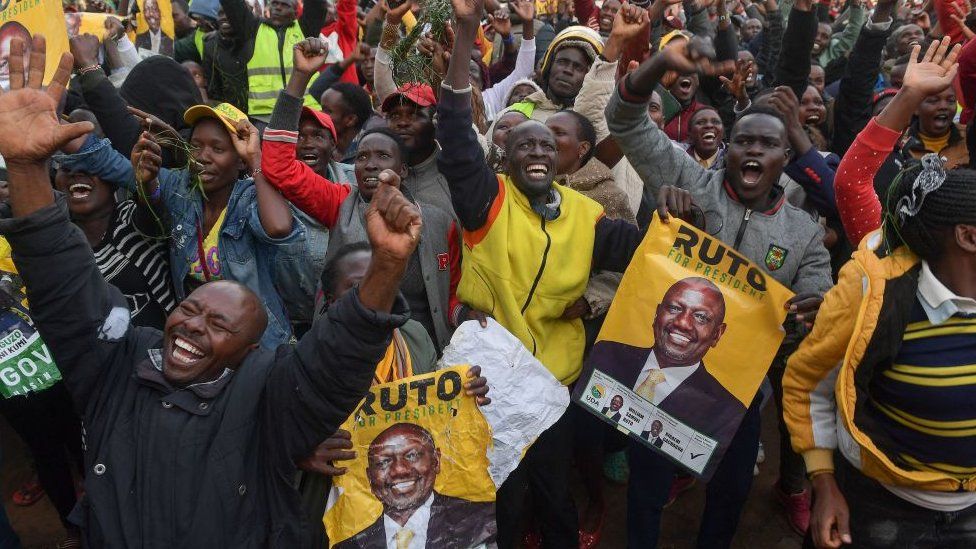
William Ruto's supporters celebrate
Supporters of President-elect William Ruto are adamant that he is the rightful winner

The speed and transparency of the publication of the initial results left some in other African countries in awe.

Noting that there was no internet shutdown, arrest of opposition leaders, and no hint that the incumbent was planning to cling on to power, they compared what they perceived as deficiencies in their country’s electoral systems to what they saw happening in Kenya.

“Thank you Kenya for teaching the East African Community what transparent election is. Hopefully Tanzania will borrow a leaf for the next election,” a Tanzanian tweeted.

Kenyan public law scholar Prof Migai Akech told the BBC the commission did “an excellent job of transmitting results in record time”.

“The process was much more transparent. Even if there are disputes, you just tally the polling stations outcomes.”

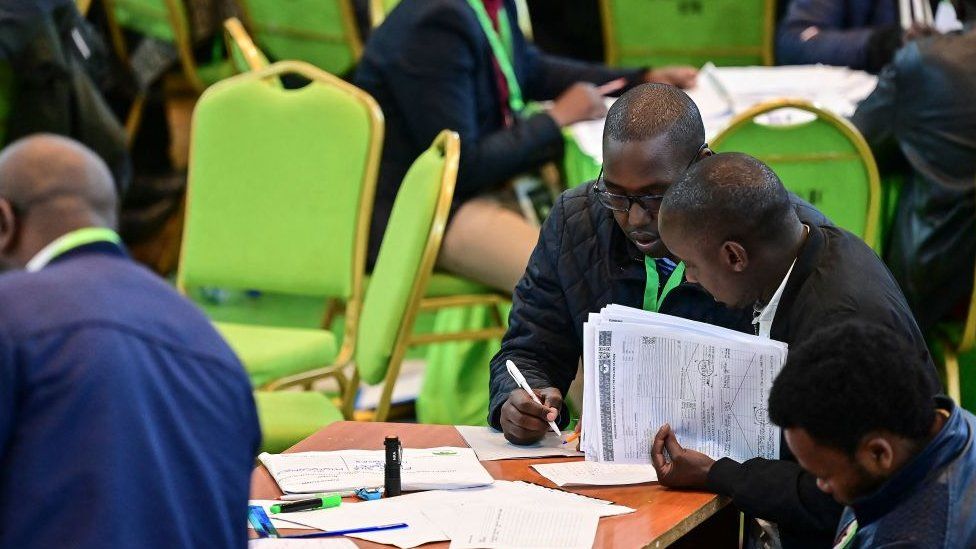
Agents verifying results forms
Poll officials had to compare whether results sent using electronic gadgets from more than 46,000 polling stations matched physical copies

The efficiency in the results transmission was not a fluke but a consequence of a case brought by Mr Odinga after he lost the last election alleging massive fraud, including the failure of the electoral commission to transmit all results electronically as required by law, to reduce the risk of them being tampered with.

In a majority ruling, the Supreme Court judges found that “illegalities” and “irregularities” had taken place and therefore annulled the 2017 election and ordered a rerun.

“Essentially the Supreme Court was saying that there was no election. Counting and tallying were not faulty – the problem had to do with the transmission and verification of results. Because of this it constituted a violation of the law,” said Prof Akech.

According to lawyer Omwanza Ombati, who successfully argued to overturn an MP’s election win in 2008 – the first since the reintroduction of multiparty in the early 1990s – although Mr Odinga has a mixed record in terms of his election challenges, he has made “a large contribution to how electoral law is applied in presidential contests”.

And yet Mr Odinga, who has now lost five presidential elections, has been widely mocked online.

“I can’t believe he started rejecting election results before I was born,” one Tweeter said, referring to the 1997 election when Mr Odinga was among opposition leaders to reject then President Daniel Moi’s win.

“He would have rejected his own victory if he had won,” said another.

But Mr Ombati says the various challenges brought by Mr Odinga and others have improved Kenyan democracy in numerous ways, including the procurement of election materials, hiring of electoral staff, and that results at polling stations should be final.

After his 2013 challenge to President Uhuru Kenyatta’s victory was dismissed, Mr Odinga explained why he had no regrets about going to court.

“My decision to file a petition at the Supreme Court to challenge the validity of the election was a statement of my faith in the independence of the judiciary. We did so for the sake of our democracy and for the sake of all Kenyans who wanted to exercise their constitutional right to elect their leaders through free and fair elections.”

He was speaking just five years after the country had imploded after claims that election rigging had cheated him of victory. The inter-ethnic violence killed more than 1,200 people and forced 600,000 others from their homes.

Mr Odinga was also one of the key advocates for a new constitution, which was passed in 2010.

Under the previous constitution, it sometimes took five years – a full political term – to hear a case challenging an election, Mr Ombati said.

While Mr Moi was in power, from 1978-2002, the opposition could not serve him court papers challenging his victories because they were required to do so physically. “That constitution gave special status to the election winner,” Mr Ombati said.

Judges also showed loyalty to Mr Moi – “the law was used as an instrument to serve Moi’s totalitarianism,” he added.

The 2010 constitution created the Supreme Court and an open and expedited process that provides a path for election losers to argue their case.

Mr Odinga’s latest petition against the declaration of William Ruto as president-elect is being seen as yet another opportunity to help address some of the grey areas that have emerged during the conduct of the recent election, Mr Waikwa says.

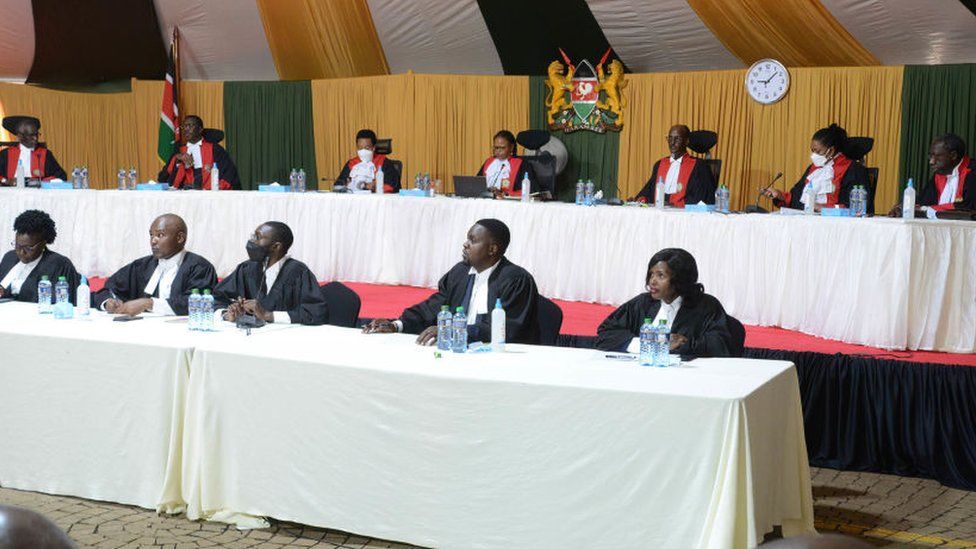
Supreme Court judges
Seven Supreme Court judges will listen to the petition

Although the election was widely praised as being transparent and credible by other electoral agencies, four out of the seven members of the electoral commission have alleged that the latter stages of the results verification process was “opaque”, and accused Mr Chebukati of acting unilaterally to declare results the team had not agreed on.

The dissenting commissioners accused Mr Chebukati of announcing results that were a “mathematical absurdity that defies logic”.

They said that if you added the percentages each candidate received as announced by the chairperson of the commission the sum came to 100.01%.

But Mr Chebukati said this was down to a rounding error and was not suspicious.

The electoral commission chief in turn accused his colleagues of betraying their oath of office and wanting him to “moderate” the results to force a re-run.

After Mr Odinga’s previous case led to an improvement in the transmission process, now the judges must make a ruling to improve the verification stage, which has led to the current dispute, lawyers say.

These are the questions that Mr Waikwa wants the Supreme Court to answer:

  • What should the electoral commission do if its verification process finds substantial discrepancies?
  • Should the electoral team take a vote on how to resolve these discrepancies and would their action disenfranchise voters?
  • Are there distinctive duties for the chairperson of the electoral commission and the commissioners and if so what are they? For example, is declaring presidential results the job of the commission or the chairperson?
  • In a very closely contested election, what factors will the Supreme Court take into account in deciding whether to order a fresh election?

In the next 14 days, Kenyans will be treated to the spectacle of the country’s best and brightest lawyers engaging in legal jousting at the Supreme Court, which might rekindle the intense passions felt during the closely fought presidential campaigns.

But it will also be a time to celebrate the culture that has now taken root – challenging elections results in court and not on the streets which has often sparked deadly violence in the past.

“The capacity of Kenya institutions has now outpaced the political culture,” remarked Murithi Mutiga, Africa Director of Crisis Group.

Win or lose, Mr Odinga, who has been imprisoned and tortured for his fight for a better Kenya, is likely, for the third time in a row, to inspire a ruling that will help make elections more credible and transparent – and that is a monumental contribution to the country’s democracy.

…………………………………………………………

t least 43 dead in Algeria wildfires – police

 Algerian police say at least 43 people are now known to have died in wildfires that raged for days in the north of the country.


More than 30 fires were put out over the weekend, but with some still burning, casualties are expected to rise further.

More than 1,000 families have been evacuated from the worst affected areas, which includes the El Tarf region near the border with Tunisia.

Thirteen people have been arrested on suspicion of involvement in starting the fires.

……………………………………………………………

Monday, 22 August 2022

Elections2022: Politicians and religious groups pray for elections

 Lobito - Several religious denominations and political parties prayed Sunday, in Benguela Province, in favour of peaceful elections on August 24.


In an ecumenical service, an initiative of the Provincial Commission of Churches for Benguela Province (COPIEB), the religious people pledged to work with all political parties, civil society and the government that will emerge from the upcoming elections, for the welfare of the people, its coordinator, pastor Higino Jorge said.


"We are in a phase in which each one wishes that the candidate of his party wins, but in case that doesn't happen we must have emotional balance, because elections are a political game in which only one can win", the pastor reminded.


Father António Francisco defended that the elections should run in the best way possible, that is with fairness and transparency, so that Angolans can see the results that come as the actual  will of the people.


For the second provincial secretary of the ruling MPLA in Benguela, António Kapewa Kalianguila, the ecumenical service is an opportunity for the union and solidarity of all Angolans, regardless of their ideas and interests, so that peace, as a common good, is safeguarded.


The provincial secretary of CASA-CE coalition, Martins Domingos, said that he left the cult more moralized from the spiritual point of view, since love for the neighbour and concord should prevail above group or individual interests.


The PRS representative, Horácio Abel, took the opportunity to appeal to the population to accept the result of the elections, regardless of who the winner will be.


With the exception of UNITA, which was not present, the politicians were aligned on the idea of citizens leaving the polling stations after exercising their civic duty, to avoid situations that could cause disturbances to the electoral process.


Religious denominations were present at the event including Catholics, Tocoistas, Kimbanguists, Methodists, members of CICA, IECA, IURD, and others.


The general elections on August 24 will elect the President of the Republic, the Vice President and the deputies (220 Mps).


At least eight political forces are running for the general elections, namely MPLA, UNITA, PRS, FNLA, APN, PHA and P-NJANGO parties and the CASA-CE coalition.


Roughly 14.3 million voters are expected to cast ballots on Wednesday.

Elections2022: Government decrees closure of markets on polling day

 Luanda - The Angolan government on Saturday ordered the closure of markets and fairs on Wednesday 24th August, which will be the polling day in Angola.


A joint decree from the ministries for Territorial Administration and for Trade and Industry said that the measure is extended to commercial establishments, which on Wednesday should give the necessary time off to their staff so that they can exercise their right to vote, even if they work on a shift system.


According to the document, the measure that is also extended to street and itinerant sales, aims to guarantee the massive participation of citizens on polling day.


“The markets and street fairs should open, exceptionally, on Monday, 22, in their normal opening hours”, states the decree that ANGOP has received.


For the voting process, roughly 14.3 million voters are expected to cast ballots. From tht number, 22,560 will vote from abroad (Angolans residing abroad), spread across 25 cities in 12 countries of Africa, Europe and South America.


This year 's elections count on the participation of eight political forces, namely MPLA, UNITA, PRS, FNLA, APN, PHA and P-NJANGO and the electoral coalition CASA-CE.

José Eduardo dos Santos’ funeral with no date set

 Luanda- The minister of Territory Administration, Marcy Lopes, said Saturday in Luanda, that with the arrival in Luanda of the corpse of the former Angolan President José Eduardo dos Santos, the coming days will be reserved for the tackling administrative and protocol issues related to the funeral.


The minister made the statement to the press at Luanda’s 4 de Fevereiro International Airport, following the arrival of the remains of the former Angolan statesman, who died on July 8 in Spain.


Regarding the date of the funeral, the minister, who coordinates the commission for the organization of the exequies, said the process needs to be handled with care and attention, adding that the date for the funeral will be communicated soon.


José Eduardo dos Santos died at the age of 79 in a Barcelona hospital, where he had been hospitalized since June 23 following a cardiac arrest.


Jose Eduardo dos Santos’ remains are in this moment in his official residence in the Miramar neighborhood, in Luanda.


In the next hours, the former president’s remains will be under the responsibility of the Ministry of Health until the date of the funeral to be announced by government authorities.


Outcome in Court

On August 16 the Court of Catalonia (Spain) decided to deliver the body of the Former President of the Republic, José Eduardo dos Santos, to his wife, Ana Paula dos Santos, for his burial.


The decision was made after the judge received reports from the Forensic Medical Institute and the Toxicology Laboratory.


The document says that in the resolution the judge recognizes Ana Paula dos Santos as the widow of the former Angolan Head of State.


The deliberation gave the former first lady the custody of the body of the former Head of State to proceed with the translocation process.


Ana Paula dos Santos was the interlocutor of the Angolan government when her husband was interned in a clinic in Barcelona, where he died.


During the process, the former First Lady of the Republic had the support of the Angolan government.


The legal dispute over the custody of the body involved the widow and the eight children of the former President of the Republic, especially the three eldest who were opposed to the delivery and transfer of the body of the former Head of State.


The transfer of the remains from Barcelona to the Angolan capital was accompanied by the widow of the former statesman, Ana Paula dos Santos, her children, relatives and  Angolan government officials.


José Eduardo dos Santos came to office as President of the Republic in September 1979, following the death of António Agostinho Neto, Angola's first president, and was in office for 38 years, until he was succeeded by João Lourenço.

World Teachers’ Day 2026 - Dia Mundial dos Professores 2026

Standing with teachers: 60 years of protecting the profession, advancing its status and shaping our futures     On 5 October, we observed Wo...