Arrivals from 37 more destinations will have their vaccination status certificates recognised, meaning they can avoid more expensive post-arrival testing requirements.
Vaccinated travellers from Brazil, Hong Kong, India, Pakistan, South Africa and Turkey will be treated the same as returning fully-vaccinated UK residents so long as they have not visited a red-list country in the 10 days before arriving in England.
All arrivals will still complete a passenger locator form.
The UK government sets Covid travel rules for England. Devolved administrations in Scotland, Wales and Northern Ireland will announce any changes to their rules in due course.
‘A long two years’
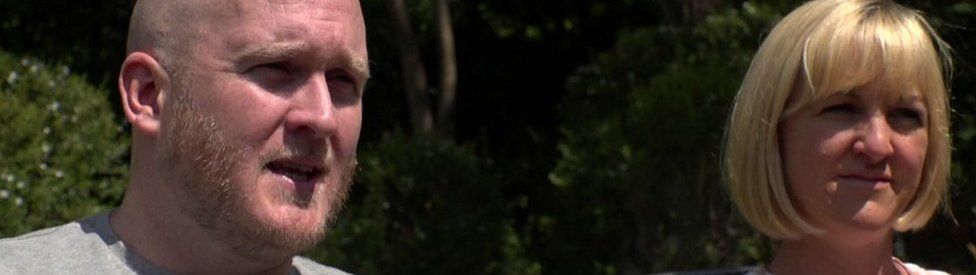
For British expats Matt and Hannah Pirnie, who have lived in South Africa for a decade, the country’s removal from the red list will mean it is easier to see family again.
“It’s been a long pandemic for us. Not seeing family, not being allowed to go back, but more importantly grandparents not being able to come here and see their grandkids. It’s been a long two years,” Matt says.
“First of all when all the aeroplanes stopped initially – that was quite anxiety provoking – and then to be put on the red list for so long has just been quite hard to wrap your head around why,” Hannah adds.
“Taking three children into a prison-like mentality was just a no-go, plus the cost. It’s been quite hard really.”
On Wednesday in Casablanca, the Moroccan national football team thrashed its Guinea Bissau counterpart 5 goals to nil in their World Cup Qualifying match. But there is more to the story than the final score.
In all, 25 players and some technical staff were taken to hospital for treatment. Some were treated and discharged instantly, but, six persons with severe symptoms were admitted in the intensive care unit for further observation.
While a section of citizens assert that it might have been an unconscious food poisoning or common allergies, others believed that the Moroccan Football Federation diabolically used the hotel catering services to stock the food of the visiting team so they can beat them.
However, reports from the hospital where the team were treated indicated that the team did not show any sign of illness. Strangely, the players refused to provide samples for medical tests.
Whereas many sports pundits and fans across the globe expressed that the match, which was fixed on Wednesday, 6th October, 2021, should have been postponed, CAF disagreed.
Dominic Prempeh, DNT News with reporting from Julius Ouya
Luanda - Peace and stability in the Central African Republic (CAR) dominated the meeting the Angolan President of the Republic João Lourenço held with the United Nations secretary-general's representatives on Wednesday in Luanda.
Speaking to the press, the representatives of the UN Secretary General for Central Africa (UNOCA), François Lounvény Fall, and of UN Mission for the Central African Republic (MINUSCA), Mankeur Ndiaye, praised the commitment of the Angolan statesman to the search for peace in that country.
François Lounvény Fall stated that the meeting served to extol President João Lourenço's efforts for peace in CAR and in the Great Lakes Region.
He said that the local situation and ways to implement the roadmap for peace and lasting national reconciliation in CAR had been evaluated.
Mankeur Ndiaye explained that the roadmap for the ceasefire should involve the cantonment of rebel forces, the collection of weapons and the search for funding, being monitored by the UN and regional representatives.
At the regional and international forums, including at the UN, Angolan president João Lourenço backs the lifting of the arms embargo imposed on the Central African Republic.
João Lourenço has also encouraged the promotion of dialogue between the different political forces of the CAR to work on achieving peace and stability in that Central African country.
Luanda – Angolan Executive has predicted a Gross Domestic Product (GDP) growth of approximately 2.4% by 2022, announced Wednesday the minister of Economy and Planning, Mário Caetano João.
Speaking to the press, at the end of a meeting of the Economic Commission of the Cabinet Council, he revealed that there is a prospect of growth in the oil sector of 1.3% and in the non-oil sector of 3.1%.
He also said that there is a forecast of performance of the sectors of agriculture (4.8%), fisheries (more than 100%, due to reforms and financing of the sector).
The minister stated that the trade sector, given the developments in plant and animal production and its outflow and sale, could also contribute to GDP growth.
According to the minister, the revision carried out brings encouraging prospects for growth of 0.2% by the end of this year, returning to a growth path that occurred until 2015, while the first assessment, in April, predicted a scenario of stagnation in GDP.
The macroeconomic assumptions for the fiscal year 2022 will eventually take into account the average price of a barrel below the current USD 67/barrel, but above the USD 39 of this year's OGE.
Mário Caetano João said that this is a conservative price, which takes into account the risks in the global economy due to the pandemic, an encouraging move in some economies.
He pointed out that current projections foresee for the next year a production of around 1. 100 million barrels per day, 18, 000 more than it currently produces.
Indebtedness Limits
The Minister of Finance, Vera Daves, explained that the Executive has revised the limits of internal and external indebtedness, in view of the State's capacity to honour the commitments that it eventually assumes.
She indicated that a certain reorganisation of the annual debt plan was sought, establishing close to 3.25 billion kwanza for domestic debt and 2.42 billion kwanza for external debt.
Previously, it was expected to commit 2.18 billion for the internal debt and 3.99 for the external one, according to the minister, noting that the country is indebted in external markets less than expected.
Investor Fees and Emoluments
The CEO of the Angola Private Investment and Export Promotion Agency (AIPEX), António Henriques da Silva, informed that the State seeks transparency in the collection of fees and emoluments from investors.
AIPEX's CEO reacted to the approval of the regulation on fees and emoluments to be charged with the aim of simplifying the processes of implementation of investment projects, with quality to meet the expectations of investors.
He announced that the projects were categorized according to their amount to be invested and the number of jobs to be created, and their impact in structural terms.
António Henriques referred to the existence of a table, to be published, which fixes, for example, the charge of 40,000 for the presentation of investment proposals, 300,000 for the issuance of an investment registration certificate, among others, as well as transparency to create alternative funds for the functioning of the agency.
Ethical Investing, Divestment, and Energy Positive Homes
Dearest in Mind, welcome to the tenth day of our program!
We went through FOOD, STUFF and MOVE domains. So far, the #AnatomyofAction has reached 8.3 million people worldwide! From today, we are all invited to use our MONEY more consciously. This will enable us to employ higher awareness when deciding which businesses, banking institutions, or energy providers we use.
Ethical investing is a strategy where an investor chooses investments based on a personal ethical code.
Ethical investing is a way to grow your savings without compromising on your values. As with all investing, it involves risks. Traditionally, ethical investment products, such as funds, enabled you to avoid investing in companies or sectors you disagree with. This is known as divestment.
Ethical investing is an umbrella term for all approaches to investing that consider values as well as returns.
WHY INVEST IN ANGOLA?
Investing in Angola is investing in a country with over 3 million hectares of arable land and over 1,650 kilometers of coastline;
An African country with enormous potential in mineral and natural resources such as oil, natural gas, diamonds, iron, gold and more;
Angola has a privileged hydrographic basin that represents 12% of the water tables of Africa;
Investing in Angola is investing in a growing African country with numerous business opportunities in sectors ranging from Agriculture, Fisheries, Agriculture, Health, Transport, Manufacturing Industry, Mining, Energy and others;
A country with economic and political-social stability, with a favorable business environment and bilateral agreements to promote and protect investment.
Ethical investments have a positive impact on the world while also aiming to make a profit. It means you get a financial return without sacrificing your social, moral or religious principles. Green investing refers to investing activities aligned with environmentally-friendly business practices and the conservation of natural resources.
What are ethical investments?
Ethical (as applied to funds) Applying negative and/or positive ethical or ‘values-based’ screens to help sift investments.
Sustainable and Responsible Investment (SRI)/Socially Responsible A wide range of investment strategies that focus on ethical, social and environmental issues.
Environmental, Social and Governance (ESG) investing Strategies that take into account environmental, social and governance related risks and opportunities, often to help reduce risk.
Impact investing Investing in a way that delivers measurable social and/or societal effects and benefits as well as financial returns.
Dark green investing A strictly screened approach, avoiding any company or industry that does not meet its criteria.
Light green investing Seeks out companies that are doing good as opposed to excluding companies that are considered to cause harm.
Sustainable investing Focuses on environmental and social sustainability issues to help deliver strong investment returns and address issues such as climate change.
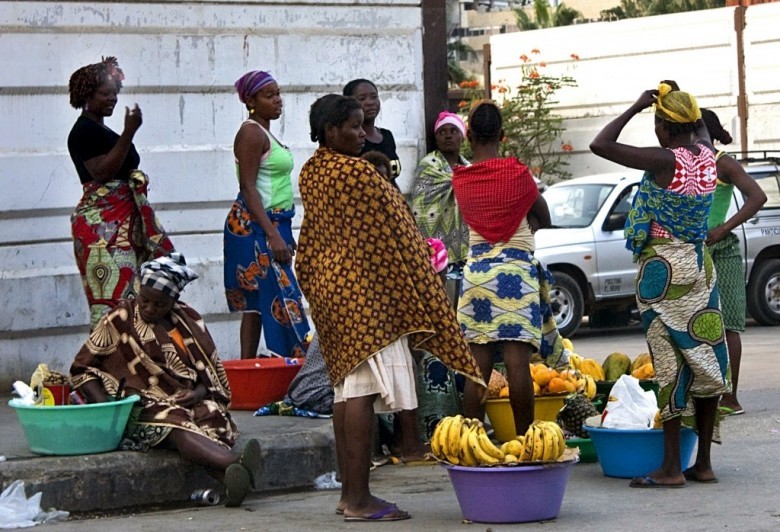
Mango sales are a new source of livelihood for many families in Luanda
The sale of mangoes has become the livelihood of many families in Luanda, at taxi stops, public roads or even inside the taxi, mangoes are sold at a price accessible to all budgets.
In addition, hunger forces 124 families to feed on green mangoes in the Country. Old ladies, children and young people find their livelihood in this business. Mango is one of the most popular fruits in the market, not only for being cheap but also for being very delicious.
Over the next three days, we will understand what Ethical Investing, Divestment, and Energy Positive Homes mean; we do not need to have a bank account to start learning about green finance, pensions funds, and resource-efficiency. For instance, did you know that just 100 companies, all in the oil and gas industry, are responsible for 71% of global carbon emissions? We need to take action to ensure we support those that enable SDG 12 (sustainable consumption and production).
These facts provide you with some food for thought and information to explain why it is fundamental to participate in this domain of the challenge:
Financial institutions provide the capital funding over-exploitation of lands and seas, positioning biodiversity in free-fall. However, global inflows into sustainable funds are increasing, making ethical investing easier for everyone.
In the last 30 years, urban areas have doubled at the expense of forests, wetlands and grasslands! We should always keep in mind that how the construction sector uses natural resources has a huge impact on ecosystems and biodiversity.
Tunisian authorities have shut down a television station after one of its hosts read an anti-dictatorship poem.
Amer Ayad – a Zitouna TV talk show host – has been arrested and accused of “undermining the security of the state”.
Zitouna has been critical of President Kais Saied’s recent suspension of parliament, and his assumption of almost complete control of the country.
State officials said the channel had been broadcasting illegally.
On Sunday, Ayad read out The Ruler by Iraqi poet Ahmed Matar on air. Matar is famous for his satirical and critical poems about dictators from the Arab world. Ayad was arrested soon after.
His detention is the latest in a series of arrests that have targeted journalists and lawmakers who had expressed their opposition to the president’s measures.
On Wednesday, Zitouna posted on Facebook that security forces had stormed its studios and began damaging equipment.
“Zitouna has been broadcasting illegally for years,” Nouri Lajmi, president of the Independent High Authority for Audio-Visual Communication, told the AFP news agency.
Zitouna started broadcasting in 2012, following the fall of dictator Zine al-Abidine Ben Ali in an uprising. This triggered a wave of similar uprisings across the Arab world.
In 2015, some of the channel’s equipment was seized but it continued operating.
In July, President Kais Saied stunned many in the country and abroad by announcing the suspension of parliament, the sacking of the cabinet and assuming emergency powers – citing an imminent threat to the Tunisian state.
Critics of the president may argue that this move against Zitouna is an attempt to undermine freedom of the press.
It comes after police closed the office of Qatari broadcaster Al Jazeera in the capital Tunis in July, without giving reasons.
The EU is like playing in the Champions League, one official in Brussels said recently. Not, they claimed pointedly, a more minor domestic competition.
0
The message being that it isn’t easy to win membership.
For years Western Balkans states have tried to climb the accession ladder into the EU.
Commission chief Ursula von der Leyen conceded at a summit in Slovenia on Wednesday that the long wait was causing “impatience” and “frustration”.
The lack of a decision on even opening negotiations with North Macedonia and Albania was “jeopardising our standing and leverage in the region”, she warned.
She was at pains to stress: “We want the Western Balkans in the European Union.”
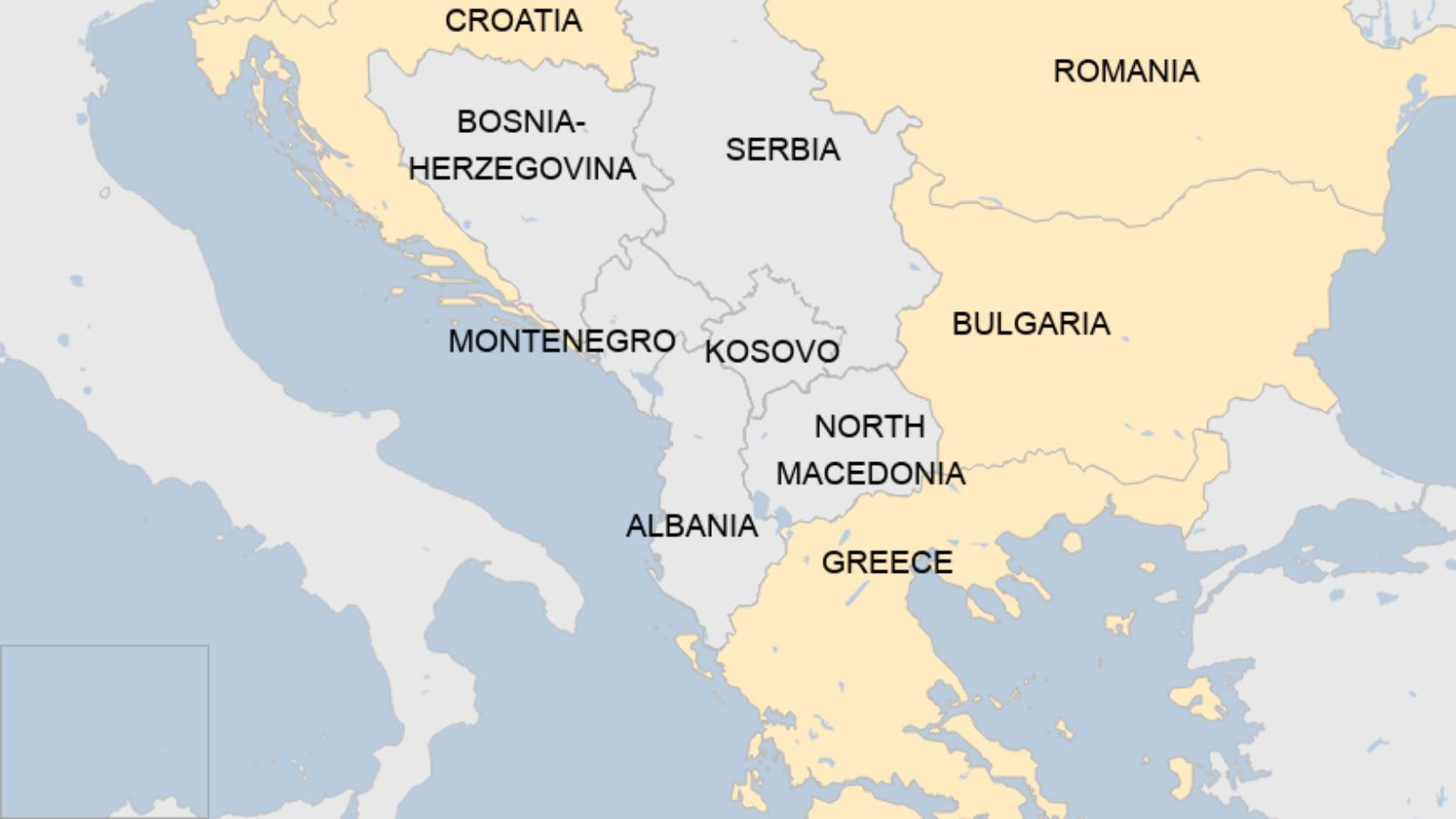
The Slovenian gathering involved family photos, lunch and all the usual pageantry, where EU leaders met their counterparts from Albania, Bosnia-Herzegovina, Serbia, Montenegro, the Republic of North Macedonia and Kosovo.
But it wasn’t a decision summit on enlargement, rather a “reaffirmation” of ties.
Mrs von der Leyen said that, while there had been progress by Balkan states, there was more to do on fighting corruption and economic reforms.
European Council President Charles Michel conceded it was no secret that the 27 member states weren’t in agreement about the bloc’s capacity to take on new members.
Albania, North Macedonia, Montenegro and Serbia all have “candidate status”, although some nations are more advanced in the process than others. Bosnia is still a potential candidate, while Kosovo is not even recognised as a state by some EU members.
Countries are tested on their ability to align with a large body of rules and standards, divided into 35 chapters. It’s never a simple process.
But these four candidates have formed a queue that now dates back to the early noughties.
One of the most recent stumbling blocks: a language dispute between EU member state Bulgaria and North Macedonia.
University of Oxford EU politics lecturer Eli Gateva says the accession process can be “held hostage to domestic politics”.
Following previous rapid expansions, enlargement has in some cases, she says, become “another word for immigration – and this can be fuel for far-right parties”.
France and the Netherlands are often named as among the most cautious EU member states when it comes to enlargement.
The EU is, after all, already wrestling with serious issues among existing member states, principally Poland and Hungary, on the all-important “rule of law”.
So the case is made that the EU needs to sort out the structural issues within its own house before building on that extension.
Wednesday’s summit statement went no further than “reconfirming” the bloc’s commitment to enlargement, and even that took some haggling.
However, the Commission president was keen to point out that those words had made it into paragraph one of the declaration.
While the political process may appear painfully slow, money is fast being poured into the region with billions in grant funding.
Andi Hoxhaj, a scholar in EU Law at the University of Warwick, calls it an “economy first” approach. The idea being that if you integrate countries economically, the politics may follow.
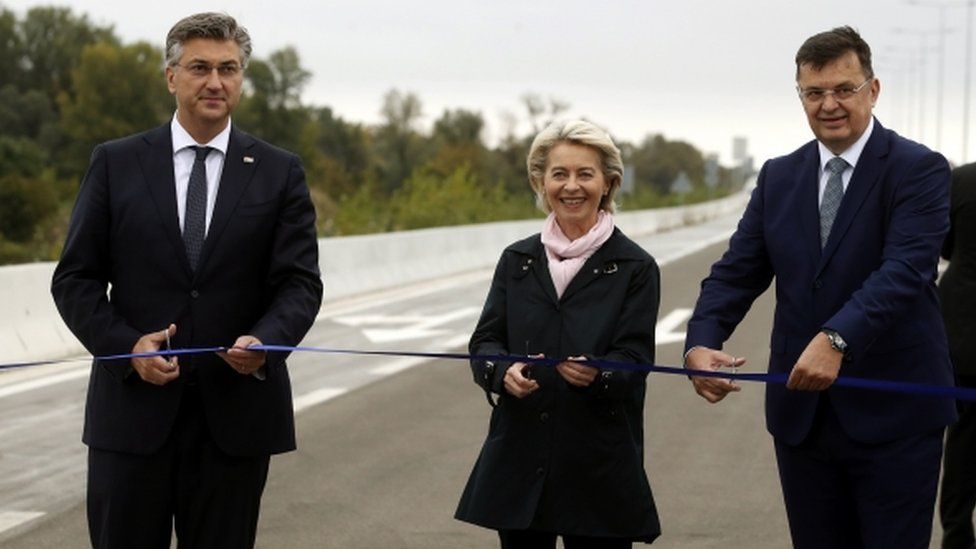
Mrs von der Leyen already spent last week love-bombing the region, covering six countries in three days.
IMAGE SOURCE,EPA
Image caption,Bridge to the future: The European Commission chief (C) opened a crossing between Croatia and Bosnia last week
Following a phone call between the Commission chief and the US President this week, Joe Biden also expressed “strong support for continuing the accession process with countries in this region”.
That is because the Western Balkans, which suffered so much in the bloody wars of the 1990s, are strategically important to the European Union.
“It’s not our backyard, it’s our front yard,” one EU diplomat told me: and you want your front yard “clean and neat”.
“If we are not going to be in the region, someone else will fill the void.”
Eli Gateva agrees: “We have other foreign actors trying to vie for influence in this region such as China, Russia and Turkey.”
Ask around and there can be huge reticence to name a date as to when the candidate countries might finally get an official seat around the EU table.
Slovenia, which holds the European Council presidency, reportedly (and unsuccessfully) urged the EU to commit to admitting the Western Balkan states by 2030.
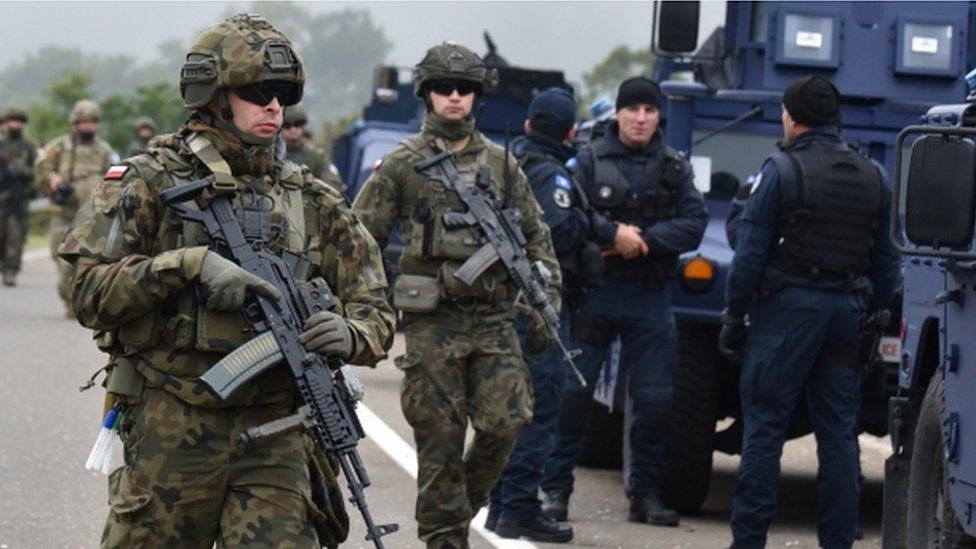
IMAGE SOURCE,REUTERS
Image caption,Relations between Serbia and Kosovo are tense and a two-week border row ended only days ago
The Slovenians believe there needs to be a strong political message to reassure the region that enlargement is still a priority; they see hopes of accession as a vital spur for candidate countries to tackle corruption and pursue judicial reforms.
An EU official remarked this week that the door wasn’t “closed”, but it certainly isn’t gaping open either.
The danger is those countries in the waiting room start to look at other options, and the European Union’s quest to project power fades.