Translate

Monday, 9 August 2021

U.S. now averaging 100,000 new COVID-19 infections daily, again


NEW ROCHELLE, NY - MARCH 18: Coronavirus crisis volunteer Rhiannon Navin greets local residents arriving to a food distribution center at the WestCop community center on March 18, 2020 in New Rochelle, New York. New Rochelle has been a hot spot for the COVID-19 pandemic in the U.S. (Photo by John Moore/Getty Images)

The U.S. is now averaging 100,000 new COVID-19 infections a day, returning to a milestone last seen during the winter surge in yet another bleak reminder of how quickly the delta variant has spread through the country.

The U.S. was averaging about 11,000 cases a day in late June. Now the number is 107,143.

It took the U.S. about nine months to cross the 100,000 average case number in November before peaking at about 250,000 in early January. Cases bottomed out in June but took about six weeks to go back above 100,000, despite a vaccine that has been given to more than 70% of the adult population.

The seven-day average for daily new deaths also increased, according to data from Johns Hopkins University. It rose over the past two weeks from about 270 deaths per day to nearly 500 a day as of Friday.

The virus is spreading quickly through unvaccinated populations, especially in the South where hospitals have been overrun with patients.

Health officials are fearful that cases will continue to soar if more Americans don’t embrace the vaccine.

“Our models show that if we don’t (vaccinate people), we could be up to several hundred thousand cases a day, similar to our surge in early January,” Centers for Disease Control and Prevention director Rochelle Walensky said on CNN this week.

The number of Americans hospitalized with the virus has also skyrocketed and it has gotten so bad that many hospitals are scrambling to find beds for patients in far-off locations.

Houston officials say the latest wave of COVID-19 cases is pushing the local health care system to nearly “a breaking point,” resulting in some patients having to be transferred out of the city to get medical care, including one who had to be taken to North Dakota.

Dr. David Persse, who is health authority for the Houston Health Department and EMS medical director, said some ambulances were waiting hours to offload patients at Houston area hospitals because no beds were available. Persse said he feared this would lead to prolonged respond times to 911 medical calls.

“The health care system right now is nearly at a breaking point … For the next three weeks or so, I see no relief on what’s happening in emergency departments,” Persse said Thursday.

Last weekend, a patient in Houston had to be transferred to North Dakota to get medical care. An 11-month-old girl with COVID-19 and who was having seizures had to be transported on Thursday from Houston to a hospital 170 miles (274 kilometers) away in Temple.

In Missouri, 30 ambulances and more than 60 medical personnel will be stationed across the state to help transport COVID-19 patients to other regions if nearby hospitals are too full to admit them, Missouri Gov. Mike Parson announced Friday.

…………………………………………………………

Afghanistan war: Taliban push on while rejecting truce


The Taliban have rejected international calls for a ceasefire in Afghanistan, as they push for new territory.

They are reported to have overrun the key northern city of Kunduz, as well as Sar-e-Pul and Taloqan. Fierce fighting continues in two more northern cities.

Five regional capitals have fallen to the militants since Friday, with Kunduz their most important gain this year.

US and Afghan planes have carried out airstrikes on the militants. Afghan officials say dozens of Taliban died.

However, a spokesman for the Taliban warned against further US intervention while speaking to Al Jazeera TV on Sunday.

Violence has escalated across Afghanistan after US and other international forces began to withdraw their troops from the country, following 20 years of military operations.

Taliban militants have made rapid advances in recent weeks. Having captured large swathes of the countryside, they are now targeting key towns and cities.

The three northern cities fell to Taliban control within hours of each other on Sunday, with one resident in Kunduz describing the situation as “total chaos”.

Videos posted on social media showed Taliban fighters inside government buildings in Kunduz and Sar-e-Pul, though they cannot be independently verified.

The Afghan government, meanwhile, said special forces were still fighting inside Kunduz.

A Taliban spokesman told the BBC they were now targeting Pul-e-Khumri, the capital of Baghlan province.

Heavy fighting has been reported in the city, as well as in Mazar-e-Sharif, a trading hub on the border with Uzbekistan.

On Monday morning a loud explosion was heard outside the police headquarters in the southern city of Lashkar Gah.

Residents there said about 20 civilians had been killed in the past two days, and a school and a clinic destroyed in the fighting.

The seizure of Kunduz is the most significant gain for the Taliban since they launched their offensive in May. The city of 270,000 people is considered a gateway to the country’s mineral-rich northern provinces.

And its location makes it strategically important as there are highways connecting Kunduz to other major cities, including Kabul, and the province shares a border with Tajikistan

That border is used for the smuggling of Afghan opium and heroin to Central Asia, which then finds its way to Europe. Controlling Kunduz means controlling one of the most important drug smuggling routes in the region.

It also holds symbolic significance for the Taliban because it was a key northern stronghold before 2001. The militants captured the city in 2015 and again in 2016 but have never been able to hold it for long.

………………………………………………………

Across Africa in five minutes or less


AFRICA

From Tunisia to South Africa, the pandemic has reopened or exposed existing economic and political challenges. Failures to tackle unemployment, debt, rising poverty and inequalities are leading to social unrest, with no end to the health crisis in sight. As the third wave takes a grip across Africa, the International Monetary Fund (IMF) has warned the gap between rich and poor nations is widening.

NIGERIA

The National Assembly is carrying out its fifth amendment to Nigeria’s 1999 Constitution The National Assembly is currently amending the 1999 constitution. This would be the fifth alteration to the main Nigerian law. Lawmakers in both the Senate and the House of Representatives committees on constitution review had in May and June organised public hearings across the country’s six geopolitical zones, as part of the amendment process. Many agencies, institutions, groups and individuals submitted memoranda and appeared before the panel to make or defend their submissions.

SOUTH SUDAN

Attempts to ignite a popular uprising by civil society groups in South Sudan was off to a rocky start. Calling itself the People’s Coalition for Civil Action (PCCA), the group launched a public campaign dubbed “We have had enough” in Juba on July 31 for political change, claiming that the ruling Sudan Peoples’ Liberation Movement (SPLM) has failed after 10 years of independence. The civil society is seeking public pressure to oust SPLM regime like their counterpart did in Sudan, bringing an end to Omar al Bashir leadership.

KENYA

Twice in three months, some junior police officers in Murang’a South have written a protest letter to the regional commissioner alleging harassment by the area’s Directorate of Criminal Investigations officer (DCIO). They allege that David Cheruiyott threatens to investigate them if they refuse to help him advance his interests. The letter claims Mr Cheruiyott’s interests are in liquor businesses and political formations. In one instance, Mr Cheruiyott is accused of leaking real estate-related investigations to Maragua MP Mary Wa Maua, insider information that was used during an incident on Tuesday at Kaharate.

TANZANIA

Maize imports from Tanzania jumped more than sixfold to 118,329 bags in May on the back of President Samia Suluhu’s visit to Kenya that saw Dar and Nairobi reach a deal to lift a ban that had been put in place. Kenya’s Agriculture ministry says the volumes jumped from 16,137 bags in April to a monthly record of 118,329 in May after President Samia and her Kenyan counterpart Uhuru Kenyatta reached a bilateral deal to abolish the restrictions that Nairobi had imposed on Tanzanian maize.

UGANDA

The parliamentary taskforce on Covid-19 response has faulted the National Medical Stores (NMS), and the Health ministry on ignoring the plight of frontline medical workers across the country. The MPs in the report released to Parliament on Tuesday, said the two institutions had failed to supply medics with enough personal protective equipment (PPEs) against Covid-19. In their countrywide fact-finding report, the MPs also said essential medicines for treating Covid-19 patients were in short supplies in many health units, and that patients had been forced to buy them from private facilities.

ZIMBABWE

Ahead of the country’s Heroes Day, President Mnangagwa has honoured outstanding Zimbabweans who have raised the country’s flag high in various fields. In a Government Gazzette, the Chief Secretary to the President and Cabinet Dr Misheck Sibanda announced that outstanding Zimbabweans will be honoured under the new set of awards that were introduced by the Second Republic. Previously, only members of the uniformed forces could be conferred with such national awards and honours but in yet another first, the New Dispensation has extended the honour to civilians.

………………………………………………………

Sunday, 8 August 2021

Deadly fighting erupts between South Sudan party’s rival factions


VP Riek Machar denies claims by rivals earlier this week that they had deposed him as the head of SPLA-IO party.


Deadly fighting has erupted between rival factions of South Sudan Vice President Riek Machar’s SPLA-IO, his military spokesman said in a statement.

Global African Family Meeting

The clashes erupted on Saturday after Machar’s rivals declared this week they had deposed him as the head of the party and its military forces.

Armed forces led by a rival general in the party, Simon Gatwech Dual, had launched an attack on Machar’s men, who had “repulsed the aggressors”, spokesman Colonel Lam Paul Gabriel said.

Machar’s SPLA-IO forces had killed two major generals and at least 27 “enemy” soldiers, while they had lost three men, he added.

The fighting could not be independently confirmed and there was no immediate response from Gatwech Dual’s side.

Leaders of the military wing of Machar’s SPLM/A-IO said on Wednesday they had deposed the rebel-turned-politician for failing to represent their interests.

The fighting could put pressure on the fragile 2018 power-sharing deal between Machar and his old foe President Salva Kiir.

Machar’s allies on Friday dismissed the attempt to remove him as a “failed coup”, insisting he was still in full control of the party.

Machar himself this week accused “peace spoilers” of engineering his removal.

The 68-year-old, a wily leader who survived years of bush warfare, attempts on his life and stretches in exile, served as vice president alongside Kiir in the first government after independence from Sudan in 2011.

But the pair fell out and Machar was sacked two years later. Troops loyal to each man turned their guns on each other, and South Sudan descended into five years of civil war.

…………………………………………………

Saturday, 7 August 2021

Across Africa in five minutes


Ghana

The president’s plans for a cathedral in Ghana costing $200m (£144m) have come under fire in a week when thousands have been protesting against economic hardship and saying the money could be better spent elsewhere.

A board member of the national cathedral project defended President Nana Akufo-Addo, saying the plan was intended to unify Ghanaians.

Ethiopia

A UN expert has urged all armed groups in Ethiopia’s Tigray region to take steps to protect Eritrean refugees.

Mohamed Abdelsalam Babiker, the special rapporteur for human rights in Eritrea, said there were credible reports that government forces and their allies as well as the Tigray rebels had committed grave human rights abuses.

“Eritrean refugees have been singled out, targeted and victimised by both sides for their perceived collaboration with the other side in the conflict,” he said.

Mozambique

A new boss is taking over the running of Mozambique’s Ndlavela Women’s Penitentiary, where it was found that inmates there had been forced into prostitution. Herminia Nhamuze was sworn in as the new director, replacing Albertina Dimande.

She had been removed in June during investigations into the allegations first exposed by an anti-corruption organisation.

Ethiopia

One hundred trucks of food and medicines a day are needed in Ethiopia’s northern region of Tigray to save lives, the UN’s emergency relief coordinator says.

Speaking in Geneva on his return from Ethiopia, Martin Griffiths said a humanitarian ceasefire was a glaring necessity in order to allow aid deliveries into the warring region.

The UN estimates that 5.2 million people, or 90% of Tigray population, are in need.

Tanzania

The trial of Tanzania’s opposition leader Freeman Mbowe has been postponed until next Friday. His party Chadema told the BBC that the case has been pushed after the Director of Public Prosecutions sought to have the case handled by a higher court.

Mr Mbowe and three of his co-accused were taken back into remand custody after their brief appearance at a court in Dar es Salaam.

Egypt

An Egyptian army propaganda video appears to show troops carrying out extrajudicial killings, human rights campaign group Amnesty International says. The army posted the images on social media earlier this week in an update on its war against militants in the Sinai peninsula.

Amnesty says it has analysed the footage, and it includes a scene in which a soldier shoots a person who is asleep in a makeshift tent.

Sudan

A Sudanese court has sentenced six members of a paramilitary group to death for killing protesters during the 2019 demonstrations over fuel and food shortages. The shooting of the six protesters, who included four schoolchildren, sparked days over violent protests across Sudan.

Issuing the sentence, Judge Ahmed Hassan al-Rahma said the six members of the Rapid Support Forces (RSF) used unnecessary and excessive force during the July 2019 protests.

Tunisia

Tunisian President Kais Saied has sacked more regional governors, as he continues to implement a range of exceptional measures. The senior officials in Monastir, Medenine and Zaghouan were all dismissed.

This followed the recent sacking of the governor of Sfax. Late last month, the president sacked Tunisia’s Prime Minister Hichem Mechichi and suspended parliament.

Burkina Faso

Suspected jihadists in Burkina Faso have killed 30 people in the north of the country, officials say.

Armed men targeted villages near the border with Niger on Wednesday, before opening fire on security forces who responded to the raids. Eleven civilians are among the dead.

Uganda

Uganda’s foreign ministry has said it was not informed that Kenya’s deputy president was planning a visit earlier this week. There has been confusion over why Kenyan Deputy President William Ruto was stopped from flying out of Kenya to Uganda on Monday.

Kenyan immigration officials said he needed clearance from the president, but Mr Ruto said this wasn’t the case and he was travelling in a personal capacity.

South Africa

South Africa’s jailed former President Jacob Zuma has been admitted to hospital, less than a week before he is due in court on further charges of corruption.

The South African prison department said a routine examination at the jail in Kwazulu Natal, where Mr Zuma is being held, prompted the authorities to take him to a hospital outside the prison

Nigeria

The Nigerian military says it has killed at least 78 gunmen belonging to what it calls criminal gangs during an aerial bombardment of their hideouts in the north-west of the country. Many fighters were killed as they tried to escape the air strikes on motorbikes, Air Commodore Edward Gabkwet said.

In recent weeks the Nigerian security forces have intensified operations against these armed networks of sophisticated criminals.

……………………………………………………

The EU vaccine ‘passport’ and what it means for travel


An EU vaccine “passport” has been introduced, enabling holders to prove they have been jabbed.

The EU Digital Covid Certificate can be used to avoid self-isolating on arrival in the UK, if travelling from amber-list countries.

What’s the EU Digital Covid Certificate?

It is available in all 27 member nations – plus Switzerland, Iceland, Norway and Liechtenstein.

EU citizens (and those of Switzerland, Iceland, Norway and Liechtenstein), can download it or obtain a paper copy – at no cost. It is also available to non-EU nationals living legally in member states who have the right to travel to other member states.

Because the UK is no longer in the EU, the certificate is not available to most Britons.

EU nationals vaccinated in the UK must check with their home countries to see if they are eligible.

Travellers will still need to carry a passport or other identification.

How does it work?

  • been vaccinated against Covid-19
  • recently had a negative PCR test
  • recently recovered from Covid-19

Anyone holding a certificate should, in principle, be exempted from testing or quarantine when crossing a border within the EU (or Switzerland, Iceland, Norway and Liechtenstein).

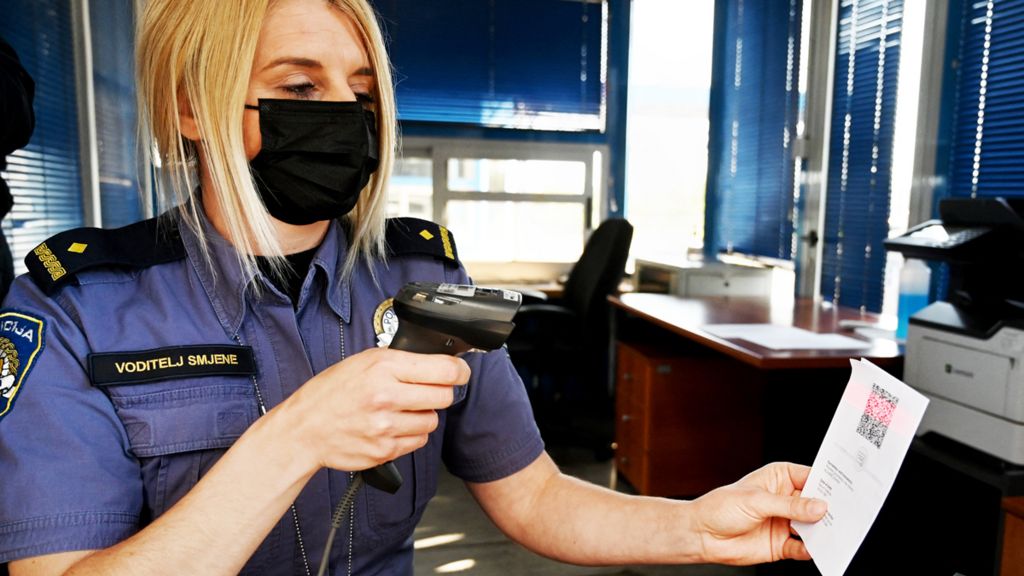
Police officer at the Bregana border crossing between Croatia and Slovenia scans QR code on an EU digital Covid passport

It has a QR code unique to the place an individual’s vaccine information is stored – a hospital or test centre, for example. The personal data is not saved locally when it’s verified – at an airport, for example.

Can I travel to the UK and use the NHS Covid Pass instead?

The NHS Covid Pass is a similar vaccine “passport”, but it is only for people who have been fully vaccinated through the NHS.

People in England arriving from an amber country can avoid quarantine by using the pass (or by calling 119 for a printed letter).

Can I use the NHS Covid Pass in the EU?

You can’t yet use it EU-wide – but some individual countries, such as Greece, Malta and Spain, do accept it.

The EU says it’s working to ensure its own certificate is compatible with similar products.

If it’s satisfied the NHS pass complies with EU standards and systems, it can decide to accept it.

………………………………………………………

World Teachers’ Day 2026 - Dia Mundial dos Professores 2026

Standing with teachers: 60 years of protecting the profession, advancing its status and shaping our futures     On 5 October, we observed Wo...