Translate

Thursday, 15 July 2021

Africa Education Watch ‘concerned’ over GHS34.8m sole-sourced WASSCE ‘pasco’ deal


The Africa Education Watch has raised concerns over the government’s procurement of past questions for both the 2020 and 2021 West African Senior School Certificate Examination (WASSCE) candidates through sole sourcing.

Global African Family Meeting

The Education think tank, in a statement on the procurement of the past questions at a cost of GHS34.8 million, added that it has no problem with the government’s decision to provide all resources required to adequately prepare students for examinations.

“We have no objection to the supply of past questions, answers and examiners’ reports to support students, so far as the teaching authorities recommend and find same useful in adequately preparing students ahead of their examinations. It is on this basis that we commend the government for providing the past questions,” it clarified.

It however raised concerns over the spending inefficiencies arising out of the decision by the Ministry of Education (MoE) to procure the past questions using sole-sourcing.

“Selecting repeatedly for two years, a company without a track record in Ghana’s publishing industry, to publish and supply about 450,000 copies of past questions raises more questions.”

It said the explanation by the Education Ministry that its decision to solely consider Kingdom Books and Stationery for the GHS34.8 million contract is due to a copyright mandate issued to Kingdom Books by WAEC, only “raises more questions.”

“While the WAEC Act of 2006 (Act 719) does not confer the copyright over WAEC’s past questions to WAEC, after being paid by MoE to conduct an assessment of Ghanaian students, it shall be useful to share any such subsidiary contract conferring such copyrights to WAEC for public review.”

“Regardless, what prevented or prevents the MoE from [also] obtaining the copyright permission and engaging its own publishers competitively rather than supporting the current monopolistic arrangement which ties Ghana down to an unfavourable procurement method?” the group queried.

Africa Education Watch further questioned the sustainability of supplying students with past questions on a disposable basis.

“At present, regular textbooks in Senior High Schools are used for over three years before replacement. What then is the justification for procuring over GHS 30 million worth of past questions on a disposable basis annually, when these past questions are scarcely used beyond six weeks in a year?”

Recommendations

The Education think tank recommended that the Education Ministry obtains copyright permission over subsequent past questions, answers, etc. “before commissioning publishers competitively to print same on their behalf.”

It also urged the ministry to demonstrate its “practical commitment to competitive procurement methods to assure the Ghanaian public of the premium it accords to the core tenets of spending efficiency.”

It again suggested that the procurement of past questions should happen once every three years, just as textbooks.

“Students should deposit the over 400 paged past question books with their respective schools after examinations, just as is done for all textbooks, to enable the subsequent batches to use for two more years.”

“With wifi available in Senior High Schools, GES must support school heads to take the responsibility of sharing soft/hard copy updates of subsequent years’ questions with teachers to facilitate their engagement with students,” it added.

The government procured some past questions for final year SHS students who sat for the last examinations.

Those who criticised the move were of the view that the government was bent on ensuring a good pass mark for the first batch of Free Senior High School graduates just to score political points despite the challenges the policy is going through.

Meanwhile, the Minister for Education, Dr. Yaw Osei Adutwum, has justified the procurement of West African Senior High School Examination, WASSCE, past questions at the cost of GHS 33.6 million.

According to him, the supply of the questions is an essential part of the government’s effort to enhance the preparation of students ahead of the WASSCE.

Dr. Adutwum in a Citi News interview after answering questions on the floor of Parliament from Bulisa South MP, Dr. Clement Apaak on the matter, justified the expenditure.

He said it was an important support to the students especially those in deprived communities.

………………………………………………………………

Wednesday, 14 July 2021

Cuban president blames social media for rare protests – as Biden supports the people’s ‘call for freedom’

 Cuba’s president has accused Cuban Americans of using social media to trigger protests over high prices and food shortages.

Cuban president blames social media for rare protests – as Biden supports the people’s ‘call for freedom’

Police have been out in force on the island’s streets after demonstrations in several cities and towns.

The protests are some of the biggest displays of anti-government sentiment seen in recent years and come as the country faces a surge in coronavirus cases and an economic crisis.

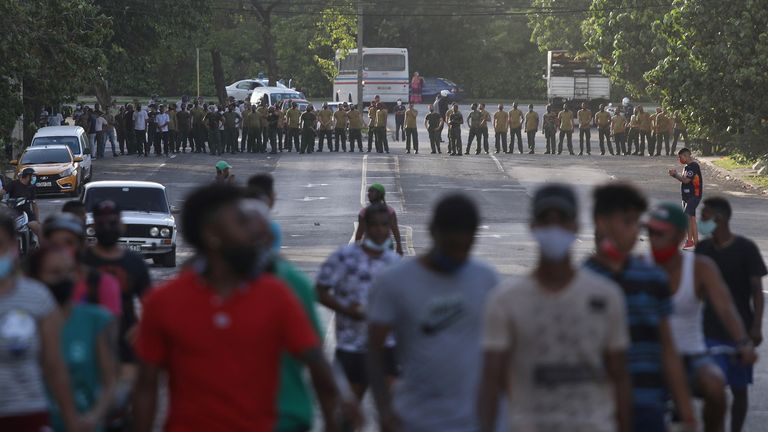
Demonstrators walk away from army soldiers blocking a road in Havana

Image:Demonstrators walk away from army soldiers blocking a road in Havana

Authorities have appeared determined to put a stop to the demonstrations. More than a 100 protesters were detained, including a leading Cuban dissident who was arrested trying to attend a march in the city of Santiago.

“We’ve seen how the campaign against Cuba was growing on social media in the past few weeks,” President Miguel Díaz-Canel said on Monday in a nationally televised appearance in which his entire cabinet was present.

“That’s the way it’s done: Try to create inconformity, dissatisfaction by manipulating emotions and feelings.”

Authorities blocked social media sites in an apparent effort to stop the flow of information into, out of and within the beleaguered nation.

Demonstrations are extremely unusual on an island where little dissent against the government is tolerated.

The last major public demonstration of discontent, over economic hardship, took place nearly 30 years ago in 1994.

Last year, there were small demonstrations by artists and other groups, but nothing as big or widespread as what erupted this past weekend.

In the Havana protest on Sunday, police initially trailed behind as protesters chanted “Freedom!”, “Enough!” and “Unite!

“It’s becoming impossible to live here,” said Havana resident Maykel, 21, who declined to give his surname for fear of retaliation.

“I don’t know if this can happen again, because at the moment, Havana is militarised.”

“Still, Cubans are losing their fear,” he said.

Amnesty International said it had received reports of “internet blackouts, arbitrary arrests, excessive use of force – including police firing on demonstrators.”

Reuters was unable to independently verify the use of firearms.

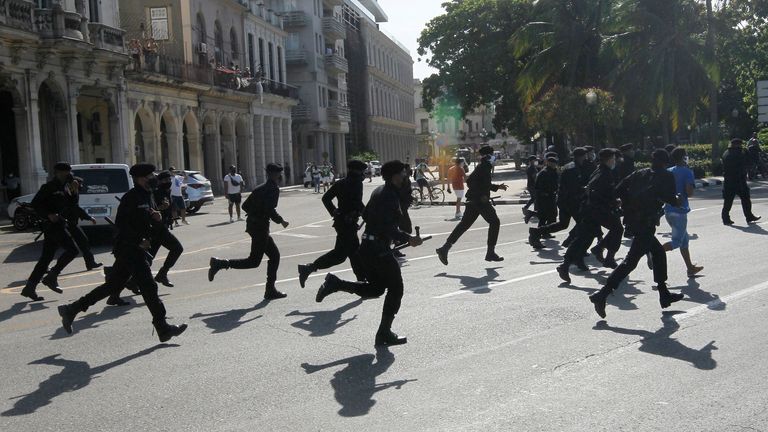
Police run during the protests

Image:Police run during the protests

Americas director Erika Guevara-Rosas said: “Instead of repressing the population, the Cuban authorities have an obligation to protect their right to demonstrate peacefully.

“It’s unacceptable that the Cuban government has denied these rights for decades and continues to do so today.”

In a statement on Monday, US President Joe Biden said Cuban protesters were asserting their basic rights.

“We stand with the Cuban people and their clarion call for freedom and relief from the tragic grip of the pandemic and from the decades of repression and economic suffering to which they have been subjected by Cuba’s authoritarian regime,” Mr Biden said.

The US urges the Cuban government to serve their people ”rather than enriching themselves’,’ Mr Biden added.

………………………………………………………………

The future of humanity will be less white and increasingly African’

 Afrophobic populists of Europe and beyond, be warned: the future of humanity will be less and less white and increasingly African. Societies can try all they might to stem this unstoppable trend, but their efforts will be in vain.

Population projections, including the most conservative among them, have all arrived at the same categorical conclusion: in 2100, one in three people on the planet will be born in sub-Saharan Africa, while Nigeria’s population will overtake that of China, becoming the second-largest country after India.

By 2050 – that’s less than 30 years from now – the Democratic Republic of Congo will be home to close to 200 million people (including 30 million in the Kinshasa metropolitan area alone), the population of Abidjan in Côte d’Ivoire will surpass the 10 million threshold and four Sahel countries will see a three-fold increase in their inhabitants. Relative to other continents, such a population explosion is unprecedented in human history, demographers say. No doubt, provided that we put it in context.

Let’s get back to the numbers.

Although fertility rates have been falling steadily since the late 1990s, they remain by far the highest in sub-Saharan Africa, where women give birth on average to 4.7 children, compared to 2.4 children globally. Moreover, birth rates exceed 5 children per woman in most West and Central African countries.

Cape Verde, Djibouti and Mauritius have successfully reined in population growth, but these are small nations to begin with. Meanwhile, Ethiopia, Rwanda and South Africa are doing all they can to keep their populations in check. And the list of countries which, from a Malthusian standpoint, can be considered worthy ends there. It should therefore come as no surprise that this part of the world, which at the current rate of growth will account for 35% of the global population in 2100, is also the youngest: the median age on the continent is 19, versus 42 in Europe*.

‘Demographic winter’

If our world is becoming increasingly African, it’s first and foremost because four out of seven continents have entered what Pope Francis once called, with concern, a “demographic winter”. Almost everywhere outside sub-Saharan Africa, including in North Africa, fertility rates have tended to fall below the replacement rate – meaning that at which a population exactly replaces itself from one generation to the next – of 2.1 births per woman.

The eminent medical journal The Lancet warns that wealthy countries are already experiencing this relentless downward spiral, which will lead to the decline of the world’s population from 2060 onwards. In Europe and North America, fertility rates are in the 1.5 to 2 births per woman range. In Asia, South Korea’s fertility rate has fallen below 1, while Japan’s adult diaper sales outpace those of baby diapers.

China is also indicative of these global trends. Long an obsession for Western commentators and a source of pride for the Chinese Communist Party, China will lose its standing as the world’s most populous nation after 2030, to the great chagrin of Beijing.


The populace of India and, by around 2090, Nigeria will outstrip the ageing giant, which has entered a cycle of population decline: with 1.5 billion inhabitants today, the population of the Xi Jinping-led country could, according to various studies, including that published in The Lancet, fall to 730 million by the end of this century.


Confronted with these numbers, the Politburo of the Chinese Communist Party decided a year ago to allow married couples to have up to three children. China’s citizens seem hardly enthused by the change, however, so it’s rather unlikely to reverse the country’s trend towards a shrinking population.


Demographic dividend

We could spend all day speculating over the various reasons why the desire to have children has plummeted in China and elsewhere in the world, with the sole exception of sub-Saharan Africa.


Anxiety over the future, concerns around unemployment and the loss of social status, environmental fear, easy access to contraception, lower rates of religious belief and other reasons have gotten the better of pro-natal policies in affluent and developing countries.

Over a period of 15 years, the South Korean government has invested $178bn in a wide range of social benefits, such as paid leave, free health care, childcare, primary schools, tuition scholarships and other perks, including free iPhones, in a bid to raise birth rates in the country. The trouble is, none of this has made a difference. South Korea’s fertility rate today stands at 0.9, the world’s lowest.


Apart from continuing to increase the retirement age (Germany is considering ticking it up to 69 years), the only potential way out of this population slump for Europe, where retirees will outnumber workers by a factor of two and deaths will outpace births, is to rely on a steady flow of immigration, with most newcomers arriving from the one continent that still has a growing population: Africa.


To maintain its population at current levels, Europe needs to integrate between 2 million and 3 million immigrants each year. If it wasn’t for the high birth rates among its citizens of African descent and from overseas departments and territories, France would already be on par with its southern (Italy, Portugal and Spain) and eastern (Germany) neighbours, where the population is stagnating and will soon be decreasing.


The reality is that, in pure capitalist logic, European governments should be encouraging immigration, if not wooing migrants with cash bonuses, rather than creating myriad roadblocks to immigration.


This couldn’t be truer now that the average level of qualification of prospective migrants in sub-Saharan Africa has risen over the last 15 years: many of them are educated and come from countries such as Côte d’Ivoire, Ghana and Nigeria, none of which belong to the group of states with the lowest average income per capita. This last finding raises a new problem, as it casts doubt on the commonly held view according to which development automatically leads to a decrease in the propensity to emigrate.


Does this mean that the so-called demographic dividend, to which in principle only Africa can lay claim by the end of this century, is an illusion? No, it doesn’t. But a number of prerequisites must be met in order to benefit from it.


The paradox that it is in sub-Saharan African countries, where life expectancy is the lowest in the world (61 years, compared to 72) and human development indicators are the lowest, that the greatest number of children born is not related to faith and confidence in the future that a decision to procreate often represents. In the poorest households, the need for security in old age – with young people expected to care for the elderly – and the economic contribution of child labour remain key factors driving high birth rates.


The future of humanity will be less white and increasingly African’

Higher standards of living, education levels and rates of urbanisation correlate with lower fertility rates. If Africa is to retain its dynamic, bold and creative citizenry – i.e., those most likely to venture down the risky path of emigration – and reap the rewards of its demographic dividend outside the realm of political discourse, then the continent must emphasise education, work training programmes and forward-thinking job creation policies as much as better family planning.


This is the price to pay to ensure Africa’s sustainable development and rightful standing in tomorrow’s world.


* Africa has the world’s widest age gap between its general population and its leaders, whose median age is 62 years. For example, Cameroonian President Paul Biya is 88, whereas the median age in his country is just 19 years. Nigeria’s Muhammadu Buhari is 78, compared to his nation’s median age of 18, while Uganda’s Yoweri Museveni is aged 76, well above the median age of 17 in the country.

J&J, AstraZeneca explore COVID vaccine changes due to clots: WSJ

 J&J, AstraZeneca explore COVID vaccine changes due to clots: WSJ


Researchers from Johnson & Johnson, AstraZeneca and the University of Oxford are working with other scientists to see if modifying their COVID-19 vaccines could reduce or eliminate the risk of rare but serious blood clots, The Wall Street Journal reported.


Teams at Johnson & Johnson, AstraZeneca and the University of Oxford are working with outside scientists to potentially modify their COVID-19 vaccines to reduce or eliminate the risk of rare but dangerous blood clots that have been linked to the shots, The Wall Street Journal (WSJ) reported on Tuesday, citing people close to the process.

The research is in its early stages, but “fast-developing clues into how the clots form — driven in part by independent scientists in Europe, the US and Canada — are boosting hopes of identifying the cause and possibly re-engineering AstraZeneca’s shot by next year”, the WSJ reported, citing some of the people close to the process.

It is not yet certain whether the two vaccines can be modified or whether it makes commercial sense to do so, the paper said.

A J&J spokesman told the WSJ that the company supports “continued research and analysis as we work with medical experts and global health authorities”.

AstraZeneca has said it is “actively working with the regulators and scientific community to understand these extremely rare blood-clotting events, including information to drive early diagnosis and intervention, and appropriate treatment”, the WSJ reported.

In April, the US Food and Drug Administration and the US Centers for Disease Control and Prevention (CDC) called for a pause in the use of J&J’s COVID-19 vaccine after it was linked to rare cases of severe blood clots, but they lifted the temporary halt after determining that the vaccine’s benefits outweighed its risks.

The AstraZeneca vaccine has not been approved for use in the US but is widely used in other parts of the world. Regulators in the United Kingdom and Europe, where it has been extensively used, have recommended that younger people, who are thought to be more susceptible to the clots, receive a different COVID-19 vaccine, the WSJ reported.

Separately, both the J&J and AstraZeneca vaccines are being scrutinised for links to Guillain-Barre syndrome – a disorder in which the immune system attacks the nerves. On Monday, US regulators added a warning to the J&J vaccine of a small but increase risk of the disorder.

The CDC said in a statement on Monday that about 100 preliminary reports of Guillain-Barre syndrome have been detected after 12.8 million doses of J&J’s COVID-19 jab in the US.

Regulators in Europe have also recommended a similar warning that AstraZeneca’s COVID-19 vaccine could lead to an increased risk of Guillain-Barre syndrome.

SOURCE: NEWS AGENCIES

………………………………………………………………

Lebanese riot police clash with families of Beirut blast victims

 Angry protesters surrounded the interior minister’s residence in Beirut as explosion investigation continues to stall.

Lebanese riot police clash with families of Beirut blast victims

Beirut, Lebanon – Riot police beat and tear-gassed protesting families of the Beirut blast victims outside the Lebanese interior minister’s Beirut residence on Tuesday.

The demonstrators held placards of their lost family members, and challenged caretaker Interior Minister Mohamad Fahmy for rejecting a legal request to interrogate General Security Chief Major-General Abbas Ibrahim.

Riot police surrounded the building as the protesters tried to break in. Some climbed over its exterior walls, sprayed graffiti on the building, and placed empty coffins by its entrance. Security forces and plain-clothed officers beat some of the demonstrators with batons who tried to break through.

“The criminals are not being held accountable, and the judiciary wants them summoned,” lawyer and activist Wasif Harake told Al Jazeera. “If they are not summoned, then the people will take matters into their own hands and hold them accountable themselves.”

Protesters threw tomatoes, water bottles, and rocks as clashes intensified. Security forces fired tear gas to clear the area.

Earlier, demonstrators gathered near parliament demanding that legislators lift the immunity of three legislators and former ministers so they can be interrogated over the enormous blast at Beirut Port that killed 211 people.

The crowd was able to break down two metal gates leading to the building [Kareem Chehayeb/Al Jazeera]

Lift immunity

The investigation over a devastating explosion 11 months ago continues to stall.

On July 2, investigating Judge Tarek Bitar announced legal procedures against a handful of politicians and high-ranking security officials, including Major-General Ibrahim.

Bitar asked the interior ministry for permission to question Ibrahim and head of State Security Major-General Tony Saliba. However, Fahmy rejected Bitar’s request last week.

Bitar also requested parliament to lift immunity off ex-finance minister Ali Hasan Khalil, former public works minister Ghazi Zaiter, and ex-interior minister Nohad Machnouk. Parliamentarians continue to stall on that decision.

The deadly Beirut Port explosion last August 4 also wounded more than 6,500 people, after hundreds of tonnes of ammonium nitrate fertiliser exploded in a dockside warehouse.

In February, a Lebanese court removed Bitar’s predecessor, Judge Fadi Sawan, after he charged three former ministers and outgoing Prime Minister Hasan Diab with negligence.

More than a dozen women dressed in black snuck in carrying posters of their loved ones who died in the blast [Kareem Chehayeb/Al Jazeera]
SOURCE: AL JAZEERA

………………………………………………………………

Fanon said the masses shall rise against the rich – in South Africa


Fanon said the masses shall rise against the rich – in South Africa

 I see the South African government and middle class, developing an air of arrogance around the Zuma issue, but my fear is this maybe a gross miscalculation of the destitution of the masses and loss of hope which are converging into resentment for the gatekeeping ruling black elite, that will ignite a revolution.


Firstly, the same angry masses that the white super structure are driving their gatekeepers to provoke today, are the same stock who drove the Defiance Campaign against the apartheid regime in the 1950s; the Sharpville protests of 1960, June 16 in 1976 and the bombing of SASOL fuel tanks in 79, against a much better prepared, insulated, stronger and more brutal nuclear power.

What is even more concerning is this government has many powerful enemies within, which include supporters of Jacob Zuma in the intelligence, VIP protection, army, police, civil service and those banished from this exclusionary white economy, ready to pour the resources to ignite this crisis.

On this continent where South Africa has sabotaged many nations, there are bitter, duplicitous leaders who are itching to help light the fuse to set South Africa alight as she has done to other countries.

It’s no secret that the richest country on the continent has few friends on the continent, many enemies and competitors, especially now that it smells more and more like an outpost of neo-colonialism.

Meanwhile, elsewhere in the world there are many powerful countries seeking a foothold in South Africa, who might feel that it’s easier to gain that hold by arming a faction within in such chaos. Think of Congo and the fact that Kagame (who has no diplomatic relations with South Africa) and others are deploying their troops with loads of weapons a stone-throw away in Mozambique shortly.

I know that it’s tempting for the SA government and its middle class to look down upon these masses as a bunch of toyi toying recalcitrants who can be easily contained. But remember how Sharpville and June 16 started against a powerful white elite and how these events became the beginning of the end of apartheid?

The hooliganism we are seeing now is being orchestrated by politicians who are fighting for their very existence, and any good politician is just a dispute away from being a warlord. Sadly, in this fight, many a smart politician have been left outside in the cold, with the threat of also losing their freedom hanging over their heads.

So, the reality is many of these leaders are forced to push the fight for Zuma and may even turn into warlords to stave off their own future incarceration on an inequitable and unjust precedence being tested on Zuma now.

And these leaders are not alone, they are covertly backed by a huge section of black entrepreneurs who see the arrest of Zuma as an attack on radical economic transformation by whites who seek to consolidate their monopoly over the economy by sidelining black businesses.

More insidious, is the fact that within the corridors of the executive, are very ambitious kings and king makers in waiting, who have their fingers on the pulse of the nation, ready to exploit any interregnum in what is quickly becoming a game of throwns.

Anything is possible in chaos. Many civil wars on the continent were started by South African mercenaries, precisely because of chaotic situations in which evil men and well meaning men found common ground to remove a prevailing autocracy.

The current South African order that has maintained apartheid, is untenable and antithetical to African decolonization and progress. So it’s guaranteed that many African governments are ready to secretly throw their lot into this fight, creating a very volatile situation.

If I was to hasten a guess, what is happening in the country now has been planned for already over the years and chances are the ones behind the escalation already have backers on standby. There are also strong chances that the usual funders of African revolutions against imperialism are ready to offer their assistance too.

For these reasons, I urge the South African government and the aloof middle class, to put their self interest aside and stop pretending that rule-of-law is when a country in which whites who perpetrated a crime against humanity are rewarded by being allowed to keep stolen property, while blacks who seek to take back some of their stolen property are criminalized.

South Africa, end these war games for crumbs falling from the white man’s table while he cuts your golden goose and dialogue as comrades with the common interest of destroying apartheid injustice, before those who seek opportunity in turmoil, make their move.

Remember that the apartheid order which is behind this impasse was defeated before and only resurrected by the compromised black elite who took stakes in its criminal enterprises. Such an unjust system against the majority will never become legitimate even if it has coopted a few black elites into its ranks.

Instead, it will become more repugnant to a point of radicalizing a once complacent class of peasants who were hypnotized by the illusion of the rainbow nation, to turn into a revolutionary horde determined to eat the rich.

By Rutendo Bereza Matinyarare of ZASM.

………………………………………………………………

Tuesday, 13 July 2021

Texas Democrats to leave state to block Republicans’ from passing voter suppression laws

Without a quorum, the state’s GOP can’t move forward with any of its proposals during the special legislative session.


Texas’ Democratic lawmakers are planning to leave the state Monday in order to deny Republicans a quorum during a special legislative session, blocking a vote on a restrictive elections law and several other contentious GOP bills, several media outlets have reported.

At least 58 of the state’s Democrats are planning to flee Austin, with most of them heading to Washington, D.C. They could need to stay there for up to several weeks, until the special session called by Texas Gov. Greg Abbott (R) comes to a close, sources told NBC News. Those lawmakers were at the Austin airport on Monday readying for takeoff, Vice News reported.

Without those Democrats present, Republicans won’t have the quorum of two-thirds of lawmakers that the Texas Constitution requires for conducting any legislative business. That means a pair of voting measures that Republicans have been rapidly advancing in the past few days won’t be able to move forward. The bills would establish harsher voter ID requirements, ban 24-hour and drive-through voting, prohibit election officials from sending voters unsolicited absentee ballots, and expand protections for partisan poll watchers.

As GOP lawmakers have done in more than a dozen other states this year, Texas Republicans crafted these proposed election restrictions based on the pretense that voter fraud is a widespread problem that affected the 2020 presidential election ― a claim for which no evidence has been found, despite former President Donald Trump’s constant declarations to the contrary.

Evidence does show, however, that creating such restrictive voting requirements would make it harder for many qualified voters to access the polls, especially ethnic and racial minorities, low-income workers and people in rural areas.

“When Harris County implemented 24-hour voting, over 10,000 people voted in the night hours,” Texas state Rep. Claudia Ordaz Perez (D) wrote Sunday in a series of tweets detailing the problems with the bills. “These voters were healthcare workers, custodians, and others with long overnight shifts.”

The walkout is expected to prevent the GOP from progressing bills that would block transgender youth from sports, strengthen cash bail requirements and crack down on access to medication abortion, among a litany of other hotly contested measures.

This will be the second time the state’s Democratic lawmakers stage a walkout in protest of the GOP’s voting measures. In late May, they walked out in the final hours of the regular legislative session, forcing Abbott to table the legislation. He immediately announced that he would declare this special session, which started Saturday and may last no more than 30 days. Abbott can also call additional special sessions.

The legislature does have the power to compel lawmakers to return to Austin, but that would require the state’s Department of Public Safety tracking down enough of them. So long as at least 51 of the Democrats are out of state, the GOP cannot proceed with any business at the state Capitol.

………………………………………………………………

World Teachers’ Day 2026 - Dia Mundial dos Professores 2026

Standing with teachers: 60 years of protecting the profession, advancing its status and shaping our futures     On 5 October, we observed Wo...