Translate

Sunday, 13 June 2021

Meltwater Entrepreneurial School of Technology (MEST) Africa


 Entrepreneurial Training Program 2022 for young African Entrepreneurs (Fully Sponsored) – Deadline Extended

Application Deadline: September 17th, 2021. https://bit.ly/3g9jlx5

MEST offers a 12-month graduate-level training to aspiring entrepreneurs across the African continent.

The entrepreneurial training program in business, communications and software development includes extensive hands-on project work, culminating in a final pitch and the chance to receive seed investment and grow businesses.

The successful world-class training program is run with the help of an internationally recognized faculty. Our teaching fellows hail from some of the best universities around the world like Oxford, Stanford, Harvard, etc. 

We also offer our entrepreneurs-in-training (EITs) the opportunity to be mentored by real-life Entrepreneurs, CEOs and other executives from all over the world. Guest lectures have been executives of Uber, Facebook, Safaricom, Samsung, Interswitch, and many more.

Candidate Profile

A degree from a top university or Technical College or equivalent experience with at least two (2) years corporate and startup experience (preferred)
Deep skills in either communications, business or software development (from the onset or acquired during the Pre-Learning stage)

Young persons crazy about tech and entrepreneurship, and how to use technology to achieve business results

Should be ready to commit to a full residential program for a whole year

Disciplined, motivated self-starter who can work and deliver on assignments and projects - demonstrate this by completing the required Pre-Learning courses and MEST’s rigorous recruitment process

An entrepreneurial spirit and strong desire to start a company
Ability to communicate candidly and persuasively
Ability to work well in teams, proven academic or professional excellence

Demonstrated leadership abilities
Confident and independent thinking

Deforestation in Brazil Amazon rainforest soars 67 percent

May begins the dry season in the Amazon rainforest, making it easier for loggers and other industries to cut down trees.


Deforestation in Brazil’s Amazon rainforest rose for a third consecutive month in May, preliminary government data showed on Friday, with President Jair Bolsonaro yet to follow through on his April pledge to boost funding for environmental enforcement.

Global African Family Meeting
Deforestation soared 67 percent in May from the same month last year, according to Brazil’s national space research institute INPE, with much of the land targeted for cattle ranches, farms and logging.

For the first five months of the year, the data show deforestation was up 25 percent compared with a year earlier, with 2,548 square kilometres (949 square miles) destroyed – an area more than three times the size of New York City.

Deforestation peaks during the dry season – from May to October – when it is easier for illegal loggers to access the forest for valuable wood.

Bolsonaro pledged at an Earth Day summit in April to double the funding for environmental enforcement. The next day, he signed the 2021 federal budget that slashed environmental spending.

Environment Minister Ricardo Salles immediately submitted a proposal for the Economy Ministry to increase environmental spending, but that request has gone unanswered for more than a month.

An aerial view shows a river and a deforested plot of the Amazon near Porto Velho, Rondonia State, Brazil [File: Ueslei Marcelino/Reuters]
Bolsonaro’s office did not respond immediately to a request for comment from the Reuters news agency.Deforestation in the Amazon has surged under Bolsonaro, who took office in 2019 and has called for the development of protected nature reserves and criticised environmental enforcement.

US President Joe Biden’s administration has been negotiating with Brazil on potentially funding efforts to conserve the Amazon. But the US officials say they do not expect immediate action.

“Unfortunately the Bolsonaro regime has rolled back some of the environmental enforcement,” the US climate envoy, John Kerry, told a congressional hearing last month. “We’ve had this conversation. They say they are committed now to raise the budget.

“If we don’t talk to them, you’re guaranteed that that forest is going to disappear.”

Bolsonaro’s strategy to protect the Amazon has relied heavily on expensive military deployments that first began in late 2019. But the government withdrew the armed forces at the end of April, having failed to return deforestation to pre-Bolsonaro levels.

Greenpeace activists paint the slogan ‘Stop deforestation’ on the hull of a cargo ship from the Cerrado region in Brazil, carrying 60,000 tonnes of soybean meal, off the port of Saint-Nazaire on the Atlantic coast of France ‘to denounce the lack of action by French government on the question of imported deforestation’ [Stephane Mahe/Reuters]
Environmental agencies like Ibama are again taking the lead on protecting the forest, but the government has not increased their funding or staff.Marcio Astrini, head of the Climate Observatory environmental advocacy group, said rising deforestation is proof that Bolsonaro’s recent promises to protect the Amazon should not be taken seriously.

“It seems to be more empty talk,” Astrini said.

Adding to the peril for the Amazonian rainforest has been a drier than usual rainy season, running roughly from November until April, raising the risk of severe fires. INPE data show that leaves the area under greatest threat is in an area known as the “arc of deforestation”.

“The rainy season is already finished and it was a bad rainy season,” said Marcelo Seluchi, a meteorologist in the Science Ministry’s disaster monitoring centre. “The fire season will probably be bad.”

SOURCE: REUTERS
………………………………………………………………

Army in Burkina Faso raids Jihadists, impounds cache of arms


The Burkinabe Army invaded a hideout in the northern part of the country killing six JIhadists and impounding a small cache of arms and motorbikes with which the Jihadists cause terror in the surrounding towns.


More updates from DNT later from our correspondence on the ground

………………………………………………………………

Saturday, 12 June 2021

Queen honours Philip’s closest aides in rare set of awards to mark day he would have turned 100

 Her Majesty also recognised others who played key roles in the Duke of Edinburgh's funeral including the Land Rover crew.

Queen honours Philip’s closest aides in rare set of awards to mark day he would have turned 100

The Queen has honoured the Duke of Edinburgh’s most loyal and trusted aides, some of whom had key roles in his funeral, in a rare set of awards to mark what would have been her late husband’s 100th birthday.


The rare Demise awards have been issued in the wake of the duke’s death to recognise the service of those closest to Prince Philip.

The duke’s long-serving private secretary Brigadier Archie Miller-Bakewell was made a Commander of the Royal Victorian Order (CVO).

Brig Miller-Bakewell, who was also Philip’s treasurer, was the duke’s right hand man for 11 years, taking on the role in 2010.

William Henderson, who was the duke’s page, has become a Lieutenant of the Royal Victorian Order (LVO).

Philip’s valet David Berwick, who worked for the Queen‘s consort for 46 years, joining his staff in 1975, has been made a Member of the Royal Victorian Order (MVO).

All three devoted years of service to the duke and Royal Family, and were invited to process behind his coffin as it was transported through the grounds of Windsor Castle on a Land Rover hearse.

The Queen last awarded Demise honours 19 years ago in 2002, in a combined list following the deaths of her mother Queen Elizabeth the Queen Mother and sister Princess Margaret, honouring those such as private secretaries, ladies in waiting and the bearer party.

She has recognised others who played key roles at Philip’s funeral including the Land Rover crew.

The duke designed a custom-built Land Rover Defender TD5 130 as his own hearse and the vehicle was used to transport his coffin from the castle to the chapel.

Meanwhile, almost 100 honours recipients have backed a campaign calling for the government to replace “Empire” with “Excellence” to sever the system’s link to Britain’s colonial past.

Public figures from charities and civil society who have previously been recognised are calling for part of the system to be renamed so that it becomes an “inclusive source of recognition, celebration and patriotism”.

They would like to see the wording changed for the Order of the British Empire, which covers the ranks of DBE, KBE, CBE, OBE, and MBE.

The #ExcellenceNotEmpire campaign has written to the government asking that its request be considered for future recipients.

The Cabinet Office said there are no plans to change the wording.

………………………………………………………………

G-7 nations expected to pledge 1B vaccine doses for world

 ST. IVES, England (AP) — The Group of Seven nations are set to commit to sharing at least 1 billion coronavirus shots with the world, British Prime Minister Boris Johnson announced Thursday, with half coming from the U.S. and 100 million from the U.K. as President Joe Biden urged allies to join in speeding the pandemic’s end and bolstering the strategic position of the world’s wealthiest democracies.

G-7 nations expected to pledge 1B vaccine doses for world

Johnson’s announcement on the eve of the G-7 leaders’ summit in England came hours after Biden committed to donating 500 million COVID-19 vaccine doses and previewed a coordinated effort by the advanced economies to make vaccination widely and speedily available everywhere.

“We’re going to help lead the world out of this pandemic working alongside our global partners,” Biden said, adding that on Friday the G-7 nations would join the U.S. in outlining their vaccine donation commitments. The G-7 also includes Canada, France, Germany, Italy and Japan.

The prime minister’s office said the first 5 million U.K. doses would be shared in the coming weeks, with the remainder coming over the next year. Biden’s own commitment was on top of the 80 million doses he has already pledged to donate by the end of June.

“At the G7 Summit I hope my fellow leaders will make similar pledges so that, together, we can vaccinate the world by the end of next year and build back better from coronavirus,” Johnson said in a statement referencing the U.S. president’s campaign slogan.

Earlier Thursday, French President Emmanuel Macron welcomed the U.S. commitment and said Europe should do the same. He said France would share at least 30 million doses globally by year’s end.

“I think the European Union needs to have at least the same level of ambition as the United States,” he said at a news conference. He added that time was of the essence, saying, “It’s almost more important to say how many (doses) we deliver the next month than making promises to be fulfilled in 18 months from now.”

The G-7 leaders have faced mounting pressure to outline their global vaccine sharing plans, especially as inequities in supply around the world have become more pronounced. In the U.S., there is a large vaccine stockpile and the demand for shots has dropped precipitously in recent weeks.

Biden predicted the U.S. doses and the overall G-7 commitment would “supercharge” the global vaccination campaign, adding that the U.S. doses come with no strings attached.

“Our vaccine donations don’t include pressure for favors or potential concessions,” Biden said. “We’re doing this to save lives, to end this pandemic, that’s it.”

He added: “Our values call on us to do everything that we can to vaccinate the world against COVID-19.″

The U.S. commitment is to buy and donate 500 million Pfizer doses for distribution through the global COVAX alliance to 92 lower-income countries and the African Union, bringing the first steady supply of mRNA vaccine to the countries that need it most.

The Pfizer agreement came together with some urgency in the last four weeks at Biden’s direction, said a senior White House official, both to meet critical needs overseas and to be ready for announcement at the G-7. The official, who spoke on condition of anonymity to discuss internal plans, added that the Biden administration was to apply the same wartime posture applied to the vaccine rollout in the U.S. to its effort to share vaccines globally.

Biden said the 500 million U.S.-manufactured vaccines will be shipped starting in August, with the goal of distributing 200 million by the end of the year. The remaining 300 million doses would be shipped in the first half of 2022. A price tag for the doses was not released, but the U.S. is now set to be COVAX’s largest vaccine donor in addition to its single largest funder with a $4 billion commitment.

The well-funded global alliance has faced a slow start to its vaccination campaign, as richer nations have locked up billions of doses through contracts directly with drug manufacturers. Biden’s move, officials said, was meant to ensure a substantial amount of manufacturing capacity remains open to the wealthy nations. Just last month, the European Commission signed an agreement to purchase as many as 1.8 billion Pfizer doses in the next two years, a significant share of the company’s upcoming production — though the bloc reserved the right to donate some of its doses to COVAX.

COVAX has distributed just 81 million doses globally and parts of the world, particularly in Africa, remain vaccine deserts.

White House officials said the ramped-up distribution program fits a theme Biden plans to hit frequently during his week in Europe: that Western democracies, and not authoritarian states, can deliver the most good for the world.

U.S. national security adviser Jake Sullivan told reporters Wednesday that G-7 leaders are “converging” around the idea that vaccine supply can be increased in several ways, including by countries sharing more of their own doses, helping to increase global manufacturing capacity and doing more across the “chain of custody” from when the vaccine is produced to when it is injected into someone in the developing world.

Biden, in his remarks, harked back to the Detroit-area workers who 80 years ago built tanks and planes “that helped defeat the threat of global fascism in World War II.”

“They built what became known as the arsenal of democracy,” Biden said. “Now a new generation of American men and women, working with today’s latest technology, is going to build a new arsenal to defeat the current enemy of world peace, health and stability: COVID-19.”

He noted that Pfizer’s main COVID-19 vaccine plant in Kalamazoo, Michigan, is not far from Detroit.

Last week, the White House unveiled plans to donate an initial allotment of 25 million doses of surplus vaccine overseas, mostly through the World Health Organization-backed COVAX program, promising infusions for South and Central America, Asia, Africa and others.

Officials say a quarter of that excess will be kept in reserve for emergencies and for the U.S. to share directly with allies and partners, including South Korea, Taiwan and Ukraine. Johnson said the U.K. would follow a similar model with its doses, holding 20% in reserve for bilateral agreements but sending the vast majority to COVAX.

China and Russia have shared their domestically produced vaccines with some needy countries, often with hidden strings attached. Sullivan said Biden “does want to show — rallying the rest of the world’s democracies — that democracies are the countries that can best deliver solutions for people everywhere.”

The U.S.-produced mRNA vaccines have also proven to be more effective against both the original strain and more dangerous variants of COVID-19 than the more conventional vaccines produced by China and Russia. Some countries that have had success in deploying those conventional vaccines have nonetheless seen cases spike.

………………………………………………………………

Nigeria: Police fire tear gas in ‘Democracy Day’ protests

 Nationwide protests were called over bad governance, insecurity and recent Twitter ban, among other issues.

Nigeria: Police fire tear gas in ‘Democracy Day’ protests


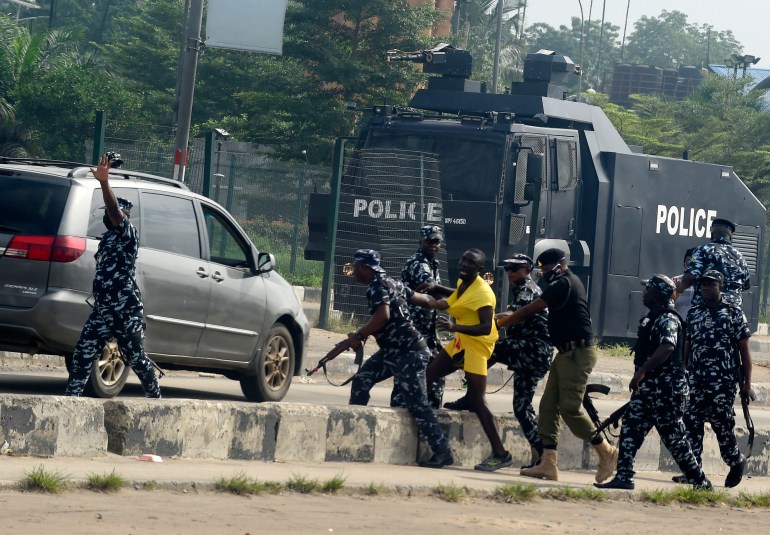
Nigerian police have fired tear gas to disperse anti-government protesters in Lagos and the capital, Abuja, with reports of arrests and injuries.


Activists had called for nationwide protests on Saturday on Democracy Day, which marks Nigeria’s move to civilian rule more than 20 years ago, over what they criticise as bad governance and insecurity, as well as the recent Twitter ban by the government of President Muhammadu Buhari.

There were also pockets of protests in Ibadan, Osogbo, Abeokuta and Akure, all in southwestern Nigeria.

The protests were the first to take place simultaneously in several cities since the #EndSARS movement against police brutality in October grew into the largest anti-government rallies in Nigeria’s modern history.

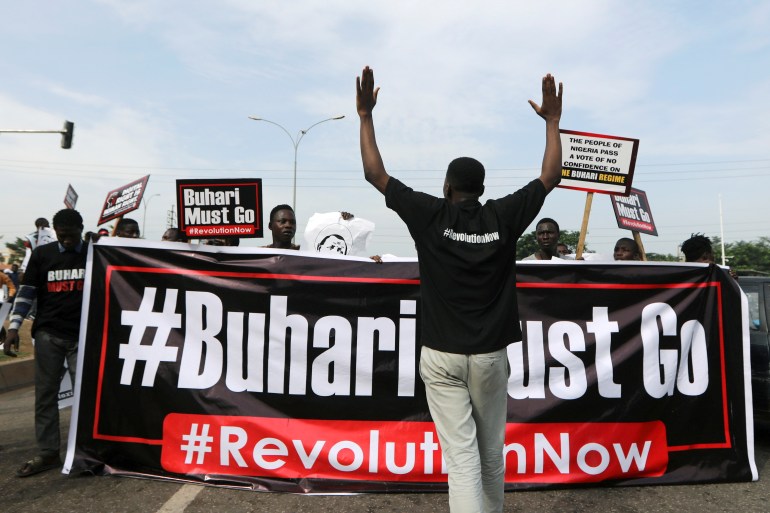
Hundreds of protesters gatheredin Lagos, a sprawling megalopolis of more than 20 million people, and police fired tear gas to disperse the crowd. The protesters carried banners and placards saying “Buhari Must Go”, calling for reforms.

Al Jazeera’s Ahmed Idris, reporting from Lagos, said the protest march in Lagos “started peacefully and in an organised fashion, with demonstrators chanting pro-democracy songs”.

“The police were deployed in large numbers here in Lagos and in other parts of Nigeria in anticipation of trouble on this day,” he added. “When the demonstrators breached the first line of defence of the police, the second and the third, the police started firing tear gas at them and journalists at the scene. Later, there were live rounds fired in the air.”

Anti-riot policemen detain a protester during a demonstration at Ojota in Lagos [Pius Utomi Ekpei/AFP]

In Abuja, a similar scenario played out as the protesters gathered as early as 7am (06:00 GMT).A detachment of police and army broke up the crowd using tear gas, AFP news agency reporters at the scene said, adding that some journalists were harassed by the security forces.

Police had said the protests were unauthorised and AFP reporters said they saw several people being detained.

“We cannot continue like this … all the bad governance must stop,” said protester Samson Okafor in Lagos, where tear gas canisters smouldered in the street as police shouted at demonstrators to leave the scene.

Officers were also seen smashing mobile phones confiscated from protesters, some of whom criticised the government’s decision to suspend access to Twitter after the social media platform removed a post by Buhari.

Protesters carry placards and banners during a June 12 Democracy Day rally in Abuja [Afolabi Sotunde/Reuters]

Buhari, a former general first elected as president in 2015, has been under pressure over growing insecurity in Africa’s most populous nation, home to more than 200 million people.Security forces are battling an armed uprising in the northeast, a surge in mass kidnappings and attacks by criminal gangs in the northwest, and a rise in separatist tensions in the southeast.

The government also triggered an outcry a week ago when it indefinitely suspended Twitter in the country, saying the platform was used for activities aiming to destabilise Nigeria.

Saturday’s demonstrations were called to coincide with “Democracy Day”, marking the anniversary of Moshood Kashimawo Abiola’s election as Nigerian president in 1993.

Abiola’s victory was annulled by the then military government, plunging Nigeria into months of civil unrest.

Nigeria returned to civilian rule in May 1999, but Buhari chose June 12 as Democracy Day after becoming president to honour Abiola and other heroes of the struggle.

SOURCE: AL JAZEER AND NEWS AGENCIES

………………………………………………………………

Hong Kong activist Agnes Chow released on protest anniversary

 The 24-year-old activist served nearly seven months for her role in an unauthorised assembly during anti-government protests in the city in 2019.

Hong Kong activist Agnes Chow released on protest anniversary


Hong Kong democracy activist Agnes Chow was released Saturday from prison on the second anniversary of the city’s huge democracy rallies, with police out in force and protests now all but banned.


Two thousand officers have been placed on standby after social media calls for residents to commemorate the failed democracy demonstrations.

Authorities have maintained a coronavirus prohibition on public gatherings despite the city recording just three local infections in the last month.

A Beijing-imposed national security law has also criminalised much dissent and most of the city’s democracy leaders have been arrested, jailed or fled overseas.

On Saturday morning, one of those figures walked free from prison.

Chow, 24, was mobbed by waiting media but made no comment as she was driven away.

Supporters shouted “Agnes Chow add oil”, a Cantonese-language expression of encouragement that was widely used at the protests that roiled the city.

Some supporters wore black T-shirts and yellow masks and one held a yellow umbrella, a symbol of protests in the former British colony dating back to 2014.

Sweeping crackdown

Chow hails from a generation of activists who cut their teeth in politics as teenagers and became an inspiration for those who chafe under Beijing’s increasingly authoritarian rule.

She spent some seven months behind bars for her role in a 2019 protest outside the city’s police headquarters. Fellow youth activists Joshua Wong and Ivan Lam were sentenced in the same case.

Chow’s release comes at a sensitive time.

Two years ago on June 12, thousands of protesters surrounded the city’s legislature in an attempt to stop the passage of a bill that could have allowed extraditions to mainland China’s judicial system.

Riot police used tear gas and rubber-coated bullets to disperse the huge crowds.Footage of the clashes deepened public anger, and fuelled what became an increasingly violent movement calling for full democracy that raged for seven straight months.

Huge crowds rallied week after week in the most serious challenge to China’s rule since Hong Kong’s 1997 handover.

Beijing’s leaders have dismissed the call for democracy, portraying those who protested as stooges of “foreign forces” trying to undermine China.

They have since overseen a sweeping crackdown that has successfully curbed dissent and radically transformed the once outspoken semi-autonomous city.

The spear tip of that crackdown has been the national security law.

More than 100 people have been arrested under the new law, including Chow, although she has not yet been charged.

Dozens more have been charged, including jailed pro-democracy media tycoon Jimmy Lai.

Most have been denied bail and they face up to life in jail if convicted.

Protests have been extremely restricted for the last year in Hong Kong, but anniversary events have tended to focus attention.

On Friday, two activists from Student Politicism, a pro-democracy group, were arrested on suspicion of advertising an unauthorised assembly.

Last week, authorities banned an annual candlelight vigil to commemorate victims of Beijing’s deadly 1989 Tiananmen Square crackdown.

However, many in Hong Kong still quietly signalled defiance by turning on mobile phone lights and lighting candles that evening.

SOURCE: AFP, REUTERS

………………………………………………………………

A Ciência e a Inteligência Artificial estão a dar vida às memórias!

A Inteligência Artificial já consegue transformar fotografias antigas em experiências visuais surpreendentes Hoje, testemunhamos como a ciên...