Translate

Thursday, 3 June 2021

Bird flu: China sees first human case of rare H10N3 strain


A 41-year-old Chinese man has been confirmed as the first human case of infection with a rare bird flu strain.


Officials did not give details on how the man got infected but the H10N3 strain is thought to not easily spread from humans to humans.

The Jiangsu province resident, who was diagnosed last week, has now recovered and is ready to be discharged.

There are many bird flu strains and it is not unheard of that people working with poultry occasionally get infected.

Contact tracing did not find any other cases of the virus.

Beijing’s National Health Commission (NHC) said on Tuesday the resident of the city of Zhenjiang was hospitalized on 28 April and diagnosed with H10N3 one month later.

“No human cases of H10N3 have been reported in the world. This case is an occasional poultry-to-human cross-species transmission, and the risk of a large-scale spread is extremely low,” the NHC said, according to a Global Times report.

The commission also said H10N3 was low pathogenic meaning it did not cause severe diseases in poultry and was unlikely to spread rapidly.

The World Health Organization (WHO) told the Reuters news agency that “at this time, there is no indication of human-to-human transmission”.

“As long as avian influenza viruses circulate in poultry sporadic infection of avian influenza in humans is not surprising, which is a vivid reminder that the threat of an influenza pandemic is persistent,” the WHO explained.

There is currently an outbreak among birds of a the H5N8 variant which has led to hundreds of thousands of poultry culled in various European countries.

In February, Russia reported the first case of that particular strain in humans.

Human infections with bird flu have been rare since a larger outbreak of the H7N9 strained killed around 300 people in 2016 and 2017.

………………………………………………………………

PRESIDENT POINTS OUT WAYS TO BETTER PROTECT CHILDREN


Luanda - The President of the Republic, João Lourenço, Tuesday said that Angola has made great advances in the strategy for child protection, but much remains to be done, mainly in terms of empowering families.

In a message on the International Children's Day (1 June), the Angolan Head of State encouraged the official bodies responsible for this purpose to continue their efforts to strengthen the fight against paternity denial and early pregnancy.

He also called for more action to combat domestic violence, sexual aggression, obscurantist practices such as accusing children of witchcraft, exploitation of child labour and other negative situations that are at the root of many of the problems of children in Angola.

He highlighted the issue of empowering families, as it is the nucleus where the first attention should be paid to children and where the first values are transmitted to ensure their full development, besides preventing possible deviations of conduct.

The Angolan President also recalled that since the first years of National Independence, the rights of children "began to be enshrined in the famous slogan Give the child everything he or she deserves and were formalised in the 11 Commitments for Children, adopted by the Government in 2007, and in other documents of equal importance".

COVID-19: ANGOLA REPORTS 208 NEW INFECTIONS, 8 DEATHS, 74 RECOVERIES


Luanda - At least 208 new infections, eight deaths and 74 recovered patients is the balance of the last 24 hours announced Wednesday by the Secretary of State for Public Health, Franco Mufinda.

Franco Mufinda, who was speaking at an updating session, said that 151 were diagnosed in Luanda, 22 in Huambo, 13 in Huíla, 7 in Benguela, 7 in Zaire, 4 in Cabinda, 3 in Cuando Cubango and 1 in Bié.

With ages ranging from 1 to 92 years old, the list included 121 men and 87 women.

The deaths, he said, four cases were recorded in Luanda, two in Huambo and two in Huila.

Among those recovered, 33 reside in Luanda, 29 in Huíla, 9 in Huambo and 3 in Benguela.

The laboratories processed 2,009 samples, with a daily positivity rate of 10.4 percent.

141 citizens are under institutional quarantine, 222 are hospitalised and 2,538 are under epidemiological surveillance.

Angola has 34,960 positive cases, with 780 deaths, 28,264 recovered and 5,916 active. Of the active cases, 11 are critical, 33 serious, 175 moderate, 7 with mild symptoms and 5,690 asymptomatic.

CHAD WOOING ANGOLA’S SUPPORT FOR POLITICAL-MILITARY STABILITY


Luanda - Chad’s Transitional Military Council has requested Angola's political and diplomatic support for political-military stability in its country.

The information was released Wednesday in Luanda by the minister of Foreign Affairs, African Integration and Chadians Abroad, Cherif Mahamat Zene.

Cherif Mahamat Zene was speaking at a press conference, as part of the visit to Angola of the President of the Transitional Military Council of the Republic of Chad, Mahamat Idriss Déby.

He said that his country recognises the role played by Angola for the stability of member countries of the Economic Community of Central African States (ECCAS) and the International Conference on the Great Lakes Region (ICGLR).

“I would like to underline Angola's leadership in Central Africa and its commitment to preserving stability and peace on the continent. In this sense, we have come to present the political-military situation in Chad to the Angolan side so that they can help us," he stressed.

The Chadian minister said that he rely on support of ECCAS and the African Union, which are following the transition process in Chad, expressing hope for a definitive exit of mercenaries from his country.

Strengthening cooperation

Cherif Mahamat Zene stated that Angola and Chad have had excellent cooperation relations for several years, which deserve to be deepened with reciprocal advantages.

He noted that during the ministerial meeting, held on Wednesday, the two countries addressed the strengthening of cooperation in the fields of agriculture, livestock, infrastructure, telecommunications and energy.

“We talk about the progress made and what we can improve. We are committed so that cooperation is beneficial for both parties and we are going to propose to the joint commission in order to look for other areas in which we can cooperate together”, he said.

In his turn, the Angolan minister of foreign affairs, Téte António, pledged Angola's support for stability in Chad, stating that this country has contributed to the stability of the Sahel region.

He spoke of Angola’s  interest in contributing to stability in Chad, and is also concerned about the unfolding of events in Libya, which for many years has been a source of destabilisation in the Sahel."

"We call for the withdrawal management of these mercenaries and the United Nations and other international organisations play their role in this issue," he added.

Political-military situation in Chad

Chad has been hit by civil war since December 2005, in the conflict involving government forces and various armed groups.

The political-military situation in this country has become more acute following the death, on 20 April this year, of the re-elected President Idriss Déby Itno, who did not resist the injuries sustained in combat against armed opposition forces, in the desert of Tibesti (northern region of the country.

Idriss Déby Itno died a day after being declared the winner, for the sixth consecutive time, in the April 11 presidential election, with 79.32% of the vote.

Due to the situation, a Military Transitional Council assumed the management of the country's affairs and, on the 2nd of May, created a Transitional Government that should lead the country until the holding of new elections, in the next 18 months.

The Angolan Head of State, João Lourenço, chairs the International Conference on Great Lakes Region (ICGLR), and has been regularly informed about the situation prevailing in that member country of the organization

Wednesday, 2 June 2021

South China Sea dispute: Malaysia accuses China of breaching airspace


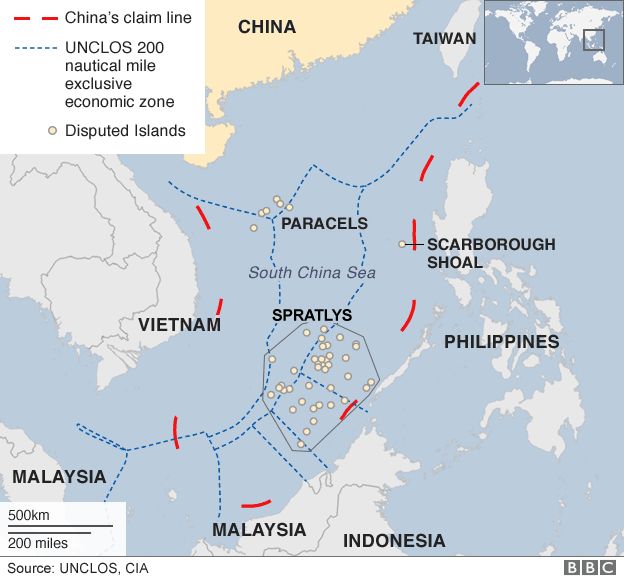
Malaysia says it is to summon China’s ambassador after 16 Chinese military aircraft flew over disputed waters off its eastern state of Sarawak.

Fighter jets were scrambled to intercept the transport planes on Monday after detecting “suspicious” activity over the South China Sea.

Malaysia’s foreign ministry described the manoeuvre as a “serious threat to national sovereignty”.

China, however, said its aircraft had abided by international law.

Malaysia, the Philippines, Brunei, Taiwan and Vietnam all contest China’s claim to almost all of the South China Sea. The row has rumbled on for decades but tensions have increased in recent years.

Beijing continues to claim an area known as the “nine-dash line” and has backed its claim with island-building and patrols, expanding its military presence while maintaining that its intentions are peaceful.

According to the Malaysian air force, the Chinese aircraft were “flying in tactical formation” at up to 27,000 ft (8.2km) and came within 60 nautical miles (110km) of Sarawak, a Malaysian state on the island of Borneo. Attempts to contact them went unheeded, a statement said.

Malaysian fighter jets were then scrambled from the Labuan Air Base to carry out “visual identification”.

Foreign Minister Hishammuddin Hussein said the planes had entered the country’s “maritime zone” and that a complaint would be lodged with Beijing.

He said the Chinese ambassador was being summoned to explain the “breach of the Malaysian airspace and sovereignty”.

“Malaysia’s stand is clear – having friendly diplomatic relations with any countries does not mean that we will compromise on our national security,” he said in a statement.

The BBC is not responsible for the content of external sites.View original tweet on Twitter
Presentational white space

A statement from the Chinese embassy in Kuala Lumpur played down the incident, saying Chinese military aircraft enjoyed “the freedom of overflight in the relevant airspace”.

“During this training, the Chinese military aircraft strictly abided by the relevant international law and did not enter the territorial airspace of any other country,” a spokesman said.

“China and Malaysia are friendly neighbours, and China is willing to continue bilateral friendly consultations with Malaysia to jointly maintain regional peace and stability.”

In recent years the South China Sea has become a flashpoint between China and other nations in the region which claim sovereignty over two largely uninhabited island chains, the Paracels and the Spratlys.

China claims the largest portion of territory, saying its rights go back centuries.

In March, the Philippines raised a complaint with China, saying more than 200 Chinese fishing boats were encroaching on its territorial waters.

The Philippines says the boats do not appear to be fishing and are crewed by Chinese maritime militia. China has largely ignored the protest.

South China Sea
Presentational white space

……………………………………………

Uganda minister shot in assassination attempt: Katumba Wamala

Gunmen have attacked and wounded Uganda’s Transport Minister and former army commander, Gen Katumba Wamala, killing his daughter and driver.


Witnesses say men on motorbikes fired several shots at their vehicle near their home in the capital, Kampala.

The army says phone calls potentially linked to planning the assassination attempt are being investigated.

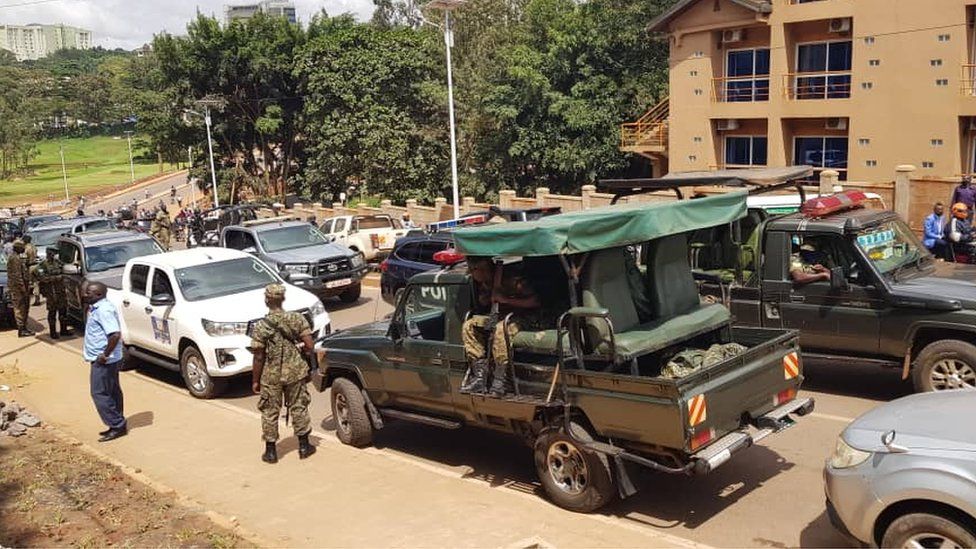
Soldiers are guarding the hospital where Gen Wamala is being treated for non life-threatening injuries.

He is regarded as one of Uganda’s most respected politicians and military men.

The attempt on his life comes as a shock although such attacks are not rare, the BBC’s Patience Atuhaire reports from Kampala.

Soldiers outside the hospital in Kampala
image caption Soldiers have been sent to secure the hospital where Gen Wamala is being treated

Gen Wamala was previously a police chief as well as an army commander.

At the time of Tuesday’s attack, he was travelling in army vehicle that was then sprayed with bullets from the sides and front.

His daughter Brenda Wamala and his driver, named locally as Haruna Kayondo, did not survive.

Video footage from the scene in Kisaasi shows the former army chief visibly shaken and covered in blood – being rushed to hospital on the back of a motorbike.

Over the last few years, the country has been rocked by such shootings by armed men riding on motorcycles, our correspondent says.

In June 2018, Ibrahim Abiriga, a politician and ardent supporter of President Yoweri Museveni, was shot and killed near his home.

Former police spokesperson Andrew Felix Kaweesi was assassinated in a similar manner in April 2017.

A magistrate and several Muslim clerics were killed in the same way.

None of the assassinations has ever been successfully investigated or prosecuted

………………………………………………………………

Mali suspended from African Union, threatened with sanctions


AU calls on military to ‘urgently and unconditionally return to barracks’ and to refrain from further interference in Mali’s political process.


Mali’s membership with the African Union has been suspended with immediate effect and the impoverished country threatened with sanctions following a second military coup in nine months.


The AU “decides … to immediately suspend the Republic of Mali from participation in all activities of the African Union, its organs and institutions, until normal constitutional order has been restored in the country”, the body’s Peace and Security Council said in a statement late on Tuesday.

The AU called for the military to “urgently and unconditionally return to the barracks, and to refrain from further interference in the political processes in Mali”.

It warned that if the military did not hand back power to civilian transitional leaders, “the Council will not hesitate to impose targeted sanctions and other punitive measures”.

Condemning the coup “in the strongest terms possible”, it added it was “deeply concerned about the evolving situation in Mali and its negative impact on the gains made thus far in the transition process in the country”.

The move follows a similar suspension on Sunday from the Economic Community of West African States (ECOWAS).

The coup sparked deep concerns over stability in the volatile Sahel region and warnings of economic penalties from across the international community.

Colonel Assimi Goita was at the ECOWAS crisis summit in Ghana on Sunday to argue the military’s case but has now returned to Mali.

Last August, Goita led army officers who overthrew elected President Ibrahim Boubacar Keita, following mass protests over perceived corruption and a bloody insurgency.

After the takeover, the military agreed to appoint civilians as interim president and prime minister under the pressure of ECOWAS trade and financial sanctions.

Elections pledge
But in a move that provoked a diplomatic uproar, soldiers last week detained transitional president Bah Ndaw and prime minister Moctar Ouane, releasing them on Thursday while saying that they had resigned.

Mali’s constitutional court completed Goita’s rise to full power on Friday by naming him transitional president.

With the military going back on its previous commitment to civilian political leaders, doubts have been raised about its other pledges, including a promise to hold elections in early 2022.

The military said this week it would continue to respect that timetable, but added that it could be subject to change.

The United States and Mali’s former colonial master France had both threatened sanctions in response to the second coup.

But ECOWAS, at a crisis summit in Ghana on Sunday, refrained from reimposing sanctions – a move it had adopted after the first coup.

The 15-nation bloc still pushed for Mali to transition to civilian rule under a previously agreed timetable.

The bloc suspended Mali from ECOWAS until February 2022, “when they are supposed to hand over to a democratically elected government,” Ghana’s Foreign Minister Shirley Ayorkor Botchwey said after the meeting.

Mali is among the world’s poorest countries, and the previous ECOWAS sanctions hit hard.

It is also battling an armed uprising which first emerged in the north of the country in 2012 and has since spread to Burkina Faso and Niger, leaving swaths of the vast nation of 19 million people outside government control.

SOURCE: AFP
………………………………………………………………

When Telecommunications Collapse: What Angola's Mobile Network Crisis Teaches Us About Governance, Justice, and National Security

  The recent disruption of Angola's mobile networks has affected banking, digital payments, businesses, emergency communications, and mi...