In line with the UN Food Systems Summit 2021, the Youth Alliance for Zero Hunger is organizing a Food Systems Dialogue.
We invite young people to participate in this video challenge. Selected participants will have the chance to engage with global policy makers at the Food Systems Dialogue organized by the Youth Alliance for Zero Hunger.
Your videos will also serve as inputs to the Global Youth Food Pledge & Actions 4 change of the Food Foundation & GAIN!!
The deadline to send your videos is the 11st April and the Food Systems dialogue will be held in May.
Don't miss out on the opportunity!!
We would really appreciate it if you could share this information widely with your youth networks and contacts.
We are pleased to announce the launch of our new campaign ''Still left behind: Inclusive education for disabled and illiterate girls''
“Our work continues to break down the barriers that can still prevent girls getting an education in developing countries. While great strides have been made towards increasing girls’ participation in education, the same cannot be said for children with disabilities. Therefore, this campaign is dedicated to all disabled and illiterate girls in developing world."
Cultural stigma and lack of awareness may mean families do not enrol disabled girls in schools. In extreme cases they are hidden as a result of family shame.
Of the 25 million children who will never start school, 15 million are girls. In developing countries, 90% of children with disabilities do not attend school.
Our today's guest is called Dó, she will share with us the challenges that prevent her from being at school.
Hello. How are you?
Hi, I am fine thanks.
What is your name?
My name is Dó.
How old are you?
I'm 10 years old.
Dó do you study?
No, I don't.
Why not?
Because my father doesn't have money to pay for my studies.
Have you ever attended a school?
Not, never.
How many siblings do you have?
We are seven.
Are they studying?
Not.
Would you like to study?
Yes.
If someone offers you an opportunity. Would you go to school?
Yes, I want to study.
How has your day to day been. What do you do everyday?
I do the dishes, tidy up the backyards and the kitchen, then I go to play in the street.
Both disability inclusion and gender equality are key factors in achieving inclusive education as both gender and disability are significant factors of exclusion.
Inclusive education is often seen as making sure that all disabled children go to mainstream schools, but huge improvements need to be made in specialist schools too.
We need to work out how to break down the barriers that leave so many disabled children out of school. We need to think creatively and trial programs in different contexts and cultures. We need to gather robust data on what works and what doesn’t.
Some families resist sending their disabled daughters to school because of fears about their safety or in a bid to protect them from sexual violence. Girls with disabilities experience attacks and exploitation at much higher rates than other children.
Girls with disabilities in developing countries are effectively unseen and unheard and are often not benefiting from international efforts to improve access to education in developing countries.
Each and every child deserves to learn. Filismina will conclude our today's program singing a beautiful song - "I give it to you"
By so many places I passed
And of your miracles I heard
Until one day I found you
And in Thy presence I rested
My dreams wanted to achieve
You gave me the strength to fight
While people did not believe
You saw the best that was in me
Don't miss this opportunity to bring girls back to school. Join us!
Our campaign aims to identify illiterate and girls with disabilities in such a way that it supports building an inclusive society for all.
The Challenge of Inclusive Education in Africa, shows that disability gaps in education are increasing. We call for urgent action of Ministries of Education and other stakeholders. We need the global political will to tackle this devastating problem that is failing tens of millions of the world’s most vulnerable.
There are more than 100 million children with disabilities across the world – and in developing countries, 90% never go to school.
We recommend investment in inclusive schools and classrooms, equity focused planning and monitoring, as well as incorporating the needs of girls specifically in efforts to help disabled people access education.
Around the globe, women journalists and female media workers face offline and online attacks putting their safety at risk – these attacks can range from harassment, stigmatization, sexist hate speech, trolling, physical assault, rape to even murder. In addition to being targeted on the basis of their work as journalists, they are also the targets of gender-based violence.
Studies have shown that female journalists are targeted online significantly more than their male colleagues, and that the threats they face are highly sexualized, focused on their physical features, ethnicity, or cultural background, rather than on the content of their work. As a result, these threats tend to silence women journalists’ voices and to deplete freedom of speech by interrupting valuable investigative journalist work. They also distort the media landscape by threatening diversity and perpetuating inequalities both in newsrooms and in societies.
A number of recent UN resolutions and reports show that there is growing recognition by the international community of the need to take into account the specific risks women journalists face both offline and online. UNESCO Director-General in her annual request to Member States regarding judicial follow-up of killings of journalists also inquires on specific actions taken by Member States to address safety of women journalists. A summary of the reported measures can be found in the Director-General's Report on Safety of Journalists and the Danger of Impunity.
UNESCO takes effective measures to tackle the issue of the safety of women journalists on three main levels:
Luanda - Angola announced on Thursday the record of 98 new cases, two deaths and 12 recovered patients, in the last 24 hours.
Among the new cases, 89 were diagnosed in Luanda, 7 in Cabinda, 1 in Zaire and 1 in Bié.
The list of new cases, whose ages range from 2 to 86 years, includes 51 mem and 57 women.
The deaths involve two Angolan citizens in the provinces of Luanda and Cunene.
Among the recovered patients 10 reside in Luanda and two in Huila.
In the last 24 hours, laboratory technicians processed 3,347 samples.
The Covid-19 pandemic in Angola has affected 23,108 people, with 549 deaths, 21,557 recovered and 1,002 active. Of those active, four are critical, 11 severe, 40 moderate, 28 mild and 919 asymptomatic.
There are 47 citizens in institutional quarantine, while 83 people are hospitalised in treatment centres.
The authorities are keeping 1,012 contacts of positive cases under epidemiological surveillance.
BRUSSELS (AP) — Life expectancy across much of the European Union has dropped last year, as the 27-nation bloc struggled with the impact of the coronavirus pandemic.
The EU statistical agency Eurostat said Wednesday that “following the outbreak of the COVID-19 pandemic last year, life expectancy at birth fell in the vast majority of the EU member states.” It said the biggest drop was in Spain, with a loss of 1.6 years compared with 2019.
Bulgaria followed with a loss of 1.5 years, followed by Lithuania, Poland and Romania, which all saw a drop of -1.4 years. Denmark and Finland were the only nations to see a rise in life expectancy, with 0.1 years.
Election rallies led by Modi and other politicians as well as crowded festivals and religious gatherings contribute to the second wave.
India’s COVID-19 cases have soared 13-fold in barely two months, a vicious second wave propelled by open disregard for safety protocols in much of the vast country.
The country on Friday reported 131,968 new COVID-19 infections, a record increase for a third-straight day, data from the health ministry showed. Deaths rose by 780 to a total of 167,642.
With an overall tally at 13.06 million, India’s overall caseload was the third-highest globally, behind the United States and Brazil.
Election rallies led by Prime Minister Narendra Modi, main opposition leader Rahul Gandhi and other important political figures, as well as crowded festivals and religious gatherings have contributed to the record resurgence of the new coronavirus.
After quelling the first surge late last year, India’s leaders let down their guard. Allowing or even encouraging dangerous behaviour, they underestimated the virus, reopening the economy too fast and too broadly, experts say.
Days after the federal health minister declared India’s COVID-19 outbreak contained in late January, Mumbai reopened its huge suburban train network and authorities let tens of thousands of visitors into stadiums for international cricket matches.
Many of the South Asian nation’s 1.35 billion people ignored masks and social distancing, while politicians including Modi and Home Minister Amit Shah greeted hundreds of thousands of mostly maskless supporters at election rallies.
Political parties have largely flouted COVID-19 rules during campaigns for multi-phase elections in four big states and one federal territory that started last month.“Political leaders are themselves responsible” for the resurgence by allowing the packed rallies, said Dr Subhash Salunke, a former World Health Organization official who advises the worst-hit state, Maharashtra. “The upward trend is going to be there for another couple of weeks.”
Health Minister Harsh Vardhan told officials of 11 of the worst-hit states this week that “people largely gave up on COVID-appropriate behaviour, became very careless” as activity resumed.
“There have been elections, religious gatherings, reopening of offices, lots of people travelling, attending social functions, not following rules, little mask-wearing in functions like weddings, even on crowded buses and trains,” he told a video conference.
But Vardhan himself has faced criticism for tweeting dozens of images and videos of party rallies.
Authorities have refused to call off a weeks-long Hindu festival, held once every 12 years on the banks of the Ganga river in the northern state of Uttarakhand.
A successfully run Kumbh Mela or Pitcher festival, which is expected to draw millions of devotees, is seen as crucial for the campaign of Modi’s Hindu nationalist party in the state, which votes next year.
Devotees gather on the banks of Ganges river to pray during the Kumbh Mela or Pitcher festival, in Haridwar, India [File: Anushree Fadnavis/Reuters]
When daily infections fell below 10,000 in early February, some experts predicted India would see only a modest second wave at most.
“We were really premature to celebrate,” said University of Michigan epidemiologist Bhramar Mukherjee.
“This is a lesson,” said Mukherjee, who leads a team of researchers modelling the trajectory of India’s outbreak. “The really treacherous thing about this virus is how silently it casts its footsteps. By the time you see the cases and deaths, the damage is done.”
With 13.6 million cases, India is just behind Brazil and well below the US, which has recorded more than 30 million infections.
India’s COVID-19 deaths are above 166,000, although its death rate is one of the lowest in the world, partly because of its relatively young population.
Authorities have imposed some curbs on movement but federal ministers and industrialists have advised against another national lockdown. Last year’s curbs thrashed the economy and threw millions of poor people out of jobs.
Instead, an increasing number of states are imposing local curbs, including night curfews in mega-cities such as New Delhi and Mumbai.
New Zealand on Thursday suspended entry for all travellers from India, including its own citizens, for about two weeks.
Shashank Tripathi, a professor at the Centre for Infectious Disease Research at the Indian Institute of Science in Bengaluru, said that even if most people are eventually exposed to the virus, “there is no guarantee that it will not come back and infect you again.”
LONDON (AP) — Prince Philip, the irascible and tough-minded husband of Queen Elizabeth II who spent more than seven decades supporting his wife in a role that both defined and constricted his life, has died, Buckingham Palace said Friday. He was 99.
His life spanned nearly a century of European history, starting with his birth as a member of the Greek royal family and ending as Britain’s longest serving consort during a turbulent reign in which the thousand-year-old monarchy was forced to reinvent itself for the 21st century.
He was known for his occasionally racist and sexist remarks — and for gamely fulfilling more than 20,000 royal engagements to boost British interests at home and abroad. He headed hundreds of charities, founded programs that helped British schoolchildren participate in challenging outdoor adventures, and played a prominent part in raising his four children, including his eldest son, Prince Charles, the heir to the throne.
Philip spent a month in hospital earlier this year before being released on March 16 to return to Windsor Castle.
“It is with deep sorrow that Her Majesty The Queen has announced the death of her beloved husband, His Royal Highness The Prince Philip, Duke of Edinburgh,” the palace said. “His Royal Highness passed away peacefully this morning at Windsor Castle.”
Philip saw his sole role as providing support for his wife, who began her reign as Britain retreated from empire and steered the monarchy through decades of declining social deference and U.K. power into a modern world where people demand intimacy from their icons.
In the 1970s, Michael Parker, an old navy friend and former private secretary of the prince, said of him: “He told me the first day he offered me my job, that his job — first, second and last — was never to let her down.”
Speaking outside 10 Downing St., Prime Minister Boris Johnson noted the support Philip provided to the queen, saying he “helped to steer the royal family and the monarchy so that it remains an institution indisputably vital to the balance and happiness of our national life.”
The queen, a very private person not given to extravagant displays of affection, once called him “her rock” in public.
In private, Philip called his wife Lilibet; but he referred to her in conversation with others as “The Queen.”
Princess Elizabeth stands with her husband the Duke of Edinburgh and their children Prince Charles and Princess Anne at the couple’s London residence at Clarence House in 1951.
Over the decades, Philip’s image changed from that of handsome, dashing athlete to arrogant and insensitive curmudgeon. In his later years, the image finally settled into that of droll and philosophical observer of the times, an elderly, craggy-faced man who maintained his military bearing despite ailments.
The popular Netflix series “The Crown” gave Philip a central role, with a slightly racy, swashbuckling image. He never commented on it in public, but the portrayal struck a chord with many Britons, including younger viewers who had only known him as an elderly man.
Philip’s position was a challenging one — there is no official role for the husband of a sovereign queen — and his life was marked by extraordinary contradictions between his public and private duties. He always walked three paces behind his wife in public, in a show of deference to the monarch, but he was the head of the family in private. Still, his son Charles, as heir to the throne, had a larger income, as well as access to the high-level government papers Philip was not permitted to see.


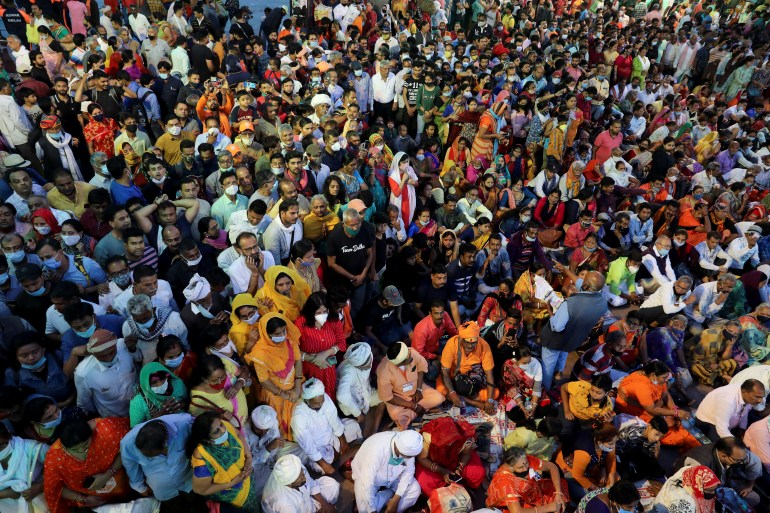 Devotees gather on the banks of Ganges river to pray during the Kumbh Mela or Pitcher festival, in Haridwar, India [File: Anushree Fadnavis/Reuters]


