Leymah Gbowee’s office is a hive of activity. At any one time, there are at least a dozen people within its bright, mural-clad walls. Sitting behind her generously proportioned desk, Gbowee commands authority, bellowing “Come!” in response to frequent knocks on the door.

Leymah Gbowee’s office is a hive of activity. At any one time, there are at least a dozen people within its bright, mural-clad walls. Sitting behind her generously proportioned desk, Gbowee commands authority, bellowing “Come!” in response to frequent knocks on the door.
But the men and women who enter are at ease and show her considerable affection. As the Liberian Nobel Peace laureate eats a hurried late lunch, she receives hugs and kisses from friends, more than one of whom proceeds to pick up her fork and swipe a mouthful of fried potato greens from her plate.
Next to Gbowee’s larger-than-life demeanour, the older woman on the other side of the desk seems more docile. While Gbowee, 49, sports thick-rimmed spectacles, silver trainers and bold Bantu knots – intricate cornrows coiled into buns on her head – Etweda “Sugars” Cooper makes less of a statement, with smart leather shoes and grey hair cropped short. But at 74, she nonetheless shares her protégé’s energy, gamely propelling her office chair across the floor to open a conversation on the other side of the room.
It is the end of a busy morning celebrating International Women’s Day at the Gbowee Peace Foundation’s headquarters near the Liberian capital, Monrovia. A ceremony attended by officials, diplomats and women’s rights and peace activists culminated in the unveiling of a memorial wall bearing the names of 300 women who, led by Gbowee under the Women of Liberia Mass Action for Peace campaign, were instrumental in bringing Liberia’s second civil war to an end nearly 20 years ago.
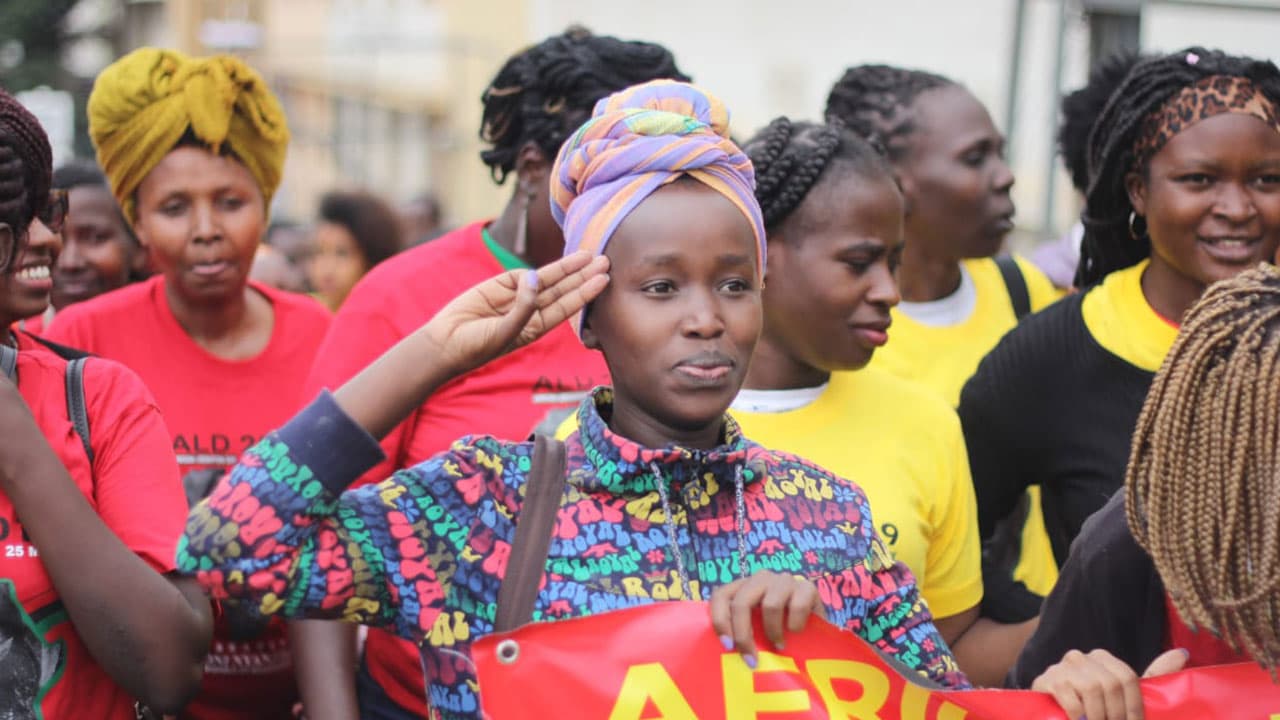
Dressed in white, the women became a visible presence in wartime Monrovia as they fasted, sang and prayed for peace. In torrential rain and under the scorching sun they continually turned out, even threatening a sex strike for as long as fighting continued. The number of women joining the peaceful sit-ins swelled to thousands from diverse religious and social backgrounds. In June 2003, Gbowee and her female peace warriors accompanied then-President Charles Taylor and rebel leaders to talks in Ghana; when progress stalled, they blocked the exits of the negotiating hall until a consensus was reached.
Liberia’s back-to-back civil wars, from 1989 to 1997 and 1999 to 2003, killed some 250,000 people and displaced more than a million. Fighting first broke out on Christmas Eve of 1989 when Taylor led a group of rebels into Liberia from neighbouring Ivory Coast with the intention of overthrowing then-President Samuel Doe. Doe was killed in 1990, but 13 more years and multiple rebel groups came and went before the second war ended with the signing of the Accra Comprehensive Peace Agreement. Taylor was exiled and disarmament proceeded under a transitional government that ran the country until Ellen Johnson Sirleaf was elected president in 2005.
Early days of comradeship
Gbowee and Sugars – who was given her nickname as a child by her sisters – first met three years before their feat at the Accra peace talks. Aged 28, with little experience of women-led campaigning, Gbowee approached a group of established female activists with the idea of starting a Liberian branch of the regional Women in Peacebuilding Network (WIPNET), which later gave birth to the Mass Action for Peace campaign.
Sugars was a founding member of the Liberian Women’s Initiative which, along with several other groups, had advocated for women’s rights and sought to carve out a space for women in peace efforts since the mid-1990s. Her mother was a key influence in her path into activism, through her belief that women should be recognised as individuals, rather than somebody’s daughter, wife or mother. “She always said, ‘a woman is never her own’,” Sugars remembers, adding that she and her sisters were highly educated ahead of their time and avid readers of National Geographic, Time and Newsweek thanks to their mother’s conviction.
When war broke out, Sugars carried this conviction forward: “I felt that Liberia was my home and we [the women] were the ones to do something for her.” When her own children were sent to safety abroad, Sugars’s agenda was to help deliver peace “to enable them to come home and be Liberians”. She succeeded: Her daughter Jeanine is the serving minister of agriculture.
“Sugars was uncompromising in her activism,” Gbowee recalls, as Sugars bows her head in affirmation. “President Taylor had said of her that she was the only woman he truly respected. If she said she hated you as a politician, she hated you and she would never come in the covers of darkness to ask you for a dime or anything. Others could be compromised but not her.
“She was the oracle to go to if you wanted to start a network of women’s peacebuilders,” Gbowee continues matter-of-factly, “so I went to her.”
It was just as well she did. Gbowee was more accustomed to working with men in her role as a community social worker, providing trauma counselling to former child soldiers. She had not anticipated the tirade of abuse that would meet her proposal to lead the new group: “These women were sharks!
Aside from Gbowee being an unknown entity, their frosty reception stemmed from deep-rooted social issues. Many of the leading female activists – Sugars included – belonged to the Americo-Liberian elite; the descendants of freed slaves who settled in Liberia in the first half of the nineteenth century. This small minority had historically dominated Liberian politics, breeding inequality and grievances among the rest of the population which were among the root causes of the civil conflict.
In contrast, Gbowee, as a member of the Indigenous Kpelle ethnic group, was regarded by many of the women as uneducated and unworthy of the leadership role. But Sugars sensed she possessed qualities the other women did not. “I didn’t know her at all but I knew the other women and my gut instinct told me that she would do a better job,” she explains.
Noticing her discomfort, Sugars took Gbowee aside and instructed her to pull herself together before returning to the meeting where she presented her new protégé as the WIPNET leader. “The place went quiet, no one said anything and I was the leader,” recalls Gbowee.
From then on, the two women worked closely together, cultivating a strong mother-daughter dynamic, and Sugars continued to open doors for Gbowee as the peace movement gained traction. “I was coming with a fresh idea and she knew the landscape,” says Gbowee. “She was our bridge to the established women’s organisations.”
Their joint quest has seldom been easy. In the face of hostility and rumours continuing into peacetime, Sugars often felt compelled to defend her mentee and faced criticism for doing so. Gbowee recalls how she came across a visibly upset Sugars one morning on the sidelines of the Accra peace talks. A group of women had criticised her for masquerading as a lowly “countrywoman” by associating so closely with Gbowee: “She felt they were just reinforcing the same nonsense that brought the war in the first place.”
At this, Gbowee saw red. “I think it transported me back to 2000 and being judged based on my social status and not my intellectual ability or the work I’ve been able to do. I barged into that room and said: ‘Let me tell you old witches that the next time any one of you opens your mouth and talks to Sugars in that way, I will deal with you.’ But by lunchtime, we were all friends again.”
While Gbowee owes much to Sugars for installing her at the helm of WIPNET and her subsequent mentorship and loyalty, this is but one example of the mutual support in their relationship. Although known to be a fearless activist in her own right, brokering peace deals and disarming factions at the end of the first civil war, and impervious to the call of the gravy train as she focused on her cause, Sugars admits she shies from the limelight. “I like to be in the back of things,” she confides.
Post-war and the co-Nobel fallout
After peace had been secured, Gbowee turned her attention to furthering her education in the United States and supporting grassroots peace movements around the world. Meanwhile, Sugars was elected mayor of the town of Edina in 2010 before becoming superintendent of Grand Bassa county two years later.
In October 2011, Gbowee was awarded the Nobel Peace Prize along with then-President Sirleaf and the Yemeni activist Tawakkol Karman. The trio was recognised for its “non-violent struggle for the safety of women and for women’s rights to full participation in peacebuilding work”.
Even as she refers to Sirleaf as “my co-Nobel sister”, Gbowee does not shy away from discussing the rift that emerged between them. Barely a year after backing Sirleaf’s successful bid for a second six-year presidential term and winning the Nobel award, Gbowee resigned from her post as the head of the government’s peace and reconciliation commission and publicly criticised Sirleaf for corruption and nepotism.
“I was speaking up because we were trying to protect the rights of the women,” she says. One of the things we said was if President Sirleaf doesn’t do well, her failure will be an indictment for women’s leadership in this country. And today we see it! You were there for 12 years and what did you all do?”
Gbowee recalls the betrayal she felt when members of WIPNET went to the gender ministry and declared their support for Sirleaf in the face of Gbowee’s criticism. “What pained me was that some of the very women I worked with were the ones who went and signed, declaring me a disgrace to womanhood.”
Nine years on, the wounds appear to have healed as the women dressed in white are out in force at Gbowee’s International Women’s Day reception and Sirleaf is one of the first guests to arrive, sitting quietly on the end of the VIP row waiting for the proceedings to begin. In a short address, she discloses that Gbowee had coerced her into making a speech by warning “if you don’t go there and talk they’ll say we’re still fussing!”
Sirleaf goes on to acknowledge the crucial role played by Gbowee, Sugars and their team of women in bringing peace to Liberia, paving the way for democratic elections in 2005 and “for me to become president”.
Meanwhile, the women in white deliver a call-and-response of “Sugars” and “Spice!” when Gbowee thanks her mentor “for staying in the shadows and allowing me to shine”.
The future of female activism
Gbowee says she “stumbled on peacebuilding”. The outbreak of war forced her to abandon a longstanding ambition to be a paediatrician and she applied for a social work programme focusing on trauma-healing. “Engaging with people has always been one of my better traits,” she discloses. This, combined with her aptitude for public speaking dating back to her school days, equipped her well for the world of women’s activism.
Since becoming a Nobel Peace laureate, Gbowee’s life has continued to revolve around peacebuilding both at home and abroad. She provides educational support and mentorship to young Liberians through the Gbowee Peace Foundation which she founded in 2012, providing scholarships and social support to some 700 students from disadvantaged backgrounds. The foundation also organises peace camps across the country, promoting reconciliation, peaceful coexistence and educating young people about the war.
Internationally, Gbowee helps to elevate the voices and work of grassroots women’s organisations and has assisted in peacebuilding efforts from Libya to Sri Lanka. In her role as adviser to the UN secretary-general on mediation, she successfully advocated for sexual and gender-based violence caused by COVID-19 lockdowns to be included in the UN’s call for a global ceasefire during the pandemic.
Gbowee admits to having grown more thoughtful in her advocacy because of the weight her words now carry. “I’m not a noisy gun,” she says. But that does not mean she remains silent. In July 2019, she used her platform as the national orator of the state-organised Independence Day celebration to launch a scathing attack on the performance of the ruling party and opposition as Liberians endured the effects of worsening economic hardship.
As a result of this speech, Gbowee considers her invitations from the government to have dried up for good. But she accepts this as part of the loneliness of activism; a lesson she learned early on from her mentor. “Sugars was isolated, never invited to government functions. She was too vocal for their comfort.”
Sugars has now retired from front-line activism and public service. “What I needed was somebody else to carry the torch and that’s what Leymah is doing,” she says. “And she is just getting started. Probably if we had begun earlier and tried harder we could have prevented the civil crisis from happening, but then maybe we needed the crisis to show us that we still need to do a lot for Liberia.”
Gbowee announces at the Women’s Day celebration that she is looking for the woman who will one day take over from her. Yet she holds a somewhat dim view of the current generation of female activists. “When we were advocating for peace in Liberia it was not about notoriety or who got the most likes. It was about the work: we just wanted peace. But today a lot of it is about getting an award, a grant, or to travel. There’s not a lot of humility with this new generation of activists.”
This year, one of her priorities is to spend more time with Sugars. “To say that I’ve neglected her is a little bit true.” Sugars smiles wryly as Gbowee recounts their trip to a nightclub in Ghana on her 60th birthday. “Sugars is a cool ma. The active role is over but the next phase of our relationship is literally sitting under the baobab tree and taking as much wisdom as I can from her, because it’s always a treat.”
SOURCE : AL JAZEERA