Angola's Minister of Trade and Industry, Victor Fernandes, said Saturday that Angola's entry into the Free Trade Area of the African continent was an opportunity for the country's business class.
Speaking to the press, in Luanda, at the end of the 13th Special Session of the African Union, by videoconference, the Angolan official noted that, alongside new opportunities for businesspeople, the Free Trade Area would contribute to raising the quality of products and services.
"We are going to have an increasing supply of quality products and services, because not only will Angola provide these goods, but other countries will also do so," the minister said after the meeting, at which Angola was represented by the President of the Republic, João Lourenço.
The Free Trade Agreement for the African Continent, to which Angola is party, enters into force in January, 2021.
Of the 54 African states, 30 have already ratified the treaty. In a first phase, it will lead to the elimination of tariffs on 90 percent of products.
The aim of the African Union is to create an extensive free trade area, with a market estimated at US$2.5 trillion.
Victor Fernandes said that all the products that Angola produces had space in the Free Trade Area, as long as they complied with the rules established under the agreement.
Angolan player Yanick Moreira, of AEK Athens, was distinguished as the most valuable player (MVP) in the European Champion Clubs' Basketball League, during the month of November.
In the last game, on 17th November, the 2.11 meter tall player (28 years old) converted 21 points and captured four rebounds in his team's victory over Cholet de France, by 83-81.
The AEK of Athens of Greece lead Group C of the European League with six points, resulting from three victories, followed by Tsmoki Minsk from Belarus with 5 points and Hapoel from Greece (4), while Cholet is fourth and last in the series with three points.
Trained in 1º de Agosto schools, Yanick soon embraced professionalism and played, among others, in American college basketball.
Angola attended on Monday the 9th Meeting of the Virtual Smart Africa Council, held from Kigali, Rwanda.
The video conference event analysed the continent's challenges towards digital transformation.
Angola’s minister of Telecommunications, Information Technologies and Social Communication, Manuel Homem, attended the meeting on behalf of the Angolan Head of State, João Lourenço.
Chaired by the Rwanda Head of State, Paul Kagame, in his capacity as chairperson of the Smart Africa Alliance, the event reflected on the need for infrastructure development in Africa.
The event, attended by statesmen Felix Tchissekedi of Democratic Republic of the Congo (DRC), and Alpha Condé (Guinea Conakry), reflected on the need to improve connectivity in order to boost the growth of African economies and the digital economy in particular.
The participants also mentioned the issues such as regularization and digital inclusion as crucial to speedup digital transformation on the continent.
Angola joined the Smart Africa Alliance as a Member State
The Smart Africa Alliance is a public-private platform dedicated to shaping and driving Africa's digital transformation.
Launched in 2013 by seven African heads of state, the Alliance has grown to 22 member countries and dozens of members from the private sector and academia.
Founding members include the African Union Commission (AUC), International Telecommunication Union (ITU), World Bank, African Development Bank (AfDB) and the United Nations Economic Commission for Africa (UNECA).
It includes the African Telecommunications Union (ATU), New Partnership for Africa's Development (NEPAD), the GSM Association (GSMA) and the Internet Corporation for Assigned Names and Numbers (ICANN).
Angolan Health minister Silvia Lutucuta, Monday warned the population to remain alert against fake Covid-19 vaccines in the country.
The government official, who was speaking to the press at the end of a meeting of the multisectoral commission against Covid-19, stressed the need for the population not to be fooled and denounced attempts to introduce false vaccines in the country.
According to Silvia Lutucuta, the health authorities will pass on all information on the vaccination process as soon as the country receives the vaccines authorised and certified by the WHO.
Last Friday, the minister announced that Angola planned to receive a total of 15 million vaccines against Covid-19 by April 2021.
According to the Cabinet minister, who was speaking on the sidelines of the launch of the vaccination campaign against polio, Vitamin A and measles, these doses will be received in stages.
In a first phase, she said, five million vaccines will arrive in the country, from a batch of 12 million, underlining that the forecast is to receive 15 million by April 2021. "They will not all come at the same time. It will be five million in the first phase. By April we will have 15 million doses", she said.
In a first phase, professionals at the forefront of the fight against Covid-19, such as those in Health, and people at risk (patients), will be vaccinated.
She announced that the Angolan government was working with the Covax initiative, formed by the Global Alliance for Vaccines and Immunization, World Health Organization (WHO) and Coalition of Epidemic Preparedness Innovations (CEPI) to ensure that the country has access to to vaccines when they become available.
The health authorities registered Monday 57 new infections and 15 patients recovered.
According to the National Director for Public Health, Helga Freitas, who was speaking at the update session, there were 30 cases registered in Luanda, 21 in Zaire, Huíla and Lunda Norte, with two each, Moxico and Cuanza Sul, with one case each, respectively.
The new cases, she said, are from 4 to 78 years old, 22 women and 35 men.
According to the health official, 15 recovered cases were still registered, in the 20 to 63 age group.
Angola has 15,648 positive cases, with 354 deaths, 8,353 recovered and 6,941 active people. Of the active cases, three are in a critical condition, eight serious, 101 moderate, 151 light, 6,678 asymptomatic.
Coronavirus has further exposed inequalities within societies. Often it is those at the bottom of the economic ladder who are suffering the most.
Hello, my name is Mariete!
Mariete why are you in this situation?
Right now I'm here looking for help. I hope to get anything because I have a 5 year old son to support. I have nothing to give him to eat.
Before the emergence of the coronavirus and now, how has your life been?
My life is very difficult, especially when it comes to food. In the beginning of the pandemic, I spent a long time without eating properly, sometimes the neighbors of good faith feel sorry for me and bring a plate of food to eat.
Right now I'm on the street asking for alms from people who pass by.
Where is your child's father?
The child's father did not take responsibility, he did not accept because of my disability, and his family also interfered negatively, saying that I am not a woman for him.
I heard rumors that he already married someone else.
Right now I am raising my son on my own, fighting so that there is no lack of food at home to feed him.
How has the coronavirus affected you?
It hit me very, very much. Before coronavirus appeared, every time I went out, I always got something. But nowadays everything is more difficult, sometimes when I go out I come back with nothing, from time to time I can get 500 or 1000 kwanzas but it’s not enough, I must separate the money for transport because I live far away from this place, the change is insufficient to buy enough food for my son. With the coronavirus, life has become very difficult.
The negative societal effects COVID-19 has wrought all over the world have, in many cases, been even more profound when viewed through the lens of persons with disabilities. Persons with disabilities living in poor countries already deal with increased health challenges, exacerbated threats to their security, and societal marginalization that negatively impacts nearly every facet of their lives.
This is the first and the only Coronavirus show in Angola where the most ordinary citizens show their brilliant talents.
The heroes of the program are the most ordinary citizens - they share with the audience their songs, poems and real stories of how the Coronavirus pandemic affected their lives.
During the annual festival to celebrate Yemoja, the goddess of the river, the day begins with music, dance and prayers. There are 400 gods – called òrìsà in the Yoruba language – each representing a force of nature. Yemoja is considered the mother of them all, such is the importance of water to life.
These days, most Nigerians belong to one of the two main religions, Christianity and Islam, while traditional religions, much derided during colonial times, have fallen by the wayside in many places.But in Ibadan, where faith in all orisa – the Yoruba gods – remains joyful and strong, celebrations of the old religion continue. The 17-day-long Yemoja festival in October is as old as the Yoruba people. It has been celebrated since “time immemorial”, according to the priestess, Ifawemimo Omitonade.
October 31 is the grand finale of the Yemoja Festival in Ibadan, when different groups of orisa devotees dance to the rhythm of thrumming drums in front of the Yemoja Temple.
Inside sits Ogunleki, a 400-year-old statue of Yemoja, a woman breastfeeding a baby, 3 feet (about 1 metre) high. Devotees, young and old, sing Yoruba songs, giving thanks to the òrìsà for keeping them healthy since the previous year, and for allowing them to see another festival.
A Yemoja worshipper kneels in front of Ogunleki, a more than 400-year-old artistic portrayal of Yemoja [Femi Amogunla/Al Jazeera]
They also sing songs of prayers, trusting that they will return the following year more prosperous, and later they will proceed to the river to make their offerings and more prayers.
Chief Akinola Olaosun – ‘the river is inhabited by spirits’
Inside the temple, Chief Akinola Olaosun prepares the items to be presented to Yemoja at the river. Chief Akinola is also known as “Aare Adimula fun Odo Babalawo Ilu Ibadan”, which translates as “President of the young herbalists of Ibadan”.
Chief Akinola Olaosun during the preparation of Yemoja’s food at the temple [Femi Amogunla/Al Jazeera]
In front of him, next to the statue of Ogunleki, is an array of calabashes – large, melon-like fruit which have been hollowed out – into which he drops sacred items as offerings to the goddess. Among these are dried kola nuts into which people have spoken words of prayer to Yemoja.After these preparations are complete at the temple, prayers are said by Chief Egbelade Omikunmi, who is the Baale Yemoja – the chief priest to Yemoja – his hands outstretched to the devotees, who respond with “Ase”, the Yoruba ending to a prayer. Then the procession to the river begins.
Baale Yemoja of Ibadan land prays for the celebrants at in front of Yemoja’s temple [Femi Amogunla/Al Jazeera]
Accompanied by music, women dressed in white carry calabashes on their heads. In each calabash, there are different items – corn and beans cooked together, yam porridge and fruits – prepared for the òrìsà. Attendees follow the procession of arugba – the calabash carriers. Their destination: the nearby river. Their purpose: propitiation and prayers to Yemoja.
Chief Akinola Olaosun takes one of the calabashes containing food to Baale Yemoja for propitiation [Femi Amogunla/Al Jazeera]
“The river is inhabited by spirits that we converse with,” says Chief Akinola. “We also make pledges to them yearly. So, during the festival, we redeem our pledges by giving them what is due to them.” By so doing, he explains, devotees express their gratitude for the past year and pray for a better year ahead.
Some of the attendees and devotees offer prayers to the deity as the propitiation continues in the river [Femi Amogunla/Al Jazeera]
Because of initial fears about the spread of COVID-19 and this year’s unrest over police brutality in Nigeria, the crowd at the festival is more modest than it might have been, but more than 300 have come along nonetheless.
Ifawemimo Omitonade – Priestess
“It is good to know that people actually came and demonstrated their faith in our mother,” says Ifawemimo Omitonade, the priestess to Yemoja. As for the chief priest, the priestess is chosen by worshippers who have “consulted” with the orisa, Yemoji, through divination and prayer. Once a person has been chosen for this rank, they undergo a nine-day initiation process of rigorous self-examination to bring them closer to their chosen orisa, known as ita. Once chosen, a priest or priestess keeps his or her title for life.
Iyalorisa Omitonade uses ‘Aja’, an instrument used in invoking Yemoja’s spirit, during the propitiation process [Femi Amogunla/Al Jazeera]Iyalorisa Omitonade guides one of the calabash carriers during a procession to the river [Femi Amogunla/Al Jazeera]
Ifawemimo, who is in her 30s, is one of those devotees dedicated to keeping the old traditions alive in this part of Nigeria. She shares the beauty of the traditional religion on social media.
Friends of the Yemoja priestess who came to celebrate with her pose for a picture just before the procession to the river [Femi Amogunla/Al Jazeera]
“People are always of the opinion that traditionalists are fetishists … and other kinds of negativity,” she laments. She is glad, however, that young people are developing an interest in traditional religions and are demystifying them.When the prayers at the river, at the end of the celebration, are over, Ifawemimo takes some of the water from the river in a bucket and sprinkles it on her fellow devotees. In addition to the sprinkling, some of the devotees collect some of the river water in bottles. This sacred water is considered medicinal – mixed with the water people drink or added to a bath to heal ailments.
Omintonade sprinkles water from the river on some of the attendees after the propitiation. ‘This is some form of rejuvenation and blessings from the Orisha,’ she says [Femi Amogunla/Al Jazeera]
“The water is for rejuvenation and blessings from Yemoja,” Ifawemimo explains.
Foluke Akinyemi – ‘a most beautiful inheritance’
Yoruba culture enthusiast Foluke Akinyemi, who hosts the local Yoruba radio talk show, Awa Ewe which means “We, the Youth”, has come along to this year’s festival. She has been invited by Omitonade who she met through social media. Raised a Christian, she says the festival is an opportunity to reconnect with her Yoruba roots by worshipping the deities her ancestors prayed to.
‘I am happy I am part of this year’s festival … I will continue to let other this the beauty in this tradition,’ says Foluke, a culture enthusiast and radio host [Femi Amogunla/Al Jazeera]
“Yoruba culture is the most beautiful inheritance,” she says. “I personally value the role Yemoja plays in the Yoruba pantheon and mythical histories. At this year’s festival, I feel connected, I feel fulfilled. I am so glad to get to know more about orisa worship and I will continue to make people see that too,” she says.
Efunleye Orisatarada – carrier of calabashes
Women play an integral part in the worship of Yemoja, from preparing the offerings and carrying the calabashes, to carrying out duties as priestesses.
One of the calabash carriers, Efuleye collects food to be taken to the river from the fire minutes before the procession begins [Femi Amogunla/Al Jazeera]
This year, Efunleye is part of the arugba, a special group of women selected by worshippers through prayer and consultation with Yemoja herself to carry the calabashes to the river.
Efuleye Orisatara on her way to the river with the calabash containing the food for the Orisha [Femi Amogunla/Al Jazeera]
“All the women carrying the calabashes have designated roles, given to them by Yemoja,” she explains.“She says specifically what she wants each person to carry. If you carry what you have not been called for, the person will become unfortunate.”
The calabashes used in carrying the food of the deity. Yemoja chooses whoever she wants to carry the calabash each new year [Femi Amogunla/Al Jazeera]
The selection may be different the following year. “By next year, the orisa may say ‘I want a completely new set of people to champion my celebration this year or she may decide that these people continue’.”
Toluwani ‘Omisegun’ Johnson – new initiate
Each year, new initiates undertake religious rites.
Johnson Omisegun, one of the new initiates, says she ‘feels comfortable,’ in her newfound religion [Femi Amogunla/Al Jazeera]
For the final day of the festival, the new initiates cut their hair short and wear special beads. For Toluwani Johnson it is a very special event.“I first got to know about Yemoja through my mother, after we moved from Lagos to Ibadan. After some years, I decided to take things further by getting initiated fully. That is why this particular festival is special to me. That is what is responsible for my haircut and these beads I wear,” she explains.
She points to the three-layered, choker-like, blue-and-red collection of beads around her neck. “Once it is a month from now, I will cut one of the layers off; two months, the second one goes off and then the third one.” At that point, Toluwani will be entitled to wear the transparent, long, white beads worn by Yemoja devotees.
Toluwani now has a new name – Omisegun, which means “water conquers” – and says she considers that Yemoja is her personal orisa.
Toluwani Johnson alongside other new initiates on their way to the river [Femi Amogunla/Al Jazeera]
Jelili Atiku – ‘as the fish eat, the water rejoices’
Atiku Jelili, a Yemoja devotee, says ‘civilisation has made us lose some of our core values and traditions’ [Femi Amogunla/Al Jazeera]
The procession comes to an end with the presentation of the contents of the calabashes to Yemoja at the river. One by one, the items are opened and put into the river: a yam is cut into smaller pieces; the head of a pigeon is cut off and left to be carried off by the water; the yam porridge is emptied into the river.
One of the devotees of the Orisha takes tubers of yam to Baale of Yemoja during the propitiation process in the water [Femi Amogunla/Al Jazeera]Baale Yemoja alongside other devotees cut the new yam into sizeable portion before offering them to the deity [Femi Amogunla/Al Jazeera]A pigeon, offered to Yemoja as sacrifice, slowly gets taken away by the river [Femi Amogunla/Al Jazeera]Baale Yemoja alongside other devotees prepares to offer porridge, one of Yemoja’s preferred delicacies, to her [Femi Amogunla/Al Jazeera]
“People have a lot of misconceptions about what we take to Yemoja,” says Jelili, one of the devotees in the gathering at the river. “They are basically things that fish eat: honey, soft corn, and other things. Once the fish begin to eat, the water where they live begins to rejoice, as seen in its movement.“The breeze from the river is cooling and whoever has anything to ask of Yeye [another name for Yemoja] goes ahead to ask. If by the next year you do not have answers to such requests, please check yourself and ask yourself why.”
Chief Egbelade Omikunmi, “Baale Yemoja” – or Chief Priest to the orisa – also serves as the leader of all traditional Yoruba worshippers in Oyo state. After the singing and dancing at the temple – before the devotees go to the river – he prays for everyone, his hands stretched forward.
After the procession to the river, Chief Egbelade is assisted by other male devotees. He sits by the water and communes with Yemoja. One by one, he drops the offerings from the calabashes into the river. As he does, murmured prayers rise from the watching crowd, many hands pointing towards the river.
Baale Yemoja waits for the next batch of offerings to be brought by one of Yemoja’s devotees [Femi Amogunla/Al Jazeera]
Year in, year out, the festival proceedings have remained the same, says Chief Egbelade.“People come with different prayers. Last year, if someone came with a prayer and had their wish granted, the next year, they will come with more friends. Whenever prayers are answered, more people will come,” he says.
Some of the attendees look from the bridge into the water below as the propitiation process continues [Femi Amogunla/Al Jazeera]
Chief Egbelade says he has no fears that the practice of worshipping Yemoja will die out just yet.


 A Yemoja worshipper kneels in front of Ogunleki, a more than 400-year-old artistic portrayal of Yemoja [Femi Amogunla/Al Jazeera]
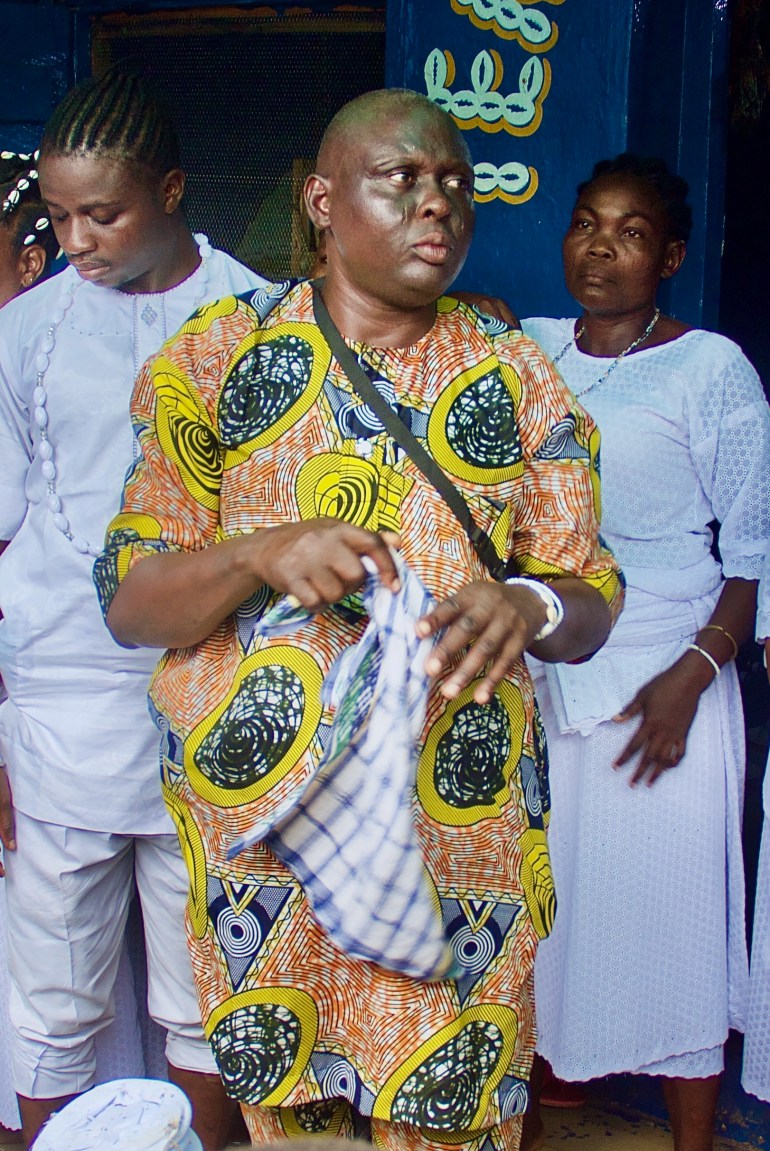 Chief Akinola Olaosun during the preparation of Yemoja’s food at the temple [Femi Amogunla/Al Jazeera]
 Baale Yemoja of Ibadan land prays for the celebrants at in front of Yemoja’s temple [Femi Amogunla/Al Jazeera]
 Chief Akinola Olaosun takes one of the calabashes containing food to Baale Yemoja for propitiation [Femi Amogunla/Al Jazeera]
 Some of the attendees and devotees offer prayers to the deity as the propitiation continues in the river [Femi Amogunla/Al Jazeera]
 Iyalorisa Omitonade uses ‘Aja’, an instrument used in invoking Yemoja’s spirit, during the propitiation process [Femi Amogunla/Al Jazeera]
 Iyalorisa Omitonade guides one of the calabash carriers during a procession to the river [Femi Amogunla/Al Jazeera]
 Friends of the Yemoja priestess who came to celebrate with her pose for a picture just before the procession to the river [Femi Amogunla/Al Jazeera]
 Omintonade sprinkles water from the river on some of the attendees after the propitiation. ‘This is some form of rejuvenation and blessings from the Orisha,’ she says [Femi Amogunla/Al Jazeera]
 ‘I am happy I am part of this year’s festival … I will continue to let other this the beauty in this tradition,’ says Foluke, a culture enthusiast and radio host [Femi Amogunla/Al Jazeera]
 One of the calabash carriers, Efuleye collects food to be taken to the river from the fire minutes before the procession begins [Femi Amogunla/Al Jazeera]
 Efuleye Orisatara on her way to the river with the calabash containing the food for the Orisha [Femi Amogunla/Al Jazeera]
 The calabashes used in carrying the food of the deity. Yemoja chooses whoever she wants to carry the calabash each new year [Femi Amogunla/Al Jazeera]
 Johnson Omisegun, one of the new initiates, says she ‘feels comfortable,’ in her newfound religion [Femi Amogunla/Al Jazeera]
 Toluwani Johnson alongside other new initiates on their way to the river [Femi Amogunla/Al Jazeera]
 Atiku Jelili, a Yemoja devotee, says ‘civilisation has made us lose some of our core values and traditions’ [Femi Amogunla/Al Jazeera]
 One of the devotees of the Orisha takes tubers of yam to Baale of Yemoja during the propitiation process in the water [Femi Amogunla/Al Jazeera]
 Baale Yemoja alongside other devotees cut the new yam into sizeable portion before offering them to the deity [Femi Amogunla/Al Jazeera]
 A pigeon, offered to Yemoja as sacrifice, slowly gets taken away by the river [Femi Amogunla/Al Jazeera]
 Baale Yemoja alongside other devotees prepares to offer porridge, one of Yemoja’s preferred delicacies, to her [Femi Amogunla/Al Jazeera]
 Baale Yemoja waits for the next batch of offerings to be brought by one of Yemoja’s devotees [Femi Amogunla/Al Jazeera]
 Some of the attendees look from the bridge into the water below as the propitiation process continues [Femi Amogunla/Al Jazeera]


