Translate

Friday, 27 November 2020

Preliminary election results hand victory to Kabore

 President Roch Marc Christian Kabore will serve another five years as Burkina Faso’s leader, according to preliminary results announced by the National Independent Electoral Commission.

Preliminary election results hand victory to Kabore

“Mr Kabore… with 57.87 percent of the vote, is provisionally elected president of [Burkina] Faso in the first round,” Newton Ahmed Barry, head of the commission, said on Thursday.

Kabore vowed on Thursday to strengthen dialogue in his troubled country after the landslide victory in his bid for a second term.

“I will deploy all my efforts so that through continuous consultation, through dialogue… we can work together for peace and development,” he said at his party’s headquarters in the capital Ouagadougou.

Some analysts had expected a closer contest in the election held on Sunday between Kabore, who was elected in 2015, and his 12 rivals, who argued he had failed to contain armed groups and ethnic violence.

The voting process was marred by threats of attacks by armed groups linked to al-Qaeda and ISIL (ISIS) which operate across vast swathes of Burkina Faso amid an escalating security situation in West Africa’s Sahel.

Last year, the conflict killed some 2,000 people in Burkina Faso. More than one million Burkinabe people have been displaced by the fighting.

Kabore received 1.6 million votes of the nearly three million cast, with voter turnout at 50 percent, Barry said.

The opposition had hoped to split the vote and deprive Kabore of the 51 percent needed for an outright victory and then form a coalition behind the strongest candidate for round two.

But leading candidate, Eddie Komboigo, head of the Congress for Democracy and Progress, received 15 percent and the other leading rival, Zephirin Diabre, from the Progress and Change Party, who lost to Kabore during the previous election, received approximately 12 percent.

The opposition has accused the governing party of foul play, including bribery.

The process was “riddled with fraud” and the electoral commission was not up to the task of organizing responsible elections, Tahirou Barry, an opposition candidate, told a news conference.

The electoral body, though, has dismissed such claims and an international observer mission gave the election a mostly clean bill of health.

The opposition has seven days to appeal the vote. It was not immediately clear if they would.

The African Union and the Economic Community of West African States, a regional bloc, said appeals should be made through legal avenues in a “calm environment and especially to avoid violence,” Makuza Bernard, who led the AU delegation, told The Associated Press.

Civil society organizations say the president will need to work harder in his second term to unite an increasingly divided country.

“He should make sure that promises not met during the last five years will be met in order to alleviate social discontent. The social discontent is not only happening in big towns but that is happening more and more in the countryside, ”Chrysogone Zougmore, president of the Burkinabe Movement for Human Rights, a local advocacy group, told AP.

Ahmed Idris, reporting from Abuja in Nigeria, said the indication is that the opposition do intend to challenge the results.

“So the biggest question for most Burkinabes is how far will the opposition go. Are they going to call on their supporters onto the streets of Ouagadougou and other cities around the country? ” he said.

“[Some] believe that it will give the opportunity to armed groups to attack targets in Burkina Faso, despite the fact that the election passed peacefully without any major incident or attack from any of the armed groups that have been bothering the country for the last five years. ”


SOURCE: AL JAZEERA AND NEWS AGENCIES

UN warns of ‘very critical’ shortages in Ethiopia’s Tigray region

 The United Nations has raised alarm over shortages that have become “very critical” in Ethiopia’s Tigray, as Prime Minister Abiy Ahmed announces a “final phase” of the three-week conflict in the embattled region.

UN warns of ‘very critical’ shortages in Ethiopia’s Tigray region

Tigray’s population of six million remains sealed off and its capital is under threat of attack by Ethiopian forces seeking to arrest the regional leaders.

Fuel and cash are running out, more than a million people are displaced and food for nearly 100,000 refugees from Eritrea will be gone in a week, according to a new report released by the UN overnight on Thursday.

More than 600,000 people who rely on monthly food rations have not received them this month, the global body said.

Travel blockages are so dire that even within Tigray’s capital, Mekelle, the UN World Food Program cannot gain access in order to transport food from its warehouses there.

Communications add travel links remain severed with the Tigray region since the deadly conflict broke out on November 4.

Human Rights Watch is warning that “actions that deliberately prevents relief supplies” violate international humanitarian law.

More than 40,000 refugees from Tigray have crossed the border into Kassala, one of the most impoverished regions of Sudan, which itself is one of the world’s poorest countries.

Analysts and international aid agencies warn that Sudan urgently needs assistance in order to be able to help those desperately fleeing Ethiopia.

“A larger influx would have very dangerous economic repercussions for Sudan,” said Sudanese economist Mohamed el-Nayer.

“We need the international community to urgently intervene economically and help provide food, shelter and medicines to those refugees. If not, Sudan’s economy will be over-burdened. ”

Al Jazeera’s Malcolm Webb, reporting from Kenya’s Nairobi, said: “Civilians have been caught up in this conflict so far.”

“The Ethiopian government’s human rights commission has said that more than 600 civilians were killed in an attack that took place two weeks ago in a massacre that it says was carried out by a Tigray militia,” he said.

"Both sides have been accused of killing civilians but both sides have denied targeting civilians."

Abiy on Thursday ordered Ethiopia’s army to launch a final offensive against Tigray’s leaders in Mekelle, saying the window for their surrender had expired.

Abiy’s government set a 72-hour ultimatum on Sunday for the Tigray People’s Liberation Front (TPLF) forces to lay down its arms or face an assault on Mekelle, the highland regional capital city of 500,000 people.

“The Ethiopian National Defense Forces have now been directed to conclude the third and final phase of our rule of law operations,” Abiy said in a statement on Twitter.

“In this final phase, great care will be given to protect innocent civilians from harm. All efforts will be made to ensure that the city of Mekelle, which was built through the hard work of our people, will not be severely damaged. ”


SOURCE: AL JAZEERA AND NEWS AGENCIES

Leader of S Korea ‘sextortion’ ring jailed for 40 years

 A Seoul court on Thursday sentenced the ringleader of the Nth Room - one of the biggest online sex trafficking rings ever discovered in South Korea - to 40 years in prison, falling short of the life sentence demanded by prosecutors.

Leader of S Korea ‘sextortion’ ring jailed for 40 years

The Seoul Central District Court found Cho Ju-bin guilty of violating laws to protect minors from sexual abuse and of operating a criminal ring to make profits by producing and selling abusive videos, the Yonhap news agency reported.

“The accused has widely distributed sexually abusive content that he created by luring and threatening many victims,” the court said.

The Nth Room ran on the encrypted messaging service Telegram and the perpetrators used private information - sometimes collected illegally from local government offices - to blackmail dozens of women and children into performing sexually explicit acts on camera, with thousands of users paying cryptocurrency to watch.

At least 74 women, including 16 teenagers, were ensnared in what authorities called “virtual enslavement” between May 2019 and February 2020.

The discovery of the ring sparked a national outcry, with millions of Koreans signing petitions urging authorities to release Cho's identity and investigate not only the ringleaders but also those who participated in the network, paying as much as 1.5 million won ($ 1,360) to view the abusive videos and images.

The punishment fell short of a life sentence sought by prosecutors last month who cited irreparable damage done to his victims. One of the victims said in a petition that Cho and his co-conspirators were evil and deserved to be jailed for 2,000 years.

Police have said at least 124 suspects have been arrested and 18 operators of chat rooms on Telegram and other social media, including Cho, imprisoned following investigations into similar sexual crimes that have been under way since late last year.

In April, the National Assembly passed a string of laws to make digital sex crimes easier to prosecute. Under the new law, those who possess, buy, store or watch illegally filmed sexual content can be sentenced to a maximum of three years in prison or 30 million won ($ 24,660). Before the new legislation was enacted, it was not illegal to possess such content.


SOURCE: AL JAZEERA AND NEWS AGENCIES

Extreme heat is a threat to lives in Africa, but it’s not being monitored

 Extreme heat is a serious hazard to people’s health. It affects the cardiovascular system and is particularly dangerous for the elderly and people with pre-existing health conditions.

Extreme heat is a threat to lives in Africa, but it’s not being monitored

Recent research has found that since the 1950s, extreme heat has become more frequent and severe, and lasted longer, in nearly all regions of the world. The biggest increases have been seen in the Middle East, South America and parts of Africa.

Because societies in different parts of the world have adapted to varying average temperatures, there’s no universal definition of what temperature range qualifies as extreme. For instance, in the UK temperatures above 25⁰C are rare whereas the Indian Meteorological Service only considers temperatures above 40⁰C as hot.

But almost everywhere thresholds are now more frequently exceeded and for more days at a time.

More worrying is that climate projections show that such heatwaves over the African continent will become hotter and more dangerous, even if global warming is kept below 1.5 ° C. Particularly strong increases in extreme heat are foreseen over Eastern and Southern Africa.

Bearing in mind changes in populations, the number of people exposed to dangerous heat in African cities is expected to increase at least 20-fold by the end of the century. Yet extreme heatwaves aren’t systematically monitored in many countries in the sub-Saharan Africa region.

As we explain in a recent paper, this means the effects of extreme heat are under-reported - putting even more people in harm’s way.

In most countries in sub-Saharan Africa there are no early warnings and no heat action plans. Unnecessary, premature deaths aren't counted. And there are very few adaptation efforts for the fastest growing hazard in a changing climate.

Gaps in the records

There’s a near-complete absence of reported heatwave events over sub-Saharan Africa in disaster databases. The largest of these databases, EM-DAT, lists technological and environmental disasters across the world. It records events like earthquakes and oil spills and their impact on lives, livelihoods and economies.

EM-DAT lists only two heatwaves in sub-Saharan Africa since 1900. These have led to 71 recorded premature deaths. By contrast, 83 heatwaves were recorded in Europe over the last 40 years alone. Other inventories of weather-related disasters contain similarly stark discrepancies.

Heatwaves in Africa are not reported by governments, weather services or public health agencies, although they are obviously happening. Exposure and vulnerability to extreme weather is also more pronounced in many sub-Saharan African countries when compared with European countries. This is mainly due to higher poverty levels, informal settlements and the need for outdoor work.

Hence, there’s likely to be an even larger number of premature deaths from severe heat. But they have never been registered, so the number is unknown.

Reporting and observing

A lack of reporting on deaths associated with heatwaves means there’s little awareness that extreme heat can be deadly. It was only after the 2003 European heatwave killed more than 70,000 people that countries and cities began to plan for such times.

The Indian city of Ahmedabad implemented a heatwave plan after an extremely hot and deadly pre-monsoon season in 2010. This resulted in the country reporting fewer deaths after an even more intense heatwave in 2015.

This type of planning is impossible if heatwaves aren’t recorded.

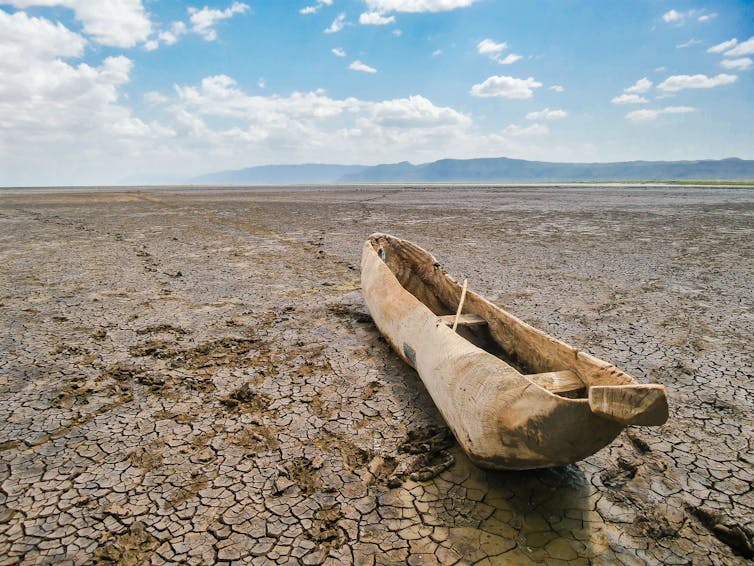
An old wooden fishing boat on a dried up river bed.
Heatwaves are possibly unreported as they may occur along with other extreme weather events such as droughts. Shutterstock

Since heatwave mortality is rarely reported in sub-Saharan Africa, we don’t know the precise temperature thresholds that result in heat-related mortality. Yet this information is crucial for local communities to adapt.

In Ahmedabad, for example, the average daily maximum temperatures are usually around 40°C in April and May. In Western Europe such temperatures would constitute a severe heatwave. The consequences would be deadly if the temperatures remained at this level for several consecutive days.

One reason for this uneven reporting of extreme heat lies in which entities report the impact of extreme weather. In most developed countries, national governments provide numbers about affected people, mortality rates and even economic losses for extreme weather events. But for many lower-income countries, these reports are provided by different NGOs as an unsystematic by-product of their disaster relief work.

Reporting standards differ depending on the NGO and usually have little or no connection to meteorological services. There’s no central place that records the nature of the event and its impact.

Another reason heatwaves aren’t reported could be that they might occur in combination with droughts. They can often lead to food insecurity and humanitarian crises. So most observations and response mechanisms developed by NGOs and governments are tailored to the adverse outcomes of drought.

What needs to be done

In our paper we identified several key areas where improvements can occur quickly.

First, early warning systems and heat action plans can be beneficial. At first they might have to be based on information from other countries with similar climates. More analysis of historical periods of extreme heat in sub-Saharan Africa from a purely meteorological standpoint can help to build a useful definition of heatwaves for the region and improve warnings.

Second, collaborations between local researchers, hospitals and epidemiologists can identify direct health impacts of extreme heat. There have been successful pilot projects in Ghana and The Gambia.

Heatwaves are killers. But relatively simple measures such as opening public buildings to provide cool rooms, distributing free drinking water, informing people about the dangers of heat and early warning can reduce the danger dramatically.

Combining data with local expertise, the effects of heatwaves can be understood and future risks minimised even though the hazard itself is increasing.

Thursday, 26 November 2020

COVID-19: THE GOVERNMENT PREPARES FINANCIAL RESERVE FOR VACCINES

 Angolan minister of Health Sílvia Lutucuta announced Tuesday in Luanda that the Executive is preparing a financial reserve for the acquisition of vaccines against SARS Cov-2.

Ministra da Saúde, Silvia Lutucuta

Sílvia Lutucuta announced so during a session of debate on 2021 State Budget at Parliament, adding that in addition to the reserve, the Government is also working with the World Bank on funding the purchase of vaccines.

In addition to these initiatives, she said, Angola will benefit from 12 million vaccines, through the Covax initiative, made up of Global Alliance for Vaccines and Immunization (GAVI), World Health Organization (WHO) and Coalition for Epidemic Preparedness Innovations (CEPI) .

"Studies on the vaccines are still in progress and we think that, in the first quarter of next year, we will start to have vaccines, but not in quantities to solve the problems and worldwide demand. Hence the need to maintain preventive measures against Covid - 19 ”, she said.

According to her, the patients with comorbidities will be the top priority.

During the meeting, the members of the National Assembly defended the need to increase the portion of Budget for the Health sector.

The revised Budget for 202 The allocated 816 billion kwanzas to the Health sector, and that of 2021 foresees an amount estimated at 842 billion.

Subsidy for medicines for people with chronic diseases: the MPs proposed to the Executive the adoption of measures to subsidize the medicines for the diabetic patients, with arterial hypertension and tuberculosis.

The proposal was presented by the 8th Commission of the National Assembly to the Minister of Health, Sílvia Lutucuta, during the discussion on State Budget for 2021 proposal.

The proposal is part of the range of concerns raised by the social partners, which defends the subsidy of medicines for families with an income below 150,000 kwanzas.

The MPs also defended the financial autonomy of hospitals and special attention to autistic children who suffer from global developmental disorders.

Sílvia Lutucuta guaranteed that the Executive is working on this process. "We have already held an initial public tender for medicines, but now it is necessary to do it comprehensively”, she stressed.


COVID-19: ANGOLA REPORTS 79 NEW INFECTIONS, 73 RECOVERIES

 Angolan health authorities announced Wednesday the record of 79 new infections of Covid-19, 73 patients recovered and two deaths, in the last 24 hours.

Franco Mufinda, Secretario de Estado da Saúde

According to the Secretary of State for Public Health, Franco Mufinda, who was speaking at the country usual update session for Covid-19, 67 new cases were diagnosed in Luanda, five in Huambo, four in Lunda Sul and one each in Lunda Norte, Cabinda and Uíge.

The list of new patients, aged between one and 78 years, is composed of 46 males and 33 females. It reported that 73 patients were recovered, 28 from Malanje, 18 from Uíge, 15 from Luanda, nine from Cuanza Sul and three from Namibe, aged between two and 70 years.

In relation to the deaths, Franco Mufinda said that these were two Angolan citizens, living in Zaire, one male and one female, aged 34 and 67, respectively.

Angola has a record of 14,821 cases, with 340 deaths, 7,517 recovered and 6,964 active cases.

Of the active population, five are in critical condition with invasive mechanical ventilation, 13 severe, 175 moderate, 185 with mild symptoms and 6,586 asymptomatic.

Health authorities follow 378 patients admitted to treatment centers in the country.


Donald Trump pardons former aide Michael Flynn who pleaded guilty to lying to the FBI

 Donald Trump has pardoned his former national security adviser Michael Flynn, who pleaded guilty to lying to the FBI during an investigation into Russian meddling in the 2016 election.

Donald Trump pardons former aide Michael Flynn who pleaded guilty to lying to the FBI

Retired Army general Flynn was one of several former aides to the outgoing president to plead guilty or be convicted at trial in former Special Counsel Robert Mueller’s investigation into Moscow’s interference to boost the former reality TV host’s candidacy.

He is expected to be the first of several key associates pardoned by Mr Trump before he leaves the White House on 20 January.

.

In the days since his election loss Mr Trump has returned to criticising the probe, which he has long insisted was motivated by political bias.

“It is my Great Honor to announce that General Michael T. Flynn has been granted to Full Pardon,” Mr Trump tweeted.

“Congratulations to (at) GenFlynn and his wonderful family, I know you will now now have a truly fantastic Thanksgiving!”

Flynn is the second Trump associate convicted in the Russia investigation to be granted clemency by the president.

The president commuted the sentence of longtime confidant Roger Stone just days before he was to report to prison, amid a broader effort to undo the results of an investigation that has shadowed his administration and prompted criminal charges against a half dozen associates.

The pardon voids the criminal case against Flynn just as a federal judge was weighing whether to grant a Justice Department request to dismiss the prosecution - despite Flynn’s own guilty plea to lying to the FBI about his Russia contacts.

Coming as Mr Trump nears the end of his single term, the move is likely to energize supporters who have rallied around the retired Army lieutenant general as the victim of what they claim is an unfair prosecution.

His continued backing comes despite the fact Mr Mueller’s prosecutors once praised him as a model co-operator in their probe into ties between Russia and the 2016 Trump campaign.

The pardon is the final step in a case defined by twists and turns over the last year after the Justice Department abruptly moved to dismiss the case.

Officials insisted Flynn should have never been interviewed by the FBI in the first place, only to have US District Justice Emmet Sullivan refuse the request and appointments a former judge to argue against the federal government’s position.

Flynn’s lawyer Sidney Powell told the judge in September that she had discussed the case with Mr Trump but also said she did not want a pardon - presumably because she wanted him to be vindicated by the courts.

Ms Powell emerged separately in recent weeks as a public face of the Mr Trump's efforts to overturn the results of his election loss to president-elect Joe Biden, but the defeated leader's legal team ultimately distanced itself from her after she promoted a series of uncorroborated conspiracy claims.

The pardon spares Flynn the possibility of any prison sentence, which Mr Sullivan could potentially have imposed had he ultimately decided to reject the Justice Department’s dismissal request.

Wednesday could well be summarized as one of chaos and contradiction from the Trump camp.

While the president’s actions seem to be tacitly acknowledging the reality that he lost the general election and that his one term as president is drawing to a close, his words, still, do not.

It wasn’t much of a surprise when he tweeted that he would extend a presidential pardon to his former National Security Advisor General Michael Flynn.

Yet just hours before pardoning Flynn he used a mobile phone call to supporters at a hearing of the Pennsylvania State Senate to insist that “this is an election that we won easily. We won it by a lot ”.

Flynn pleaded guilty to lying to the FBI about conversations with a Russian diplomat just before Trump took office. The charge came to light as part of the Robert Mueller investigation into Russian interference in the 2016 presidential election.

Trump was incensed at the very existence of the Mueller investigation, he’d already hinted he would pardon Flynn and he certainly hasn’t shied away from pardoning his political allies in the past.

But while the recipient was predictable the pardon itself is still an interesting signal as to how the president sees his position.

Presidential pardons, particularly to allies, are usually a last hoorah; some of the final things a leader does before they leave office.

When seen alongside his move earlier this week to finally allow the formal presidential transition to begin, you could almost conclude that Donald Trump has resigned himself to reality and may even go quietly.

Well, that seems unlikely.

___

Source: skynews

World Teachers’ Day 2026 - Dia Mundial dos Professores 2026

Standing with teachers: 60 years of protecting the profession, advancing its status and shaping our futures     On 5 October, we observed Wo...