Translate

Monday, 3 August 2020

South Africa hits 500,000 confirmed cases, still not at peak.

JOHANNESBURG (AP) — South Africa on Saturday surpassed 500,000 confirmed COVID-19 cases, representing more than 50% of all reported coronavirus infections in Africa’s 54 countries.


Health Minister Zwelini Mkhize announced 10,107 new cases Saturday night, bringing the country’s cumulative total to 503,290, including 8,153 deaths.

South Africa, with a population of about 58 million, has the fifth-highest number of cases in the world, behind the U.S., Brazil, Russia and India, all countries with significantly higher populations, according to a tally by Johns Hopkins University. Experts say the true toll of the pandemic worldwide is much higher than confirmed cases, due to limited testing and other reasons.ADVERTISEMENT

“Half a million is a significant milestone, because it shows we’ve entered a stage of rapid increases. We may reach 1 million cases very quickly,” said Denis Chopera, a virologist based in Durban. “What we know for sure is that the figures are an underestimate and that this virus will be with us for a long time to come.”

South Africa’s Gauteng province — which includes Johannesburg, the country’s largest city and Pretoria, the capital — is the country’s epicenter with more than 35% of its confirmed cases. Local hospitals have been struggling to cope, and health experts say the country could reach the peak of its outbreak in late August or early September.

Cape Town, a city beloved by international tourists at the country’s southern tip, was the first epicenter and reached its peak last month, according to health experts.

South Africa will have multiple peaks across the country, each challenging its different provincial health care systems, said Chopera, executive manager of the Sub-Saharan African Network for TB/HIV Research Excellence.

“The Western Cape had the first peak and did relatively well. Gauteng is the epicenter now and appears to be coping so far,” he said. “Other provinces, like the Eastern Cape and KwaZulu-Natal, do not have reputations for well-organized health care systems. They may have serious problems.”

South Africa imposed a strict lockdown in April and May that succeeded in slowing the spread of the virus but caused such economic damage that the country began a gradual reopening in June.

South Africa was already in recession before the coronavirus hit and its unemployment stands at 30%. President Cyril Ramaphosa’s government has extended grants to the country’s poorest, increased supplies to hospitals and recently accepted a $4.3 billion loan from the International Monetary Fund.ADVERTISEMENT

Corruption in the country’s pandemic response is a growing problem. On Thursday the top health official in Gauteng province was forced to step down over corruption allegations related to government contracts for COVID-19 personal protective equipment.

Ramaphosa has warned that now, more than ever, South Africa’s persistent problem with widespread graft is endangering people’s lives.

Chinese Scientist Who Fled To US Claims Coronavirus Came From a ‘military lab’


Dr Li Meng-Yan, a specialist in virology at Hong Kong’s School of Public Health, says she “clearly assessed” Covid-19 came from a lab linked to the People’s Liberation Army.


China has previously faced allegations it covered up the early days of the coronavirus outbreak and has angrily dismissed claims the virus may have come from a lab.

Dr Li however claimed the source of the outbreak was a military lab which she had discovered while studying person-to-person transmission of the virus.

Speaking during a livestream interview with Lude Press, she claimed she was not taken seriously when she reported her findings to her boss, reports Taiwan News.

Dr Li said: “At that time, I had clearly assessed that the virus came from a Chinese Communist Party military lab.

“The Wuhan wet market was just used as a decoy.”

Scientists currently believe that the virus may have originated at a wet market in Wuhan were it jumped from animals to humans.

Dr Li feared if she spoke up she would be snatched, so decided to flee to the US from Hong Kong in April.

“I knew that once I spoke up, I could disappear at any time, just like all the brave protesters in Hong Kong,” she said.

“I could disappear at any time. Even my name would no longer exist.”

The University of Hong Kong has previously denied that she carried out research on human-to-human transmission of the disease, and said her assertions do not “accord with the key facts”.

In an interview with Fox News, Dr Li previously claimed she was one of the first people to begin researching the new virus.

“The reason I came to the US is because I deliver the message of the truth of Covid,” she said.

Dr Li said she her supervisor first asked her to conduct a “secret” investigation into a new “SARS-like” virus in Wuhan on December 31.

She said she then spoke to a number of contacts, including one who worked at China’s Center for Disease Control and Prevention.

She said the friend told her of an unknown virus that had emerged in Wuhan and that “family cluster cases”, an indicator of human-to-human transmission, had been observed.

Dr Li claims that when she took her findings to her superior she was told to “keep silent and be careful”.

“He warned me…, ‘Don’t touch the red line’,” Dr Li said, referring to the unspoken limits placed by Beijing on such investigations.

Since the coronavirus pandemic took hold, the Chinese government has faced accusations that it sought to silence anyone who had earlier tried to raise the alarm.

Doctors have reported being detained after speaking out on social media about what they were witnessing, while journalists have recounted being harassed and having their equipment confiscated after trying to report on the issue.

The virus spread out from China, and has now infected 18million people worldwide and killed almost 700,000.

China strongly denies any allegations of improper behaviour over its handling of the pandemic, but the US continues to hammer them over the pandemic.

US President Donald Trump continues to call the pandemic the “China Virus” and has accused China of a cover-up.

The Trump administration has even gone as far as suggesting the pathogen could be man-made – and that they have “evidence”.

China has recorded 84,385 cases and 4,634 deaths, while the US has seen 4.7million cases and 157,905 deaths.

Taking a tough line, US Secretary of State Mike Pompeo has called for “free nations” of the world to help take on China.

Mr Pompeo warned: “If the free world doesn’t change Communist China, Communist China will change us.”

The pandemic has seen diplomatic relations plunge, with both the US and China ordering the other to shut down consulates in a tit-for-tat row.

The US has pledged to pull its funding from the World Health Organisation over allegations it is “China-centric”.

Meanwhile, a bombshell spy dossier claimed China lied to the world about coronavirus by covering up the outbreak.

The dossier, from the Five Eyes intelligence agencies of the US, Canada, the UK, Australia and New Zealand, stated that China’s secrecy surrounding the virus led to an “assault on international transparency”.

It said: “Despite evidence of human-human transmission from early December, PRC authorities deny it until January 20.”

The scientific consensus is that Covid-19 originated in the Chinese city of Wuhan, but there is so far no concrete evidence linking it to a Chinese lab.

Russia Aims For Mass COVID-19 Vaccination From October

Russia is preparing to start a mass vaccination campaign against the novel coronavirus from October, the country’s health minister said on Saturday.


The vaccination will be free of charge, and doctors and teachers would be the first to be vaccinated, Mikhail Murashko told reporters.

People will be immunized with the first Russian vaccine developed by the Gamaleya National Research Centre, which is currently in process of getting the state registration, Murashko said.

However, clinical trials of the vaccine will continue along with its production and use in order to improve it as more details emerge.

The first Russian vaccine is based on adenovirus.

Another vaccine developed by the Defense Ministry is expected to get the same “conditional registration” in September and its production is likely to be launched in October, while two more vaccines are being examined by experts for approval of clinical trials.

Sunday, 2 August 2020

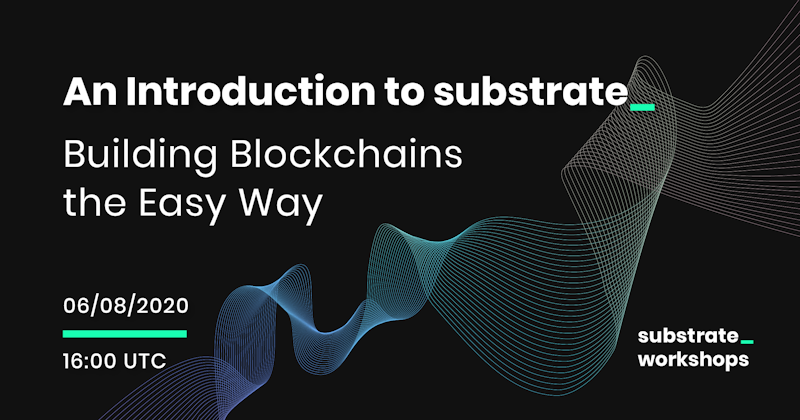
FREE WORKSHOP: Want to learn how to launch your blockchain the easy way?

Sign up for the online workshop on August 6th to experience Substrate building framework hands-on and see how you can build entire blockchains in minimal time!


Learn how Substrate makes it easy to encapsulate your domain-specific logic in just a few lines of code and include it in a running blockchain in about 30 minutes. 

A hands-on workshop

In this live technical workshop, you will learn how Substrate and its meta-framework "FRAME" makes it easy to build a custom blockchain that comes fully loaded with best-in-class cryptographic algorithms from the researchers at the Web3 Foundation. 

Workshop topics

  • the “Substrate and FRAME way” of thinking about blockchains
  • how to use FRAME to write custom blockchain logic in just a few lines of code
  • how to use Polkadot JS Apps UI and other ecosystem tools to interact with a Substrate-based chain
  • the Substrate-based chains that Parity hosts and how they can be used as developer resources

Who should attend

Blockchain developers who want to learn about the technical advantages of using Substrate for their blockchain solutions. No previous experience needed!

Speaker

Dan Forbes, Developer Advocate, Parity Technologies

Agenda (1 h)

  • Welcome to Substrate (15 min) 
  • Workshop - live content (30 min)
  • Q&A (15 min)

*****

About Substrate

Substrate comes with everything you need to build your blockchain. By using Substrate’s pallets you can easily create what you want, or craft your own custom logic. Either way, Substrate makes building a blockchain far faster, easier, and safer than ever before.

Start hacking!


Open Call: OPEC Fund Internship Program 2020 for University Student

Applications are open for the OPEC Fund Internship Program 2020. The OPEC Fund offers an Internship Program enabling students from diverse academic backgrounds to experience work with an international organization.

Deadline: October 1, 2020

Open Call: OPEC Fund Internship Program 2020 For University Students

Applications are open for the OPEC Fund Internship Program 2020. The OPEC Fund offers an Internship Program enabling students from diverse academic backgrounds to experience work with an international organization.

The Internship Program runs for between two and six months and is designed to:

  • Provide a framework to support students assigned to any OPEC Fund department so that the focus remains on enriching the student’s experience;
  • Provide an immersive experience so that students gain practical experience of working for an international organization; and
  • Provide the opportunity for students to understand the OPEC Fund’s vision, mission and related values.

Duties

Interns are assigned to different departments/units depending on their interests and qualifications, and according to departmental needs. The Internship Program offers opportunities to focus on one or more of the following: public sector operations; private sector and trade finance operations; grants; financial management; risk management; strategic planning and economic services; internal audit; human resources; administration; communication; legal services; and information technology.

Work assignments undertaken by interns may include:

  • Conducting research;
  • Writing documents;
  • Organizing information; and
  • Assisting employees with their day-to-day work.

Eligibility

Applicants must be between 19 to 25 years of age and enrolled in an undergraduate program (having completed at least two years) or graduate program. Alternatively, applicants may be recent graduates, having graduated a maximum of one year before the application deadline.

Applicants must be:

  • Proficient in English. Knowledge of an additional language (e.g. French, Spanish, Arabic) is an asset;
  • Computer literate in standard software applications (Microsoft Office);
  • Keenly interested in the work of the OPEC Fund;
  • Able to demonstrate cultural awareness; and
  • Able to demonstrate the OPEC Fund’s core values (Integrity, Empowerment, Excellence, Innovation, Community).

Application

Candidates must submit:

  • The online application form;
  • A Curriculum Vitae (CV);
  • A copy of their university diploma or equivalent, or an original letter of confirmation from a university/school certifying the applicant is / was an undergraduate student;
  • A copy of their most recent university transcripts, showing the cumulative GPA or equivalent; and
  • A short statement in English (about 150-250 words) outlining their motivation for applying.

Apply Now

Apply now: The NNPC/Seplat National Undergraduate Scholarship Programme 2020/2021 for young Nigerians

Seplat Petroleum Development Company Plc has announced the opening of applications for undergraduates in State and Federal Universities in Nigeria to qualify for its scholarship.
Application Deadline: August 7th 2020

APPLY: 2020 NPDC/SEPLAT National Undergraduate Scholarship For ...

Requirements

Applicants must be in their second year of study or above.
Applicants must have at least 5 O’ level credit passes (English and Mathematics inclusive) at one sitting.
Applicants must not hold any other scholarship award

Field of Study


Accountancy
Agriculture
Architecture
Business Administration
Chemical Engineering
Civil Engineering
Computer Engineering
Computer Science
Economics
Electrical / Electronic Engineering
Geology
Geophysics
Medicine
Law
Mass Communication
Mechanical Engineering
Metallurgical Engineering
Petroleum Engineering


Eligibility: 

  • Applicants must be in their second year of study or above.
  • Applicants must have at least 5 O’ level credit passes (English and Mathematics inclusive) at one sitting.
  • Applicants must not hold any other scholarship award

How to Apply: 

  • Eligible students must complete and submit an online application form
  • All applicants are expected to have a valid personal email account for ease of communication.
  • Only the shortlisted applicants will be contacted.
  • Applications are subject to Seplat JV Scholarship Award Terms and Conditions.

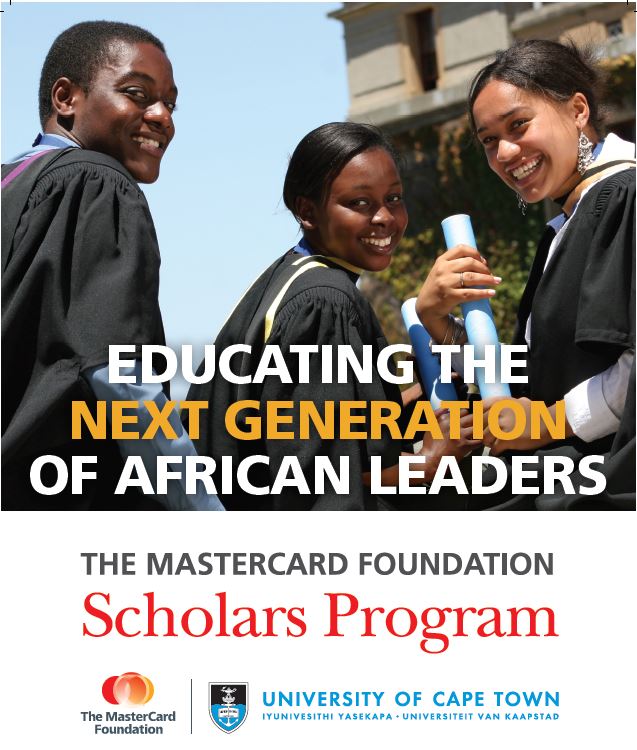
Apply now: University of Cape Town MasterCard Foundation Scholars Program 2020/2021 for study in South Africa (Fully Funded)

The MasterCard Foundation has partnered with the University of Cape Town (UCT) to oversee the implementation of financial, academic, social and post-graduation support to awarded candidates under the scholarship titled The MasterCard Foundation Scholars Program at the University of Cape Town. 

Application Deadline
:30th September, 2020 
https://bit.ly/3fhsCze

University of Cape Town MasterCard Foundation Scholars Program ...

Requirements

Academically talented, must value learning and be driven to complete their education.
Economically disadvantaged and facing significant financial barriers to accessing education.
Committed to giving back to their own communities once studies are completed, to return to their home countries and take a leadership role in promoting social and economic improvement.
Future leaders committed to embracing ethical leadership to improve the lives of others.
Commitment to community service through previous and/or past engagements with community outreach activities
Citizens and residents of a Sub-Saharan African country.

Benefits

. The scholarships will cover for the following:
• Reimbursement of costs incurred for visa application processing
• An economy class air ticket to Cape Town South Africa for awardees who are i) citizens and/or residents of an African country other than South Africa or ii) residing in South Africa but outside of Cape Town
• Full tuition fees and international student fees
• Accommodation in a student residence managed by the UCT Student Housing Admissions and Advocacy Services at UCT
• Meals through the student housing system at UCT
• Medical cover with a recommended medical aid service provider
• A living stipend; to be used to cover ad hoc expenses pertaining to awardees’ studies
• Costs related to community activities as prescribed by The Mastercard Foundation Scholars Program at the University of Cape Town

When Telecommunications Collapse: What Angola's Mobile Network Crisis Teaches Us About Governance, Justice, and National Security

  The recent disruption of Angola's mobile networks has affected banking, digital payments, businesses, emergency communications, and mi...