Translate

Tuesday, 24 May 2022

Australia’s new PM sworn in ahead of Japan summit

 Anthony Albanese has been sworn in as Australia’s new leader and will fly immediately to an international summit.

Mr. Albanese’s Labor Party defeated Scott Morrison’s conservative government in an election on Saturday.

It remains unclear whether Mr. Albanese will form a majority or govern with the support of cross benchers.

The prime minister left for Tokyo on Monday to meet the leaders of the so-called Quad nations – the US, India and Japan.

Earlier in the day, he was sworn in with four key cabinet members, including new Foreign Minister Penny Wong, who is travelling with him to Japan.


Richard Marles is the new deputy prime minister and employment minister, Jim Chalmers is treasurer, and Katy Gallagher is attorney-general and finance minister.


It is Australia’s first Labor government in almost a decade. The party has won 74 lower house seats but counting continues to determine whether they can get the 76 needed to form a majority.
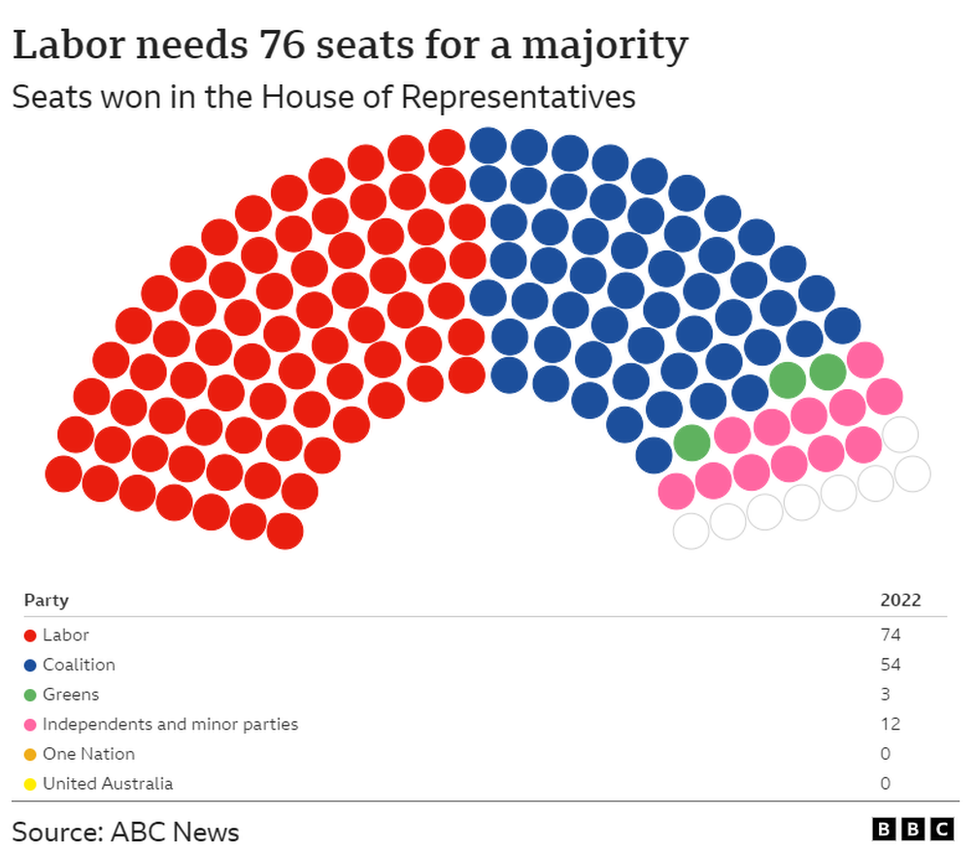
Chart showing seats won in the lower house of parliament

But the primary vote for both major parties fell – almost a third of Australians put the Greens, independents and other minor parties as their first preference.

The Quad group is seen as largely aiming to counter growing Chinese influence in the Indo-Pacific region.

It will meet on Tuesday following recent diplomatic tensions in the Pacific, after the Solomon Islands last month signed a security pact with China.

The US and Australia hold fears the deal could allow China to build a naval base there.

In a statement ahead of the meeting, Mr. Albanese said: “The Quad Leaders’ Summit brings together four leaders of great liberal democracies – Australia, Japan, India, and the United States of America – in support of a free, open and resilient Indo-Pacific.”

Ms Wong – Australia’s first overseas-born foreign minister – signalled they would bring “new energy and much more to the table” on climate action, after “a lost decade”.

Climate change played a huge role in the election result, with a surge in support for candidates wanting urgent action.

Mr. Morrison’s government had committed to a 2030 emissions reduction target of 26%-28% – about half that of the UK and US. Mr. Albanese’s government has a target of 43%.The Greens have picked up seats in Queensland, usually considered a conservative heartland

The Greens are expected to pick up four lower seats, adding to seven climate-focused independents. They could put pressure on Labor to take even stronger action, especially if it fails to reach a majority.

Mr Morrison’s unpopularity and his party’s stance on climate have been blamed by some Liberal MPs for wiping out their vote.

Losses included senior party figures, including deputy leader Josh Frydenberg, in traditional Liberal strongholds.

Mr. Morrison stepped down as party leader on Saturday and former defense minister Peter Dutton is the favorite to succeed him.

Mr. Dutton – from the party’s right – has been a controversial figure at times. Some question whether he could rebuild Liberal support in more progressive, metropolitan areas.

…………………………………………………………

Putin ‘Survived Assassination Attempt Two Months Ago’


Vladimir Putin survived an assassination attempt not long after starting his war in Ukraine, the country’s intelligence chief has claimed.


Kyrylo Budanov said Putin was ‘attacked.. by representatives of the Caucasus’ – a region that includes Armenia, Azerbaijan, Georgia and parts of southern Russia – around two months ago.

‘[It was an] Absolutely unsuccessful attempt, but it really happened… It was about 2 months ago,’ Budanov said. ‘I repeat, this attempt was unsuccessful. There was no publicity about this event, but it took place.’

If true, it would be the only known attempt on Putin’s life since he launched all-out war against Ukraine on February 24.

Budanov did not directly link the assassination attempt to the Ukraine war, and Putin has a number of well-established enemies in the region from previous conflicts.

He gave the order for Russian to invade Georgia in 2008 – a war that ended in an uneasy stalemate – and has been fighting a low-level conflict against Islamist insurgents including ISIS in the region for many years.

The security situation has also been destabilised in recent years by fighting between Armenia – a close ally of Russia – and Azerbaijan, which included a war over the disputed Nagorno-Karabakh region in 2020.

Hostilities along their shared border had ticked up in the early months of this year, just before Putin ordered the invasion of Ukraine in late February.

Putin is said to be fearful of assassination since declaring war, after hit squads were sent into Ukraine to take out President Zelensky in the early days of the conflict.

Read Full Story …. Dailymail.co.uk >>> :   

Source: Dailymail.co.uk

DNT News

………………………………………………………………

Monday, 23 May 2022

New EU-ACP agreement boosts relations among states

 Luanda - Angola's ambassador to the Kingdom of Belgium, Mário Constantino, on Friday considered historical and inclusive the new agreement of the Organisation of African Caribbean and Pacific States (OACPS), which is intended to boost trade and diplomatic relations among states.


Angola takes up the rotating presidency of this organisation in December, whose secretary-general is the Angolan Ambassador Georges Rebelo Pinto Chikoti.


Mário Constantino was speaking to the press, as the president of the working group of the Committee of Ambassadors in preparation for the 10th Summit of Heads of State and of Government of the OACPS  to take place in  December 6 to 10, in Luanda.


The Committee of Ambassadors, which included the Assistant Secretary-General of the OACPS, met with Angolan MPs members of the Commission of Foreign Affairs, International Cooperation and Angolan Communities Abroad.


The diplomat indicated that, for this summit, the existence of an information strategy is fundamental, deeming fruitful the meeting with MPs, "since the parliamentary activity is also one of the central elements of the OAPCS”, he stressed.


Historical Summit 

The ambassador considered the Luanda Summit historic since it marked the beginning of a new agreement between the states and a new partnership with the European Union (EU).


"Before we were a group, now we are a new international organisation and, during Angola's presidency, we will be able to implement this agreement and we aim for a new partnership with the European Union, with enormous advantages for the states", the Angolan diplomat disclosed.


Constantino added that the  new agreement gives another dimension to the organisation which is no longer a group but an international player with unavoidable challenges in international relations. 


The diplomat emphasised that the group of ambassadors has been working towards having a very representative and results-oriented summit, within the framework of Angola's three-year presidency.


The new agreement is a renewed partnership with the European Union, which already existed under the Lomé Convention.


"We are going to have a different partnership with the EU. For example, the European development funds will cease to exist and there will be new forms of programme financing and co-operation in the parliamentary framework it will also be different", he explained.


According to the diplomat, the new agreement has specific areas and one of them is sustainable development.


The deputy secretary-general of the OACPS, Norbert Richard Ibrahim, on his turn, said they interacted with Angolan MPs, in the context of the meeting of the Joint Parliamentary Assembly scheduled for October, in Maputo, Mozambique.


The Maputo meeting will play a sensitising role for the success of the 10th Summit of Heads of State and of Government of the EACP.


Norbert Richard Ibrahim is in Angola to participate in the Technical Preparatory Meeting of the Secretariat and the Working Group for the summit. 


The Organisation of African Caribbean and Pacific States (OACPS) is an association of 79 countries, formed to co-ordinate activities of the 1975 Lomé Convention (Togo).


All member states except Cuba are signatories to the Cotonou agreement, which replaced the Lomé conventions.

Angolan Head of State returns home from UAE visit

 Luanda – President João Lourenço returned to the country on Saturday from Abu Dhabi, United Arab Emirates (UAE), where he carried out a two-day working visit.


The Head of State was welcomed back, in Luanda’s 4 de Fevereiro International Airport, by the Vice President, Bornito de Sousa, and by members of his Executive.


In Abu Dhabi, João Lourenço had a meeting on Friday with the new UAE President, Mohammed bin Zayed Al Nahyan, with whom he discussed issues of bilateral interest.


The meeting took place in the Presidential Palace, and was also attended by the Angolan Foreign minister, Téte António, and the ambassador to that Middle-Eastern country, Albino Malungo.


This is President Lourenço’s third visit to the UAE.


Angola/UAE Co-operation


Angola and the United Arab Emirates hold co-operation relations in the sectors of oil and gas, minerals, trade, investment, energy, defence, transports, agriculture, fishery, banking, telecommunications, finance and in fiscal matters.    
 

A good example of the participation of UAE entrepreneurs in the Angolan economy is the tractors assembly plant located in the Special Economic Zone (ZEE) in Viana municipality, in Luanda.

Construction of Caraculo photovoltaic power plant kicks off

 Moçâmedes - The minister of Mineral Resources, Oil and Gas, Diamantino de Azevedo, laid Friday the first stone for the construction of the photovoltaic power plant that will produce 50 megawatts of electricity located in Bibala Municipality, south-western Namibe Province.


The project, being installed in the desert area of Caraculo, in two phases, is budgeted at over 30 million US dollars and has created 350 direct jobs for local youths.


The minister said the oil and gas sector is aware of its responsibilities as a pillar of the energy transition, so it will continue to need fossil fuels for decades to come.


"The hydrocarbon producing countries need to increasingly make that position clear at the world level, to prevent the increase of energetic poverty", the minister said.


He also pointed out that Sonangol (state-owned oil firm), with this project, demonstrates its strategy to transform itself into an energy company and not just staying with hydrocarbons.


The minister added that there are other ongoing projects, such as solar energy and bio-fuels to be implemented in Namibe Province.


"We are not carrying out these projects in an empirical way. As we don't want to bypass the transformation that our planet is experiencing, we created the sonangol development research center and expanded its social object", he explained.


The minister pointed out that the project will contribute to the sustainable development of the communities in the surrounding areas, which will benefit from social intervention, such as access to energy, water, education, and health.


In the first phase, the infrastructure, the first of its kind in Angola, will produce 25 MW of energy to benefit the Municipality of Moçâmedes.


The infrastructure is the first to rely on private investment and has benefits for the environment, reducing the emission of greenhouse gases and promoting savings of tens of millions of dollars in the replacement of fossil fuels currently used.


Sonangol's executive director, Baltazar Miguel, said the act symbolizes the first step of the company's entry into green energies and opens a new phase for the oil sector.


He explained that the choice of Namibe Province, specifically the town of Caraculo, was due to its high potential of solar irradiation.


The Caraculo photovoltaic plant is an additional source of electricity production for Namibe.


The governor of Namibe, Archer Mangueira, acknowledged that the production of this energy will contribute greatly to the process of electrification of the province.


"The main advantage of this project is that it will contribute to the sustainable development of our communities, which will have important improvements in their lives, with more and better access to water, health and education, in addition, of course, to electricity", he said.


He stressed that the project has national significance for the prosperity of the country and for the Angolan government, as it will contribute to the achievement of the objectives of the "Energy and Water Sector Action Plan 2018-2022".


On his turn, the managing director of the Italian oil company ENI, Adriano Mongini, stressed that the project will contribute to Angola's energy transition, in line with the goals set by the Angolan government for the sector, in accordance with the United Nations sustainable development goals.


"Eni is committed to an energy transition that is socially just and that, through tangible solutions, preserves the environment and provides everyone with access to the needed energy. As such, and as a Selanova shareholder, we are proud to be here today", he stressed.

Angola and United Arab Emirates discuss cooperation

 Luanda – Angolan President João Lourenço discussed Friday issues of bilateral interest with his United Arab Emirates counterpart, Mohammed bin Zayed Al Nahyan, during a meeting held in Abu Dhabi.


The meeting held at the Presidential Palace was attended by the Angolan minister of Foreign Affairs, Téte António, and the ambassador to the United Arab Emirates, Albino Malungo.


The information released Friday on the official Facebook page of the Presidency of the Republic of Angola did not add further details about the meeting.


Located in the Persian Gulf, the UAE is going through a transition period, after the death, this May 13, of the former President Khalifa Bin Zayed al Nahyan.


João Lourenço's visit to the United Arab Emirates ends Saturday.


Development of bilateral relations


Angola and the United Arab Emirates signed a reciprocal investment protection agreement in 2019, the starting point for the new phase of the cooperation.


The two countries have ratified a Convention to avoid double taxation and tax evasion, which came into force in March 2020, focusing on economic cooperation with an emphasis on transport, agriculture and industry.

World Bank foresees more economic improvements in Angola


Luanda – The World Bank (WB) foresees macroeconomic improvements at short term in Angola, stimulated by the rise in crude-oil price in the international market and the gradual recovery from the Covid-19 pandemic.

The World Bank report states that, in global terms, the macroeconomic reforms being effected by President João Lourenço are already yielding positive results.


Such results, reads the report, are visible in the non-oil economic activity, with a growth of 41 per cent in exports, in 2021. 


The oil sector, in Angola, represented a third of the Gross Domestic Product (GDP) and about 95 per cent of its exports.


It goes on to mention that in the past few years, macroeconomic balance supported by political stability has been safeguarded through a more flexible exchange rate regime, adequate monetary policy, fiscal prudence, and the rescheduling of the country’s debt with the main bilateral creditors.


In the ambit of the reforms, the WB highlights, in the economic field, the measures taken since 2017, which include the Law on Prevention and Combat to Money Laundering, Fiscal Responsibility Law, and the Law on Privatisations.


The document also mentions the financial regulations that have been taking place, coupled with the approval of a new Law on Financial Institutions, passed in May last year. The Central Bank (BNA)’s Organic Law was also underscored in the report, since a new legal tool was approved in 2021 which strengthened the institution’s autonomy.


The World Bank also commends the fact that the government instituted One-Stop Shops for Investors, aimed at improving the doing business environment.


In the political arena, the highlight went to the political stability which the country has been enjoying since the end of the civil war in the year 2002.


Such stability improves the near future prospects for the country, especially considering that Angolans are preparing for the general elections scheduled to happen in August this year.  

World Teachers’ Day 2026 - Dia Mundial dos Professores 2026

Standing with teachers: 60 years of protecting the profession, advancing its status and shaping our futures     On 5 October, we observed Wo...