Translate

Friday, 25 February 2022

Caribbean Community (CARICOM) “strongly condemns” Russia’s invasion of Ukraine


The Caribbean Community (CARICOM) strongly condemns the military attacks and invasion of Ukraine by The Russian Federation and calls for the immediate and complete withdrawal of the military presence and cessation of any further actions that may intensify the current perilous situation in that country. The recognition by The Russian Federation of the regions of Donetsk and Luhansk represents a violation of the territorial integrity and sovereignty of Ukraine.


The hostilities against Ukraine go counter to the principles of respect for sovereignty, territorial integrity, non-interference in the internal affairs of another sovereign state and the prohibition on the threat or use of force, and the peaceful resolution of disputes, which are the bedrock of this Community.

#CARICOM maintains that the principles of universal respect and adherence to these norms and principles of international law are fundamental to the maintenance of the international system and global peace and security.

CARICOM calls on all parties involved to urgently embark on intensified diplomatic dialogue to immediately de-escalate hostilities and work towards a sustainable peace.

CARICOM Secretariat

Georgetown, Guyana

24 February 2022

……………………………………………………………

Sturgeon calls for severe consequences for Russian assault

 Scotland’s first minister has called for the “severest consequences” for Russia’s military assault on Ukraine.


Nicola Sturgeon described the Russian air strikes and border breaches as “appalling and horrific”.

Ukraine says Russia has launched a “full-scale invasion” of what is Europe’s second largest country.

UK Prime Minister Boris Johnson has announced “the largest and most severe” package of economic sanctions to target the Russian economy.

Ukraine has declared a month-long state of emergency as Russia said it had carried out air strikes on Ukraine’s military infrastructure and border guard units – but said it had not targeted populated areas.

Russian military vehicles are reported to have breached Ukraine’s border in the north, south and east of the country, including from Belarus.

At least seven people have been killed by Russian shelling, while another 19 are missing, Ukraine has said.

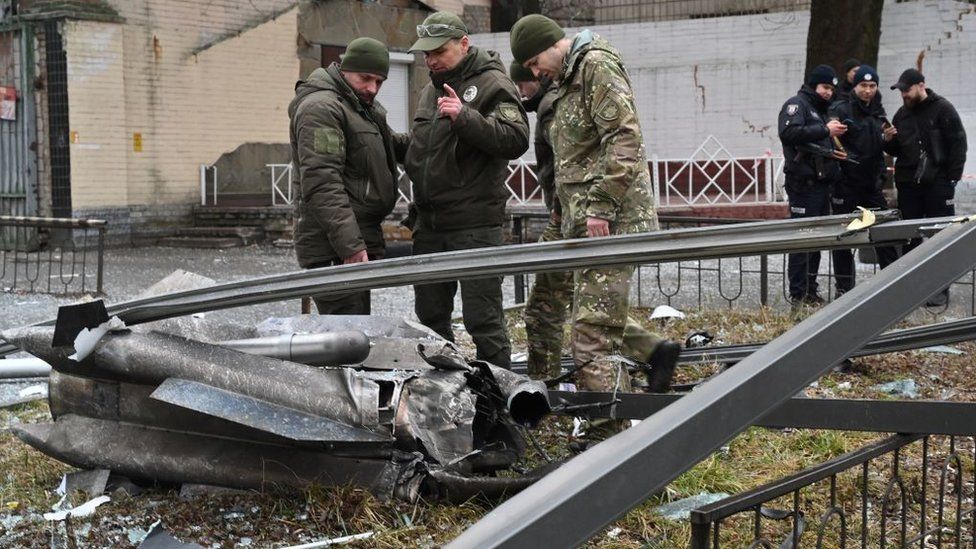
Police and security personnel inspect the remains of a shell in a street in Kyiv on February 24, 2022.
This shell landed in a street in Kyiv hours after Russia launched its attack

The Scottish Parliament unanimously passed a motion of solidarity with the Ukrainian people, after all party leaders voiced condemnation of Russia’s actions.

Ms Sturgeon said Mr Putin must face the “severest consequences”, with sanctions targeted against himself, Russian oligarchs, banks, energy and mineral companies.

She said the world “must now help and equip Ukraine to defend itself and resist Russian aggression”, while encouraging “anti-Putin forces” within Russia.

She said: “This is a clash between oppression and autocracy on one hand, and freedom and democracy on the other. We must make sure that freedom and democracy prevail.”

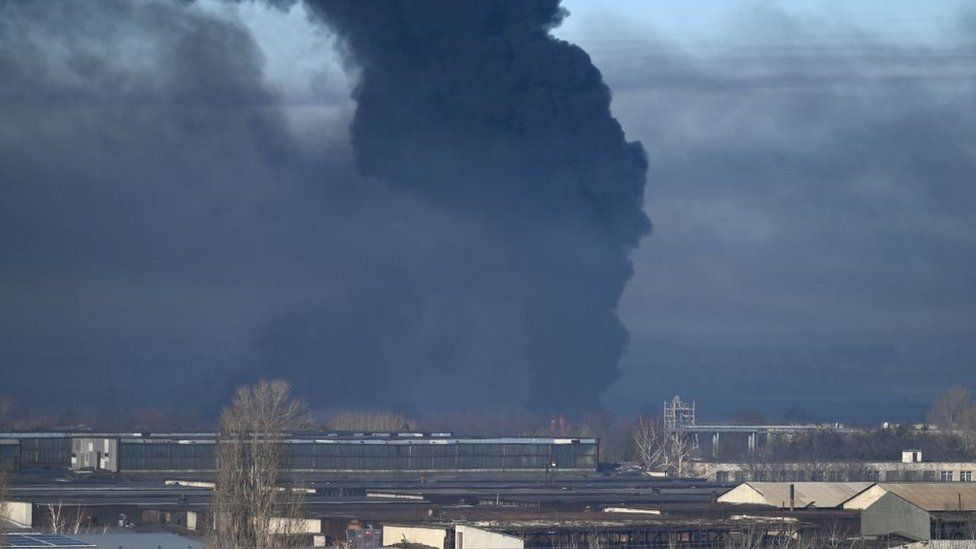
Black smoke rises from a military airport in Chuhuyev near Kharkiv on February 24, 2022
The military airport at Chuhuyev near Kharkiv was among those targeted

Scotland’s other party leaders echoed Ms Sturgeon’s comments, with Scottish Conservative leader Douglas Ross saying the world had woken up in a “far darker and most unstable place”.

Labour’s Anas Sarwar said Mr Putin should “pay a heavy price”, while calling for “urgent humanitarian assistance against the horrors of war” for people in Ukraine.

And Lib Dem leader Alex Cole-Hamilton noted that Ukrainian capital Kyiv is twinned with Edinburgh, saying that “we must be prepared to offer all of those fleeing the conflict safe harbour in the towns and villages of Scotland”.

line

Explosions are getting closer, I’m scared witless

Sean Cusick was speaking to BBC Scotland when he heard a tank approaching and ended the call

Sean Cusick from Glasgow, his wife and their two-year-old stepson are stranded in Ukraine with no way out.

The family are living near the Russian border in Kharkiv, where air strikes have destroyed the airport. They cannot afford food or rent and have relied on support from family.

They hope to scrape enough money together to travel to Poland and, eventually, the UK – but Sean said bureaucracy has prevented his Ukrainian wife from obtaining a valid passport or national ID.

Speaking to the BBC, Sean said: “I woke up to the house shaking and the sounds of distant thunder and explosions – I didn’t know what was happening.

“The sounds are getting much closer, I’m getting exceedingly more terrified.

“Even though I’m scared witless, I’m not in any current danger that I’m aware of – but that can change in a matter of seconds.”

Sean was forced to end the interview and go indoors as he heard the sound of a nearby tank.

Mr Johnson, in a phone call with Ukrainian President Volodymyr Zelensky, vowed the West “would not stand by as President Putin waged his campaign against the Ukrainian people”.

In a televised address to the nation, the prime minister said Vladimir Putin had “unleashed war in our European continent without any provocation and any credible excuse”, referring to the president as a “dictator”.

He added: “Our mission is clear – diplomatically, politically, economically and eventually militarily, this hideous and barbaric venture of Vladimir Putin must end in failure.”

He said all major Russian banks would have their assets frozen and be excluded from the UK financial system.

And Russian airline Aeroflot will also be banned from landing in the UK.

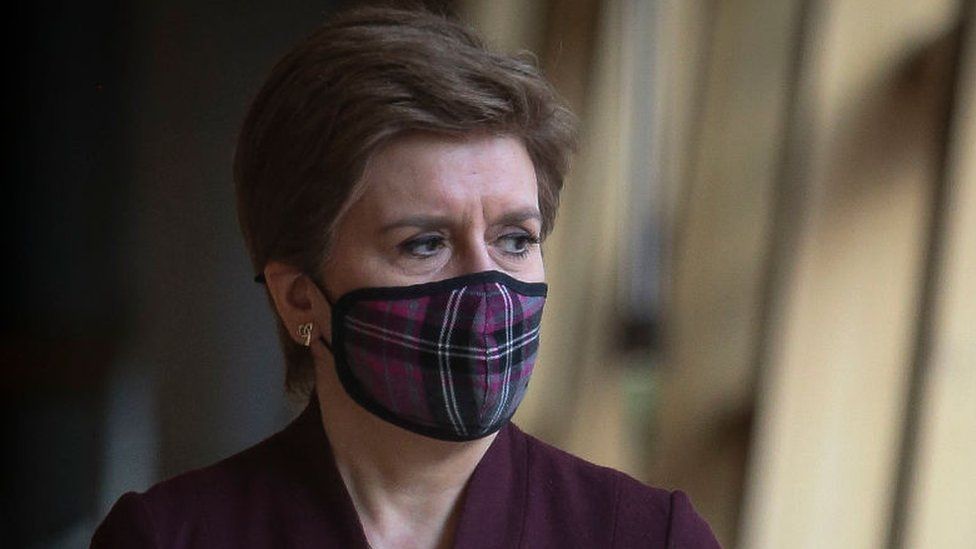
Nicola Sturgeon
Nicola Sturgeon said Vladimir Putin should be hit personally by sanctions

On Wednesday, Ms Sturgeon met the acting consul general of Ukraine, Yevhen Mankovskyi, and Linda Allison, the chairwoman of the Scottish branch of the Association of Ukrainians in Great Britain.

In the wake of those talks she urged the UK to impose tougher sanctions against Russia, saying while there had been “some very tough rhetoric from Boris Johnson” this now needed to be “matched by action”.

Meanwhile, former First Minister Alex Salmond has announced that he will be suspending his weekly TV show on Russian state broadcaster RT “until peace is re-established”.

Ms Sturgeon had criticised her predecessor for continuing to host the talk show, saying she was “appalled”, and urging him to “reflect” on matters.

The UK government has asked broadcast watchdog Ofcom to review the channel’s licence to air in the UK in light of the crisis in Ukraine.

Mr Salmond has always insisted he has total editorial control and RT’s deputy editor-in-chief, Anna Belkina, had earlier said she was sure the former SNP leader would not listen to “the inappropriate remarks of Ms Sturgeon”.

The programme did not air in its usual slot on RT on Thursday morning, but was posted in full on the broadcaster’s website and adverts for it continued to appear during rolling news coverage.

The weekly talk show is produced by Slainte Media, a firm set up by Mr Salmond and another former SNP MP, Tasmina Ahmed-Sheikh.

In a statement released on Thursday evening, Mr Salmond said: “The efforts of every single person should be to re-establish the peace.

“That certainly is our focus, and therefore Slainte Media have decided to suspend the Alex Salmond show until that can be secured”.

Meanwhile, supporters of Ukraine held a demonstration outside the Russian Consulate in Edinburgh.

The Church of Scotland has called on the UK government to work towards a ceasefire and “prepare a generous humanitarian response”, including preparing to resettle refugees from the conflict and support neighbouring countries to respond locally.

Lord Wallace, moderator of the General Assembly of the Church of Scotland, said: “Our prayers are with the Ukrainian people who are now under attack and in fear of their lives.”

………………………………………………………………

Thursday, 24 February 2022

EJN Research on Gender Inclusion Highlights Recommendations for Journalists and Media Outlets

 In December 2020, EJN began a research project to determine how journalists in Asia who have received grant support and mentorship from EJN include women in their reporting, or fail to do so. EJN worked with researchers in four countries – Pakistan, India, Indonesia and the Philippines – to assess how reporters think about gender and what kind of barriers they face when seeking to include women’s voices in their stories. Further, how do social and cultural views of women create challenges to inclusion?  


Researchers conducted dozens of interviews with journalists and experts about the barriers women face, both as journalists and as sources for the media. 

A few of the report’s key findings:  

  • Women are often seen as “less credible” sources than men. 
  • When pressed for time, journalists often don’t feel they can put in the effort to seek out new sources, returning to the same male-dominated lists.  
  • Women journalists face safety concerns that can make field reporting more challenging.  
  • Men still hold most leadership positions in newsrooms, leading to less awareness of the absence of women’s voices and/or a lack of support for reporters seeking to include women more.  
  • A pay gap remains between men and women journalists. 
  • There are often fewer prominent women experts, particularly in environmental fields or in high-level government positions. 
  • One common thread through all four countries was the role social and cultural norms play in terms of where women can go and who they can speak to, both as journalists and as sources. 

In India, EJN’s researchers learned from journalists how difficult it can be to find women experts in certain niche fields because women have historically been excluded from higher education. Other interviewees mentioned that women experts often must ask a supervisor for permission to speak and that traditional or generational wisdom, much of which is held by women, is not considered expertise. Another Indian interviewee, freelance journalist Aparna Karthikeyan, summed it up well: “I can’t sit in a bar like a man, I can’t walk into a panchayat [local government] meeting like a man.” 

The Gates’ Foundation’s “Missing Perspectives of Women in News” found only 14% of sources quoted in online news stories in India were women. (In the United Kingdom, which was the most gender inclusive of the six countries they considered, it was just 29%.) 

EJN’s report revealed journalists in Indonesia shared similar difficulties. Journalists struggle to find women leaders or experts to interview when reporting on forestry or mining issues in remote regions of the country. When they do interview women, it’s often as victims or members of affected communities, rather than as expert sources. One journalist, Tessa Toumbourou, highlighted the same challenge her Indian peers faced: “I know that women in the villages have a lot of experience and wisdom when it comes to dealing with environmental issues … However, their voices are not heard.” 


Women journalists, participating in an EJN workshop, interview local community members in Chidambaram, Tamil Nadu, India.


In Pakistan, this challenge was found to come into play as well. Two journalists, both men, reported to EJN that they find it difficult to interview women in remote areas of the country because of societal norms that discourage women from speaking to strangers. In both Hindu and Muslim communities in the country, women observe purdah – seclusion from strangers and/or men – in different ways. Some may cover up entirely around strangers of any gender, while others may show their faces to unknown women but not men. Navigating these differences, especially when on deadline, can be a considerable challenge.  

In the Philippines, the journalists interviewed once again cited difficulties finding women experts as a major obstacle to including more women sources in their stories. One journalist, Leilani Chavez, noted that men tend to respond quicker to her interview requests than women: “Women sources have more clarifications and considerations before they agree to interviews. They want to make sure they are the right person to be quoted.” 

Overall, the report reiterates that more work needs to be done to advance gender equality in the media and presents a dozen recommendations for how EJN and other organizations can support journalists in making their work more gender balanced. Here are just a few: 

  • Create databases of women experts by country and field.  
  • Support gender sensitivity and awareness trainings for journalists and editors to increase the number of women quoted and the number of high-ranking women journalists in newsrooms. 
  • Support media engagement trainings that focus on ways to make women sources feel more comfortable interacting with journalists.  
  • Train journalists and media outlets on the ‘expertise gap,’ to recognize the value of traditional and/or generational wisdom as a form of legitimate expertise.  

The findings expand upon a pilot study EJN conducted as part of Reflect Reality, a methodology Internews launched in 2019 to increase women’s visibility in the news media.  

EJN will continue to support journalists in our network to include more women’s voices in their reporting and expand our efforts to help women journalists stay safe and advance in their careers despite the barriers they face.  

Download the full report. 

To read more about Reflect Reality, Internews’ methodology for increasing women’s visibility in the news media, go to their website

Banner image: Women reporters from the Indigenous Mentawai community in Indonesia participate in an EJN-supported training on video journalism. 


A related report on women’s under-representation in the media, funded by the Bill and Melinda Gates Foundation in 2020, studied the news landscape in six countries and concluded: “News is produced mainly by men, featuring more men and is consumed by more men.”

Wednesday, 23 February 2022

Five Russian banks and three high-net worth individuals targeted in UK sanctions on Moscow


The UK is sanctioning five Russian banks and three wealthy individuals, freezing their UK assets and banning travel to Britain, Boris Johnson has announced.


The prime minister told the House of Commons it was the “first tranche” and “first barrage” of measures, in response to Russian troops moving into two separatist regions of Ukraine.

“We hold further sanctions at readiness to be deployed,” Mr Johnson told MPs, as he warned of a “protracted crisis” un Ukraine.

The PM addressed the Commons after chairing a meeting of the government’s emergency COBRA committee at 6.30am this morning.

Mr Putin on Monday night recognised two breakaway areas of eastern Ukraine as independent states and ordered Russian forces to carry out ”peacekeeping” duties in the Donetsk and Luhansk regions.

Mr Johnson warned that Russian President Vladimir Putin was” bent on a full-scale invasion” of Ukraine.

The PM said Russia and Mr Putin had now “plainly” violated Ukrainian sovereignty and “completely torn up international law”.

Downing Street said the UK’s new sanctions against Russia were part of a “coordinated” approach to the Ukraine crisis together with the US and EU.

On Tuesday, Germany announced it had halted the approval of the Nord stream 2 gas pipeline, which runs under the Baltic Sea from Russia to Germany, in response to Mr Putin’s actions over Ukraine.

The PM has frequently urged European economies to end their reliance on Russian gas and oil.

Russia’s ambassador to the UK was summoned to the Foreign Office on Tuesday morning.

……………………………………………………………

Al-Shabab spent $24m on weapons last year – report


Somalia’s militant Islamist group al-Shabab spent $24m (£18m) in 2021 on purchasing weapons, according to a report by a Mogadishu-based research group, the Hiraal Institute.


The report further alleges that al-Shabab, which is affiliated to al-Qaeda, has an annual revenue collection of about $180m.

Entitled Al-Shabab’s Arsenal – From Taxes to Terror, the report says the group uses various methods to procure weapons, including direct purchases from local black markets, and from arms traders contracted to buy and deliv­er weapons from abroad, mainly Yemen.

The Hiraal institute also says that the insurgents control large parts of Somalia and maintain a degree of influence on the populace through a mix of persuasion, administration and coercion.

The authors recommend several measures aimed at disrupting al-Shabab’s weapons acquisition and movement, including countering arms imports from the Gulf of Aden.

……………………………………………………………

Nigeria seizes tonnes of hides on sale as food


Nigerian authorities say they have seized 120 tonnes of imported animal hides and skins in Lagos city.


They were intercepted on suspicion that were already processed with chemicals for use in leather industries yet they were being sold as foodstuff, the national food and drug agency, Nafdac, said.

In Nigeria, cow hides are cooked as a popular delicacy known as “ponmo”.

It’s not yet clear from which countries they were imported from.

Nafdac said seven suspects have been arrested.

It added that the raids on warehouses were carried out following “several complaints” by members of the public regarding the distribution and sale of such products it described as dangerous.

…………………………………………………………

Death has forgotten me – Woman who witnessed First World War


“I want to die because I am tired and weak. Others are working all I do is sleep the whole day, yet I want to eat. I think death has forgotten me,” am tired 106-year-old woman has said.


Euphrasie Kanyundo is reminding death of her long existence.

Having witnessed the First World War, said she has enjoyed the full capacity of life on her own terms and she wants death to embrace her as soon as possible.

Though she is not unhappy in life as she is surrounded by a host of descendants who take care of her, she said her frail state makes it uneasy for her to enjoy life like she used to.

The aged African grandmother told Afrimax TV that she is tired of living her life like a baby; being lifted about and having to crawl on her butt.

However, she is physically healthy and still has a couple of teeth sticking out of her gums.

If death fails to approach in the coming days, Euphrasie Kanyundo fears she will have to break the heart of her children with her last option; suicide.

Her last child, who is also in his sixties, has taken it upon himself to keep watch on his mother, to prevent her from taking her own life.

Unlike the ordinary human who detests the sound of death, Euphrasie said she becomes excited whenever she witnesses a funeral in her community as she is hopeful she would be the next.

Having buried eight of her 10 children who passed on after experiencing the greying stage, she said her time to exit the world is long overdue.

…………………………………………………………

When Telecommunications Collapse: What Angola's Mobile Network Crisis Teaches Us About Governance, Justice, and National Security

  The recent disruption of Angola's mobile networks has affected banking, digital payments, businesses, emergency communications, and mi...