Translate

Wednesday, 24 November 2021

Ethiopia’s Haile Gebrselassie and Feyisa Lilesa ready to join Tigray war

 Ethiopian Olympic heroes Haile Gebrselassie and Feyisa Lilesa say they are ready to go to the front line in the war against rebel forces.


Their announcement comes after Prime Minister Abiy Ahmed said he would go to the front to lead the war.

Tigrayan rebels say they are advancing towards the capital Addis Ababa.

Germany and France have become the latest countries to advise their citizens to leave Ethiopia, amid an escalation in the civil war.

On Tuesday, US envoy to the region Jeffrey Feltman warned that tentative diplomatic progress towards ending the conflict was being jeopardised by alarming developments on the ground.

The rebels earlier this week said that they had taken control of Shewa Robit, a town about 225km (140 miles) north-east of Addis Ababa. There is no independent confirmation of the claim.

With Mr Abiy gone to direct the war effort, his deputy, Demeke Mekonnen Hasse, had taken charge of routine government business, a spokesman was quoted by state-linked media as saying.

Mr Abiy’s announcement has bolstered recruitment for the army, with hundreds of new recruits attending a ceremony, marked by patriotic songs, in Addis Ababa on Wednesday.

Earlier, Gebrselassie, 48, was quoted by state television as saying: “I am ready to do whatever is required of me, including going to the front line,” he said.

Gebrselassie is regarded as a legend in Ethiopia, and his comments were seen as an attempt to rally public support behind the war effort.

During his 25-year career as an athlete, he claimed two Olympic gold medals, eight World Championship victories and set 27 world records. He announced his retirement from competitive running in 2015.

Expressing his support for the war, Feyisa, 31, was quoted by the state-affiliated Fana Broadcasting Corporation website as saying that he was ready to draw inspiration from the “gallantry of my forefathers” and go to the front line to “save my country”.

The athlete won the marathon silver at the 2016 Rio Olympics.
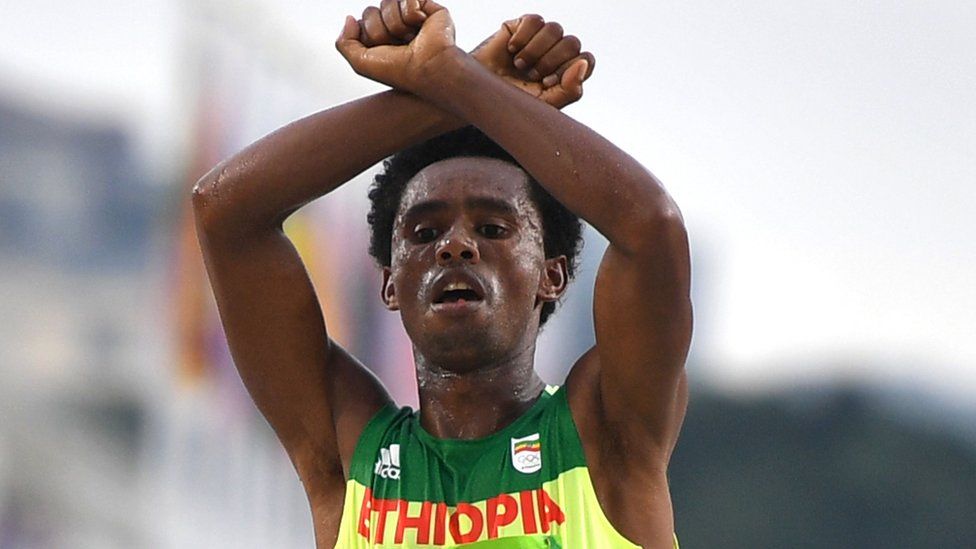
Ethiopian runner Feyisa Lilesa making a Oromo protest gesture at the OlympicsIMAGE SOURCE,AFP
Image caption,

Feyisa Lilesa made the protest at Rio 2016 as he took silver in the marathon

He became famous for holding up his crossed wrists as if they were shackled to draw global attention to the crackdown on demonstrators demanding political reforms in Ethiopia.

The Tigray People’s Liberation Front (TPLF) was the dominant party in government at the time. Following the protests, Mr Abiy became prime minister and the TPLF lost the grip on the country it had held for 27 years.

It later retreated to its stronghold of Tigray, from where it launched a rebellion last November after a huge fall-out with Mr Abiy over his reforms.

The war has created a massive humanitarian crisis, leaving thousands dead, forcing millions from their homes, and several hundred thousand in famine-like conditions as aid agencies battle to get food in war-affected areas.

The African Union is leading efforts to find a negotiated end to the fighting, but neither side has committed to talks.

The TPLF are advancing towards Addis Ababa on the A2 highway, having previously said they had taken Kemise.

Analysis box by Andrew Harding, Africa correspondent

The prospect of some of Ethiopia’s most venerated sporting figures heading to the front lines to fight captures something profound and powerful about the mood in Addis Ababa and beyond.

At a time of intense crisis, many Ethiopians are clearly rallying behind their flag and prime minister, and are keen to play their part in galvanising public support for a military campaign that has suffered undeniable setbacks in recent months, though much remains in dispute in terms of casualty figures and battlefield momentum.

It is clear many people see the military threat posed by the TPLF and their assorted allies as an existential one for Ethiopia.

Added to that is a profound dislike of the TPLF itself, which stems from its decades heading an authoritarian national government. But there is more to it than that.

The prime minister has sought to portray his country as a victim, not just of Tigrayan aggression, but of a vast international conspiracy designed to weaken Ethiopia and punish it for, allegedly, challenging Western colonial interests on the continent.

Western media are portrayed as enthusiastic backers of that conspiracy theory – one which appears to have gained widespread credibility in a country struggling to explain how the rebel group could have made such startling headway.

More on the Tigray crisis:
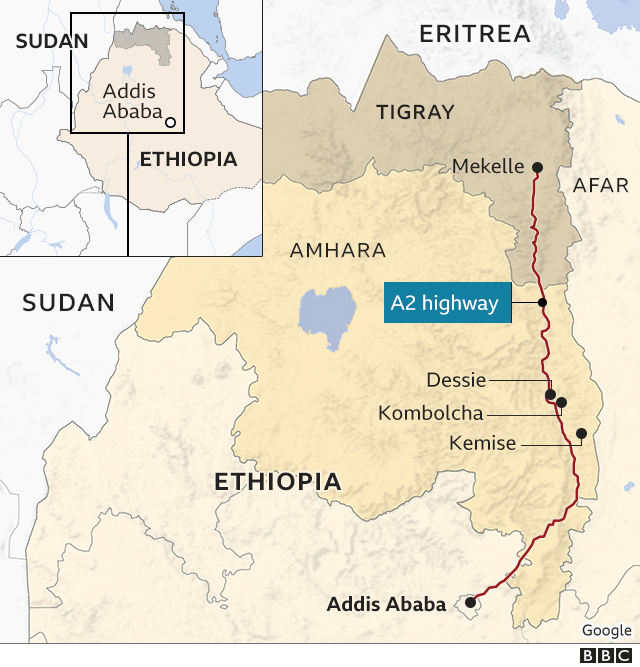
Map of Ethiopia

……………………………………………………………

Gun makers ask US court to dismiss Mexico’s claim for damages

 Gun manufacturers have urged a US court to dismiss a Mexican lawsuit that holds them responsible for the violence inflicted by drug cartels.


Mexico is seeking billions in damages, accusing manufacturers of facilitating the illegal trafficking of weapons.

The firms, including Smith & Wesson, argue their sales are constitutionally protected in the US, calling Mexico’s lawsuit a “clash of national values”.

In 2019 alone, some 17,000 murders in Mexico were linked to trafficked arms.

Mexico’s strict rules on arms sales mean they can only be purchased legally at one shop in Mexico City.

Mexico says criminal organisations therefore buy thousands of weapons in the US. A US department found that some 70% of firearms recovered in Mexico between 2014 and 2018 had come from the US.

Mexico’s lawsuit accuses some of the biggest gun manufacturers of knowingly contributing to illegal arms trafficking and fuelling bloodshed through reckless business practices.

It said the companies had sold “ever-more lethal” weapons without “mechanisms of security or traceability”.

On Monday the gun makers, including Glock, Colt’s and Baretta, said in a motion to dismiss that their firearms were purchased lawfully in the US and that the sales were protected by the US constitution.

They argued they had no responsibility for protecting Mexican residents or for the actions of third parties who had bought the guns.

The firms said that while Mexico had acted to eliminate private gun ownership, the US recognised the right to keep and bear arms, and that Mexico could not apply its gun laws across borders.

They said Mexico was seeking to “bankrupt US gun makers” and the lawsuit “threatens America’s constitutional freedoms”.

The lawsuit was filed by Mexico in August in the US state of Massachusetts.

Several Mexican governments have in the past urged the United States to halt illicit trafficking of firearms.

…………………………………………………………

Low wind speeds and Covid slow Scotland’s economic growth

 Low wind speeds powering wind turbines and Covid absences from school contributed to a slowdown of economic growth in September.


The latest estimated Scottish government figures show output across the economy rose by 0.4% across the month.

That was helped upwards by the dominant services sector, which accounts for around three-quarters of the economy.

It was up 0.5%, while construction also returned to growth.

However, the production sector fell 0.9% – and 3.7% over the July to September quarter, much of that due to lower electricity generation.

Total output in September remained 1.1% percentage points below the peak pre-pandemic output level.

Scottish economic recovery to September was slightly weaker than the UK’s, which saw September growth of 0.6%, putting it 0.6 percentage points behind the peak reached in February 2020.

‘Experimental’ figures

Finance Secretary Kate Forbes and Scottish Secretary Alister Jack welcomed the figures.

Ms Forbes said: “These latest GDP figures underscore Scotland’s continuing economic recovery from coronavirus.”

She pledged the forthcoming Scottish budget would help households and businesses across the country, and would also see the launch of a strategy to create green, fair and sustainable jobs over the next decade.

The finance secretary added: “Challenges remain, but the indicators show we are in a strong position from which to drive Scotland’s economic recovery and renewal.”

Mr Jack said: “Economic activity levels in Scotland and the UK more widely are moving in the right direction but there is much more to be done as we recover from the pandemic.

“That’s why we are levelling up right across the UK.”

He said this will be helped by the announcement of £41bn per year for the Scottish government in the autumn budget.

Mr Jack added: “We remain focussed on a sustained recovery.”

Estimates for Scottish output, or Gross Domestic Product, during July and August were revised downwards by government statisticians. That means the third quarter of the year saw only modest growth of 0.8%.

That was a sharp fall in growth since the second quarter – April to June, at 5.6% – when businesses and education were reopening as the winter lockdown was eased.

The September figures are so far classified as “experimental”, meaning they are the first estimate.

The Scottish figures do not include offshore oil and gas production.

……………………………………………………………

Apple sues Israeli spyware firm NSO Group

 Apple is suing Israeli spyware firm NSO Group and its parent company for allegedly targeting iPhone users with a hacking tool.


NSO’s Pegasus software can infect both iPhones and Android devices, allowing operators to extract messages, photos and emails, record calls and secretly activate microphones and cameras.

NSO Group said its tools were made to target terrorists and criminals.

But it has allegedly also been used on activists, politicians and journalists.

NSO Group says it only supplies Pegasus to military, law enforcement and intelligence agencies from countries with good human-rights records.

However earlier this month, US officials placed the company on a trade blacklist, saying the software had “enabled foreign governments to conduct transnational repression, which is the practice of authoritarian governments targeting dissidents, journalists and activists”.

Apple’s move follows a lawsuit launched in 2019 by WhatsApp which is still working its way through the US court system.

In its initial court filing, WhatsApp said NSO Group “developed their malware in order to access messages and other communications after they were decrypted on target devices”.

Other tech firms, including Microsoft, Meta Platforms (formerly Facebook), Google-owner Alphabet and Cisco Systems have all previously criticised NSO.

In a blog post announcing the California lawsuit, Apple said it wanted to hold NSO Group and its parent company OSY Technologies “accountable for the surveillance and targeting of Apple users”.

“To prevent further abuse and harm to its users, Apple is also seeking a permanent injunction to ban NSO Group from using any Apple software, services, or devices,” it said.

2px presentational grey line
Analysis box by James Clayton, North America technology reporter

Apple prides itself on its privacy. It’s a major selling point for its devices.

So it’s not totally surprising that a company that has allegedly sought to bypass Apple security features might antagonise the giant.

That’s not the only reason Apple is making a stand though.

Not all hackers are considered equals. NSO Group has government clients, or as Apple puts it, is “state-sponsored”.

NSO claims it only works with agencies with good human rights records.

In that way the company has tried to distinguish itself from underground hackers doing nefarious activities.

By suing NSO Group Apple is rejecting that distinction.

Apple is making the point that it doesn’t matter who you are, if you’re a group trying to hack into an Apple product they’ll take action – whatever the motives.

But there’s a bit more depth to it than that.

Apple will feel it’s easier, and more politically palatable, to sue a private company, rather than the governments who are allegedly using the tech.

2px presentational grey line

In its complaint, filed in the US District Court for the Northern District of California, Apple said NSO’s tools were used in “concerted efforts in 2021 to target and attack Apple customers” and that “US citizens have been surveilled by NSO’s spyware on mobile devices that can and do cross international borders.”

Apple alleged that NSO group created more than 100 fake Apple ID user credentials to carry out its attacks.

The tech giant said that its servers were not hacked, but that NSO misused and manipulated the servers to deliver the attacks on Apple users.

Apple also alleged that NSO Group was directly involved in providing consulting services for the spyware, but NSO maintains that it only sells its tools to clients.

Apple said it was forced to engage in a continual arms race with NSO, saying the Israeli firm was “constantly updating their malware and exploits to overcome Apple’s own security upgrades”.

The iPhone maker said that it will donate $10m, as well as any damages recovered in the lawsuit, to cybersurveillance research groups including Citizen Lab, the University of Toronto group that first discovered NSO’s attacks.

NSO Group said in response: “Thousands of lives were saved around the world thanks to NSO Group’s technologies used by its customers”.

“Paedophiles and terrorists can freely operate in technological safe-havens, and we provide governments with the lawful tools to fight [them].

“NSO group will continue to advocate for the truth.”

…………………………………………………………

A Ciência e a Inteligência Artificial estão a dar vida às memórias!

A Inteligência Artificial já consegue transformar fotografias antigas em experiências visuais surpreendentes Hoje, testemunhamos como a ciên...

