Translate

Wednesday, 10 November 2021

Ahmaud Arbery: What do we know about the case?


The trial is beginning of three men accused of killing a black jogger last year in broad daylight in the US state of Georgia, and the community at the heart of the racially charged case is on tenterhooks.

Ahmaud Arbery was shot on 23 February 2020 in a confrontation with Gregory and Travis McMichael. It took more than two months for the men to be arrested, along with the neighbour who filmed the death.

Lawyers for Mr Arbery’s family have called his death a “modern-day lynching”. The McMichaels argue that they were defending themselves while trying to make a “citizen’s arrest”.

Mr Arbery’s mother tells BBC News that she plans to attend every day of the trial, in honour of her son.

Here’s what we know so far.

Who is on trial?

Gregory, 64, and Travis McMichael, 34, and William Bryan – a neighbour who filmed a video of the confrontation – were arrested in May last year. They each face nine charges, including murder and aggravated assault. They have pleaded not guilty.

The case is expected to scrutinise whether the men’s actions were motivated by racism.

Prosecutors allege that Travis McMichael used a racial epithet and an expletive directed at Mr Arbery as he lay on the ground. The men deny racism.

Lawyers for the McMichaels last month asked a judge to ban mention of a decal on their car of the Confederate flag, which was flown by the pro-slavery southern states during the US Civil War. The men said it would be “prejudicial” to the jury, but failed to convince the judge, who said jurors could interpret it “in any way they deem appropriate”.

Travis McMichaelIMAGE SOURCE,GETTY IMAGES
Image caption,

Travis McMichael seen in court during jury selection

How did Arbery die?

Mr Arbery was out for an afternoon jog in the coastal city of Brunswick.

A neighborhood resident, Gregory McMichael, told police he believed Mr Arbery resembled the suspect in a series of local break-ins. Police have said no reports were filed regarding these alleged break-ins.

Gregory McMichael and his son, Travis, armed themselves with a pistol and a shotgun and pursued Mr Arbery in a pickup truck through the neighborhood.

According to the elder McMichael, he and his son had said “stop, stop, we want to talk to you”.

Joggers out in solidarity with the killed 25-year-old

He said Mr Arbery then attacked his son. Lawyers for Mr Arbury’s family have said the 25-year-old was unarmed.

Three shots were fired and Mr Arbery fell down on the street.

A post-mortem examination showed Mr Arbery had two gunshot wounds in his chest, and a gunshot graze wound on the inside of one of his wrists. He did not have drugs or alcohol in his system.

What is the latest in the case?

Jury selection finished at the beginning of November, with only one black member on the 12-person panel. Prosecutors have alleged that the defence team sought to illegally bar ethnic minorities during the selection period.

In cases involving issues such as racism, the selection process can be seen as hugely important to the outcome of the trial and how fair it is perceived. A lack of diversity could lead to questions about the legitimacy of the verdict.

Ahead of opening arguments, Greg McMichael’s lawyer told BBC News that the defence will hinge on a two-part strategy: citizen’s arrest and self-defence.

“They got in the truck to pursue Mr Arbery for the purpose of detaining him long enough for the police to arrive to take over and investigate whether in fact he had committed any crimes,” said lawyer Franklin Hogue.

“That turned from a citizen’s arrest into self-defence.”

On 8 November, the jury saw footage from police body-worn cameras in the moments just after Mr Arbery was killed. Prosecutors used the video in court in an effort to undermine the defence’s argument that the three men were simply trying to detain Mr Arbery.

“You had no choice,” the elder McMichael is heard telling his son, Travis, as the first officer approaches. Mr Arbery is shown on the ground, bleeding, just a few steps away.

The footage also shows neighbour William Bryan speak to police, and tell an officer that Mr Arbery had looked tired from the chase before he was shot dead.

“When I rounded the corner out there, it was almost like the black guy was tired of running,” he said.

Why has the case been delayed?

The case is currently on its fourth prosecutor.

Two local district attorneys had earlier recused themselves due to professional connections to the elder Mr McMichael – a former police detective and private investigator.

Brunswick District Attorney Jackie Johnson – whose office initially handled the case – was charged in September with violating her oath of office and obstructing the arrest of the McMichaels immediately after the shooting. She has denied any wrongdoing.

The second district attorney involved, Waycross Circuit District Attorney George Barnhill, had told police he believed the father and son had used citizen’s arrest rights in confronting the jogger, and that as a result there were no grounds for arrest.
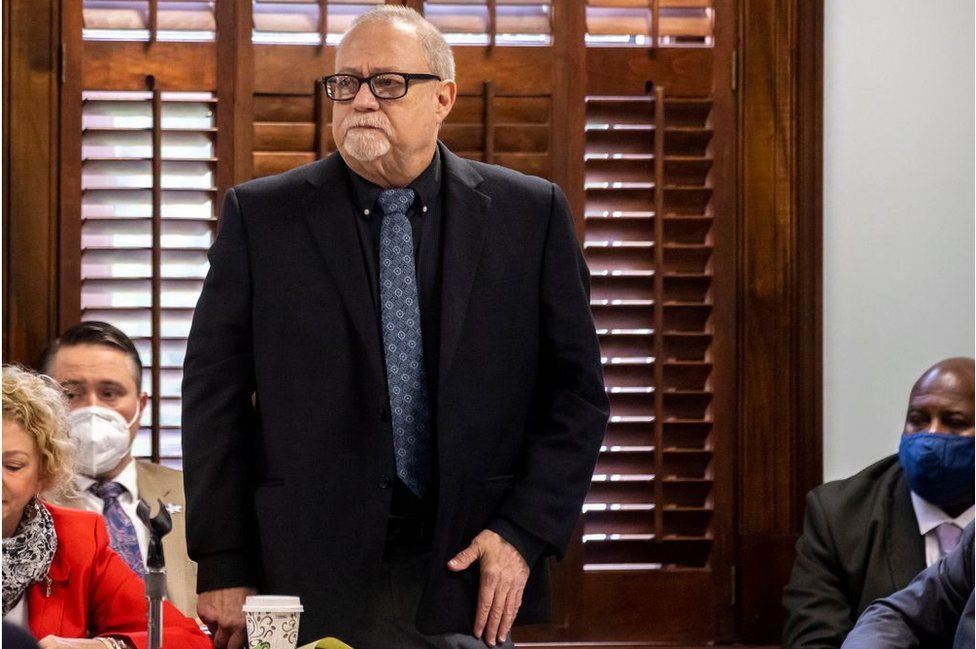
Greg McMichael has ties to local law enforcementIMAGE SOURCE,GETTY IMAGES
Image caption,

Greg McMichael has ties to local law enforcement

Mr Barnhill recused himself, citing concerns raised by the victim’s mother over his ties to Mr McMichael.

Mr McMichael had previously been involved in an investigation of Mr Arbery, according to a letter written by Mr Barnhill.

Who was Ahmaud Arbery?

A former star high school football player, his father said he often exercised in the area.

His family has described him as a good, generous young man with a big heart.

Demonstrators watch a parade of passing motorcyclists riding in honour of Ahmaud ArberyIMAGE SOURCE,GETTY IMAGES
Image caption,

Demonstrators watch a parade of motorcyclists riding in honour of Ahmaud Arbery

When Mr Arbery was in high school, he received five years of probation for a first-time weapons charge and in 2018, was convicted of probation violation for shoplifting, according to the Atlanta Journal-Constitution newspaper.

It emerged that, in 2017, a Glynn County officer attempted to tase him after he denied their request to search his car at a park.

Police bodycam footage showed the encounter with officers, who said he was in a car in an area known for drug use. He said he was on his day off from work. The taser malfunctioned and he was allowed to leave on foot.

What is the footage in the case?

The first video surfaced publicly on 5 May 2020. The 36-second clip was filmed from a vehicle following Mr Arbery.

It shows Mr Arbery jogging, and approaching a stationary pickup truck which is ahead of him on the road.

He tries to bypass the truck and then is seen struggling with a man carrying a shotgun. There is muffled shouting and three gunshots are heard.

A second man is standing in the bed of the pickup. The second man is then shown with a pistol standing alongside the other armed man with the jogger no longer in view.

The clip – which sparked nationwide outcry swiftly followed by criminal charges – was leaked at the behest of Gregory McMichael because he thought it would make him and his son look better, according to WSB-TV in Atlanta.

On 10 May 2020, another video emerged, showing a man believed to be Mr Arbery at a home construction site shortly before the shooting.

In the footage from a surveillance camera, a black man in a white T-shirt walks on to the site and is seen looking around for a few minutes before leaving and jogging down the street.

Mural saying Welcome to Brunswick Georgia with police cars in frontIMAGE SOURCE,GETTY IMAGES

Lee Merritt, an attorney for Mr Arbery’s family, said in a statement that it was Mr Arbery in the clip, and that it confirms the young man was out for a jog and did nothing illegal.

Who is William Bryan?

Police arrested William “Roddie” Bryan, who filmed the first video, two weeks after the McMichaels. Mr Bryan, along with the two McMichaels, appeared to have been following Mr Arbery “in hot pursuit”, according to a memo by Mr Barnhill.

He is also mentioned in the Glynn County police report of the shooting, in which officers noted that Mr Bryan had unsuccessfully tried to block Mr Arbery’s path. Prosecutors say he was attempting to “confine and detain” Mr Arbery.

However, Mr Bryan told a local TV station that he “had nothing to do with it” and was in “complete shock”.

He did not answer questions on why he was there or why he started recording, but his lawyer said: “My client was responding to what he saw, which was someone in the community he didn’t know being followed by a vehicle he recognized.”
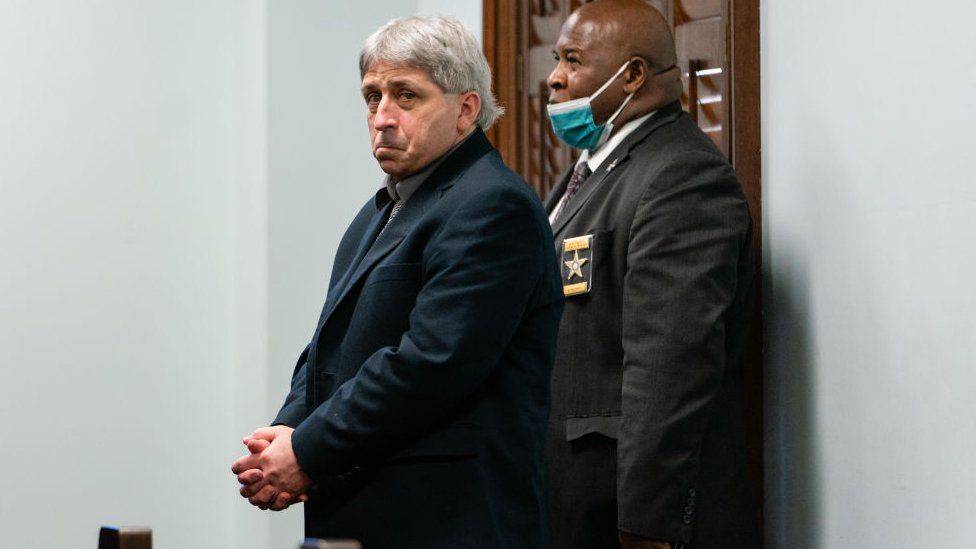
William Bryan Jr is being kept in the same jail as the McMichaels as they await trialIMAGE SOURCE,GETTY IMAGES
Image caption,

William Bryan Jr is being kept in the same jail as the McMichaels during the trial

In a CNN interview, Mr Bryan said he was praying for the Arbery family and hoped his tape would help bring closure.

“If there wasn’t a tape, then we wouldn’t know what happened,” he said. “I hope that it, in the end, brings justice to the family and peace to the family.”

What do we know about the burglary claims?

Around the time of the incident, a number of emergency calls were made, CBS News has reported. In one, a neighbour said a black man was seen at a home under construction before later “running down the street”.

The dispatcher says: “I just need to know what he was doing wrong. Was he just on the premises and not supposed to be?”

The caller replies: “He’s been caught on the camera a bunch before at night. It’s kind of an ongoing thing out here.”

A neighbour told CNN that cameras on his property recorded a man that appeared to be Mr Arbery “trespassing” on 23 February 2020.

A lawyer for the homeowner later said it’s their belief that Mr Arbery had been looking for water. Security footage shows he was not the only person to enter the construction site – children from the neighbourhood were also filmed playing there.

Travis McMichael had also previously called 911 to report seeing a “black male, red shirt and white shorts”.

“When I turned around and saw him and backed up, he reached into his pocket and ran into the house,” Mr McMichael told the police. “So I don’t know if he’s armed or not. But he looked like, he was acting like he was.”

Police records show one report of theft in the neighbourhood between 1 January and 23 February 2020, US media report. That incident involved a gun being reported stolen from a pickup truck outside the home of Travis McMichael on 1 January.

What does Arbery’s family say?

Mr Arbery’s family have expressed distrust of local law enforcement and say police attempted to “cover-up” the death.

Jasmine Arbery, sister of Ahmaud Arbery (right), and Wanda Cooper-Jones, Ahmaud's motherIMAGE SOURCE,GETTY IMAGES
Image caption,

Wanda Cooper Jones (centre), Ahmaud Arbery’s mother, and his sister, Jasmine (right)

“Ahmaud was happy. Ahmaud was love,” his mother, Wanda Cooper Jones, told the BBC’s Aleem Maqbool. “And I hope that as the jurors see me sitting there they will see me in that light as well,” she said.

“I hope that in losing Ahmaud, that people that look like Ahmaud will be able to jog and be free and not to be worried about being chased with guns and being killed.”

Benjamin Crump, a lawyer for the family, has asked for the same justice for Mr Arbery if the situations were reversed and two black men had attacked an unarmed white man.

“We know beyond a shadow of a doubt they would’ve been arrested on day one,” Mr Crump said.

What’s the law in Georgia?

Under the citizen’s arrest law, an individual could detain someone they had seen committing a serious crime and if the suspect was trying to escape.

The state law, which dates back to the American Civil War era, was repealed in the wake of the incident.

Georgia was also one of only four states at the time with no hate crime statutes. Hate crime legislation has since been passed into law.

Is the federal government involved in this case?

In a separate trial due to begin next year, a federal grand jury has accused them of hate crimes and attempted kidnap of Mr Arbery. They have pleaded not guilty.

In a statement, the US Attorney’s office in the Southern District of Georgia said the three men were charged with allegedly interfering with Mr Arbery’s right to use a public street because of his race.

They are also accused of attempting “to unlawfully seize and confine Arbery by chasing after him in their trucks in an attempt to restrain him”.

Gregory and Travis McMichael are each further charged with a count of using, carrying and brandishing a firearm. Travis is also charged with discharging the firearm.

………………………………………………

Seán FitzPatrick: Former Anglo-Irish Bank boss dies aged 73


The former chief executive and chairman of Anglo Irish Bank, Seán FitzPatrick, has died at the age of 73.

The controversial Irish businessman was in charge of the bank when it was brought to the brink of collapse during the global financial crisis.

It was nationalized in 2009, costing the Irish taxpayer billions of euros.

Mr Fitzpatrick was later prosecuted for misleading Anglo’s auditors about loans but he was acquitted after the longest criminal trial in Irish history.

He had pleaded not guilty to 27 charges and was cleared on the direction of a judge who said the investigation into his loans was not sufficiently impartial.

Better known as Seanie, he was a high-profile banker whose rise to prominence and spectacular fall from grace was seen as a symbol of the Republic of Ireland’s Celtic Tiger economy.

Analysis box by John Campbell, NI economic and business editor

‘Seanie’ was in many ways the face of Ireland’s banking and property crisis in the late 2000s.

As chief executive, he built Anglo Irish Bank into a fast-moving, risk-taking property-focused lender.

The business model was unsustainable and came spectacularly crashing down in 2008, by which time he was chairman.

He gave an extraordinary interview to RTÉ radio shortly after the government had given the country’s ailing banks a €400bn (£342bn) guarantee – effectively putting the state on the hook for the bank’s losses.

He declined the opportunity to apologies for his bank’s role in the crisis saying: “I can’t say sorry with any degree of sincerity and decency, but I can say thank you.”

line

The County Wicklow accountant became general manager of the tiny Irish bank in 1980. He was later appointed chief executive of the parent company and transformed it into Anglo.

In 2005, he became the chairman, though he maintained a hands-on role.

He became an influential figure, at one stage acting as an unofficial advisor to Prime Minister Brian Cowen.

But in 2008, he was forced to resign amid allegations about the true size of his personal borrowings from the bank.

The multi-millionaire was then declared bankrupt by the High Court in Dublin in 2010 with debts reportedly in the region of more than €70m (£60m).

A spokesman for Mr Fitzpatrick’s family confirmed that he died on Monday.

He is survived by his wife and three adult children.

…………………………………………………………

As many try living with virus, China keeps up zero tolerance


The Beijing resident has been stuck for more than three weeks, much of it in quarantine, after authorities discovered a cluster of COVID-19 cases in a nearby city. He was among more than 9,000 tourists who became trapped in Ejin Banner, a remote part of China’s Inner Mongolia region that is in the Gobi.


As vaccination rates rise in many parts of the world and even countries that previously had strict COVID-containment strategies gingerly ease restrictions, China is doubling down on its zero-tolerance policy.

China pioneered that approach — of strict lockdowns, multiple rounds of mass testing and centralized quarantine — during the world’s first major outbreak of the coronavirus in Wuhan. And it continues now, even as it says it has fully vaccinated 77% of its 1.4 billion people and started giving booster shots.

“The cost is truly rather high, but compared with not managing it, relaxing (the zero-tolerance policy), then that cost is even higher,” Zhong Nanshan, a top government doctor, said in a recent TV interview.

The impact of the restrictions is not widespread — but unpredictable. Unlucky travelers can find themselves in the wrong place at the wrong time, like the tourists in the Gobi Desert, some of whom were bused 18 hours to finish their quarantine in another city. People from Beijing have complained online about leaving for a work trip and not being able to return home.

In a sign of the effect the regulations can have even on thriving businesses, the wildly popular hotpot restaurant chain, Haidilao, decided to shutter 300 outlets in part because of the pandemic and is scaling back a plan to add 1,200 new ones. The strain has been particularly felt in places like Ruili, a city in the southwest that has been locked down repeatedly this year.

But for authorities in Beijing, control over the virus has become a point of pride, a potent tool of propaganda — and proof, they say, of a superior form of governance. They often trumpet their success at keeping deaths relatively low, especially in contrast to the United States, whose COVID-19 response the Foreign Ministry spokesman has called a “total failure.”

China has reported about 4,600 deaths — compared to more than 755,000 in the U.S., a country with less than a quarter the population.

“It’s becoming part of the official narrative that promotes that approach and links that to the superiority of the Chinese political system,” said Yanzhong Huang, a senior fellow at the Council on Foreign Relations.

It’s impossible to tell how much popular support the policies have since opinion polls are rare and criticism often censored. When Zhang Wenhong, a doctor in Shanghai who has been compared to top American health official Anthony Fauci, briefly raised the prospect of living with the virus, he was shut down by official criticism and a plagiarism investigation.

But the head of China’s Center for Disease Control, Gao Fu, recently suggested the country could open up once it is 85% vaccinated — a sign the government is aware that at least some are eager for that.

In the last three and a half weeks, Wang has had 18 tests for COVID-19. Yet, he isn’t complaining. He’s able to work remotely and has started a vlog of his daily life, interacting with residents of Inner Mongolia online.

“Regardless of the time you sacrificed, or how much money you spent, in the face of life, in front of health, those things are not worth mentioning,” said Wang. “For everyone’s health, for society to be more stable, some people have to make sacrifices.”

But China’s strategy sets it apart, as many countries shift to trying to live with the virus, especially as it continues to mutate and vaccines cannot fully prevent infection. Most notably, New Zealand, which had long pursued a zero-tolerance approach, announced last month a cautious plan to ease restrictions, despite a simmering outbreak. Australia, Thailand and Singapore — all of which imposed severe travel restrictions for much of the pandemic — have also begun to open their borders.

China, by contrast, slashed the number of international passenger flights allowed into the country by 21% last month to 408 flights per week until late March, while increasing the number of cargo flights by 28%.

In Singapore, which started allowing quarantine-free entry to fully vaccinated travelers from certain countries, the number of new cases has jumped to thousands a day from less than 100 before. But most are not winding up in the hospital.

“It’s just completely unrealistic to think that you can stay at zero,” said Dale Fisher, a professor in the National University of Singapore’s medical school.

But even if only a small percentage of infected people end up in hospitals, that could be a problem in China, with its huge population — and would be especially complicated for a government that has staked its reputation on keeping numbers very low.

“I think what the government leaders, and scholars and public health officials are worried about (is), even a small opening may lead to bigger outbreaks on a much larger scale,” said Huang, of the Council on Foreign Relations.

Some of the most dramatic examples of China’s policy come from Ruili, which is bordered on three sides by Myanmar and has struggled to keep the virus at bay.

Videos of a 21-month-old boy with round cheeks who has been tested 78 times have circulated widely online. The boy’s father declined an interview but confirmed he shot the videos, which have inspired empathy, but have also been used by state media as propaganda to show how tough Chinese citizens are.

………………………………………………………

Judge rejects Trump’s bid to withhold records


A US judge has ruled a congressional committee investigating the Capitol riot can access some of ex-President Donald Trump’s White House records.

Mr Trump had argued the materials were covered by executive privilege, which protects the confidentiality of some White House communications.

The inquiry is trying to find out if Mr. Trump had foreknowledge of the riot.

The ruling came on the day 10 Trump aides were issued with legal summonses to testify before lawmakers.

Hundreds of Mr Trump’s supporters stormed the Capitol building and disrupted the official certification of President Joe Biden’s election victory on 6 January this year.

The House of Representatives Select Committee wants to see a trove of phone records, visitor logs and other White House documents that could shed some light on the events leading up to the attack on Congress.

The former president had requested an injunction to keep the documents under wraps.

But US District Judge Tanya Chutkan ruled on Tuesday that the National Archives, the federal agency that holds Mr Trump’s White House records, should comply with the panel’s request.


Judge Chutkan, an Obama appointee, ruled that Mr Trump’s request for a preliminary injunction seemed to rest “on the notion that his executive power ‘exists in perpetuity'”.

“But Presidents are not kings, and Plaintiff is not President,” she added in the 39-page decision. The legal battle is likely to wind up at the Supreme Court.

Sixteen of Mr. Trump’s closest aides have been subpoenaed in the past two days.They include Kayleigh McEnany, the White House press secretary, Stephen Miller, who was Mr Trump’s senior adviser, Bill Stepien, campaign manager, Mark Meadows, former White House chief of staff, and Michael Flynn, former national security adviser.

Bennie Thompson, the Mississippi Democrat who chairs the House Select Committee, said in a statement he wants to know every detail about what happened on 6 January, and in the days leading up to it.

The committee expects the witnesses to “comply fully”, he added.

The panel has already subpoenaed Dan Scavino, former deputy chief of staff, and Steve Bannon, a former Trump strategist.

Mr. Bannon refused to comply with the subpoena and was charged with contempt of Congress.

Following the Capitol riot, Mr Trump was impeached by Congress, but cleared by lawmakers of inciting an insurrection. More than 670 people have been arrested for the invasion of the Capitol complex.

…………………………………………………

Barry Bennell: Victim stayed at paedophile coach’s home, court told


Paedophile former football coach Barry Bennell created an attractive environment for young people, one of his victims has told the High Court.

The man told a judge he had stayed at Bennell’s “football-orientated” home as a boy while pursuing his dream of becoming a footballer.

He is one of eight men suing Manchester City, asserting Bennell was a scout for the club when he abused them.

City disputes the claim for damages from the men.

The man told Mr Justice Johnson that football had been his world, and his world had revolved around the coach, who is now serving a jail term after being convicted of child sex crimes.

The man, who cannot be named for legal reasons, said he first met Bennell when he was about 11 or 12.

“He approached me and said he was a Manchester City scout,” the man told Mr Justice Johnson.

“He gave me a calling card.”

The man said he played for a team coached by Bennell, trained with him at City’s training ground, went to watch City games with him and stayed at Bennell’s home.

“It was something I wanted to do,” he told the judge.

“It was an environment a young person was attracted to. Everything was football-orientated.

“Football was my world and revolved around him at the time.”

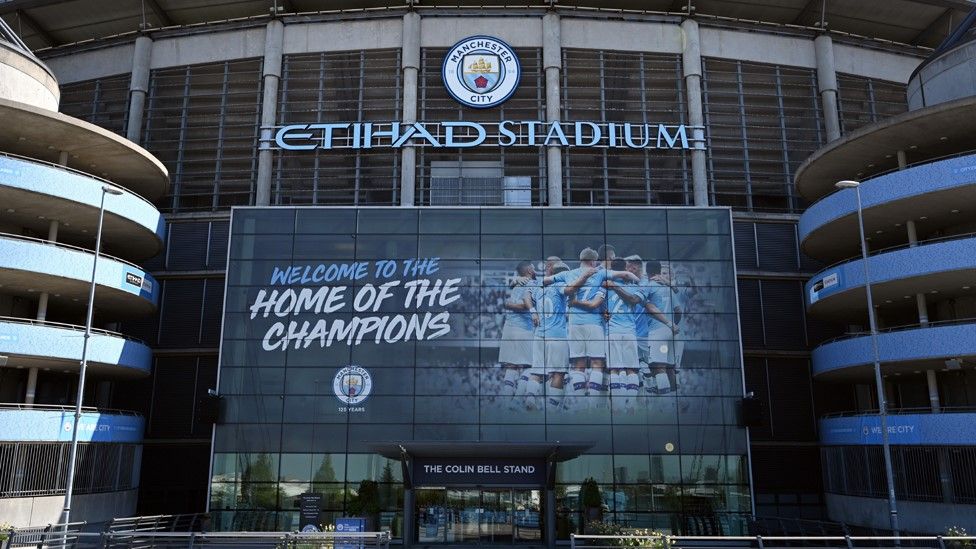
Etihad StadiumIMAGE SOURCE,PAUL ELLIS/AFP/GETTY
Image caption,

Manchester City denies it is vicariously liable for the sexual abuse

The man added: “I wanted to be a footballer – that is what I was convinced I was going to be.”

He said Bennell’s abuse had scarred him and he had “lost his love” for football.

He told the judge: “I see the abuse as the crossroads and the crux of the matter.”

Mr Justice Johnson has heard the men, now in their 40s and 50s, were sexually and emotionally abused by Bennell in the North West of England between 1979 and 1985.

The men are claiming damages after suffering psychiatric injuries.

Six are also claiming damages for loss of potential football earnings.

Manchester City FC said Bennell was a local scout in the mid-1970s but was not a scout between 1979 and 1985.

…………………………………………………

International Day of Care and Support | 29 October 2026

  Small acts of solidarity, big impacts on human lives. In 2020, at the height of the COVID-19 pandemic, I joined community solidarity ini...