Translate

Tuesday, 2 November 2021

Climate change: Can India meet its targets?

 India’s Prime Narendra Modi has set his country a target of net zero greenhouse gas emissions by 2070, a significantly later deadline than many other countries attending the Glasgow climate summit.

Climate change: Can India meet its targets?

India is the world’s third largest emitter of carbon dioxide (CO2), after China and the United States.

With its rapidly growing population and an economy heavily dependent on coal and oil, its emissions are set on a steep upward trajectory unless radical action is taken to curb them.

What emission cuts has India promised so far?

India has resisted setting a target for an overall reduction, saying industrialised nations should bear a much greater share of the burden as they have contributed far more to emissions over time.

It says an “emissions-intensity” target, which reflects a country’s economic growth, is a fairer way to compare it with other countries, it says.

By 2030 India will reduce the carbon intensity of its economy by 45%, says Mr Modi – a more ambitious target than the previous goal of a of a 33-35% cut in its emissions intensity from the 2005 level by 2030..

However, a fall in carbon intensity does not necessarily mean a reduction in overall emissions.

And India’s relatively rapid economic growth in recent years has been driven by its reliance on fossil fuels – accounting for most of the country’s greenhouse-gas emissions.
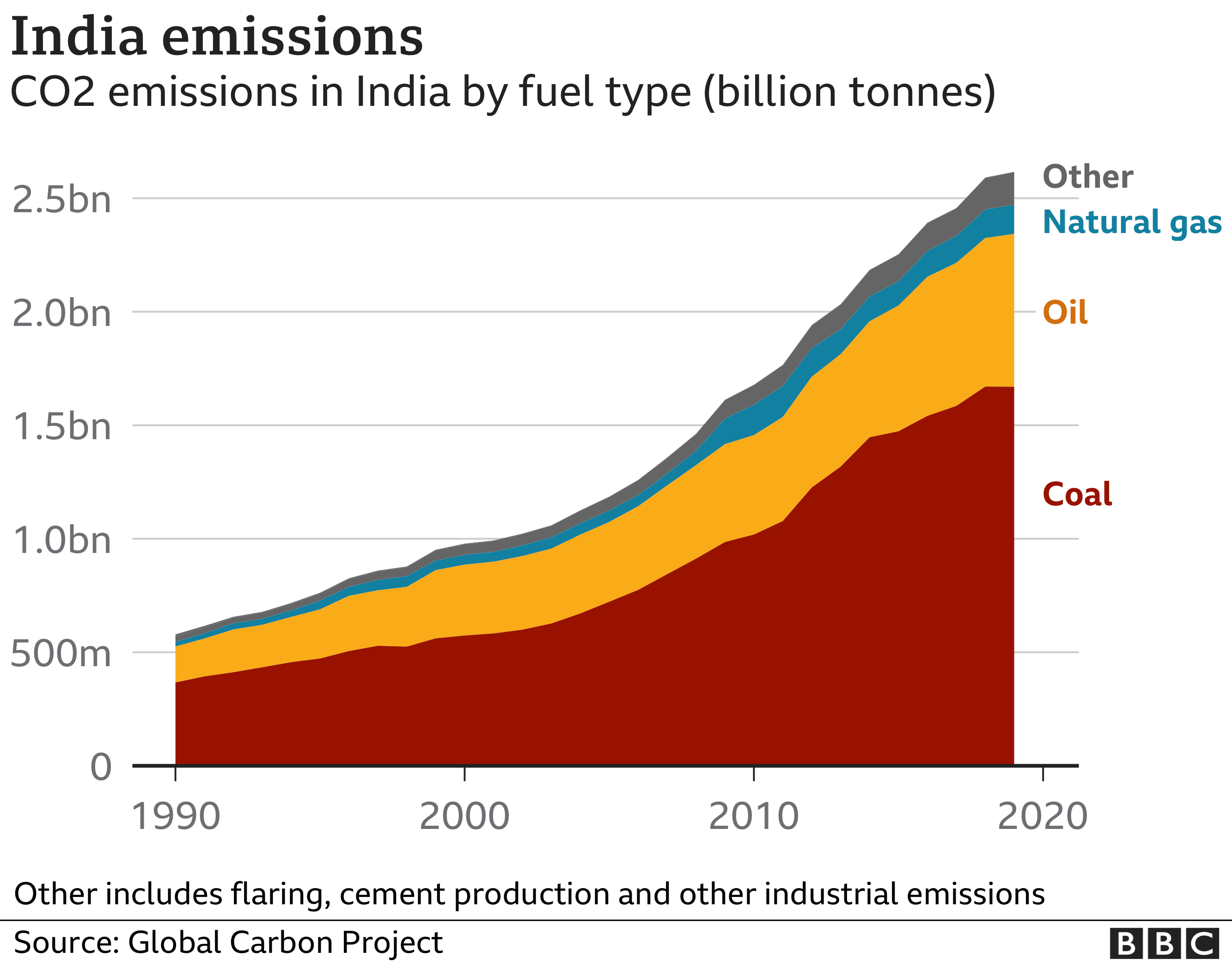
Chart showing CO2 emissions by fuel type in India

The Inter-governmental Panel on Climate Change (IPCC) says a target of global net zero – where a country is not adding to the overall amount of greenhouse gases in the atmosphere – by 2050 is the minimum needed to keep the temperature rise to 1.5C.

And more than 130 countries have publicly promised to meet this.
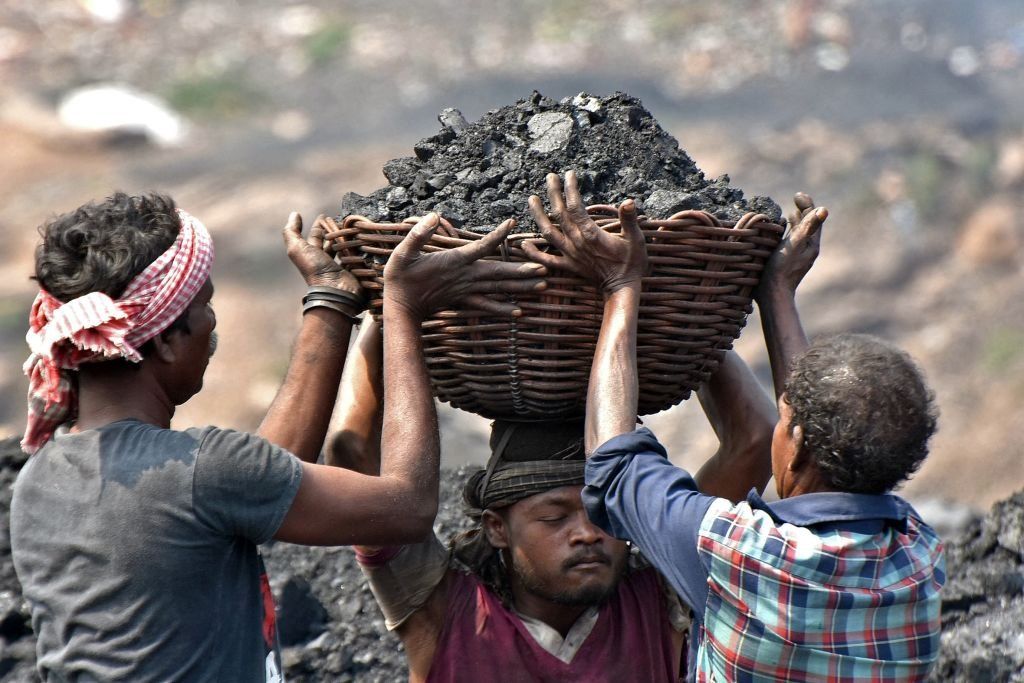
Coal supplies power to around 70% of India's electric gridIMAGE SOURCE,GETTY IMAGES
Image caption,Coal supplies power to about 70% of India’s electric grid

India’s prime minister has pledged that it will increase its non-fossil fuel energy capacity to 500 gigawatts (GW) by 2030.

This is an ambitious target given that it currently has a capacity of around 100GW and had previously set itself a target of 175GW by next year.
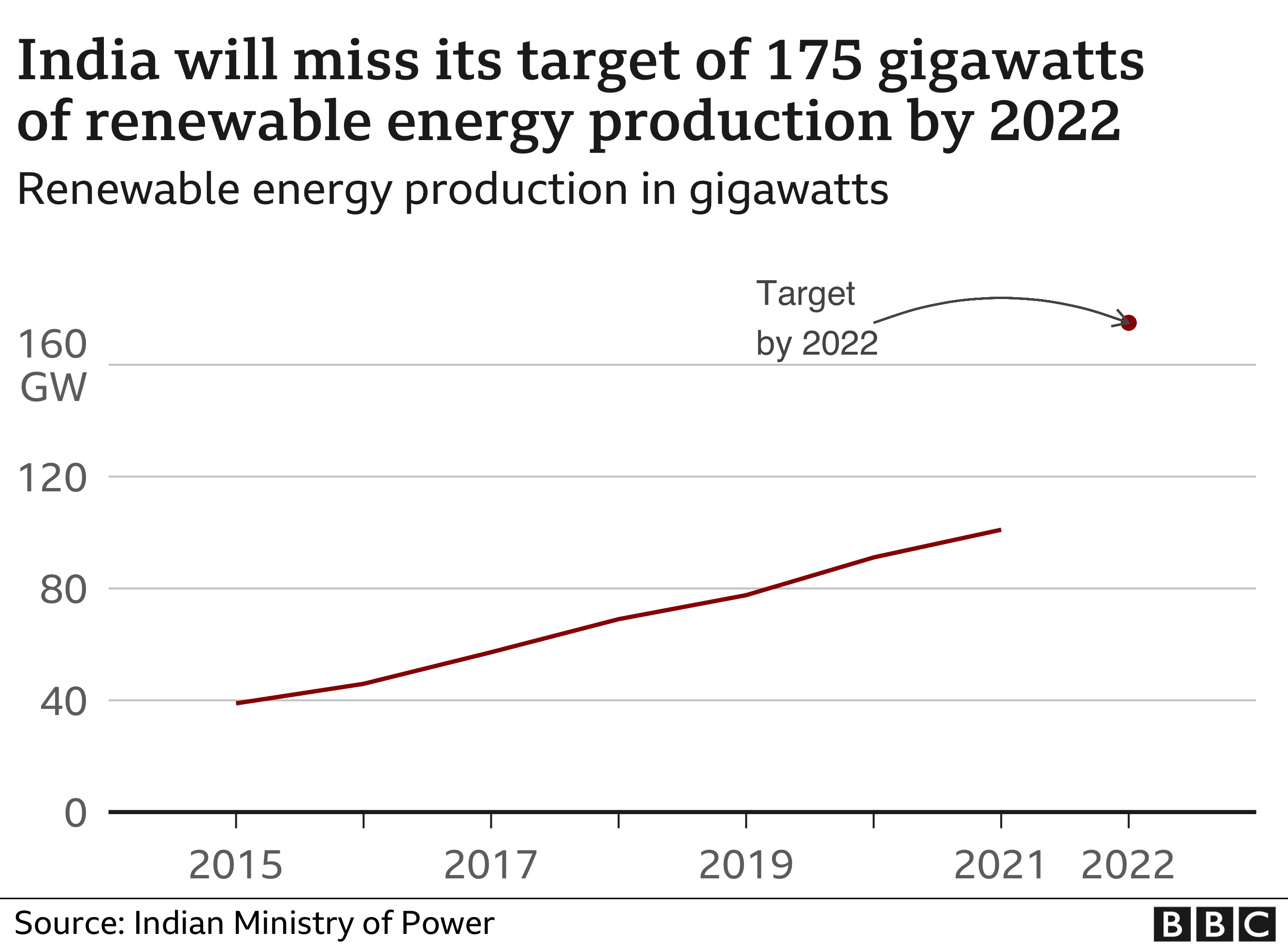
Chart on India's renewable energy target and what's achieved so far

Also in 2015, India promised to provide 40% of all electric power from non-fossil fuel sources by 2030. Mr Modi has now increased this figure to a significantly more ambitious 50%.

According to the International Energy Agency (IEA), in 2019 this figure stood at 23%.

Cindy Baxter, of CAT, says developing countries such as India, need international support to decarbonise their economies and limit the temperature increase to 1.5C in line with the Paris Agreement.

“India has no plan to decarbonise,” Ms Baxter said.

“Nor does it have a conditional target that identifies where it needs support or indeed how much support it needs.”

Are India’s forests expanding?

India has highlighted many times it wants to bring a third of its land area under forest cover.

But it has not given a timescale for this – and progress has been patchy.

Although there have been replanting initiatives in the southern parts of India, the north-eastern region has lost forest cover recently.

The expansion of green cover acts a carbon sink.

And India plans to plant enough trees by 2030 to absorb an additional 2.5-3 billion tonnes of CO2 from the atmosphere.
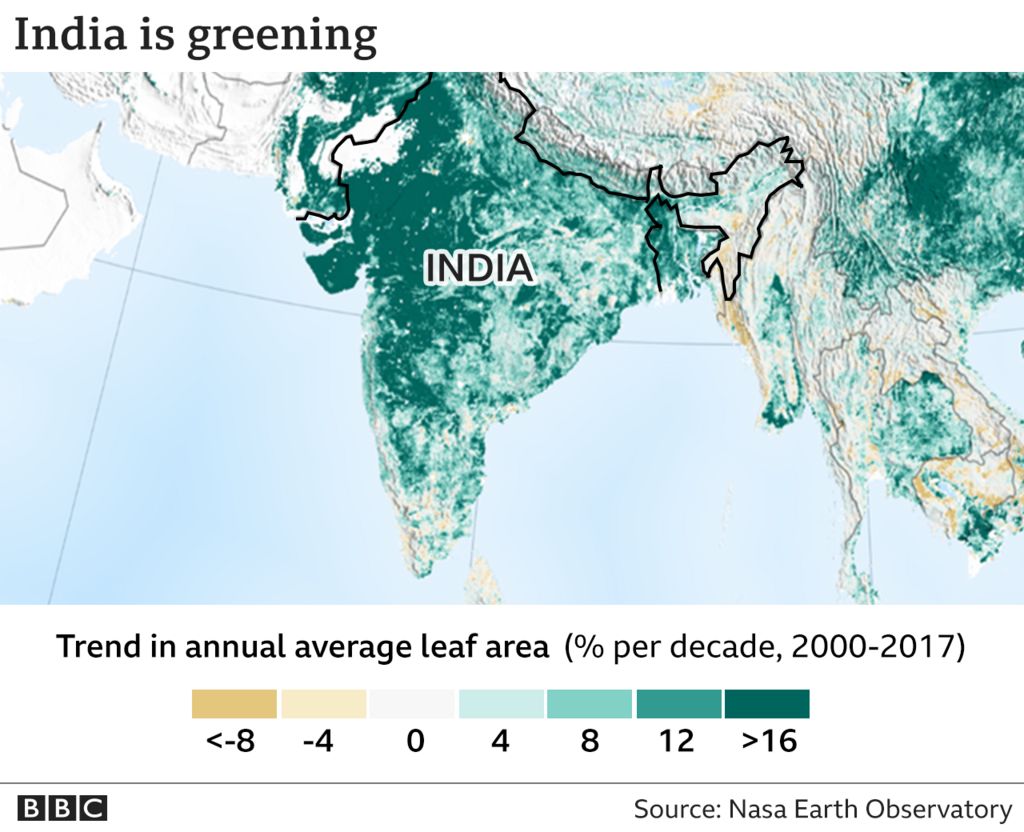
Satellite image showing India's green cover

Global Forest Watch – a collaboration between the University of Maryland, Google, the United States Geological Survey and National Aeronautics and Space Administration (Nasa) – estimates India lost 18% of its primary forests and 5% of its tree cover between 2001 and 2020.

But the Indian government’s own survey data indicates a 5.2% increase in forest cover between 2001 and 2019.

This is because the GFW report includes only vegetation taller than 5m (16ft), whereas India’s official calculation is based on tree density over a given area of land.

Additional research by David Brown

More on climate summit top strapline

The Cop26 global summit, in Glasgow, in November, is seen as crucial if climate change is to be brought under control. Almost 200 countries are being asked for their plans to cut emissions – and it could lead to major changes to everyday lives.

…………………………………………………………

COP26: World leaders promise to end deforestation by 2030

More than 100 world leaders will promise to end and reverse deforestation by 2030, in the COP26 climate summit's first major deal.

COP26: World leaders promise to end deforestation by 2030

Brazil – where stretches of the Amazon rainforest have been cut down – will be among the signatories on Tuesday.

The pledge includes almost £14bn ($19.2bn) of public and private funds.

Experts welcomed the move, but warned a previous deal in 2014 had “failed to slow deforestation at all” and commitments needed to be delivered on.

Felling trees contributes to climate change because it depletes forests that absorb vast amounts of the warming gas CO2.

UK Prime Minister Boris Johnson, who is hosting the global meeting in Glasgow, will call Tuesday’s deal a “landmark agreement to protect and restore the Earth’s forests”.

“These great teeming ecosystems – these cathedrals of nature – are the lungs of our planet,” he will say at a COP26 event later where world leaders are meeting to discuss forests and land use.

The two-week summit in Glasgow is seen as crucial if climate change is to be brought under control.

The countries who say they will sign the pledge – including Canada, Brazil, Russia, China, Indonesia and the Democratic Republic of the Congo, the US and the UK (the full list is here) – cover around 85% of the world’s forests.

Some of the funding will go to developing countries to restore damaged land, tackle wildfires and support indigenous communities.

Governments of 28 countries will also commit to remove deforestation from the global trade of food and other agricultural products such as palm oil, soya and cocoa.

These industries drive forest loss by cutting down trees to make space for animals to graze or crops to grow.

More than 30 of the world’s biggest financial companies – including Aviva, Schroders and Axa – will also commit to end investment in activities linked to deforestation.

And a £1.1bn fund will be established to protect the world’s second largest tropical rainforest – in the Congo Basin.

Prof Simon Lewis, an expert on climate and forests at University College London, said: “It is good news to have a political commitment to end deforestation from so many countries, and significant funding to move forward on that journey.”

But he told the BBC the world “has been here before” with a declaration in 2014 in New York “which failed to slow deforestation at all”.

He added that this new deal did not tackle growing demand for products such as meat grown on rainforest land – which would require high levels of meat consumption in countries like the US and UK to be addressed.

…………………………………………………………

Few vote so far in South Africa’s local elections

 About 3.5 million voters had cast their ballots by noon local time (10:00 GMT) in South Africa’s local government elections, the Independent Electoral Commission has said.

Few vote so far in South Africa’s local elections

Just over 26 million people had registered to vote in an election that will decide who controls cities and towns across South Africa – including Johannesburg, Pretoria and Nelson Mandela Bay.

Some glitches have already been reported, with 19 polling stations in Eastern Cape province and 20 others in KwaZulu Natal failing to open on time because of community protests.

An electoral commission presiding officer has also been arrested in KwaZulu-Natal for allegedly stuffing marked ballot papers at a polling station.

Polls are due to close at 21:00 local time.

…………………………………………………………

‘Ordinary people suffer most’: China farms face climate woes

 JIAOZUO, China (AP) — Wang Yuetang’s sneakers sink into the mud of what was once his thriving corn and peanut farm as he surveys the damage done by an unstable climate.

‘Ordinary people suffer most’: China farms face climate woes

Three months after torrential rains flooded much of central China’s Henan province, stretches of the country’s flat agricultural heartland are still submerged in several inches of water. It’s one of the many calamities around the world that are giving urgency to the U.N. climate summit underway in Glasgow, Scotland.

”There is nothing this year. It’s all gone,” Wang said. “Farmers on the lowland basically have no harvest, nothing.” He lost his summer crop to floods, and in late October the ground was still too wet to plant the next season’s crop, winter wheat.

On other nearby farms, shriveled beanstalks and rotted cabbage heads bob in the dank water, buzzing with flies. Some of the corn ears can be salvaged, but because the husks are moldy, they can be sold only as animal feed, bringing lower prices.

The flooding disaster is the worst that farmers in Henan like Wang can remember in 40 years — but it is also a preview of the kind of extreme conditions the country is likely to face as the planet warms and the weather patterns growers depend upon are increasingly destabilized.

“As the atmosphere warms up, air can hold more moisture, so when storms occur, they can rain out more extreme precipitation,” said Richard Seager, a climate scientist at Columbia University. “Chances are extremely likely that human-induced climate change caused the extreme flooding you saw this summer in places like China and Europe.”

China, the most populous country in the world, with 1.4 billion people, is now the planet’s largest contributor to climate change, responsible for around 28% of carbon dioxide emissions that warm the Earth, though the United States is the biggest polluter historically.

As world leaders take part this week in the climate summit, China is being criticized for not setting a more ambitious timeline for phasing out fossil fuels.

President Xi Jinping, who has not left China since the start of the COVID-19 pandemic and will not be attending the summit but sent a veteran negotiator, has said the country’s carbon emissions will level off before 2030. Critics say that’s not soon enough.

Chinese government projections paint a worrying vision of the future: rising sea levels threatening major coastal cities, including Shanghai, Guangzhou and Hong Kong, and melting glaciers and permafrost imperiling western China’s water supply and grand infrastructure projects such as the railroads across the Tibetan plateau.

Top government scientists also predict an increase in droughts, heat waves and extreme rainfall across China that could threaten harvests and endanger reservoirs and dams, including Three Gorges Dam.

Meanwhile, China’s people are already suffering the brunt of climate change. And in a common pattern around the world, those who have contributed least to the warming and have the fewest resources to adapt often feel the pain most acutely.

In late July, Chinese news broadcasts carried startling footage of torrential rains swamping Henan’s provincial capital, Zhengzhou — at one point, 8 inches (20 centimeters) fell in a single hour — with cars swept away, subways flooded and people struggling through waist-deep water. More than 300 people died as the megacity turned into an accidental Venice, its highways transformed into muddy canals.

Even after the most dramatic storms ceased, the water continued to pool in much of the surrounding countryside, a flat and fertile region.

Here the economy depends on corn, wheat and vegetables, and other regions of China depend on Henan for food. The local government reported that nearly 3 million acres (1.2 million hectares) of farmland were flooded — an area about the size of Connecticut — with damage totaling $18 billion.

“All I could do at the time was to watch the heavens cry, cry and cry every day,” said Wang, the peanut farmer.

A limited number of rudimentary pumps were shared among farmers in Henan. Soft plastic tubes were stretched across fields to drain water, but they periodically burst, sending farmers running to patch holes.

A 58-year-old farmer who gave only her last name, Song, said everything she owned was submerged by the floods — her home, furniture, fields, farming equipment.

“Nothing was harvested. This year, the common people have been suffering all year long,” she said. “Ordinary people suffer most.”

“We have been working so hard, breaking our backs … without even a penny back, my heart aches,” said Hou Beibei, a farmer whose simple vegetable greenhouses — plastic tarps covering plots of eggplant, garlic and celery — remain flooded, her hard work washed away.

She is worried about her two young children. “The tuition fees of the children and the living expenses of the whole family rely on this land,” she said.

The summer also saw another climate-linked natural disaster in China. In July, the hottest month on Earth in 142 years of record-keeping, according to U.S. weather experts, a vast and toxic blue-green algae bloom spanning 675 square miles (1,748 square kilometers) engulfed coastal waters off the prosperous city of Qingdao, threatening navigation, fishing and tourism. State broadcasts carried footage of people using dump trucks to remove the mounds of algae.

Another threat to China’s coastal provinces is sea level rise. Government records show that coastal water levels have already risen around 4.8 inches (122 millimeters) between 1980 and 2017 and project that within the next 30 years, waters could rise an additional 2.8 to 6.3 inches (70 to 160 millimeters).

Because China’s coastal areas are largely flat, “a slight rise in the sea level will aggravate the flooding of a large area of land,” erasing expensive waterfront properties and critical habitats, a government report projects.

“I think these impacts are triggering a national awakening. I think people are increasingly asking, ‘Why have extreme weather events like this happened? What are the root causes?’” said Li Shuo, a climate policy expert at Greenpeace East Asia in Beijing.

“I think this is bringing the Chinese policymakers and the general public to a realization that we are indeed in a climate emergency.”

………………………………………………………

Glenn Youngkin’s Right-Wing Allies Are Ready To Claim Virginia’s Election Was Stolen

 Donald Trump and his supporters, including surrogates for Republican Glenn Youngkin’s campaign for governor, have already begun spreading lies about election fraud.

Glenn Youngkin’s Right-Wing Allies Are Ready To Claim Virginia’s Election Was Stolen

Glenn Youngkin, the Republican private equity executive locked in a tight Virginia governor’s race with former Gov. Terry McAuliffe (D), has said during debates that he would “absolutely” accept the results of Tuesday’s election were he to lose.

But some of Youngkin’s most ardent right-wing allies and supporters do not feel the same way. In the week leading up to Election Day, several of Youngkin’s prominent right-wing supporters ― including some who’ve acted as surrogates for his campaign ― have set the stage to claim that Democrats fraudulently stole the election.

With polls tightening in recent weeks, the Virginia governor’s race is a toss-up that either candidate could win, and the narrative in Virginia and nationally suggests that Youngkin has momentum and enthusiasm on his side heading into the race’s final 24 hours.

In that environment, Youngkin’s right-wing allies have once again primed conservative voters to believe that there’s no way a Democratic candidate like McAuliffe could prevail unless there is fraud, even in a state where Democrats have won every statewide election since 2009, including two governor’s races, four presidential contests, and multiple races for lieutenant governor and attorney general. Even if Youngkin were to lose and concede the race to McAuliffe, it seems inevitable that some of his most influential backers will refuse to accept defeat.

The loudest of those claims have come from Amanda Chase, the Virginia state senator who faced formal censure earlier this year after she attended the Jan. 6 “Stop the Steal” rally that precipitated the insurrection at the U.S. Capitol, and who has repeatedly lied about widespread election fraud in the 2020 contest former President Donald Trump lost.

Chase has used radio interviews, Facebook and other platforms to spread elaborate and convoluted conspiracy theories about Democratic plots to “steal” the Virginia election, the biggest contest to take place since Trump’s loss last year.

But she is not alone: At a recent campaign event, country music singer John Rich insisted that a Youngkin loss would be the result of fraud while sharing a stage with the GOP gubernatorial candidate. Former Trump adviser Steve Bannon and conservative radio host John Fredericks have suggested that Democrats are attempting to steal the race. And Trump himself has spread the same old lies.

“I am not a believer in the integrity of Virginia’s elections,” Trump said in a statement Monday morning, adding that “lots of bad things went on, are going on.”

The blatant lies in the days ahead of the Virginia race highlight the lingering dangers posed by steadfast Republican refusals to tell the truth about the 2020 election: that Trump lost a fair and legitimate contest, and that voter fraud is a rare occurrence that has not marred any recent American election. Thanks to Trump and the GOP’s repetition of such falsehoods, nearly half of Republican voters believe that Trump won the 2020 race, and are set to follow their party in treating any Democratic victory as inherently illegitimate.

Youngkin in May said that Biden won the election, and reiterated at a gubernatorial debate that there “wasn’t material fraud” during the 2020 contest. But he has refused to refute conspiracy theories spread by voters at his events or his own surrogates. He has insisted that “election integrity” is the most important issue in the race rather than a code word for GOP conspiracy theories and election lies. And he has continued campaigning alongside lawmakers like Chase, who transitioned seamlessly from claiming that last year’s election was stolen to saying that this one will be.

The late polling swing toward Youngkin has only fueled these efforts.

“Everything’s moving in Youngkin’s direction and the Republicans but a lot of people fear that this is going to get stolen,” Fredericks, the conservative radio host whose show has turned into a platform for incessant conspiracy-mongering over the final weeks of the election, said on his Oct. 27 show. “They’re gonna try and cheat. We’ve got all kinds of irregularities now going on in Fairfax County.”

Fairfax County, an affluent northern Virginia suburb of Washington, D.C., that has swung toward Democrats in recent elections, has emerged as the focal point of right-wing conspiracies. Fredericks has suggested that Fairfax is an epicenter of fraud multiple times on his show since Oct. 27, while bringing on prominent guests to repeat the baseless claims.

Retired Col. John Mills, a former Trump administration official, suggested during one appearance that Democrats and election officials are working in concert to commit absentee ballot fraud in the county.

“Fairfax is the Fulton County, Georgia, of Virginia,” Mills said on the Oct. 27 show, referring to the largest county in Georgia that was key to President Joe Biden’s 2020 victory in the state. Republicans have baselessly asserted that widespread mail-in ballot fraud occurred there in 2020, and have used those claims to justify a partisan attempt to take over the Fulton County election board.

No such fraud actually took place in Fulton County or anywhere else in Georgia, a fact election reviews, hand recounts and the state’s Republican governor and secretary state have repeatedly confirmed. The basis for Fredericks’ and Mills’ claims, meanwhile, is a lawsuit that claims Fairfax County elections officials improperly accepted absentee ballots during the early voting period.

A judge dismissed the suit on Friday.

On Oct. 28, Fredericks used his show to claim, without evidence, that election officials in other counties have helped Democrats “go into nursing homes and extract votes from people that were incapacitated,” a baseless assertion that mimics Trump and other conservatives’ claims that Democrats mined votes from dead and otherwise incapacitated voters last year. (That, too, is a lie.)

Bannon, who has called Virginia an important test of the strength of Trump’s Make America Great Again movement, used Fredericks’ Oct. 29 show to insist that Democrats are “going to steal” the election, because “they can’t win elections they don’t steal.”

During that appearance, Bannon also reiterated the lie that the 2020 election was stolen from Trump, and spread conspiracy theories about supposed fraud in Pennsylvania, Arizona and Wisconsin, all states where regular and routine audits, recounts and reviews of last year’s contest have found zero evidence of fraud and confirmed Trump’s defeat.

Chase has appeared at events with Youngkin. She, Bannon and Fredericks attended a rally alongside GOP lieutenant governor candidate Winsome Sears last month where attendees pledged allegiance to a flag carried at the Jan. 6 insurrection.

Youngkin condemned that episode, and has at times tried to maintain arm’s-length distance from the most explicitly conspiratorial assertions made by surrogates like Chase. But his campaign has not denounced them even when given the chance, and at times, his supporters have asserted that Democrats are engaged in election thievery while on stage with Youngkin himself.

Rich, the country music singer, claimed at an Oct. 27 get-out-the-vote rally in Blacksburg, Virginia, that California Gov. Gavin Newsom (D) won his September recall race through fraud, despite a margin of victory of more than 3 million votes. He also falsely claimed former Georgia state Rep. Stacey Abrams (D), who has campaigned for McAuliffe in Virginia, was responsible for a nationwide Democratic election theft scheme.

“I almost bought an apartment in Virginia just so I could vote for him, you know, do it like Stacey Abrams does,” Rich said at the event. “Why the hell is Stacey Abrams in Virginia right now? What is that? What is she doing up here?”

“We know what she’s doing up here,” Rich continued. “Do you really think California voted for Gavin Newsom again? I don’t think so. Stacey Abrams was probably out there too.”

Youngkin previously responded to Chase’s election conspiracies by saying he hasn’t spoken to her about the issues she has raised.

“I haven’t heard from the senator on this one, so I don’t know,” he told reporters on Oct. 28. “But let me just tell you what we’re doing because I believe this election will be fair, I believe this election will come out big time in our favor. We’ve got huge amounts of momentum and at the end of the day we’re going to get a lot more votes than the other guy.”

Youngkin said his campaign has run a “great election operations system” and that he believed votes “will be counted fairly.”

He has also previously said he would respect the results of the race, even if McAuliffe wins.

“I believe we’re going to get 50%-plus in order to win,” Youngkin told a voter who asked him to promise not to concede at an August campaign event, according to the Virginia Scope. “I can’t promise you I won’t concede, because I’m going to actually do what’s best for Virginia. … If I end up finding myself in a circumstance where we’ve lost but what’s right for Virginia is for me to concede, I’ll concede.”

………………………………………………………

A Ciência e a Inteligência Artificial estão a dar vida às memórias!

A Inteligência Artificial já consegue transformar fotografias antigas em experiências visuais surpreendentes Hoje, testemunhamos como a ciên...