Translate

Tuesday, 2 November 2021

‘Ordinary people suffer most’: China farms face climate woes

 JIAOZUO, China (AP) — Wang Yuetang’s sneakers sink into the mud of what was once his thriving corn and peanut farm as he surveys the damage done by an unstable climate.

‘Ordinary people suffer most’: China farms face climate woes

Three months after torrential rains flooded much of central China’s Henan province, stretches of the country’s flat agricultural heartland are still submerged in several inches of water. It’s one of the many calamities around the world that are giving urgency to the U.N. climate summit underway in Glasgow, Scotland.

”There is nothing this year. It’s all gone,” Wang said. “Farmers on the lowland basically have no harvest, nothing.” He lost his summer crop to floods, and in late October the ground was still too wet to plant the next season’s crop, winter wheat.

On other nearby farms, shriveled beanstalks and rotted cabbage heads bob in the dank water, buzzing with flies. Some of the corn ears can be salvaged, but because the husks are moldy, they can be sold only as animal feed, bringing lower prices.

The flooding disaster is the worst that farmers in Henan like Wang can remember in 40 years — but it is also a preview of the kind of extreme conditions the country is likely to face as the planet warms and the weather patterns growers depend upon are increasingly destabilized.

“As the atmosphere warms up, air can hold more moisture, so when storms occur, they can rain out more extreme precipitation,” said Richard Seager, a climate scientist at Columbia University. “Chances are extremely likely that human-induced climate change caused the extreme flooding you saw this summer in places like China and Europe.”

China, the most populous country in the world, with 1.4 billion people, is now the planet’s largest contributor to climate change, responsible for around 28% of carbon dioxide emissions that warm the Earth, though the United States is the biggest polluter historically.

As world leaders take part this week in the climate summit, China is being criticized for not setting a more ambitious timeline for phasing out fossil fuels.

President Xi Jinping, who has not left China since the start of the COVID-19 pandemic and will not be attending the summit but sent a veteran negotiator, has said the country’s carbon emissions will level off before 2030. Critics say that’s not soon enough.

Chinese government projections paint a worrying vision of the future: rising sea levels threatening major coastal cities, including Shanghai, Guangzhou and Hong Kong, and melting glaciers and permafrost imperiling western China’s water supply and grand infrastructure projects such as the railroads across the Tibetan plateau.

Top government scientists also predict an increase in droughts, heat waves and extreme rainfall across China that could threaten harvests and endanger reservoirs and dams, including Three Gorges Dam.

Meanwhile, China’s people are already suffering the brunt of climate change. And in a common pattern around the world, those who have contributed least to the warming and have the fewest resources to adapt often feel the pain most acutely.

In late July, Chinese news broadcasts carried startling footage of torrential rains swamping Henan’s provincial capital, Zhengzhou — at one point, 8 inches (20 centimeters) fell in a single hour — with cars swept away, subways flooded and people struggling through waist-deep water. More than 300 people died as the megacity turned into an accidental Venice, its highways transformed into muddy canals.

Even after the most dramatic storms ceased, the water continued to pool in much of the surrounding countryside, a flat and fertile region.

Here the economy depends on corn, wheat and vegetables, and other regions of China depend on Henan for food. The local government reported that nearly 3 million acres (1.2 million hectares) of farmland were flooded — an area about the size of Connecticut — with damage totaling $18 billion.

“All I could do at the time was to watch the heavens cry, cry and cry every day,” said Wang, the peanut farmer.

A limited number of rudimentary pumps were shared among farmers in Henan. Soft plastic tubes were stretched across fields to drain water, but they periodically burst, sending farmers running to patch holes.

A 58-year-old farmer who gave only her last name, Song, said everything she owned was submerged by the floods — her home, furniture, fields, farming equipment.

“Nothing was harvested. This year, the common people have been suffering all year long,” she said. “Ordinary people suffer most.”

“We have been working so hard, breaking our backs … without even a penny back, my heart aches,” said Hou Beibei, a farmer whose simple vegetable greenhouses — plastic tarps covering plots of eggplant, garlic and celery — remain flooded, her hard work washed away.

She is worried about her two young children. “The tuition fees of the children and the living expenses of the whole family rely on this land,” she said.

The summer also saw another climate-linked natural disaster in China. In July, the hottest month on Earth in 142 years of record-keeping, according to U.S. weather experts, a vast and toxic blue-green algae bloom spanning 675 square miles (1,748 square kilometers) engulfed coastal waters off the prosperous city of Qingdao, threatening navigation, fishing and tourism. State broadcasts carried footage of people using dump trucks to remove the mounds of algae.

Another threat to China’s coastal provinces is sea level rise. Government records show that coastal water levels have already risen around 4.8 inches (122 millimeters) between 1980 and 2017 and project that within the next 30 years, waters could rise an additional 2.8 to 6.3 inches (70 to 160 millimeters).

Because China’s coastal areas are largely flat, “a slight rise in the sea level will aggravate the flooding of a large area of land,” erasing expensive waterfront properties and critical habitats, a government report projects.

“I think these impacts are triggering a national awakening. I think people are increasingly asking, ‘Why have extreme weather events like this happened? What are the root causes?’” said Li Shuo, a climate policy expert at Greenpeace East Asia in Beijing.

“I think this is bringing the Chinese policymakers and the general public to a realization that we are indeed in a climate emergency.”

………………………………………………………

Glenn Youngkin’s Right-Wing Allies Are Ready To Claim Virginia’s Election Was Stolen

 Donald Trump and his supporters, including surrogates for Republican Glenn Youngkin’s campaign for governor, have already begun spreading lies about election fraud.

Glenn Youngkin’s Right-Wing Allies Are Ready To Claim Virginia’s Election Was Stolen

Glenn Youngkin, the Republican private equity executive locked in a tight Virginia governor’s race with former Gov. Terry McAuliffe (D), has said during debates that he would “absolutely” accept the results of Tuesday’s election were he to lose.

But some of Youngkin’s most ardent right-wing allies and supporters do not feel the same way. In the week leading up to Election Day, several of Youngkin’s prominent right-wing supporters ― including some who’ve acted as surrogates for his campaign ― have set the stage to claim that Democrats fraudulently stole the election.

With polls tightening in recent weeks, the Virginia governor’s race is a toss-up that either candidate could win, and the narrative in Virginia and nationally suggests that Youngkin has momentum and enthusiasm on his side heading into the race’s final 24 hours.

In that environment, Youngkin’s right-wing allies have once again primed conservative voters to believe that there’s no way a Democratic candidate like McAuliffe could prevail unless there is fraud, even in a state where Democrats have won every statewide election since 2009, including two governor’s races, four presidential contests, and multiple races for lieutenant governor and attorney general. Even if Youngkin were to lose and concede the race to McAuliffe, it seems inevitable that some of his most influential backers will refuse to accept defeat.

The loudest of those claims have come from Amanda Chase, the Virginia state senator who faced formal censure earlier this year after she attended the Jan. 6 “Stop the Steal” rally that precipitated the insurrection at the U.S. Capitol, and who has repeatedly lied about widespread election fraud in the 2020 contest former President Donald Trump lost.

Chase has used radio interviews, Facebook and other platforms to spread elaborate and convoluted conspiracy theories about Democratic plots to “steal” the Virginia election, the biggest contest to take place since Trump’s loss last year.

But she is not alone: At a recent campaign event, country music singer John Rich insisted that a Youngkin loss would be the result of fraud while sharing a stage with the GOP gubernatorial candidate. Former Trump adviser Steve Bannon and conservative radio host John Fredericks have suggested that Democrats are attempting to steal the race. And Trump himself has spread the same old lies.

“I am not a believer in the integrity of Virginia’s elections,” Trump said in a statement Monday morning, adding that “lots of bad things went on, are going on.”

The blatant lies in the days ahead of the Virginia race highlight the lingering dangers posed by steadfast Republican refusals to tell the truth about the 2020 election: that Trump lost a fair and legitimate contest, and that voter fraud is a rare occurrence that has not marred any recent American election. Thanks to Trump and the GOP’s repetition of such falsehoods, nearly half of Republican voters believe that Trump won the 2020 race, and are set to follow their party in treating any Democratic victory as inherently illegitimate.

Youngkin in May said that Biden won the election, and reiterated at a gubernatorial debate that there “wasn’t material fraud” during the 2020 contest. But he has refused to refute conspiracy theories spread by voters at his events or his own surrogates. He has insisted that “election integrity” is the most important issue in the race rather than a code word for GOP conspiracy theories and election lies. And he has continued campaigning alongside lawmakers like Chase, who transitioned seamlessly from claiming that last year’s election was stolen to saying that this one will be.

The late polling swing toward Youngkin has only fueled these efforts.

“Everything’s moving in Youngkin’s direction and the Republicans but a lot of people fear that this is going to get stolen,” Fredericks, the conservative radio host whose show has turned into a platform for incessant conspiracy-mongering over the final weeks of the election, said on his Oct. 27 show. “They’re gonna try and cheat. We’ve got all kinds of irregularities now going on in Fairfax County.”

Fairfax County, an affluent northern Virginia suburb of Washington, D.C., that has swung toward Democrats in recent elections, has emerged as the focal point of right-wing conspiracies. Fredericks has suggested that Fairfax is an epicenter of fraud multiple times on his show since Oct. 27, while bringing on prominent guests to repeat the baseless claims.

Retired Col. John Mills, a former Trump administration official, suggested during one appearance that Democrats and election officials are working in concert to commit absentee ballot fraud in the county.

“Fairfax is the Fulton County, Georgia, of Virginia,” Mills said on the Oct. 27 show, referring to the largest county in Georgia that was key to President Joe Biden’s 2020 victory in the state. Republicans have baselessly asserted that widespread mail-in ballot fraud occurred there in 2020, and have used those claims to justify a partisan attempt to take over the Fulton County election board.

No such fraud actually took place in Fulton County or anywhere else in Georgia, a fact election reviews, hand recounts and the state’s Republican governor and secretary state have repeatedly confirmed. The basis for Fredericks’ and Mills’ claims, meanwhile, is a lawsuit that claims Fairfax County elections officials improperly accepted absentee ballots during the early voting period.

A judge dismissed the suit on Friday.

On Oct. 28, Fredericks used his show to claim, without evidence, that election officials in other counties have helped Democrats “go into nursing homes and extract votes from people that were incapacitated,” a baseless assertion that mimics Trump and other conservatives’ claims that Democrats mined votes from dead and otherwise incapacitated voters last year. (That, too, is a lie.)

Bannon, who has called Virginia an important test of the strength of Trump’s Make America Great Again movement, used Fredericks’ Oct. 29 show to insist that Democrats are “going to steal” the election, because “they can’t win elections they don’t steal.”

During that appearance, Bannon also reiterated the lie that the 2020 election was stolen from Trump, and spread conspiracy theories about supposed fraud in Pennsylvania, Arizona and Wisconsin, all states where regular and routine audits, recounts and reviews of last year’s contest have found zero evidence of fraud and confirmed Trump’s defeat.

Chase has appeared at events with Youngkin. She, Bannon and Fredericks attended a rally alongside GOP lieutenant governor candidate Winsome Sears last month where attendees pledged allegiance to a flag carried at the Jan. 6 insurrection.

Youngkin condemned that episode, and has at times tried to maintain arm’s-length distance from the most explicitly conspiratorial assertions made by surrogates like Chase. But his campaign has not denounced them even when given the chance, and at times, his supporters have asserted that Democrats are engaged in election thievery while on stage with Youngkin himself.

Rich, the country music singer, claimed at an Oct. 27 get-out-the-vote rally in Blacksburg, Virginia, that California Gov. Gavin Newsom (D) won his September recall race through fraud, despite a margin of victory of more than 3 million votes. He also falsely claimed former Georgia state Rep. Stacey Abrams (D), who has campaigned for McAuliffe in Virginia, was responsible for a nationwide Democratic election theft scheme.

“I almost bought an apartment in Virginia just so I could vote for him, you know, do it like Stacey Abrams does,” Rich said at the event. “Why the hell is Stacey Abrams in Virginia right now? What is that? What is she doing up here?”

“We know what she’s doing up here,” Rich continued. “Do you really think California voted for Gavin Newsom again? I don’t think so. Stacey Abrams was probably out there too.”

Youngkin previously responded to Chase’s election conspiracies by saying he hasn’t spoken to her about the issues she has raised.

“I haven’t heard from the senator on this one, so I don’t know,” he told reporters on Oct. 28. “But let me just tell you what we’re doing because I believe this election will be fair, I believe this election will come out big time in our favor. We’ve got huge amounts of momentum and at the end of the day we’re going to get a lot more votes than the other guy.”

Youngkin said his campaign has run a “great election operations system” and that he believed votes “will be counted fairly.”

He has also previously said he would respect the results of the race, even if McAuliffe wins.

“I believe we’re going to get 50%-plus in order to win,” Youngkin told a voter who asked him to promise not to concede at an August campaign event, according to the Virginia Scope. “I can’t promise you I won’t concede, because I’m going to actually do what’s best for Virginia. … If I end up finding myself in a circumstance where we’ve lost but what’s right for Virginia is for me to concede, I’ll concede.”

………………………………………………………

Nigeria building collapse: Race to find survivors as dozens still missing

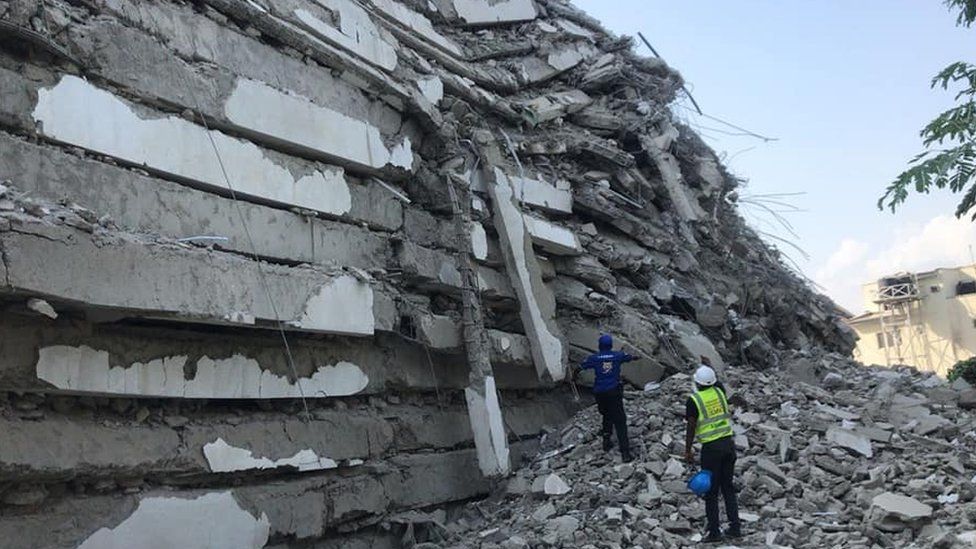
 Rescuers are searching for survivors in the wreckage of a 22-storey high-rise block that collapsed under construction in Nigeria’s largest city, Lagos.

Nigeria building collapse: Race to find survivors as dozens still missing

At least five people have died and dozens are missing.

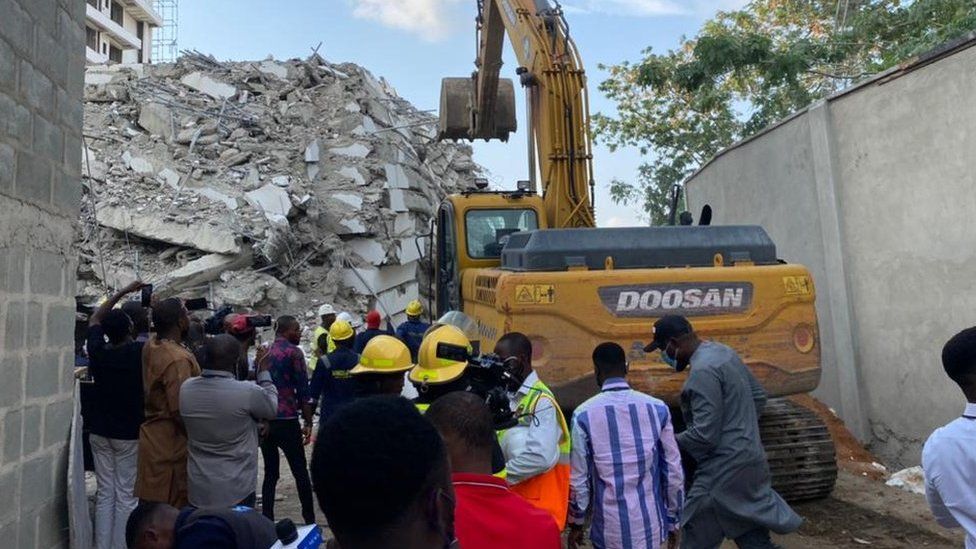
As they worked through the night, rescue workers and some locals scoured through a mound of rubble and twisted metal. Four survivors have been pulled from the wreckage.

The partially built block of luxury apartments came down on Monday.

What caused the collapse and exactly how many people are trapped under the rubble remains unclear.

In the meantime, local authorities have ordered an investigation into the collapse and pledged to make the final report public.

Nigeria building collapse: Race to find survivors as dozens still missing

Femi Adesina, a special advisor to President Muhammadu Buhari, said the president “commiserates with families who have lost loved ones”.

He added that the president had urged the authorities to step up their rescue efforts.

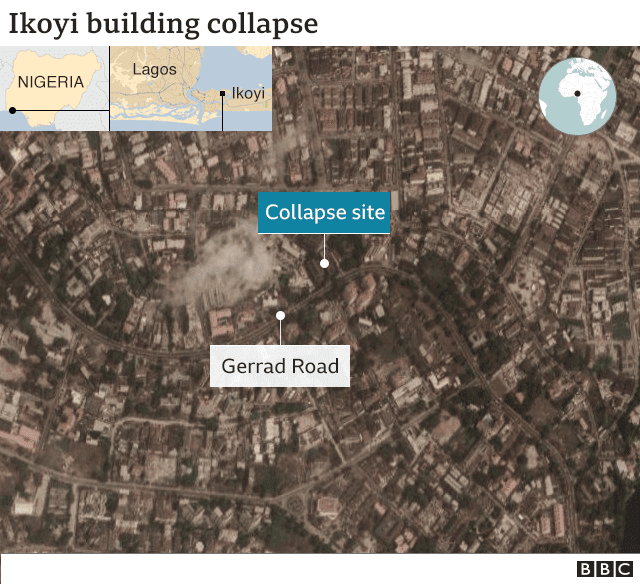
The building came down at around 14:45 local time (13:45 GMT) in the upmarket district of Ikoyi.

It was part of a complex named 360 Degrees Towers, which was intended to house luxury apartments, townhouses and penthouses, according to the development’s website, which has since been taken offline.

The housing scheme is being developed by Fourscore Homes Limited, which has a portfolio of projects in the UK, US, South Africa, and other areas of Nigeria.

Construction worker Eric Tetteh, 41, told the Associated Press that his teams had been waiting for an excavator to arrive at the site when the building suddenly fell.

“Me and my brother, we escaped, but more people are there – more than 100 people,” he said.

A witness who was working in an office building opposite the site told the BBC’s Outside Source programme that he heard a sound, looked out of his window, and “saw the building literally going down floor by floor.”

Local authorities have put an emergency rescue plan into place, and local officials have visited the site.

But according to AP, Lagos’ deputy governor Femi Hamzat was met by crowds of angry people who accused authorities of not starting rescue efforts soon enough.

Some reports say the building, which had more than 20 storeys, was several floors higher than originally intended.

Nigeria building collapse: Race to find survivors as dozens still missing
One witness told the BBC he saw the building collapse “floor by floor”

There have been several building collapses in Lagos in recent years.

In 2019, 10 people died after a school collapsed in the commercial hub.

And in 2014, a six-storey building fell during a service by a celebrity televangelist, killing 116 people.

Building standards have often been criticised and Lagos state authorities recently launched a new scheme to improve certification.

Nigeria building collapse: Race to find survivors as dozens still missing

……………………………………………………………

Ethiopia tried to limit rare UN report on Tigray war abuses

 NAIROBI, Kenya (AP) — The findings of the only human rights investigation allowed in Ethiopia’s blockaded Tigray region will be released Wednesday, a year after war began there. But people with knowledge of the probe say it has been limited by authorities who recently expelled a U.N. staffer helping to lead it.

Ethiopia tried to limit rare UN report on Tigray war abuses

And yet, with groups such as Human Rights Watch and Amnesty International barred from Tigray, along with foreign media, the report may be the world’s only official source of information on atrocities in the war, which began in November 2020 after a political falling-out between the Tigray forces that long dominated the national government and Prime Minister Abiy Ahmed’s current government. The conflict has been marked by gang rapes, mass expulsions, deliberate starvation and thousands of deaths.

The joint investigation by the U.N. human rights office and the government-created Ethiopian Human Rights Commission, or EHRC, is a rare collaboration that immediately raised concerns among ethnic Tigrayans, human rights groups and other observers about impartiality and government influence.

In response to questions from The Associated Press, the U.N. human rights office in Geneva said it wouldn’t have been able to enter Tigray without the partnership with the rights commission. Although past joint investigations occurred in Afghanistan and Uganda, the U.N. said, “the current one is unique in terms of magnitude and context.”

But Ethiopia’s government has given no basis for expelling U.N. human rights officer Sonny Onyegbula last month, the U.N. added, and without an explanation “we cannot accept the allegation that our staff member … was ‘meddling in the internal affairs’ of Ethiopia.”

Because of those circumstances, and the fact that the U.N. left the investigation to its less experienced regional office in Ethiopia, the new report is “automatically suspect,” said David Crane, founder of the Global Accountability Network and founding chief prosecutor for the Special Court for Sierra Leone, an international tribunal.

“What you need when you go into an atrocity zone is a clean slate so outside investigators can look into it neutrally, dispassionately,” Crane said. “You want to do these things where you don’t build doubt, distrust from the beginning,” including among people interviewed.

The investigation might be the international community’s only chance to collect facts on the ground, he said, but because of its setup, it may disappear “in the sands of time.”

People close to the investigation, speaking on condition of anonymity for fear of retaliation, asserted that the head of the Ethiopian Human Rights Commission, Daniel Bekele, underplayed some allegations that fighters from the country’s Amhara region were responsible for abuses in Tigray and pressed instead to highlight abuses by Tigray forces.

That’s even though witnesses have said the perpetrators of most abuses were soldiers from neighboring Eritrea, Ethiopian forces and Amhara regional forces.

In response to AP’s questions, Bekele asserted his commission’s independence, saying it is “primarily accountable to the people it is created to serve.” Attempts to influence the investigation, he added, can come from ”many directions” in such a polarized environment.

Bekele said he and the commission have consistently cited “serious indications that all parties involved in the conflict have committed atrocities.”

Observers say a major shortcoming of the investigation is its failure to visit the scene of many alleged massacres in Tigray, including the deadliest known one in the city of Axum, where witnesses told the AP that several hundred people were killed.

Bekele said the investigation lacked the support of the Tigray authorities now administering the region after Tigray forces retook much of the area in June, about midway through the joint team’s work.

The U.N. human rights office, however, said the government’s subsequent severing of flights and communications from Tigray during the planned investigation period made it difficult to access key locations, both “logistically and from a security point of view.”

Even the interim Tigray authorities hand-picked by Ethiopia’s government to run the region earlier in the war rejected the joint investigation, its former chief of staff, Gebremeskel Kassa, told the AP.

“We informed the international community we wanted an investigation into human rights but not with the EHRC because we believe this is a tool of the government,” he said.

The U.N. has said Ethiopia’s government had no say in the report’s publication, though it was given the chance to read the report in advance and to point out “anything it believes to be incorrect.”

Late last week, Ethiopia’s government and a diaspora group released the results of their own investigations focusing on alleged abuses by Tigray forces after they entered the neighboring regions of Amhara and Afar four months ago in what they called an effort to pressure the government to end its blockade on Tigray.

The ministry of justice said it found 483 non-combatants were killed and 109 raped in parts of Amhara and Afar that were recaptured by federal forces in recent weeks. It also found “widespread and systematic looting” of schools, clinics, churches, mosques and aid groups’ offices.

A separate report by the Amhara Association of America said it found that 112 people were raped in several districts covered by the ministry’s findings. The diaspora group drew on data from offices of women’s and children’s affairs as well as interviews with witnesses, doctors and officials.

The diaspora group asserted that the Tigray forces “committed the rapes as revenge against ethnic Amharas, whom they blame as responsible for abuses in their home region.”

The spokesman for the Tigray forces, Getachew Reda, said the allegations aren’t worth “the paper they’re written on.” Accusations of rapes and killings by Tigray forces are “absolutely untrue, at least on a level these organizations are alleging,” he said.

…………………………………………………………

AFRICAN YOUTH DAY | 1 NOVEMBER 2026

    20 YEARS OF THE AFRICAN YOUTH CHARTER AFRICAN YOUTH: IDENTITY, PARTICIPATION AND TRANSFORMATION 420 MILLION+ YOUNG PEOPLE | AGED 15–35 A...