Translate

Tuesday, 2 November 2021

Glenn Youngkin’s Right-Wing Allies Are Ready To Claim Virginia’s Election Was Stolen

 Donald Trump and his supporters, including surrogates for Republican Glenn Youngkin’s campaign for governor, have already begun spreading lies about election fraud.

Glenn Youngkin’s Right-Wing Allies Are Ready To Claim Virginia’s Election Was Stolen

Glenn Youngkin, the Republican private equity executive locked in a tight Virginia governor’s race with former Gov. Terry McAuliffe (D), has said during debates that he would “absolutely” accept the results of Tuesday’s election were he to lose.

But some of Youngkin’s most ardent right-wing allies and supporters do not feel the same way. In the week leading up to Election Day, several of Youngkin’s prominent right-wing supporters ― including some who’ve acted as surrogates for his campaign ― have set the stage to claim that Democrats fraudulently stole the election.

With polls tightening in recent weeks, the Virginia governor’s race is a toss-up that either candidate could win, and the narrative in Virginia and nationally suggests that Youngkin has momentum and enthusiasm on his side heading into the race’s final 24 hours.

In that environment, Youngkin’s right-wing allies have once again primed conservative voters to believe that there’s no way a Democratic candidate like McAuliffe could prevail unless there is fraud, even in a state where Democrats have won every statewide election since 2009, including two governor’s races, four presidential contests, and multiple races for lieutenant governor and attorney general. Even if Youngkin were to lose and concede the race to McAuliffe, it seems inevitable that some of his most influential backers will refuse to accept defeat.

The loudest of those claims have come from Amanda Chase, the Virginia state senator who faced formal censure earlier this year after she attended the Jan. 6 “Stop the Steal” rally that precipitated the insurrection at the U.S. Capitol, and who has repeatedly lied about widespread election fraud in the 2020 contest former President Donald Trump lost.

Chase has used radio interviews, Facebook and other platforms to spread elaborate and convoluted conspiracy theories about Democratic plots to “steal” the Virginia election, the biggest contest to take place since Trump’s loss last year.

But she is not alone: At a recent campaign event, country music singer John Rich insisted that a Youngkin loss would be the result of fraud while sharing a stage with the GOP gubernatorial candidate. Former Trump adviser Steve Bannon and conservative radio host John Fredericks have suggested that Democrats are attempting to steal the race. And Trump himself has spread the same old lies.

“I am not a believer in the integrity of Virginia’s elections,” Trump said in a statement Monday morning, adding that “lots of bad things went on, are going on.”

The blatant lies in the days ahead of the Virginia race highlight the lingering dangers posed by steadfast Republican refusals to tell the truth about the 2020 election: that Trump lost a fair and legitimate contest, and that voter fraud is a rare occurrence that has not marred any recent American election. Thanks to Trump and the GOP’s repetition of such falsehoods, nearly half of Republican voters believe that Trump won the 2020 race, and are set to follow their party in treating any Democratic victory as inherently illegitimate.

Youngkin in May said that Biden won the election, and reiterated at a gubernatorial debate that there “wasn’t material fraud” during the 2020 contest. But he has refused to refute conspiracy theories spread by voters at his events or his own surrogates. He has insisted that “election integrity” is the most important issue in the race rather than a code word for GOP conspiracy theories and election lies. And he has continued campaigning alongside lawmakers like Chase, who transitioned seamlessly from claiming that last year’s election was stolen to saying that this one will be.

The late polling swing toward Youngkin has only fueled these efforts.

“Everything’s moving in Youngkin’s direction and the Republicans but a lot of people fear that this is going to get stolen,” Fredericks, the conservative radio host whose show has turned into a platform for incessant conspiracy-mongering over the final weeks of the election, said on his Oct. 27 show. “They’re gonna try and cheat. We’ve got all kinds of irregularities now going on in Fairfax County.”

Fairfax County, an affluent northern Virginia suburb of Washington, D.C., that has swung toward Democrats in recent elections, has emerged as the focal point of right-wing conspiracies. Fredericks has suggested that Fairfax is an epicenter of fraud multiple times on his show since Oct. 27, while bringing on prominent guests to repeat the baseless claims.

Retired Col. John Mills, a former Trump administration official, suggested during one appearance that Democrats and election officials are working in concert to commit absentee ballot fraud in the county.

“Fairfax is the Fulton County, Georgia, of Virginia,” Mills said on the Oct. 27 show, referring to the largest county in Georgia that was key to President Joe Biden’s 2020 victory in the state. Republicans have baselessly asserted that widespread mail-in ballot fraud occurred there in 2020, and have used those claims to justify a partisan attempt to take over the Fulton County election board.

No such fraud actually took place in Fulton County or anywhere else in Georgia, a fact election reviews, hand recounts and the state’s Republican governor and secretary state have repeatedly confirmed. The basis for Fredericks’ and Mills’ claims, meanwhile, is a lawsuit that claims Fairfax County elections officials improperly accepted absentee ballots during the early voting period.

A judge dismissed the suit on Friday.

On Oct. 28, Fredericks used his show to claim, without evidence, that election officials in other counties have helped Democrats “go into nursing homes and extract votes from people that were incapacitated,” a baseless assertion that mimics Trump and other conservatives’ claims that Democrats mined votes from dead and otherwise incapacitated voters last year. (That, too, is a lie.)

Bannon, who has called Virginia an important test of the strength of Trump’s Make America Great Again movement, used Fredericks’ Oct. 29 show to insist that Democrats are “going to steal” the election, because “they can’t win elections they don’t steal.”

During that appearance, Bannon also reiterated the lie that the 2020 election was stolen from Trump, and spread conspiracy theories about supposed fraud in Pennsylvania, Arizona and Wisconsin, all states where regular and routine audits, recounts and reviews of last year’s contest have found zero evidence of fraud and confirmed Trump’s defeat.

Chase has appeared at events with Youngkin. She, Bannon and Fredericks attended a rally alongside GOP lieutenant governor candidate Winsome Sears last month where attendees pledged allegiance to a flag carried at the Jan. 6 insurrection.

Youngkin condemned that episode, and has at times tried to maintain arm’s-length distance from the most explicitly conspiratorial assertions made by surrogates like Chase. But his campaign has not denounced them even when given the chance, and at times, his supporters have asserted that Democrats are engaged in election thievery while on stage with Youngkin himself.

Rich, the country music singer, claimed at an Oct. 27 get-out-the-vote rally in Blacksburg, Virginia, that California Gov. Gavin Newsom (D) won his September recall race through fraud, despite a margin of victory of more than 3 million votes. He also falsely claimed former Georgia state Rep. Stacey Abrams (D), who has campaigned for McAuliffe in Virginia, was responsible for a nationwide Democratic election theft scheme.

“I almost bought an apartment in Virginia just so I could vote for him, you know, do it like Stacey Abrams does,” Rich said at the event. “Why the hell is Stacey Abrams in Virginia right now? What is that? What is she doing up here?”

“We know what she’s doing up here,” Rich continued. “Do you really think California voted for Gavin Newsom again? I don’t think so. Stacey Abrams was probably out there too.”

Youngkin previously responded to Chase’s election conspiracies by saying he hasn’t spoken to her about the issues she has raised.

“I haven’t heard from the senator on this one, so I don’t know,” he told reporters on Oct. 28. “But let me just tell you what we’re doing because I believe this election will be fair, I believe this election will come out big time in our favor. We’ve got huge amounts of momentum and at the end of the day we’re going to get a lot more votes than the other guy.”

Youngkin said his campaign has run a “great election operations system” and that he believed votes “will be counted fairly.”

He has also previously said he would respect the results of the race, even if McAuliffe wins.

“I believe we’re going to get 50%-plus in order to win,” Youngkin told a voter who asked him to promise not to concede at an August campaign event, according to the Virginia Scope. “I can’t promise you I won’t concede, because I’m going to actually do what’s best for Virginia. … If I end up finding myself in a circumstance where we’ve lost but what’s right for Virginia is for me to concede, I’ll concede.”

………………………………………………………

Nigeria building collapse: Race to find survivors as dozens still missing

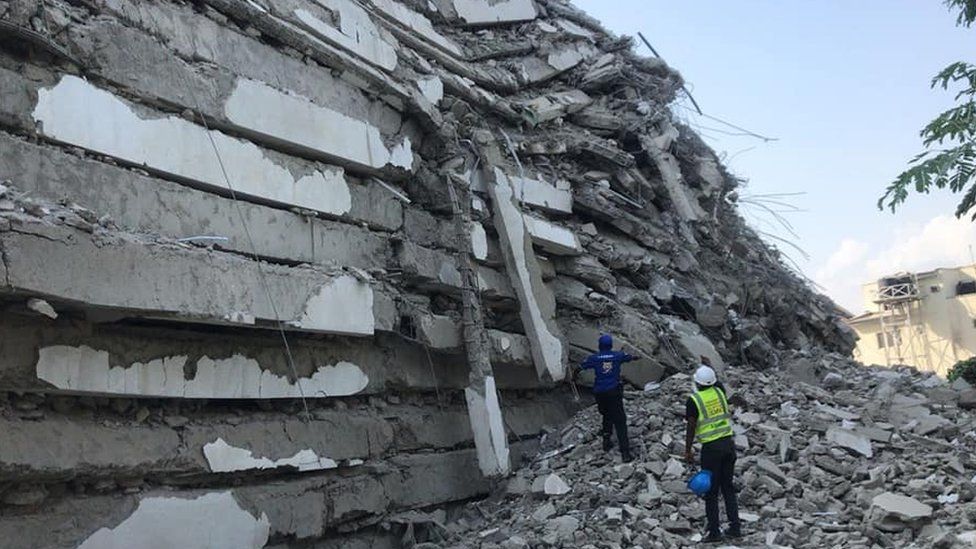
 Rescuers are searching for survivors in the wreckage of a 22-storey high-rise block that collapsed under construction in Nigeria’s largest city, Lagos.

Nigeria building collapse: Race to find survivors as dozens still missing

At least five people have died and dozens are missing.

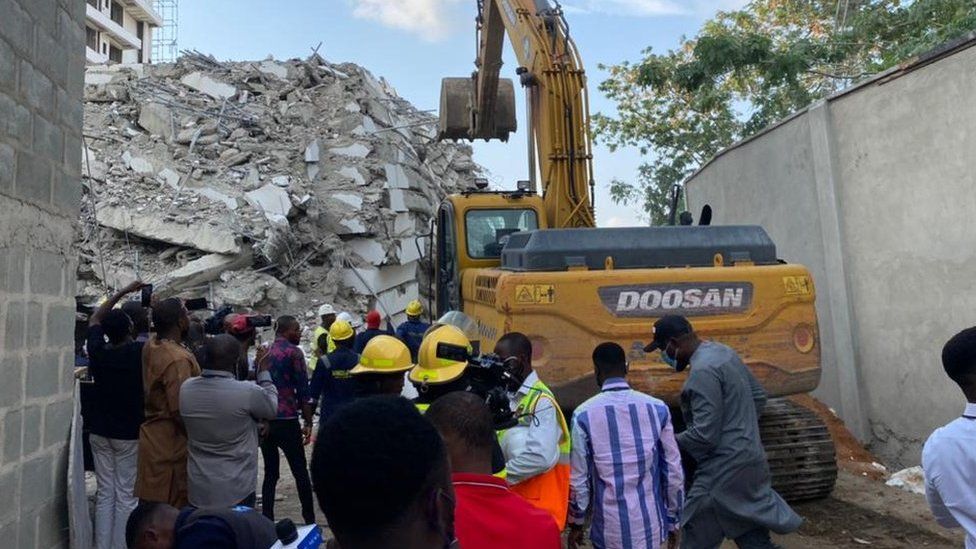
As they worked through the night, rescue workers and some locals scoured through a mound of rubble and twisted metal. Four survivors have been pulled from the wreckage.

The partially built block of luxury apartments came down on Monday.

What caused the collapse and exactly how many people are trapped under the rubble remains unclear.

In the meantime, local authorities have ordered an investigation into the collapse and pledged to make the final report public.

Nigeria building collapse: Race to find survivors as dozens still missing

Femi Adesina, a special advisor to President Muhammadu Buhari, said the president “commiserates with families who have lost loved ones”.

He added that the president had urged the authorities to step up their rescue efforts.

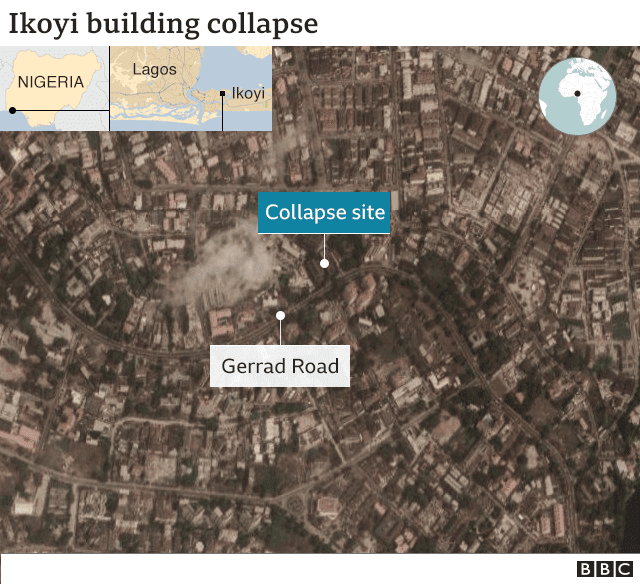
The building came down at around 14:45 local time (13:45 GMT) in the upmarket district of Ikoyi.

It was part of a complex named 360 Degrees Towers, which was intended to house luxury apartments, townhouses and penthouses, according to the development’s website, which has since been taken offline.

The housing scheme is being developed by Fourscore Homes Limited, which has a portfolio of projects in the UK, US, South Africa, and other areas of Nigeria.

Construction worker Eric Tetteh, 41, told the Associated Press that his teams had been waiting for an excavator to arrive at the site when the building suddenly fell.

“Me and my brother, we escaped, but more people are there – more than 100 people,” he said.

A witness who was working in an office building opposite the site told the BBC’s Outside Source programme that he heard a sound, looked out of his window, and “saw the building literally going down floor by floor.”

Local authorities have put an emergency rescue plan into place, and local officials have visited the site.

But according to AP, Lagos’ deputy governor Femi Hamzat was met by crowds of angry people who accused authorities of not starting rescue efforts soon enough.

Some reports say the building, which had more than 20 storeys, was several floors higher than originally intended.

Nigeria building collapse: Race to find survivors as dozens still missing
One witness told the BBC he saw the building collapse “floor by floor”

There have been several building collapses in Lagos in recent years.

In 2019, 10 people died after a school collapsed in the commercial hub.

And in 2014, a six-storey building fell during a service by a celebrity televangelist, killing 116 people.

Building standards have often been criticised and Lagos state authorities recently launched a new scheme to improve certification.

Nigeria building collapse: Race to find survivors as dozens still missing

……………………………………………………………

Ethiopia tried to limit rare UN report on Tigray war abuses

 NAIROBI, Kenya (AP) — The findings of the only human rights investigation allowed in Ethiopia’s blockaded Tigray region will be released Wednesday, a year after war began there. But people with knowledge of the probe say it has been limited by authorities who recently expelled a U.N. staffer helping to lead it.

Ethiopia tried to limit rare UN report on Tigray war abuses

And yet, with groups such as Human Rights Watch and Amnesty International barred from Tigray, along with foreign media, the report may be the world’s only official source of information on atrocities in the war, which began in November 2020 after a political falling-out between the Tigray forces that long dominated the national government and Prime Minister Abiy Ahmed’s current government. The conflict has been marked by gang rapes, mass expulsions, deliberate starvation and thousands of deaths.

The joint investigation by the U.N. human rights office and the government-created Ethiopian Human Rights Commission, or EHRC, is a rare collaboration that immediately raised concerns among ethnic Tigrayans, human rights groups and other observers about impartiality and government influence.

In response to questions from The Associated Press, the U.N. human rights office in Geneva said it wouldn’t have been able to enter Tigray without the partnership with the rights commission. Although past joint investigations occurred in Afghanistan and Uganda, the U.N. said, “the current one is unique in terms of magnitude and context.”

But Ethiopia’s government has given no basis for expelling U.N. human rights officer Sonny Onyegbula last month, the U.N. added, and without an explanation “we cannot accept the allegation that our staff member … was ‘meddling in the internal affairs’ of Ethiopia.”

Because of those circumstances, and the fact that the U.N. left the investigation to its less experienced regional office in Ethiopia, the new report is “automatically suspect,” said David Crane, founder of the Global Accountability Network and founding chief prosecutor for the Special Court for Sierra Leone, an international tribunal.

“What you need when you go into an atrocity zone is a clean slate so outside investigators can look into it neutrally, dispassionately,” Crane said. “You want to do these things where you don’t build doubt, distrust from the beginning,” including among people interviewed.

The investigation might be the international community’s only chance to collect facts on the ground, he said, but because of its setup, it may disappear “in the sands of time.”

People close to the investigation, speaking on condition of anonymity for fear of retaliation, asserted that the head of the Ethiopian Human Rights Commission, Daniel Bekele, underplayed some allegations that fighters from the country’s Amhara region were responsible for abuses in Tigray and pressed instead to highlight abuses by Tigray forces.

That’s even though witnesses have said the perpetrators of most abuses were soldiers from neighboring Eritrea, Ethiopian forces and Amhara regional forces.

In response to AP’s questions, Bekele asserted his commission’s independence, saying it is “primarily accountable to the people it is created to serve.” Attempts to influence the investigation, he added, can come from ”many directions” in such a polarized environment.

Bekele said he and the commission have consistently cited “serious indications that all parties involved in the conflict have committed atrocities.”

Observers say a major shortcoming of the investigation is its failure to visit the scene of many alleged massacres in Tigray, including the deadliest known one in the city of Axum, where witnesses told the AP that several hundred people were killed.

Bekele said the investigation lacked the support of the Tigray authorities now administering the region after Tigray forces retook much of the area in June, about midway through the joint team’s work.

The U.N. human rights office, however, said the government’s subsequent severing of flights and communications from Tigray during the planned investigation period made it difficult to access key locations, both “logistically and from a security point of view.”

Even the interim Tigray authorities hand-picked by Ethiopia’s government to run the region earlier in the war rejected the joint investigation, its former chief of staff, Gebremeskel Kassa, told the AP.

“We informed the international community we wanted an investigation into human rights but not with the EHRC because we believe this is a tool of the government,” he said.

The U.N. has said Ethiopia’s government had no say in the report’s publication, though it was given the chance to read the report in advance and to point out “anything it believes to be incorrect.”

Late last week, Ethiopia’s government and a diaspora group released the results of their own investigations focusing on alleged abuses by Tigray forces after they entered the neighboring regions of Amhara and Afar four months ago in what they called an effort to pressure the government to end its blockade on Tigray.

The ministry of justice said it found 483 non-combatants were killed and 109 raped in parts of Amhara and Afar that were recaptured by federal forces in recent weeks. It also found “widespread and systematic looting” of schools, clinics, churches, mosques and aid groups’ offices.

A separate report by the Amhara Association of America said it found that 112 people were raped in several districts covered by the ministry’s findings. The diaspora group drew on data from offices of women’s and children’s affairs as well as interviews with witnesses, doctors and officials.

The diaspora group asserted that the Tigray forces “committed the rapes as revenge against ethnic Amharas, whom they blame as responsible for abuses in their home region.”

The spokesman for the Tigray forces, Getachew Reda, said the allegations aren’t worth “the paper they’re written on.” Accusations of rapes and killings by Tigray forces are “absolutely untrue, at least on a level these organizations are alleging,” he said.

…………………………………………………………

Monday, 1 November 2021

The limits on Biden’s power to help save the planet


When Joe Biden takes to the stage in Glasgow later to deliver his speech to COP26, you can be sure he will want to underline one thing.

Just as he did at his news conference last night in Rome at the G20, he will set out his green credentials; American leadership on climate change.

He can point to a gargantuan spending bill about to go before Congress, which has an eye-watering $555bn for clean energy credits and incentives. It will be the biggest investment in US history to tackle global warming.

But, but, but – this legislation hasn’t yet been passed because he’s not sure he’s got the votes.

One of the most significant proposals – a programme that would reward power companies for moving away from fossil fuels and penalising those who don’t – was nixed by a Democratic senator from West Virginia coal country, Joe Manchin.

The failure to make progress on this legislation has been frustrating as hell for the White House, who wanted to have the measures passed before Air Force One arrived in Italy.

It doesn’t exactly give the president added leverage over his counterparts. How much moral force is there in saying “look what I would do, if I only had the votes..?”

There was something else in the Rome news conference which made my internal ironymeter hit 10, and it perfectly encapsulates the drag imposed on the US president’s green ambitions.

Whilst attempting to show his leadership on climate, Biden was at the same time trying to persuade the OPEC oil producers to increase production, so as to keep petrol prices down for US consumers.

Drivers are up in arms that they’re having to pay over $3 a gallon. Perhaps Biden should organise for them to visit a few British petrol stations to make Americans thank their lucky stars.

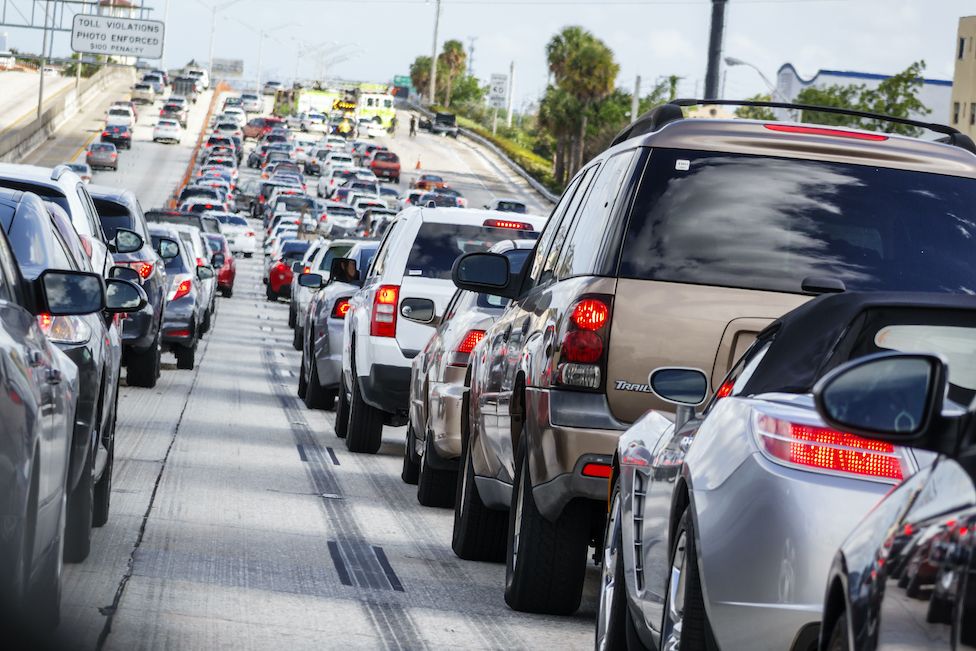
Traffic jam in Los AngelesIMAGE SOURCE,GETTY IMAGES
Image caption,The car is still king in the US

The US is a country where there is an obsession about weather – and it gets a huge amount of it – tornadoes, polar vortexes, hurricanes, eviscerating heatwaves and on and on.

But that is not matched by a similar interest in climate – even though the country has been experiencing the worst wildfires in history, flood- inducing hurricane seasons, freezing temperatures in Texas and on and on.

But this is where I want to widen the lens.

What President Biden is contending with has its own variation for any number of world leaders who were in Rome and will be heading to Glasgow.

There are parliaments, national assemblies and senates which won’t back what their prime minister or president might want. There are electorates who might just punish the politician who pushes for measures that might threaten their jobs, or increase fuel prices.

In the language that came out of the final communique from the G20 there was plenty of recognition of the urgency of keeping climate change to 1.5 degrees Celsius; of being “net-zero” by 2050. But the concrete measures to accompany the noble rhetoric? Well they were harder to find in the final document.

Maybe Glasgow will see the world’s leaders stop behaving like politicians and embrace every measure that the climate activists are demanding. But for better or worse, they will be thinking about how easy the measures will be to sell, whether their country is being put at a competitive disadvantage, whether by adopting radical measures they are opting for self-extinction.

A real projection of US power rolled past me in Rome as Joe Biden’s motorcade – complete with 85 vehicles – made its way to St Peter’s Square.

The US is still the most powerful country in the world – and the US president its most powerful man.

But for all that might, he hasn’t been able to strongarm one recalcitrant senator from West Virginia. And there’ll be a lot weaker leaders than him in Glasgow over the next two weeks.

……………………………………………………………

THE global death toll from Covid-19 topped 5 million on Monday, less than two years

It rivals the number of people killed in battles among nations since 1950, according to estimates from the Peace Research Institute Oslo. Globally, Covid-19 is now the third leading cause of death, after heart disease and stroke


THE global death toll from Covid-19 topped 5 million on Monday, less than two years into a crisis that has not only devastated poor countries but also humbled wealthy ones with first-rate health care systems.


Together, the United States, the European Union, Britain and Brazil — all upper-middle- or high-income countries — account for one-eighth of the world’s population but nearly half of all reported deaths. The US alone has recorded more than 740,000 lives lost, more than any other nation.

‘This is a defining moment in our lifetime,’ said Dr. Albert Ko, an infectious disease specialist at the Yale School of Public Health. ‘What do we have to do to protect ourselves so we don’t get to another 5 million?’

The death toll, as tallied by Johns Hopkins University, is about equal to the populations of Los Angeles and San Francisco combined. It rivals the number of people killed in battles among nations since 1950, according to estimates from the Peace Research Institute Oslo. Globally, Covid-19 is now the third leading cause of death, after heart disease and stroke.

The staggering figure is almost certainly an undercount because of limited testing and people dying at home without medical attention, especially in poor parts of the world, such as India.

Hot spots have shifted over the 22 months since the outbreak began, turning different places on the world map red. Now, the virus is pummeling Russia, Ukraine and other parts of Eastern Europe, especially where rumours, misinformation and distrust in government have hobbled vaccination efforts. In Ukraine, only 17 percent of the adult population is fully vaccinated; in Armenia, only 7 percent.

‘What’s uniquely different about this pandemic is it hit hardest the high-resource countries,’ said Dr. Wafaa El-Sadr, director of ICAP, a global health centre at Columbia University. ‘That’s the irony of Covid-19.’

Wealthier nations with longer life expectancies have larger proportions of older people, cancer survivors and nursing home residents, all of whom are especially vulnerable to Covid-19, El-Sadr noted. Poorer countries tend to have larger shares of children, teens and young adults, who are less likely to fall seriously ill from the coronavirus.

India, despite its terrifying delta surge that peaked in early May, now has a much lower reported daily death rate than wealthier Russia, the US or Britain, though there is uncertainty around its figures.

The seeming disconnect between wealth and health is a paradox that disease experts will be pondering for years. But the pattern that is seen on the grand scale, when nations are compared, is different when examined at closer range. Within each wealthy country, when deaths and infections are mapped, poorer neighbourhoods are hit hardest.

In the US, for example, Covid-19 has taken an outsize toll on Black and Hispanic people, who are more likely than white people to live in poverty and have less access to health care.

‘When we get out our microscopes, we see that within countries, the most vulnerable have suffered most,’ Ko said.

Wealth has also played a role in the global vaccination drive, with rich countries accused of locking up supplies. The US and others are already dispensing booster shots at a time when millions across Africa haven’t received a single dose, though the rich countries are also shipping hundreds of millions of shots to the rest of the world.

Africa remains the world’s least vaccinated region, with just 5 percent of the population of 1.3 billion people fully covered.

‘This devastating milestone reminds us that we are failing much of the world,’ UN Secretary-General António Guterres said in a written statement. ‘This is a global shame.’

In Kampala, Uganda, Cissy Kagaba lost her 62-year-old mother on Christmas Day and her 76-year-old father days later.

‘Christmas will never be the same for me,’ said Kagaba, an anti-corruption activist in the East African country that has been through multiple lockdowns against the virus and where a curfew remains in place.

The pandemic has united the globe in grief and pushed survivors to the breaking point.

‘Who else is there now? The responsibility is on me. Covid has changed my life,’ said 32-year-old Reena Kesarwani, a mother of two boys, who was left to manage her late husband’s modest hardware store in a village in India.

Her husband, Anand Babu Kesarwani, died at 38 during India’s crushing coronavirus surge earlier this year. It overwhelmed one of the most chronically underfunded public health systems in the world and killed tens of thousands as hospitals ran out of oxygen and medicine.

In Bergamo, Italy, once the site of the West’s first deadly wave, 51-year-old Fabrizio Fidanza was deprived of a final farewell as his 86-year-old father lay dying in the hospital. He is still trying to come to terms with the loss more than a year later.

‘For the last month, I never saw him,’ Fidanza said during a visit to his father’s grave. ‘It was the worst moment. But coming here every week, helps me.’

Today, 92 percent of Bergamo’s eligible population have had at least one shot, the highest vaccination rate in Italy. The chief of medicine at Pope John XXIII Hospital, Dr. Stefano Fagiuoli, said he believes that’s a clear result of the city’s collective trauma, when the wail of ambulances was constant.

In Lake City, Florida, LaTasha Graham, 38, still gets mail almost daily for her 17-year-old daughter, Jo’Keria, who died of COVID-19 in August, days before starting her senior year of high school. The teen, who was buried in her cap and gown, wanted to be a trauma surgeon.

‘I know that she would have made it. I know that she would have been where she wanted to go,’ her mother said.

In Rio de Janeiro, Erika Machado scanned the list of names engraved on a long, undulating sculpture of oxidized steel that stands in Penitencia cemetery as an homage to some of Brazil’s Covid-19 victims. Then she found him: Wagner Machado, her father.

‘My dad was the love of my life, my best friend,’ said Machado, 40, a saleswoman who travelled from Sao Paulo to see her father’s name. ‘He was everything to me.’

……………………………………………………

Zimbabwean ruling party endorses Mnangagwa as presidential candidate for 2023 elections

According to the state-run Sunday Mail newspaper, the party’s acting spokesperson Mike Bimha said the decision to endorse Mnangagwa was unanimous


ZIMBABWE’S ruling ZANU-PF party has endorsed president Emmerson Mnangagwa as the party’s presidential candidate for the 2023 elections.


Mnangagwa’s candidacy was endorsed by all the party wings after considering the work he had undertaken to develop the country since winning the 2018 harmonized elections.

The endorsement was made at the party’s annual conference which ended Saturday in the town of Bindura, about 60 km north of Harare.

According to the state-run Sunday Mail newspaper, the party’s acting spokesperson Mike Bimha said the decision to endorse Mnangagwa was unanimous.

‘I want to advise you that all the organs and wings of the party have endorsed President Mnangagwa (as the 2023 presidential candidate). This was the main resolution,’ Bimha told the newspaper after the meeting.

Bimha said the conference resolved to re-energize the party in preparation for the 2023 elections.

The party also undertook to discipline members who engaged in violence and other vices such as corruption and abuse of office.

……………………………………………………

Igor Kirillov: TV man known as the face of the USSR dies at 89


Igor Kirillov – the man known as the face and voice of the USSR for three decades – has died in Russia aged 89.

Kirillov was Soviet TV’s chief newsreader and announcer.

With his trademark delivery – unhurried and calm – he informed viewers of the first sputnik in space, and delivered the communiqués of the Communist Party.

He also anchored all major Soviet set-piece events: from Moscow’s Red Square parades to communist congresses. The Soviet Union collapsed in 1991.

Soviet Union timeline

Positive stories dominated Soviet news bulletins. Every year, to images of combine harvesters advancing through the fields, Igor Kirillov would declare the grain harvest a triumph.

But did he believe it?

“For me the hardest thing of all was to believe what I was reading out,” Igor Kirillov told me in an interview in 2011.

“Deep down I knew that the texts contained half-truths. But as a newsreader you had to convince yourself it was the complete truth. And I did. I persuaded myself that we really were building communism. That life really would get better. Any doubts I had I managed to overcome. If I hadn’t then I wouldn’t have been able to do my job.”

The news wasn’t always good.

In the 1980s Soviet leaders got into the nasty habit of dying in rapid succession. It was a sombre Igor Kirillov who informed the country of their passing.

It happened so often, in fact, that it sparked this famous Soviet joke: Igor Kirillov goes on air in a black tie and announces: “Comrades, you’re going to laugh, but another irreplaceable leader needs replacing.”

He had trained as an actor. So how did he break into television?

Journalists ‘read too fast’

“At the job interview, I played the guitar and sang,” he told me. “Then they asked me to read something out. Luckily the night before I’d memorised a copy of the newspaper Pravda. So I recited that, right off the top of my head. Afterwards as I was leaving the building, the chief stopped me. ‘Where are you going?’ he said. ‘You’ve got the job and you’re on air in two hours’.”

The communist newscaster had other jobs, too. He presented Soviet TV’s version of Top of the Pops. It was a little more Lenin than Paul McCartney.

In 1985 he became a global chart-topper, with a little help from Sting, whose hit song Russians kicks off with Igor Kirillov’s voice reading the news.

By the late 1980s television news was changing around the world. Journalists were replacing professional announcers as newsreaders. The USSR was no exception. Soviet TV revamped its nightly news. In came reporters… out went the “dyktory”.

In 1990, during a study year in Moscow, I interviewed Igor Kirillov for a university project. The Soviet Union’s most famous announcer was having a difficult time.

“I read the news for 20 two years on the nightly news Vremya,” he told me. “Now they’ve decided not to use ‘diktory’. There’s a condescending, disdainful attitude now towards announcers.”

He thought that journalists who became anchors delivered the news too fast.

“Russians don’t like fast talking. They have their own way of conversing: in a calm, unhurried, thoughtful way.

……………………………………………………

A Ciência e a Inteligência Artificial estão a dar vida às memórias!

A Inteligência Artificial já consegue transformar fotografias antigas em experiências visuais surpreendentes Hoje, testemunhamos como a ciên...