Translate

Thursday, 14 October 2021

Russia denies weaponising energy amid Europe gas crisis

 Russia has denied using energy as a political weapon, amid surging prices across Europe that have sent gas bills in many households skyrocketing.

Russia denies weaponising energy amid Europe gas crisis

Russia, one of Europe’s biggest natural gas providers, has been accused of intentionally withholding supplies.

President Vladimir Putin said such claims were “complete rubbish… and politically motivated tittle-tattle”.

The European Commission has been outlining measures member states can take to combat rising prices.

The wholesale price of gas has increased by 250% since January, triggering a knock-on spike in costs for consumers and businesses.

Energy prices have hit record highs for various reasons, including high demand for natural gas as economies recover from the Covid-19 pandemic.

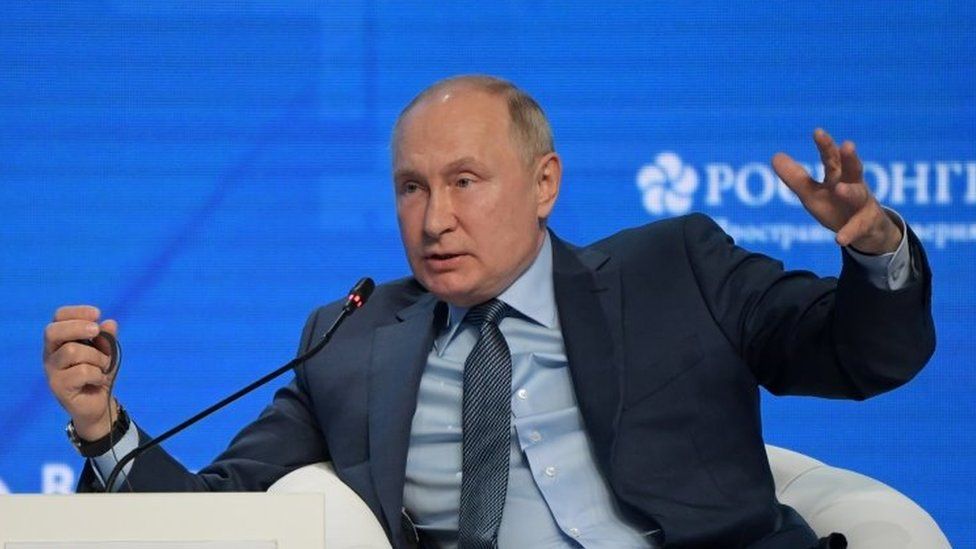
Russian President Vladimir Putin speaks at an energy forum in Moscow, Russia. Photo: 13 October 2021IMAGE SOURCE,REUTERS
Image caption,President Putin said Russia was ready to provide more gas to Europe if requested

‘There is no refusal, none’ – Putin

Speaking at a Moscow energy forum on Wednesday, President Putin blamed the current crisis on Europe, saying that after a cold winter Europeans had not pumped sufficient volumes of gas into storage facilities.

He said it was “very important” to “suggest a long-term mechanism to stabilise the energy market”.

Mr Putin stressed that Gazprom, Russia’s gas giant, was supplying gas to Europe at maximum levels under existing contracts, and was ready to provide more if requested.

“We will increase by as much as our partners ask us. There is no refusal, none,” he said.

Analysis box by Steve Rosenberg, Moscow correspondent

Europe’s gas crisis has multiple causes: from a shortfall in renewable energy to low gas stocks after a cold winter. Plus, a surge in demand as countries emerge from the pandemic.

But could another factor be Russia?

In recent weeks Moscow has faced accusations that it has contributed to the crisis and forced gas prices higher by declining to supply additional gas to Europe.

“Politically motivated tittle-tattle,” says President Putin.

But the International Energy Agency believes Russia could do more to increase gas availability to Europe.

Kremlin critics suspect it is using the crisis to fast track European approval for Russia’s controversial new pipeline.

When European regulators sign the paperwork, Nord Stream 2 will carry natural gas from Russia to Germany, bypassing Ukraine.

Opponents of the pipeline believe it is a political project designed to increase Europe’s dependency on Russian energy. Supporters insist it will provide Europe with a cheaper and more efficient supply of gas.

On Wednesday, Vladimir Putin insisted Nord Stream 2 was “a commercial project”.

That was followed by a not so subtle hint. The president said he was “100% certain” that if the pipeline was functioning, that would ease Europe’s energy problems.

What about the new EU measures?

Earlier on Wednesday, the European Commission’s energy chief, Kadri Simson, said the EU’s executive was responding to calls for urgent action by unveiling an “energy price toolbox”.

The toolbox outlines steps member states can take to reduce energy bills in their countries without breaching EU law. It mostly confirms the measures national governments can already use, but considers what more the Commission can do.

Ms Simson said member states were best placed to ease the burden of rising energy prices as winter approaches.

She urged them to consider emergency income support for vulnerable households, state aid for companies, and targeted tax reductions.

She also advised member states to temporarily pause bill payments where necessary, and put in place safeguards to avoid disconnections from the grid.

“Rising global energy prices are a serious concern for the EU,” Ms Simson said. “As we emerge from the pandemic and begin our economic recovery, it is important to protect vulnerable consumers and support European companies.”

On top of those measures, Ms Simson said the Commission would look into the possible benefits of EU countries jointly buying natural gas.

She said countries could collectively buy gas to form a strategic reserve. But, like the joint scheme to buy Covid vaccines, participation would be voluntary.

The idea was proposed recently by governments that want more EU intervention, such as Spain.

All member states were encouraged to use the EU’s €750bn (£636bn; $867bn) Covid-19 recovery fund to invest in clean energy to meet the bloc’s climate targets.

“We are not facing a surge because of our climate policy,” Ms Simson said. “Fossil fuel prices are spiking. We need to speed up the green transition, not slow it down.”

………………………………………………………………

South Africa launches initiative to attract tourists

 Johannesburg, Oct. 13, (Xinhua/GNA) – South Africa has launched its Global Advocacy Program in hopes of attracting tourists from the country’s target markets.

South Africa launches initiative to attract tourists

The program was initiated by the Department of Tourism, South African Tourism (SA Tourism) and the Tourism Business Council of South Africa (TBCSA), following protracted damaging narratives and misinformation reported globally about South Africa.

“We are going to embark on a strategic yet direct approach to our markets to ensure that consumers, trade partners and the global media are truthfully informed about the memorable and affordable, easy accessibility and safety factors that come with traveling to South Africa in this COVID-19 environment,” said Minister of Tourism Lindiwe Sisulu.

She said that they have briefed various missions and embassies about the COVID-19 situation in the country and what they have done, adding that the country wanted to tell the world that they are ready to welcome them for leisure and business events.
The TBCSA CEO Tshifhiwa Tshivhengwa said the plan is to disseminate the correct information about the country and reignite tourism.

“Our inbound tourism recovery is dependent on the attractiveness of our brand as a tourist destination.

The Global Advocacy Program will help to rebuild our country’s brand and this will ultimately attract more tourists to visit our beautiful country. The recovery and re-imagination of tourism in South Africa will benefit with the successful implementation of this programme globally,” said Tshivhengwa.

South Africa has recently been taken off the red lists of key markets such as the USA, Netherlands, UK, as well as Germany, which will serve as a major boost for the struggling tourism sector.
GNA

………………………………………………………………

Wednesday, 13 October 2021

Liberia teenage taxi rider praised for returning cash


A Liberian teenage motorcycle taxi rider has become a national hero after he found and returned $50,000 (£37,000) that had gone missing from a prominent businesswoman in north-eastern Nimba County on the border with Ivory Coast.


The young man, Emmanuel Tolue, saw the money wrapped in a plastic bag on a highway and heard the owner, Musu Yancy, desperately making a radio appeal to anyone coming across the cash.

He then let her know he had found it in the presence of local officials.

Ms Yancy told the BBC she and her boss have rewarded the cyclist with $1,500 (£1,100) and other gifts.

She was so happy and relieved about getting the money back she has almost lost her voice thanking God.

As people sing the praise of the motorcyclist, well-wishers have been pouring into the home of the lady in the town of Tappita in celebration.

Such gestures are exceptionally unusual in post-war Liberia.

………………………………………………

Former Health Secretary Matt Hancock given United Nations role


Former Health Secretary Matt Hancock has been given a role with the United Nations as a special representative.

Writing on Twitter, the ex-minister said the job would focus on helping Africa’s economy recover from Covid.

It comes four months after Mr Hancock resigned from his cabinet post for breaking social distancing guidelines by kissing a colleague.

The Under Secretary General of the UN, Vera Songwe, praised his “success” in tackling the UK’s pandemic response.

In a letter posted online by Mr Hancock, Ms Songwe said the “acceleration of vaccines that has led the UK move faster towards economic recovery is one testament to the strengths that you will bring to this role, together with your fiscal and monetary experience”.

The announcement also comes on the day a report from MPs was published, claiming the government and its scientists’ failure to do more to stop Covid spreading early in the pandemic was one of the country’s worst public health failures.

Did Matt Hancock break the law?

Matt Hancock: High profile former health secretary

How will Covid-19 affect African economies?

Mr Hancock’s official title will be “UN special representative on financial innovation and climate change for the United Nations Economic Commission for Africa”.

The Conservative MP said he was “honoured” to be appointed and would help “promote sustainable development”, alongside working on the economic recovery.

Ms Songwe said the UN had been working with people across the world on Africa’s climate actions and resilient recovery – and that she wanted to appoint Mr Hancock “given your global leadership, advocacy reach and in depth understanding of government processes through your various ministerial cabinet roles”.

She added: “The role will support Africa’s cause at the global level and ensure the continent builds forward better, leveraging financial innovations and working with major stakeholders like the G20, UK government and COP26.”

In his acceptance letter, which he also posted on Twitter, Mr Hancock wrote: “As we recover from the pandemic so we must take this moment to ensure Africa can prosper.”

The chair of the Foreign Affairs Select Committee, Conservative MP Tom Tugendhat, said it was a “fascinating and important appointment”.

He added: “Boosting the economies of Africa is one of the most essential tasks of this generation.”

……………………………………………………

Humans used tobacco 12,300 years ago, new discovery suggests


Four charred tobacco plant seeds found in an ancient Utah fireplace suggest early Americans may have been using the plant 12,300 years ago.

The finding makes the first known use of tobacco some 9,000 years earlier than previously thought.

Researchers believe hunter-gatherers in the Great Salt Lake Desert may have sucked or smoked wads of the plant.

Until now, the earliest evidence of tobacco use was a 3,300-year-old smoking pipe discovered in Alabama.

Archaeologists discovered the millimetre-wide seeds at the Wishbone site, an ancient camp in the desert in what is now northern Utah.

There, they found the remnants of an ancient hearth that was surrounded by bone and stone artefacts. These included duck bones, stone tools, and a spear-tip bearing the remains of blood from a mammoth or an early form of elephant.

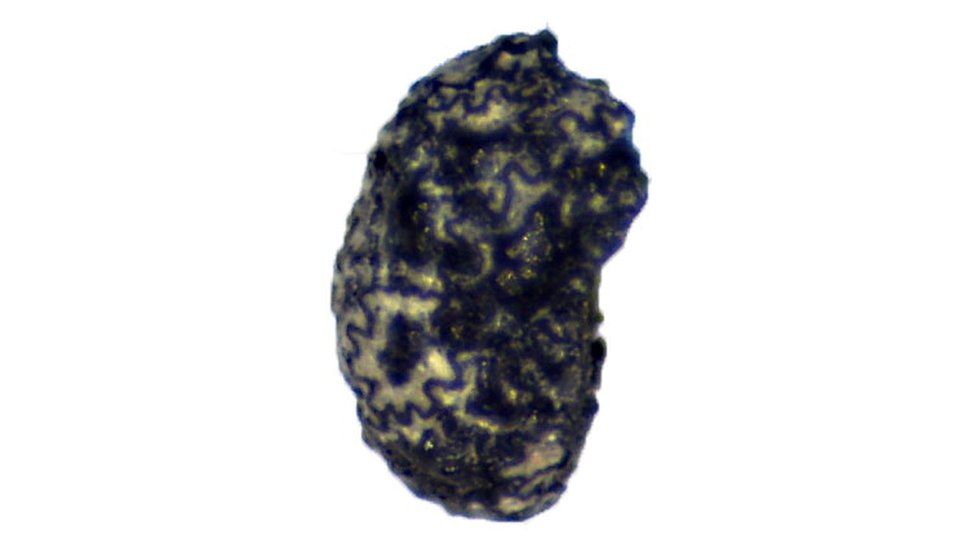
The charred remains of one of the tobacco plant seedsIMAGE SOURCE,REUTERS
Image caption,The charred remains of one of the tobacco plant seeds

Their findings suggest the native American hunter-gatherers may have consumed the tobacco while cooking or toolmaking, the scientists say in a paper published in the journal Nature Human Behaviour.

The tobacco plant is native to the Americas and contains the psychoactive addictive substance nicotine.

Tobacco was widely cultivated and dispersed around the world following the arrival of Europeans in the Americas at the end of the 15th Century.

“The tobacco seeds were the big surprise. They are incredibly small and rare to be preserved,” Daron Duke of the Far Western Anthropological Research Group told the New Scientist.

“This suggests that people learned the intoxicant properties of tobacco relatively early in their time here rather than only with domestication and agriculture thousands of years later.”

Today, the Great Salt Lake Desert is a large dry lake. But 12,300 years ago, the camp would have been on a vast marshland.

“We know very little about their culture,” Mr Duke said of the hunter-gatherers. “The thing that intrigues me the most about this find is the social window it gives to a simple activity in an undocumented past. My imagination runs wild.”

…………………………………………………

Iraq election: Nationalist cleric Moqtada al-Sadr claims victory


Shia Muslim cleric Moqtada al-Sadr has claimed victory for his nationalist Saeroun movement in Iraq’s election.

Mr Sadr, who wants to end US and Iranian influence over Iraq’s internal affairs, promised to form a government free from foreign interference.

Partial results showed Saeroun winning 73 of the 329 seats in parliament and Sunni Speaker Mohammed al-Halbousi’s Taqaddum coalition second with 38.

The pro-Iranian Fatah alliance suffered a surprise setback, getting only 14.

It is likely to take many weeks of negotiations to build a new governing coalition, which Mr Sadr cannot lead because he did not stand as a candidate.

But the record low official turnout of 41% suggests many Iraqis do not believe that there will be any real change to the power-sharing system, based on sectarian and ethnic identity, that has allowed a narrow elite to keep a firm grip on power since the US-led invasion in 2003.

Sunday’s election was the first since mass protests over government corruption, high unemployment and dire public services erupted in 2019.

The poll had been due next year but was brought forward by six months in response to the unrest, during which more than 550 demonstrators were killed by security forces and gunmen suspected of links to powerful Iran-backed Shia militias in the paramilitary Popular Mobilisation force.

The old electoral system was also replaced with one meant to make it easier for independent candidates to challenge established parties.

Initial results released on Monday night showed that Saeroun won 19 more seats than it did in the last election in 2018, the state-owned Iraq News Agency (INA) reported.

Mr Sadr hailed the results as a victory for reform and for Iraq.

“It is the day of the victory of reform over corruption. The day of the people’s victory over occupation, normalisation, militias, poverty, injustice and enslavement,” he said in a televised speech.

“It is a day when sectarianism, ethnicity and partisanship were defeated. It is the day of Iraq and we are the servants of the Iraqi people.”

The cleric warned foreign powers that all embassies would be welcomed “as long as they do not interfere in Iraq’s internal affairs and the formation of the government”, and that any intervention would be “met with a diplomatic or even a popular response”.

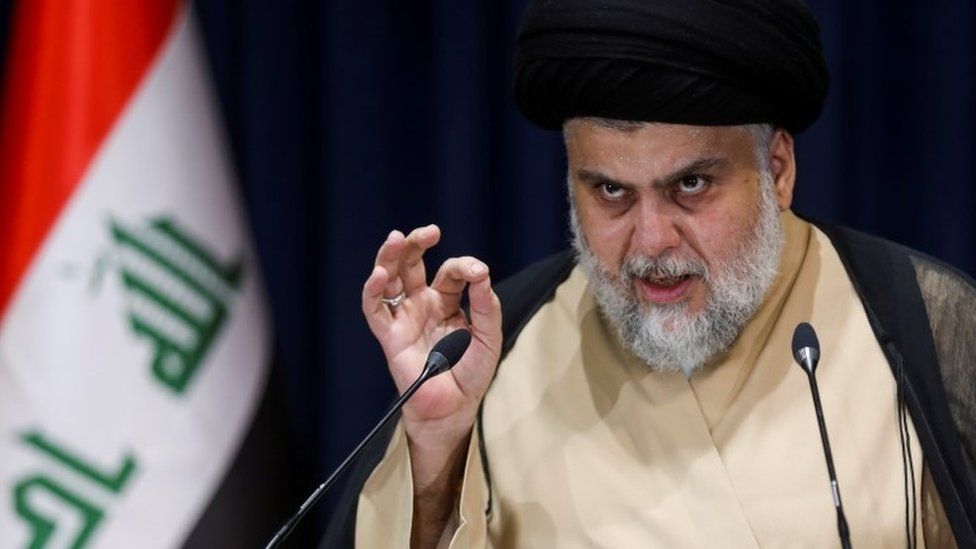
Moqtada al-Sadr speaks after the initial results of Iraq's election were announced (11 October 2021)IMAGE SOURCE,REUTERS
Image caption,Moqtada al-Sadr cannot serve as prime minister because he did not stand in the election

Mr Sadr, 47, is one of the best-known and most powerful figures in Iraq.

A son of the late Grand Ayatollah Mohammed Sadeq al-Sadr, he shot to prominence after the 2003 invasion as a vocal opponent of the foreign occupation and the head of a militia that repeatedly clashed with US forces.

In recent years, he has recast himself as an anti-corruption campaigner and also distanced himself from Iran, vowing that he would “not leave Iraq in its grip”.

He has also criticised the Iran-backed militias, which have developed significant political and economic power since helping the Iraqi government defeat the Sunni jihadist group Islamic State in 2017.

Fatah leader Hadi al-Ameri, a militia commander with close ties to the hard-line leadership in Tehran, rejected the election results.

“We will not accept these fabricated results, whatever the price, and we will defend the votes of our candidates and voters with full force,” he was quoted as saying by Al-Sumaria TV on Tuesday.

…………………………………………………………

World Teachers’ Day 2026 - Dia Mundial dos Professores 2026

Standing with teachers: 60 years of protecting the profession, advancing its status and shaping our futures     On 5 October, we observed Wo...