Speaking on the BBC Politics Wales programme, UK Labour leader Sir Keir said: “My central purpose in the issue on the rules is simply to make sure that our Labour party is facing those working families, facing outwards rather than talking to ourselves.”
Cynon Valley MP Beth Winter, part of Labour’s Socialist Campaign Group found it “really troubling” internal wrangling was “overshadowing” the conference, which is being held in Brighton.
IMAGE SOURCE,PA MEDIA
image captionSir Keir said he wanted Labour to face outwards rather than be “talking to ourselves”
She said she feared attempts were being made to push through “undemocratic” rule changes during a time of “crisis”.
“We should be taking the fight to the Tories not having an internal fight, and I really hope in the conference, moving forward, we will be focusing on those transformative, progressive policies that need to happen,” Ms Winter said.
“We must unite together as a party, which I know we can, and develop those progressive policies.”
But Ms Winter said she was “concerned” Labour would struggle to win the next general election, as there was a “lack of radical, progressive policies” in Sir Keir’s essay.
She said: “There has been a shift away from the pledges that he made when he was elected – a progressive tax system, raising a wealth tax, raising corporation tax, renationalisation of utilities, radical devolution of power throughout the UK nations.”
image captionStephen Kinnock said the annual conference was about showing Labour was serious about winning power
On BBC Radio Wales’ Sunday Supplement, Stephen Kinnock denied the row over the party’s rules was self-indulgent.
This was because the way Labour functions “sends a really important message to the country about the party that we want to be”.
The Aberavon MP added: “This conference is all about showing that Labour is serious about being a party of government and every aspect of our rulebook should reflect that.
“It should show that we’re reaching out to the country.”
Emerging from the conference, he said, were “meaty” policy proposals which would “change the face of our country”.
The transport secretary said there was “plenty of fuel” and that he had checked with the six refineries and 47 storage centres in the country.
But the Petrol Retailers Association said that “between 50% and 90%” of its members’ forecourts are dry.
Mr Shapps told the BBC’s Andrew Marr said that a shortage of heavy goods vehicle (HGV) drivers was “not anything new” but said “irresponsible briefing” to the press following a meeting with road haulage groups had sparked a reaction from people.
The Mail on Sunday reported that someone from the Road Haulage Association had selectively leaked comments about HGV driver shortages at fuel firms.
But spokesman Rod McKenzie told BBC Radio 4’s Broadcasting House that it was “absolute nonsense” and said he had not been at the meeting.
A shortage of lorry drivers has caused problems for a range of industries in recent months, from supermarkets to fast food chains.
In recent days, some fuel deliveries have been affected, leading to lengthy queues at petrol stations – with reports of dozens of cars queuing in London by 07:00 BST on Sunday morning.
Supermarket Sainsbury’s said it was experiencing “very high demand for fuel”, while Morrisons said it was a “rapidly moving situation” and it was working hard to keep its pumps open.
Asda said it had put a £30 limit on fuel transactions and said that it had good levels of fuel supply.
Brian Madderson, chairman of the Petrol Retailers Association told BBC Radio 4’s The World This Weekend that the forecourts which were not dry were “partly dry and running out soon”.
“That is something which the government obviously are loathe to recognise,” he said. “There is plenty of fuel in this country but it is in the wrong place for the motorist.”
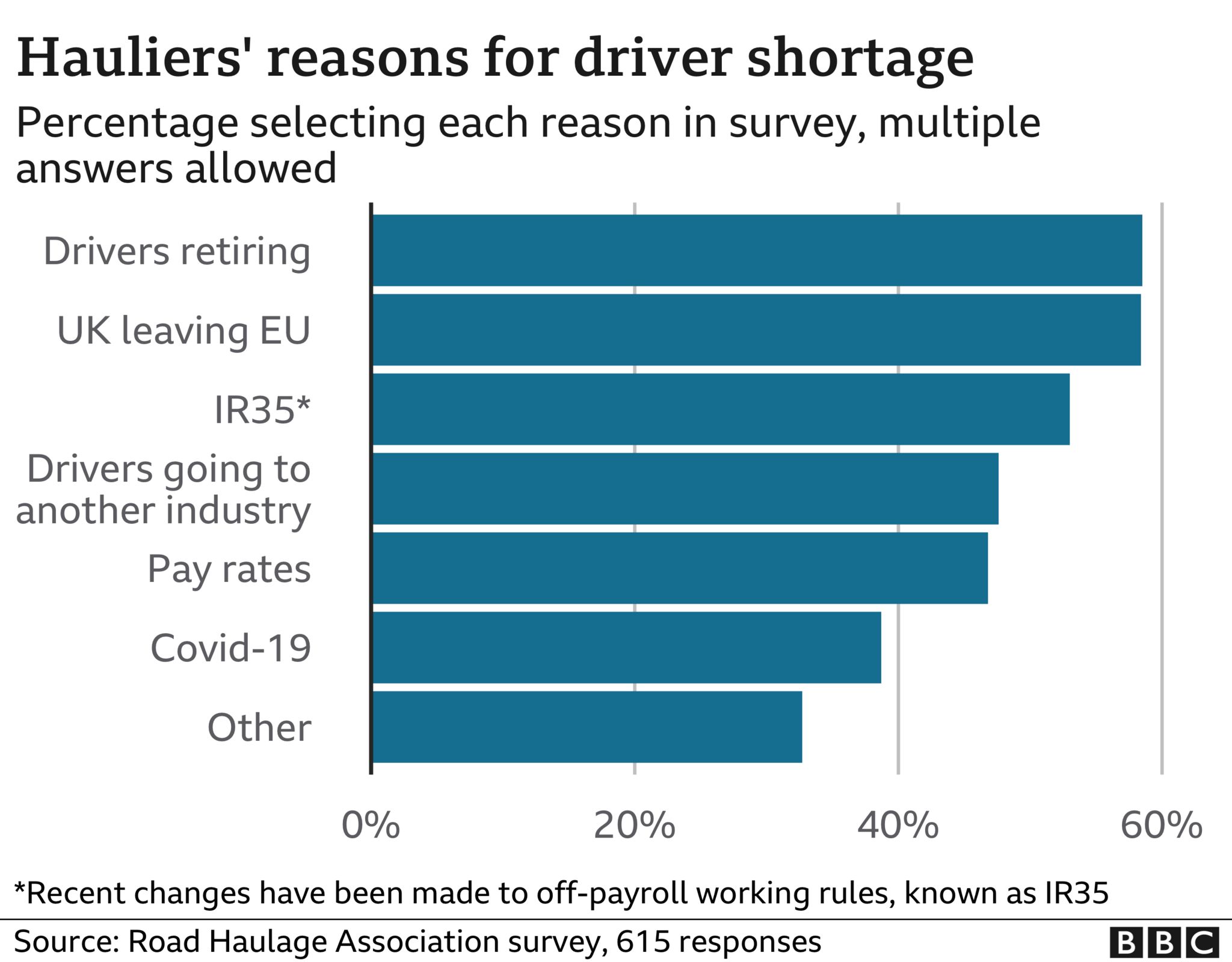
Freight industry group Logistics UK estimates that the UK needs about 90,000 HGV drivers – with existing shortages made worse by the pandemic, tax changes, Brexit, an ageing workforce, and low wages and poor working conditions.
Labour leader Sir Keir Starmer said the situation showed a “complete lack of planning” from the government.
He said the situation had been known about for years and said “we knew in particular that when we exited the EU there would be a need for a back-up plan to deal with the situation.”
He said Prime Minister Boris Johnson needed to say what he was going to do about the situation on Sunday.
Asked if he would bring in 100,000 foreign drivers, Sir Keir said: “We have to issue enough visas to cover the number of drivers that we need.”
IMAGE SOURCE,PA MEDIA
Under plans to limit supply disruption in the run up to Christmas up to 5,000 lorry drivers and 5,500 poultry workers could receive UK visas, the government announced on Saturday.
Logistics UK welcomed the policy calling it “a huge step forward in solving the disruption to supply chains”.
But the British Chambers of Commerce said the measures were the equivalent of “throwing a thimble of water on a bonfire”, while the Road Haulage Association said the announcement “barely scratches the surface”.
image captionA survey from earlier this year suggests a number of reasons for the driver shortage
Mr Shapps said the Covid pandemic had created a problem by preventing tests for new HGV drivers and Ministry of Defence examiners were being drafted in to help increase testing capacity.
He said he did not want to “undercut” British workers by bringing in foreign workers but could not “stand by and watch while queues are forming”.
Mr Shapps said the government did not want to be reliant on overseas labour in the long term but said he had acted to reassure people in the short term.
“I’m doing some things we wouldn’t necessarily have wanted to do because we believe in fixing this market for the long term so the drivers are paid better, and we welcome that – we think it is a good idea for drivers to be paid more and for conditions to be better,” he said.
While 5,000 temporary visas are being assigned for lorry drivers this is for supplying the food industry as well as fuel tankers.
Mr Shapps said there was not a “dramatic shortage in drivers” for the fuel industry with only “one, two, three hundred drivers” needed for distribution to petrol stations.
One of those who struggled to refill their car was Adrienne Kenny, from Cambridge, who needed to drive to Leeds for work on Monday.
She said she had tried three petrol stations on Saturday but “couldn’t get diesel anywhere” before trying another six without success on Sunday, leading her to postpone her meeting.
Recruitment for additional short-term HGV drivers and poultry workers will begin in October, with the visas valid until Christmas Eve.
Other measures include sending nearly one million letters to drivers who hold an HGV licence, seeking to encourage them back into the industry.
Poultry workers have also been included in the temporary visa scheme and turkey farmer Kate Martin has warned supermarkets could run out of birds before Christmas.
She said there were fewer turkeys being produced because because the big processors “know they will not get them processed”.
“Come Christmas, if you leave ordering your turkey from your local farm supplier, you are going to be out of luck,” she added.
Northern Ethiopia has been racked by more than 10 months of war that has left thousands dead.
One man said he counted 55 corpses as he escaped from his town in northern Ethiopia, stepping over bodies scattered in the streets. Another asserted he was rounded up with about 20 men who were shot in front of him. Yet others claimed Tigray forces went door-to-door killing men and teenage boys.
The allegations from the town of Kobo are the latest against Tigray forces as they push through the neighbouring Amhara region, in what they call an attempt to pressure Ethiopia’s government to end a 10-month war and lift a deadly blockade on their own home. Both Amhara and Tigrayan civilians have joined the fight, and calls by the United States and others for peace have had little effect as war spreads in one of Africa’s most powerful countries.
The accounts from Kobo are the most extensive yet of one of the deadliest known killings of Amhara in the war. The estimates of deaths there range from the dozens to the hundreds; it is not clear how many were killed in all or how many were fighters as opposed to civilians, a line that is becoming increasingly blurred.
The Associated Press news agency spoke with more than a dozen witnesses who were in Kobo during the killings, along with others who have family there. They said the fighting started on September 9 as a battle but quickly turned against civilians. At first, Tigray forces who had taken over the area in July fought farmers armed with rifles. But after the Tigray forces briefly lost and regained control of the town, they went door-to-door killing in retaliation, the witnesses said.
“We did our best, whether we die or kill, but what is heartbreaking is the massacre of innocent civilians,” said one wounded resident, Kassahun, who was armed. Like others who spoke to the AP after fleeing, he gave only his first name to protect family members still in town.
His account was echoed by a health worker who gave first aid to several wounded people. The health worker said Tigray forces withdrew from Kobo on the afternoon of September 9 and returned several hours later, once local militia units had run out of ammunition and retreated.
“Then the killing started,” he said, speaking on condition of anonymity for fear of retaliation.
The area of fighting is under a communications blackout, complicating efforts to verify accounts. Calls to the local administrator went unanswered. Ethiopia’s state-appointed Human Rights Commission this week said it had received “disturbing reports” of alleged “deliberate attacks against civilians in Kobo town and surrounding rural towns by TPLF fighters”.
The acronym stands for the Tigray People’s Liberation Front, which dominated Ethiopia’s repressive national government for 27 years but was sidelined by current Prime Minister Abiy Ahmed. What began as a political dispute erupted into war in November in the Tigray region, with thousands killed.
Senait Ambaw, left, who said her home had been destroyed by artillery, leaves by foot along a path near the village of Chenna Teklehaymanot, in the Amhara region of northern Ethiopia [File: AP]
While atrocities have been reported on all sides, the worst massacres recounted by witnesses have been against the civilians of Tigray, along with gang rapes and deliberate starvation. They were blamed on the Ethiopian government, Amhara fighters and Eritrean soldiers.
However, since the Tigray forces in June retook much of their region and entered Amhara, accusations have been piling up against them, too. Amhara civilians in multiple communities have alleged that the Tigray fighters are killing them in retaliation, as the war grows bigger and more complex.
Most allegations cannot be verified immediately, given a lack of access. But in September, the AP reached the scene of an alleged massacre in Chenna Teklehaymanot, where at least dozens of Amhara were reported killed, both fighters and civilians. The AP saw bodies scattered on the muddy ground, some in the uniforms of fighters and others in civilian clothing, and residents alleged at least 59 people were buried in a nearby churchyard.
The Tigray forces have denied targeting civilians. Tigray forces spokesman Getachew Reda told the AP that the accounts from Kobo “are just a figment of someone’s imagination. There was no such thing as our forces going in every house and targeting civilians.” He blamed local [fighters], “irregular units,” and said that “people who were hiding their guns” joined them.
“They fought and our forces had to fight back,” Getachew said. Asked about the calls for peace, he said “this cessation of hostilities thing needs to be taken seriously, but it takes two to tango,” referring to Ethiopia’s government.
As in Tigray, civilians are caught in the middle.
One resident, Mengesha, said he counted 55 corpses in the town. It was not clear whether they were of fighters or unarmed civilians. “I escaped by stepping over the dead bodies,” he said. Like other witnesses, he fled to Dessie town 165km (103 miles) to the south.
Birhanu, a farmer, said he and his friend were walking home on September 9 when they were rounded up with about 20 other men.
“They were shot in front of us,” he said. “The fighters took us to their camp and made us line up and then picked who would be shot. I managed to run away with my friend.”
He said the Tigray fighters fired at them as they fled, severing two fingers on his right hand.
Another resident, Molla, said he bandaged his wounds with grass and walked for days to safety.
“[The Tigray forces] were indiscriminately killing people, especially men,” he said. “They dragged them out and killed them while their mothers were crying. They killed my uncle and his son-in-law on his doorstep.”
A third resident, Ayene, said he watched out a window as fighters took his three brothers out of their nearby home and shot them on the street at point-blank range, along with four others.
“Then the fighters called me outside to shoot me, but luckily a woman intervened and I was saved,” he said. “There were so many bodies, I lost my mind.”
Before fleeing, Kobo residents said they spent days recovering bodies. One shop assistant, Tesfaye, said he locked himself inside his house, and then counted 50 bodies once the firing stopped.
“I saw many of my friends who were dead on the street,” he said. “I was just crying, then I went to bury them.”
Villagers carry wood on a path near the village of Chenna Teklehaymanot [File: AP]
The attack targeting a convoy going into the presidential palace is claimed by the armed group al-Shabab.
A suicide car bomb blast has killed at least eight people at a security checkpoint near the presidential palace in the Somali capital, in an attack claimed by the al-Qaeda-linked al-Shabab group.
The checkpoint falls on the route to the airport in Mogadishu, used by Somalia’s president and prime minister.
Police spokesman Abdifatah Aden Hassan told reporters at the scene the number of casualties in Saturday’s attack could be higher as some of the dead and wounded were taken away by relatives after the attack targeting a convoy going into the palace.
“Al-Shabab is behind the blast. They killed eight people including a soldier and a mother and two children. Al-Shabab massacres civilians,” he said.
In a brief statement, the group confirmed it was behind the bombing.
“The mujahideen carried [out] a martyrdom operation targeting the main security checkpoint of the presidential palace,” it said.
Al-Shabab, which wants to overthrow the government and impose its interpretation of Islamic law, frequently carries out such bombings.
“We have confirmed that eight people, most of them civilians, died and seven others wounded in the car bomb blast,” district police chief Mucawiye Ahmed Mudey said.
‘Martyrdom operation’
Al-Shabab controlled the capital until 2011 when it was pushed out by African Union troops, but it still holds territory in the countryside and launches frequent attacks against government and civilian targets in Mogadishu and elsewhere.
A witness on Saturday said the car bomb was detonated when police stopped the driver for a security check.
“They normally stop to check and clear vehicles before they can pass by the checkpoint. This car was stopped by the security guards and it went off while there were several other cars and people passing by the nearby road. I saw wounded and dead people being carried,” said witness Mohamed Hassan.
Government spokesman Mohamed Ibrahim Moalimuu said among those killed was Hibaq Abukar, a women and human rights affairs adviser in Prime Minister Mohamed Hussein Roble’s office.
“She was one of the pillars of PM’s office [for] women affairs,” he said on his Facebook page.
Roble condemned the attack and paid tribute to Abukar, whom he called “a young hard-working vibrant girl with honesty” as well as a “devoted citizen.”
“We have to cooperate in the fight against the ruthless terrorists who regularly kill our people,” he added.

 IMAGE SOURCE,PA MEDIA



 Senait Ambaw, left, who said her home had been destroyed by artillery, leaves by foot along a path near the village of Chenna Teklehaymanot, in the Amhara region of northern Ethiopia [File: AP]
 Villagers carry wood on a path near the village of Chenna Teklehaymanot [File: AP]


