Translate

Thursday, 12 August 2021

Floods hit Turkey’s north after south ravaged by wildfires

The floods are the most recent disasters experts say are connected to climate change to hit Turkey in recent weeks.


Floods caused by unusually heavy rainfall are ravaging Turkey’s northern coast, tearing down a bridge and leaving villages without power.


The floods on Wednesday came after some of the largest wildfires in the country’s history spread across the southwest.

State broadcaster TRT Haber said one person died from a heart attack in the northern province of Bartin amid the flooding, and emergency workers were looking for another person who was missing.

Thirteen people were also injured after a bridge collapsed in Bartin and there were power outages in 12 villages, the Disaster and Emergency Management Presidency (AFAD) said.

In Sinop province, 240km (150 miles) east of Bartin, a house collapsed due to the deluge and cars were left stranded in water, Reuters news agency footage showed.

A bridge collapsed in Bartin, Turkey following floods and landslidse caused by heavy rains [Ibrahim Yozoglu/Anadolu Agency]

AFAD said a hospital was being evacuated and some roads were closed in Sinop, warning that strong rains in the area were expected to continue.

Turkey’s north is prone to flash floods in the summer when rains are particularly strong. Last year, at least six people were killed in the floods in the region.

The most recent flooding came just days after the United Nations climate panel sounded a dire warning that the world’s greenhouse gas levels were high enough to guarantee climate disruption for decades.

Turkey, in particular, has faced a range of disasters related to climate change in recent months.

Raging wildfires burned tens of thousands of hectares of forest along its southern coast during the last two weeks.

Last month, Turkey registered its highest temperature since 1961 – 49.1C (120.4F) in the southeastern town of Cizre.

Water shortages continue to threaten food production and relations with Turkey’s neighbours, who are already jockeying for water rights, particularly related to the Euphrates and Tigris rivers.

The situation has heaped pressure on President Recep Tayyip Erdogan to act.

Polls show climate change is among the top issues for young voters in the country, with seven million more youths projected to be able to vote by the next election, slated for 2023.

Turkey remains one of only six nations yet to formally approve the Paris Climate Accord, a treaty that seeks to slow the rate of global temperature rise through individual commitments by signatories.

Ankara has argued the agreement unfairly classes Turkey as a “developed” rather than “developing” country, which precludes it from accessing extra funding under the treaty.

SOURCE: NEWS AGENCIES

…………………………………………………

Wednesday, 11 August 2021

British embassy worker arrested in Germany accused of spying for Russia was being monitored by MI5


The 57-year-old man, known as David S, is suspected of selling documents to a representative of a Russian intelligence service.


A British embassy worker arrested in Germany on suspicion of spying for Russia was being monitored by MI5, Sky News understands.


The British national, named as David S, was detained in Potsdam over allegations that he had been working “for a foreign secret service”, the German public prosecutor said.

A statement from the German prosecutor said: “Until his arrest, David S worked as a local employee at the British Embassy in Berlin.

“On at least one occasion he forwarded documents obtained in the course of his professional activities to a representative of a Russian intelligence service.

“In return for providing information, the accused received cash in a previously unknown amount.”

Sky’s Middle East correspondent Alistair Bunkall understands the man’s alleged activities “had been known about for some time” and he was being monitored by British security services.

The arrest is the result of a joint investigation by German and British authorities and was not a “snap arrest”, according to Bunkall.

Investigators have searched his home and office, the prosecutor’s statement said.

Germany’s foreign ministry said it was taking the case “very seriously” and that spying on allied states on German soil is unacceptable.

The Metropolitan Police said the 57-year-old had been arrested “on suspicion of committing offences relating to being engaged in ‘Intelligence Agent activity’ (under German law)”.

The force’s counter terrorism command is responsible for investigating alleged breaches of the Official Secrets Act.

David S is expected to appear at the Federal Court of Justice in Germany later.

A UK government spokesperson said: “An individual who was contracted to work for the government was arrested yesterday by the German authorities.

“It would not be appropriate to comment further as there is an ongoing police investigation.”

Labour said the arrest raised “questions” over who is in charge of security issues in government.

The security minister post has been vacant for more than a month after James Brokenshire stepped down to focus on his cancer recovery.

Shadow security minister Conor McGinn said: “Britain’s national security is under threat 24 hours a day, seven days a week, but the UK has not had a security minister in position for over a month.

“Following today’s events, it raises questions about who in Government is overseeing the most serious task of keeping the British public safe and secure.”

………………………………………………

South Africa President Cyril Ramaphosa due before corruption inquiry

South Africa’s President Cyril Ramaphosa is due to appear on Wednesday morning before the country’s long-running corruption inquiry.


It was set up to investigate allegations that his predecessor Jacob Zuma – during his term in office – allowed the wealthy Gupta family to plunder state resources and to influence policy and cabinet appointments.

Both Zuma and the Guptas deny any wrongdoing.

The corruption is estimated to have cost South Africa $81bn (£58bn) in public funds and lost opportunities.

Mr Ramaphosa was a deputy leader of the governing African National Congress (ANC) party at the time.

He has been called to answer questions on what the party knew, if anything, about the alleged misconduct and if they did anything to try to stop it.

…………………………………………………………

Tuesday, 10 August 2021

Jennifer Hudson looks like royalty in all-purple at the ‘Respect’ movie premiere


Jennifer Hudson is gearing up for her big debut as Aretha Franklin in the upcoming biopic about the late singer’s life, Respect, a role she was handpicked specifically by Franklin to play. The film, which comes out this Friday, held its big red carpet premiere tonight at the Regency Village and Bruin Theatre in Los Angeles, where of course J.Hud looked like royalty and stole the show.


Styled by @waymanandmicah, the singer and actress wore a gorgeous custom, purple Dolce And Gabbana gown with a long train that followed the superstar everywhere she turned. The dress was sparkly, strapless, and featured a high slit allowing the 39-year-old to show off her toned legs. She wore her hair parted over to one slide and slicked back into what looked like a low bun. She added a long, purple veil to the back of her ‘do that matched the dress perfectly and had her looking like a true queen. She wore minimal jewelry except for simple earrings and silver rings on her fingers. And on her feet, she wore sparkling closed-toe pumps that helped accentuate her gorgeous frame.

“This is prob her best look ever!” one fan said of the ensemble while another fan commented, “love everything about this look on Jennifer

Jennifer’s Respect co-star and fellow actor Marlon Wayans was also in attendance of the big premiere, and the two flicked it up together outside of the event. Wayans plays Ted White in the film, Aretha Franklin’s first husband and former manager.

Attending the big red-carpet premiere isn’t the only way Hudson is preparing for her big debut as the legendary soul singer. Just last week, she released her version of Aretha’s sultry classic, “Ain’t No Way,” a single that is one of 17 tracks by Franklin that Hudson has recreated in the film and in the movie’s soundtrack.

………………………………………………………

Everyday activities in France now require proof of Covid-19 status


Starting Monday across France, everyday activities such as going to a cafe or taking a train will only be allowed for those who can show they are vaccinated, have recovered or tested negative for the coronavirus as controversial measures enter effect.


The stricter rules, which also make it compulsory for all health care workers to be vaccinated by September 15, will be in effect until mid-November and will apply to everyone who is older than 18.

Teens ages 12 to 17 will have to show such proof from September 30.

Restaurants, long-distance buses, planes, trade fairs and health facilities are among the places where such proof must now be presented; a digital health passport has already been required to go to the cinema, visit a museum or attend a major event since mid-July.

However, as Health Minister Olivier Veran pointed out to Le Parisien newspaper on Sunday, some of the rules won’t be as tough as originally planned, such as allowing a negative test to remain valid for up to 72 hours, instead of 48. Self-tests are also OK, provided they are carried out under a medical professional’s supervision.

The latest weekend demonstration against the measures attracted over 200,000 people. Mass protests have taken place every weekend since President Emmanuel Macron announced the changes in mid-July in efforts to stop the rising number of new coronavirus infections.

Among France’s 67 million residents, about 63 per cent have received at least coronavirus jab. More than half are fully vaccinated.
GNA
……………………………………………………

Hundreds of residents, tourists in Italy evacuated due to wildfires


Rome, Aug. 9, (dpa/GNA) – Italian emergency crews ordered hundreds of residents and tourists to leave their residences as wildfires approached Campomarino, on the Adriatic coast, on Sunday evening.

Global African Family Meeting
Officials evacuated more than 400 people from their homes, hotels and campsites in the seaside district, according to the fire brigade.

The emergency service shared a video on social media that showed flames approaching a cafe and thick clouds of smoke drifting through the streets. Photos also showed fires consuming people’s homes.

A firefighting plane and a helicopter were deployed to aid firefighters working to douse the flames on the ground.

No casualties were reported, according to the fire brigade.
Devastating forest fires have been raging for days in southern Italy and on the large islands of Sicily and Sardinia.

Heat, drought and winds are causing the flames to spread rapidly. Arson is suspected behind many of the fires.

Meanwhile the country is bracing for a heatwave in the coming days that could increase the danger of even more wildfires breaking out, as emergency crews continued to battle blazes across the south.

“The temperatures that await us in the coming days require the utmost attention,” civil protection agency chief Fabrizio Curcio said on Sunday.

It is crucial to avoid any behaviour that causes fires and to report fires in time, even if they are small, Curcio told the public.

He described efforts throughout the south to contain numerous wildfires as “challenging” and “dramatic.”

In Sicily and Sardinia, temperatures could soar to 45 degrees Celsius on Tuesday and Wednesday, the agency said.
On the mainland, firefighters have also battled wildfires in the southern regions of Calabria and Apulia.

The civil protection agency sent reinforcements to Calabria on Sunday after a decree issued by Italian Prime Minister Mario Draghi allowed the agency to dispatch units and volunteers.
Officials in the Lazio, Campania, Molise, Umbria, Abruzzo and Basilicata regions likewise called for additional firefighting support.
Earlier on Sunday, new fires broke out near the town of San Mauro Castelverde in the province around Palermo, the Ansa news agency reported.

Firefighters have also spent the past day trying to bring a wildfire close to the town of Cesane, near the Adriatic coast, under control.
The Coldiretti agricultural association warned about the damage to agriculture caused by the ongoing drought, especially in the south.

Wheat harvests could fall by 10 per cent, while experts expect yields of cherries, peaches and nectarines to drop by up to 50 per cent, compared with an ordinary year.
Coldiretti suspects the effects of climate change are behind the weather events.

Nature reserves, such as the Aspromonte National Park in Calabria, southern Italy, and the Parco delle Madonie, east of the Sicilian capital, Palermo, meanwhile, faced incalculable damage.

Firefighting aircraft were deployed on Sunday to battle wildfires in the Madonie nature reserve, Ansa reported.

“Once again, protected natural areas are in the grip of devastating fires,” said Giampiero Sammuri, president of the Italian Federation of Parks and Nature Reserves (Federparchi).

He called for better monitoring and protection systems in a statement on Saturday.

Near the small town of San Lorenzo, at the edge of the Aspromonte National Park, a man and a woman died in connection with the fires when blazes reached their farm, the fire brigade said on Friday.

Thousands of hectares of forest, pastures, livestock and olive groves have already burnt down. The lack of rain and the drought also favoured the spread of the flames and the actions of arsonists.
On Sunday evening, firefighters said they had brought 12 fires under control.

They have registered 44,500 forest fires since June 15, according to official data, the most seen in this period since 2017. Last year, there were just under 26,200 wildfires during the same period.
Meanwhile in northern Italy, concerns were growing that heavy rainfall could lead to flooding and landslides.

A car and a vehicle were smashed by a landslide in South Tyrol, but no injuries were reported.
But rising water levels were flooding garages and paths.
The weather service had warned of heavy rains: The northern part of the province reported downpours of 87 litres within a day.
GNA
…………………………………………………

Mobile roaming charges in Europe: What you need to know


The mobile operator Vodafone is following EE’s lead by introducing extra charges for some of its customers using their phones in Europe from next year, after the UK left the EU.

Since 2017, UK consumers have, within reason, been able to use the minutes, texts and data included on their mobile phone tariffs when travelling in the EU.

But since January 2021, UK operators have been allowed to reintroduce so-called roaming charges because the UK’s BTD deals with the EU, signed at the end of 2020, did not rule them out.

What charges will there be?

From January 2022, EE will charge customers who joined or upgraded their contracts after 7 July, £2 a day to use their tariff allowances in 47 European destinations. Customers will not be charged to use their phones in the Republic of Ireland.

There will also be 30-day packages available for people travelling for longer periods.

EE said the charges would “support investment into our UK-based customer service and leading UK network”.

Vodafone is also introducing charges for some of its new or upgrading customers, which will be applied from 6 January.

The operator will then have three types of tariffs:

  • Its cheapest sim-only deals do not allow any use apart from emergency calls outside the UK and Ireland
  • Some of its more expensive Xtra plans will include roaming at no extra charge
  • The rest of its tariffs will offer roaming for £2 a day. Eight-day and 15-day passes will be available for £1 a day.

Will other networks be charging?

All four of the big operators previously said they had no plans to introduce roaming charges. Three and O2 still say that.

But there are “fair use limits” on the amount of time that customers will be allowed to use their phones abroad.

You could not, for example, get a mobile phone contract from Greece and then use it all year round in the UK.

UK customers have been told that their operators will charge extra if they spend more than half their time overseas, generally measured by being in another country for more than 62 days in a four-month period.

That could have happened while the UK was still part of the EU, but some operators have only just started enforcing it.

Similarly, data limits are also subject to fair use restrictions. Customers of O2 have a monthly data limit of 25GB and will be charged £3.50 for each GB after that. Vodafone’s limit is also 25GB with a £3.13 charge per GB after that.

Three has cut its fair use limit from 20GB a month to 12GB and will charge £3 per GB above that.

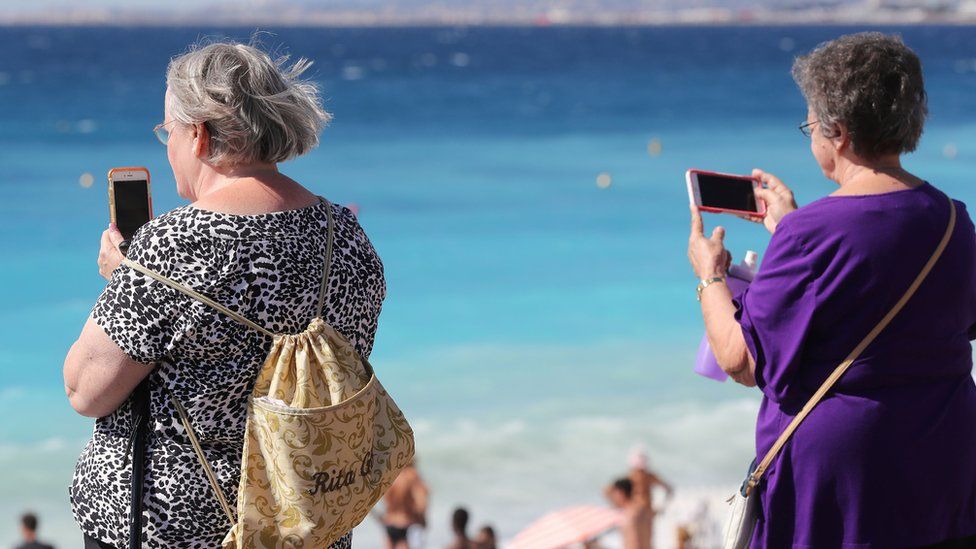
Two women using their mobile phones in France

The planned £2-a-day fees are still relatively small compared with the costs customers had to pay before the EU banned roaming charges.

In the past some people returned from European trips to face bills for hundreds or even thousands of pounds.

Are there any limits to what can be charged?

The UK trade deals with the EU said that both sides would encourage operators to have “transparent and reasonable rates” for roaming.

The UK government also passed legislation to provide some safeguards for consumers:

  • A £45-a-month limit on the amount they could be charged for using mobile data abroad before having to opt into further use
  • Requirements for customers to be informed when they have reached 80% and 100% of their data allowance
  • Operators also have to take “reasonable steps” to avoid customers being charged for accidental roaming in Northern Ireland, which could happen if a phone there locked on to a mobile signal coming from the Republic of Ireland

Will other companies end up charging customers more?

It’s not clear.

Without the EU rules in place, the charges levied depend on agreements between UK operators and their counterparts in EU countries.

While these agreements may mean costs haven’t increased so far, there’s no guarantee that they won’t do so at a later date.

However, there is a reasonable chance that some UK operators may choose to keep offering inclusive roaming:

  • Some UK operators are already part of companies that also operate in other EU countries
  • Individual companies can make reciprocal deals. For example, a UK and French operator could agree to offer each other’s customers inclusive roaming while in the other country
  • Each EU country has more than one operator, so UK operators have a choice of companies with which to deal

The four main operators in the UK declined to comment on the commercial deals they have with other operators.

…………………………………………………………

World Teachers’ Day 2026 - Dia Mundial dos Professores 2026

Standing with teachers: 60 years of protecting the profession, advancing its status and shaping our futures     On 5 October, we observed Wo...