Translate

Tuesday, 20 July 2021

Spotlight on young fishermen. Campaign with Sofonie Dala

Q&A: Overfishing in Angola. Day 2


The harder the challenge, the greater the achievement, and for some anglers that’s the perfect fishing experience. If you manage fisheries cleverly, you can create outcomes with happy people and limited overfishing. Today we will learn about the different experiences that these young fishermen will tell us.

Interview with Sebastião


Do you always fish?

No, not always.

How old are you?

I'm 14 years old

What is your name?

Sebastião.

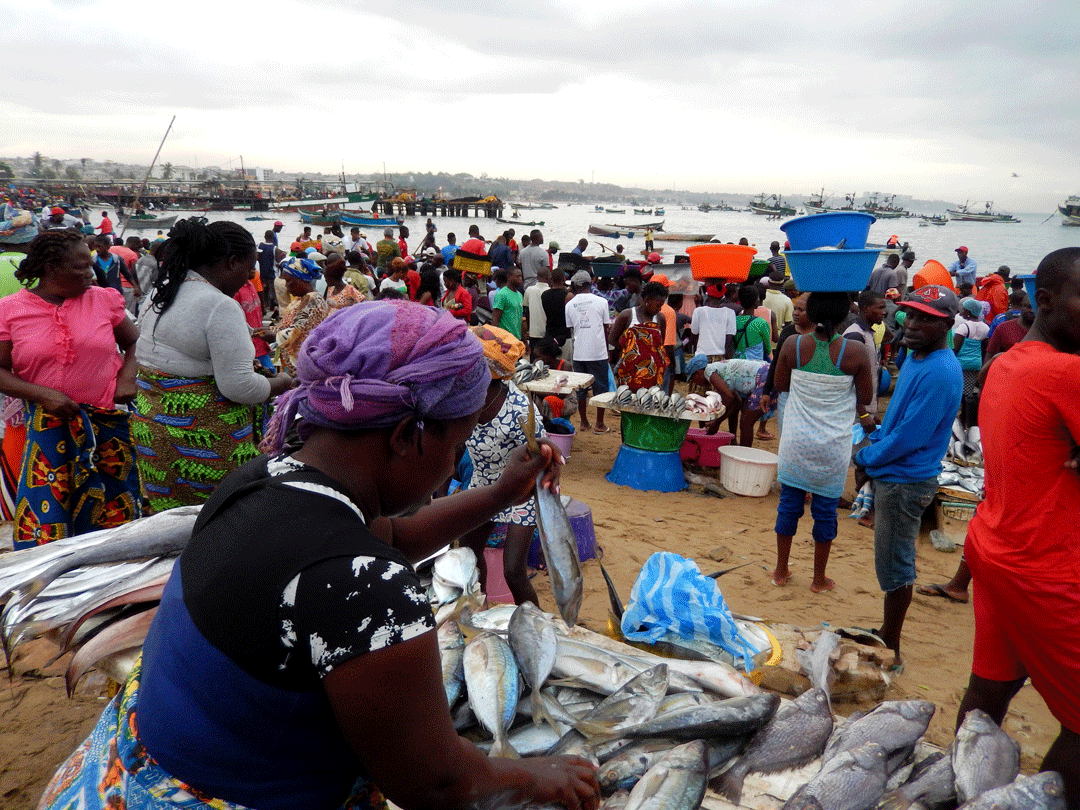
Can you show what you caught today?

Yes, here are the fish.

Are they alive?

Yes, Yes

What do you use to attract fish?

We use fishnet.

What challenges do fishermen face in the sea?

Here in the sea, there are lots of broken bottles and garbage. The shards tear the nets, which makes fishing very difficult.

What can we do to eliminate this?

It is necessary to eliminate all the irons and all the garbage to make fishing easier.


Another interview


Hi guys. Are you okay?

Yes we are fine.

Are you fishermen?

Yes we are Fishermen.

How many fish have you caught today?

We haven't caught any fish yet.

Have you been at sea for a long time?

Yes.

So, is the fishing very difficult today?

Yes, difficult.

What product do you use to attract fish?

We use baits.

Where can we find these baits?

We can find baits in the sea.

What material do you use to fish?

We use the line, bait, hook and bucket to get the fish.

Do you buy this material very expensive?

Not so much. 1 meter of line costs 20 kwanzas

And the hook?

The hook we buy 3 hooks for one hundred kwanzas.

Who sells these instruments?

It's the Fishermen.

Wouldn't you like to have a fishing net and canoe?

We'd really like to have it, but it's too expensive. And we need to have money.

But if a sponsor appears, would you take advantage?

Yes. Let's get this opportunity.

How old are you?

We are between 14 and 15 years old.

Have you been in the fishing world for many years?

Yes, a long time since our childhood. He used to go fishing with his father who is now retired.

When you catch fish, what do you do with the fish?

Some fish we sell and others we consume.

Do you come here everyday?

Yea

When you sell, do you manage to collect a large amount of money?

yes we make a lot of money

OK, very good.

Don't you study?

We're studying, but we're on vacation now, so we're here every day.


Demonstration of the use of fishing equipment.


What is this?

This is the hook.

How do you use this little thing?

We put the line with the bait here, when the fish comes to eat, this needle sticks to the fish, and we grab it.

What's in that bag of yours?

This is buoy.

What did you put there inside this buoy?

Styrofoam.

How many people can fit up there?

3 people.

Using this hook how many fish can you catch?

It depends on the hook you are going to use, you can hook 4, 3 or 2 fish

Hammm, ok, can we take many fishes at once?

Yes.


For environmental conflict and political drama, it’s hard to beat fishing. Almost all the fish consumed by developed countries comes from industrial fisheries, which generate not just a lot of revenue, but controversy over their impact, such as accidentally harming seabirds or scraping the sea floor. Every day, humans generate millions of tons of garbage. And although a lot of that litter ends up in landfills, some enters the ocean by accident or through illegal dumping. 

AGREEMENT WITH SWITZERLAND ENABLES ASSET RECOVERY

 The agreement was signed by the attorney general of the Republic, Hélder Fernando Pitta Grós, and by the ambassador of the Swiss Confederation in Angola, Nicolas Herbert Lang.

Assinatura de Memorando de Entendimento entre Angola e Suíça no domínio da justiça

According to the attorney general, the agreement provides for cooperation in the areas of notification of judicial acts, taking statements, searches, spontaneous transmission of information, effective asset recovery and freezing assets.

He said that asset recovery had been one of the main priorities of the Angolan state's criminal policy.

The ambassador of the Swiss Confederation expressed the interest of his country in helping to fight financial crime, especially embezzlement, bribery and money laundering, committed at the State's expense and to the detriment of the people.

He explained that Swiss law provides that money of illegal origin, if proven, is returned on the basis of a legal assistance procedure.

He said that, with that protocol, it would be more difficult to profit from corruption and other criminal acts, both in Angola and Switzerland.

The Vodacom Discover Graduate & Internship Programme 2021/2022 for young Africans

Application Deadline: 31 August 2021 https://bit.ly/3xLMKE2


Pode ser uma imagem de 1 pessoa e texto que diz "Power to discover the NXT LVL Discover Graduate Programme Vodacom Power to you 1"

This is a permanent employment opportunity underpinned by 2 years of skills training programme that is specifically designed for the development of future leaders. The applicants need to have completed at least their under graduate degree or degree equivalent by the end of 2021. Start date on the programme is 1st February 2022.
The Programme offers graduates a full rounded experience of the our business including mentorship and coaching, and on the job training, all whilst earning a full salary and enjoying all the benefits of a full time employee. At the end of the 2 years you will transition into a destination role within the organization. Following successful completion of your graduate programme, there will opportunities to apply for more stretch assignments locally and internationally outside of your comfort zone to build your expertise and leadership capability.
The ideal candidate for this role should demonstrate strong potential in the following areas:
Time management
Interpersonal skills
Communication skills
Passion
Flexibility
Resilience
Digital savviness
Customer obsession
Innovation
Complex problem solving
Must have less than 2 years working experience post studies.
Must be 26 years old or younger.
South African Citizen by Birth/Naturalisation, however, citizens of DRC, Ghana, Kenya, Lesotho, Mozambique, Ethiopia and Tanzania are also encouraged to apply for consideration in those markets.
Must have obtained a minimum of 65% aggregate for completed or most recent academic results.
Must have a minimum of a B-degree (B-Com, BSc & B-Tech) qualification (NQF 7).
A 3 year National Diploma (NQF 6) will be considered in the following areas only:
Electrical / Electronic Engineering
Computer Software Engineering
Information Systems/Information Technology

Monday, 19 July 2021

Promoting women´s leadership in fisheries. Campaign with Sofonie Dala

  Why talking about Angola?

Angola is a country with insufficient marine data, no environmental conservation awareness and lack of policies regarding conservation and fisheries.

The idea of promoting women´s leadership in fisheries caught my attention for the first time. I started thinking on ways to increase the economic returns in fishing for women, improve training and information transmission to women fishermen, apply quota system for women, finance women´s leadership in fisheries and farmer´s organizations.

Furthermore, there is a need to direct more financial resources than ever before toward female fishermen, since their economic independence and empowerment are linked to many issues, particularly issues of access to water and land, production resources, credit, alternative  energy sources, technology, information and markets.

Today, our main challenge is to seek all kinds of solutions to address the prevailing question: ‘’How can we make fishing more profitable and sustainable for future generation of fishermen’’?

In this article we will reflect on the story of Claudia, an amateur angler from Angola.

Claudia is a vulnerable single mother who depends on fishing to survive and support her children. Claudia claims that she faces many barriers in the world of fishing. Every day she is persecuted by the agents of the state, the so-called police and fiscal who do not allow her to fish in peace. She says that she often hides her fishing gear in the public trash can so as not to be discovered by the tax authorities, who every time they see her fishing, they forbid her to fish and receive the fish she caught to eat with her children. Usually when this happens she is forced to ask for alms in the streets to get something to eat. 

Claudia is a vulnerable single mother who depends on fishing to survive and support her children. Claudia claims that she faces many barriers in the world of fishing. Every day she and persecuted by the agents of the state, the so-called police and fiscal who do not allow her to fish in peace. She says that she often hides her fishing gear in the public trash can so as not to be discovered by the tax authorities, who every time they see her fishing, they forbid her to fish and receive the fish she caught to eat with her children. Usually when this happens she is forced to ask for alms in the streets to get something to eat.

Interview with Claudia


Good afternoon ma'am. How are you?

Good afternoon, I'm fine, thank you.
What is your name?
My name is Claudia.
Claudia, what are you doing here?
I fish here.
Are you a fisherman?
Yes, I'm a fisherwoman in this area, and I'm also a beggar here begging from people who come here to relax.
Tell me a little bit about fishing. Did you catch anything today?
I haven't fished yet, but I am about to fish, you can observe me doing it.
Did you bring your fishing gear?
Yes, I'm ready.
How has the fishing been? Is there a lot of fish?
Well, we have lots of fish, but the biggest challenge is the cops. We are suffering, they should stop doing this. Every time I come to fish, they tell me to take the line out of the water and order me to get out of here and go home.

When I go home with nothing, who will feed my children? I am a mother and father at the same time (single mother), my husband is already deceased. The father of this baby that I got involved with after my husband's death, beat my children a lot. I have not admitted this and separated from him. Thank God some people of good faith rented a house where I am living with my children now.

Do you depend on fishing for a living?
Well, I depend on fishing to survive and to support my children.
What is the material that you use for fishing?
Here is my gear, I use, line, bucket, hook, bait to lure the fish, and a drum.
Why do you keep your material in the garbage bin?
We keep our stuff here so the cops don't throw it away. 
How do you use it?
I take the canister, wrap the wire around the hook, and on the end of the hook I put bait (food to attract fish) and then I throw it into the sea.
When the tide is low, the fish don't come out. They may bite but they don't stick to the hook. We have to wait until the tide is up, and if there are fish, we catch them and put them in the bucket.

If someone offered you a sponsorship what would you like to have to make your fishing easier?
To make my fishing easier, I would like to have a net. With the net I can fish very well. I leave the baby with my son and then I dive into the sea. Since the cops forbid us to put the net here at the shore, so I go more to the bottom of the sea to fish better. That little boy swimming there is my son.
Wouldn't you like to have a canoe?
I don't know how to drive a canoe.
But you can hire someone to do it for you. 
OK, OK.
Is the fishnet expensive?
Yes, the net is very expensive. The one I would like to have is too expensive, I can't afford it.
How much does it cost?
There are some for 30,000 and for 25,000 kwanzas.


Conclusions 

As shown in the article, we did a brief reportage with fishermen in the city of Luanda, Angola. We collected stories from people of different ages, adolescents, youth and adults. They reported that there is a lot of fish in the sea but they face financial problems and lack of fishing material that is very expensive.

Furthermore,fish in the informal market is very expensive because the fishermen who sell fish to the informal traders cannot fish in large quantities due to lack of financial resources, fishing gear, and constant harassment from the police. Thus making life difficult for the most vulnerable people who depend on fishing to survive.

We also noticed a low level of women leading the fishing world, they usually play the role of fishmongers in the streets.

Local women taking part on the artisanal fishery scene by transporting, transforming and selling landing products.


Click here to join us: https://she-leads.blogspot.com/?m=1

26 killed, several injured as heavy monsoon rains lash Mumbai

 At least 26 people were killed after several homes collapsed in Mumbai following landslides triggered by heavy monsoon rains, officials said Sunday.


The rain-related accidents occurred in two suburbs of Chembur and Vikhroli after torrential downpours pounded the metropolis from Saturday evening.
Residents were advised not to venture out in the open.

Nineteen people were killed when six shanty homes collapsed in Chembur, local police officials said. Nine of those injured, who were rescued from the debris, were taken to hospital.

Separately, seven people were killed and two injured when several huts collapsed in Vikhroli, domestic media reported citing municipal officials.

Rescue operations were continuing in both areas as a few more people were feared to be trapped.

Rescue work were hampered owing to heavy rains and difficulties in access to congested localities where heavy equipment had to be taken in. Local television showed rescuers using hands to clear the rubble and retrieve bodies.

Prime Minister Narendra Modi offered his condolences and announced financial compensation for the injured and families of those who died.

Several areas in the city were inundated after the heavy rains and train services were disrupted, paralyzing daily life in India’s financial capital.

Mumbai will continue to receive heavy rainfall over the next five days, the regional weather office said.

Landslides and floods are common during India’s monsoon season, which occurs between June and October.

The rains are vital for agriculture, but often cause immense destruction of property and crops, and lead to the loss of hundreds of lives.
GNA

………………………………………………………………

COVID-19: AUTHORITIES REPORT 98 NEW CASES, 23 RECOVERIES AND 3 DEATHS

 Luanda – The Angolan health authorities announced the registration in the last 24 hours of 98 new cases of Covid-19, three deaths and the recuperation of twenty-three patients.

Covid-19 Logo

According to the daily bulletin provided by the health authorities, among the new infections 35 were diagnosed in the Moxico Province, 21 in Huila, 18 in Luanda, 18 in Cunene, 2 in Benguela, 2 in Zaire, 1 in Lunda Sul and 1 in Namibe.


With ages ranging from 5 months to 93 years, the list of the new cases includes 49 males and 49 females.


The deaths were recorded in the provinces of Huila (2) and Cunene (1).


As regards the recuperation cases 9 reside in Cunene, 7 in Namibe, 3 in Benguela, 3 in Huila and 1 in Luanda.


The labs processed 2,781 samples.


The authorities control 106 people in institutional quarantine centres. There are also 2,333 citizens under epidemiological surveillance and 81 patients in treatment centres.


Overall, Angola has now 40,805 positive cases, 957 deaths, 34,755 recoveries and 5,093 active cases.


The informative bulletin also states that of the active cases 8 are in critical condition, 7 serious, 56 moderate, 10 mildly serious, and 5,012 asymptomatic.


Ghana Boundary Commission set to resolve boundary disputes with Togo, Burkina-Faso

 The Ghana Boundary Commission (GBC) has initiated moves to resolve all boundary disputes with neighbouring Togo and Burkina-Faso.

Global African Family Meeting

The intervention has led to a temporary resolution of the boundary dispute between Ghana and Togo along river Kolpelig at Pulmakom in the Pusiga District.

An agreement has also been reached with the Boundary Commission of Burkina Faso to engage further in resolving all identified boundary disputes at Paga and Sapeliga in the Kassena West and Bawku West districts respectively.

In 2020, Togo was reported to have trespassed its boundary at the Kolpelig river, a tributary to the White Volta claiming ownership of parts of Gareke, a suburb of Pulmakom.

The country also prevented the Volta River Authority from extending electricity to the Beelintange community also within the Pulmakom claiming jurisdiction of the area.

The situation also affected Ghana’s security officials patrolling the general boundary area.

But after an evaluation of the disputed boundary areas between the land boundary commissions of Ghana and Togo, the Togo Boundary Commission agreed to work with pre-existing demarcations.

Speaking to Citi News at Beelintange, National Coordinator of Ghana Boundary Commission, Major Gen. Emmanuel Kotia, said, the dispute has been resolved and the population of both countries shall be educated to respect the 1962 boundary demarcation legacy agreement.

“The Boundary Commissions of Ghana and Togo have agreed that the 1962 boundary demarcation (Legacy Agreement) using river Pulmakom as the boundary line be respected.”

“The Ghana security agencies are allowed to extend their activities to the banks of river Pulmakom. The Ghana Immigration Service and Customs should open appropriate posts to cover entry points of the boundary”.

“The Ghana and Togo boundary commissions will jointly carry out sensitization programmes both in Ghana (Pulmakom) and Togo (Cinkasse) to educate the population on the decisions taken and the need to respect the demarcated boundaries by September 2021. The technical committees of the two commissions will undertake a technical installation of all missing boundary pillars as soon as possible”.

The GBC also engaged the boundary commission of Burkina-Faso to resolve issues about activities of Youga mining company limited around Sapeliga in the Bawku West District and evaluate and install all missing pillars along the Paga boundary line.

Major Gen. Kotia, said, both countries have agreed to discuss further the issues for an amicable resolution.

Permanent Secretary of the Burkina-Faso boundary commission Zagre Leontine commended the effort of the Ghana boundary commission and was optimistic both countries can resolve the issues and strengthen the ties between them.

………………………………………………………………

World Teachers’ Day 2026 - Dia Mundial dos Professores 2026

Standing with teachers: 60 years of protecting the profession, advancing its status and shaping our futures     On 5 October, we observed Wo...