Translate

Friday, 9 July 2021

New York declares US’s first ‘disaster emergency’ on gun crime as shooting deaths overtake COVID

Data from the NYPD shows 2,337 gun arrests have been made citywide since the beginning of this year up until 4 July, with Kings County recording the highest number with 992.


New York’s governor has declared America’s first state of emergency on gun violence, saying it’s now claiming more lives than COVID-19.

Andrew Cuomo committed to spending at least $138.7m (£100.5m) on intervention programmes to tackle the gun violence crisis and announced a new strategy to “build a safer New York“.

Speaking at John Jay College of Criminal Justice on Tuesday, Mr Cuomo said at least 51 people were shot in the state over the fourth of July weekend, and only 13 died of COVID-19.
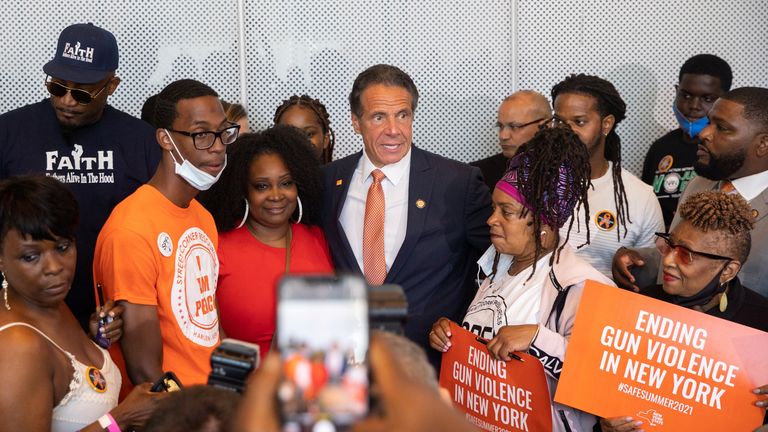
New York Governor Andrew Cuomo poses to take a picture with supporters after making an announcement that Gun Manufacturers are Liable for the harm their products cause, in New York City, New York, U.S., July 6, 2021. REUTERS/Jeenah Moon
Image:Mr Cuomo told supporters that more people in New York were dying from gun violence than COVID-19

“Treat gun violence as it is which is really a public health emergency, that’s what it is and that’s how we are going to treat it,” he said. “So today, the first state in the nation is going to declare a disaster emergency on gun violence.

“If you look at the recent numbers, more people are now dying from gun violence and crime than COVID – this is a national problem but someone has to step up and address this problem because our future depends on it.”

He added: “This is the state, when it sees an injustice, we don’t look the other way, we stand up and we fight it and that’s what we are going to do with gun violence.”

Declaring disaster emergency status allows the state to expedite money and resources to communities so they can begin “targeting gun violence immediately.”

The governor released a slide during the news conference outlining seven key strategies the state plans to take to address the problem.

While some of the steps were wide-ranging such as treating gun violence “like the public health issue it is” or keeping “guns out of the hands of dangerous people”, others were more detailed – including “positive engagement for at-risk youth” and getting “illegal guns off the streets”.

The governor’s plan will also see the launch of a new police unit to intercept illegal guns from coming into the state, and a $76m (£55m) fund used to create jobs and community activities for at-risk youth.

Mr Cuomo also created an executive order, requiring all major police departments to share incident-level data on gun violence with the New York State Division of Criminal Justice Services, to identify “gun violence hotspots”, in a similar way to how the state has been tracking COVID-19 cases.

Initial hotspots identified in New York City, Albany, Buffalo, Syracuse, and Long Island include 4,090 young men aged 18-24, who account for 48.5% of recent gun violence in those communities, according to the governor.

Resources would then be deployed to the areas worst affected.

The most recent weekly data from the New York Police Department (NYPD) shows 2,337 gun arrests have been made citywide since the beginning of this year, with Kings County recording the highest number with 992.

However, the NYPD’s citywide crime statistics show 165 shooting incidents were recorded in June, which is a 19.5% decrease compared to the same time last year when 205 incidents were reported.

……………………………………………………

EU fines 4 German car makers $1B over emission collusion

BRUSSELS (AP) — The European Union handed down $1 billion in fines to four major German car manufacturers Thursday, saying they colluded to limit the development and rollout of car emission-control systems.

Daimler, BMW, VW, Audi and Porsche avoided competing on technology to restrict pollution from gasoline and diesel passenger cars, the EU’s executive commission said. Daimler wasn’t fined after it revealed the cartel to the European Commission.

It was the first time the European Commission imposed collusion fines on holding back the use of technical developments, not a more traditional practice like price fixing.

EU antitrust chief Margrethe Vestager said that even though the companies had the technology to cut harmful emissions beyond legal limits, they resisted competition and denied consumers the chance to buy less polluting cars.

“Manufacturers deliberately avoided to compete on cleaning better than what was required by EU emission standards. And they did so despite the relevant technology being available,” Vestager said. That made their practice illegal, she said.

According to Vestager, the companies agreed on the size of onboard tanks containing a urea solution known as AdBlue that is injected into the exhaust stream to limit pollution from diesel engines, and also on the ranges that drivers could be expected to drive before the tank needed refilling. A bigger tank would enable more pollution reduction.

Vestager said cooperation between companies is permissible under EU rules when it leads to efficiency gains, such as the faster introduction of new technologies.

“But the dividing line is clear: Companies must not coordinate their behavior to limit the full potential of any type of technology,” she said.

BMW said that discussions on the AdBlue tanks had “no influence whatsoever on the company’s product decisions.” The company said it was significant that that the fine notice found there was no collusion involving earlier allegations of using software to restrict AdBlue dosing.

BMW said it set aside 1.4 billion euros ($1.7 billion) based on the commission’s initial accusations but reduced the set-aside in May due to more serious allegations in the case not being substantiated.

The case wasn’t directly linked to the “dieselgate” scandal of the past decade, when Volkswagen admitted that about 11 million diesel vehicles worldwide were fitted with the deceptive software, which reduced nitrogen oxide emissions when the cars were placed on a test machine but allowed higher emissions and improved engine performance during normal driving.

The scandal cost Wolfsburg, Germany-based Volkswagen 30 billion euros ($35 billion) in fines and civil settlements and led to the recall of millions of vehicles. The Volkswagen vehicles in the scandal did not use the urea tanks but relied on another pollution reduction technology.

…………………………………………………

July is BIPOC Mental Health Awareness Month

Hey Friend! 💙

Did you know July is BIPOC (Black, Indigenous, and People of Color) Mental Health Awareness Month? This month (and all year!), we hope you’ll join us as we amplify BIPOC experiences, resources, and organizations.


Our recent Kindness Is Action report shows us Black, Indigenous, and youth of color are less likely than white youth to report experiencing kindness, like having someone who believes in them and encourages them to do their best, or someone who listens when they have a problem. As members of our Born This Way Foundation community, you know it’s important we meet young people where they are, especially those at the margins, with much needed kindness and care.

Help do that by learning more and spreading the word about these resources that specifically support BIPOC mental health, and amplify these advocates and organizations bringing BIPOC mental health to the forefront:

We are so grateful for you and your dedication to the kinder, braver world we are all building together.

In Kindness,
Team Born This Way Foundation

Israel demolishes family home of suspected Palestinian attacker

The demolition of Montaser Shalabi’s home draws US criticism as rights groups say the policy is collective punishment.


Israeli forces have demolished the family home of a Palestinian American man accused of being involved in a shooting that killed an Israeli and wounded two others in the occupied West Bank last May.

Montaser Shalabi was indicted in an Israeli military court over the attack near the city of Nablus in which student Yehuda Guetta was shot dead.

After an appeal in an Israeli court by Shalabi’s family against the demolition was unsuccessful, the military said, the two-storey villa in Turmus’ayya, a village in which many Palestinian Americans live, was levelled in a controlled explosion on Thursday.

Israel says such demolitions deter potential Palestinian assailants. Palestinians and rights groups condemn the policy as collective punishment.

Shalabi’s wife, Sanaa, who lived with three of their children in the home in Turmus’ayya, said she spoke with her husband by telephone on Thursday. She described him as a “resister” and resolved to rebuild the house.

“They want to demoralise us, but we are steadfast. This is the situation of the entire Palestinian people,” she said.

‘Punitive demolition’

Palestinians and rights groups condemn the home demolition policy as collective punishment [Jaafar Ashtiyey/AFP]

In a statement after the home was destroyed, the US embassy in Jerusalem called on “all parties to refrain from unilateral steps that exacerbate tensions and undercut efforts to advance a negotiated two-state solution” of the Israeli-Palestinian conflict.“This certainly includes the punitive demolition of Palestinian homes,” a spokesperson said.

“As we stated numerous times, the home of an entire family should not be demolished for the actions of one individual.”

US criticism of Israeli policy towards the Palestinians was rare during the presidency of Donald Trump, who embraced Israel’s settlements – seen by many countries as illegal – in the West Bank. US President Joe Biden has sought to rebuild relations with the Palestinians.

An official in Israeli Prime Minister Naftali Bennett’s office said: “The prime minister appreciates and respects the US administration. At the same time, it acts solely in accordance with the security considerations of the State of Israel and the protection of the lives of Israeli citizens.”

SOURCE: AL JAZEERA AND NEWS AGENCIES

…………………………………………………………

Seoul spy agency: No sign NKorean leader has been vaccinated


SEOUL, South Korea (AP) — There is no sign that North Korean leader Kim Jong Un has been inoculated against the coronavirus and his country hasn’t received any foreign vaccines, South Korea’s spy agency said Thursday.


The National Intelligence Service told lawmakers in a closed-door briefing that it hasn’t detected any information that North Korea has acquired vaccines, according to Ha Tae-keung, one of the legislators who attended the session. He quoted the NIS as saying there were no signs that Kim has been inoculated.

COVAX, the U.N.-backed program to ship COVID-19 vaccines worldwide, said in February that North Korea could receive 1.9 million doses in the first half of the year. But the shipment hasn’t been made, and there have been no reports that North Korea has tried to secure vaccines elsewhere for its 26 million people.

The NIS has a mixed record in reporting developments in North Korea, one of the world’s most secretive countries. Some non-government experts have speculated that Kim and his top deputies may have received vaccines imported through unofficial channels.

Another lawmaker, Kim Byung-kee, quoted the NIS as saying that North Korea’s government is trying to dispel any expectations among ordinary citizens that they will receive vaccines from abroad and is instead urging them to boost their anti-virus vigilance.

He said North Korea is building guard posts and concrete structures along its border with China to prevent illegal border crossings as part of its anti-virus steps. He said the lawmakers were told that North Korea isn’t even allowing the entry of diplomats from China, its main ally and aid benefactor.

Kim Jong Un recently berated top officials for “crucial” failures in coronavirus prevention that he said caused a “great crisis.” But his government continues to claim a perfect record in fending off the virus from its territory, an assertion that is widely questioned by outside experts.

The World Health Organization said last week that North Korea has reported to it that it has tested 31,794 people for the virus through June 24 and that all were negative.

Kim in recent speeches has called for the nation to brace for prolonged COVID-19 restrictions, indicating the country isn’t ready to reopen its borders despite the massive toll on its economy, which had already been devastated by years of mismanagement and U.S.-led sanctions over its nuclear program.

According to the NIS briefing, North Korea had planned to reopen its border with China in April but shelved the idea due to a shortage of disinfecting equipment, Ha said.

UNICEF, which procures and delivers vaccines on behalf of COVAX, said it remains unclear when vaccines could be delivered in North Korea, which has yet to complete its paperwork for receiving supplies from COVAX.

“WHO and UNICEF have been working with the (North Korean) Ministry of Public Health to ensure access to COVID-19 vaccines through the COVAX Facility. However, (North Korea) has not received vaccines through the COVAX Facility yet and there is no confirmation when the country will receive them,” UNICEF said in an emailed statement.

Hong Min, a senior analyst at Seoul’s Korea Institute for National Unification, said North Korea’s anti-virus campaign remains focused on tough quarantines and border controls, and vaccines appear to be a secondary priority.

Kim has repeatedly urged the North Korean public to unite under his family’s leadership to build a self-reliant economy and withstand pandemic-related difficulties.

On Thursday, Kim paid respects at the mausoleum where the embalmed body of his grandfather, national founder Kim Il Sung, lies in state to mark the 27th anniversary of his death. As at other recent events, he and other top officials did not wear masks.

During the visit, Ri Pyong Chol, one of Kim’s closest associates who is considered a central figure in North Korea’s nuclear and missile programs, was standing in the third row, not in the front row along with Kim. This suggests Ri was dismissed from the Politburo’s powerful five-men Presidium leadership body. North Korean state media said recently that some unidentified top officials including a Presidium member had been dismissed.

Some experts say Kim aimed to shift public dissatisfaction over economic difficulties to those officials.

The NIS also told lawmakers that Kim doesn’t appear to have any health problem despite his recent weight loss. It said it has seen no intelligence that hospitals in charge of Kim’s health have imported medicines, and that Kim has recently presided over meetings for several hours and walked normally.

Recent North Korean photos show Kim looking much thinner, sparking speculation that he might have health issues. The NIS said it believes Kim went on a diet to improve his health and lost 10-20 kilograms (22-44 pounds) between February and June.

…………………………………………………………

Thursday, 8 July 2021

UK government urged to hold China ‘to account’ over Uighurs

British lawmakers from across the political spectrum call on PM for a partial Winter Olympics boycott and cotton trade ban.


A group of influential British lawmakers have urged the government to take tougher action against China over its treatment of minority groups, including a partial Winter Olympics boycott and cotton trade ban.


In a report following a months-long inquiry, Parliament’s Foreign Affairs Committee on Wednesday recommended exploring the feasibility of an International Criminal Court probe into the alleged crimes against Uighur Muslims and others in the northwestern Chinese region of Xinjiang.

The cross-party committee, led by Conservative politician Tom Tugendhat, said in a report that the “atrocities” being committed in Xinjiang “represent an international crisis of profound urgency, making it unconscionable for any civilised government to look the other way”.

It called on the government to accept MPs’ view – expressed in a symbolic April vote – that minority groups there are suffering genocide and crimes against humanity, and take stronger action “to bring these crimes to an end”.

The cross-party group wants Britain to use every diplomatic lever to pressure Beijing to allow international observers – in particular the United Nations High Commissioner for Human Rights – access to Xinjiang.

It also backs a fast-track asylum process for those fleeing persecution in the region, forming a coalition of “sanctuary states” with Western allies.

“It’s time for big boy politics,” said committee member Alicia Kearns, also a Conservative. “We are the mother of all parliaments. If we are not willing to speak up for those who others seek to silence, then what parliament’s going to do it?”

Rights groups believe at least one million Uighurs and other mostly Muslim minorities have been detained in camps in Xinjiang, where China is also accused of forcibly sterilising women and imposing forced labour.

Beijing has denied all allegations of abuses and has insisted its policies in Xinjiang are necessary to counter violent “extremism”.

‘Nesting the dragon’

In their 37-page report – Never Again: The UK’s Responsibility to Act on Atrocities in Xinjiang and Beyond – the British MPs argued the “truly horrifying” crimes taking place are “an international call to action”.

Among the recommended responses, it urges Prime Minister Boris Johnson’s government to ensure that Beijing “faces consequences” when it hosts the 2022 Winter Olympics.

The committee wants ministers and dignitaries to skip the opening and closing ceremonies, discourage British businesses from sponsoring or advertising at the event, and encourage fans and tourists to stay away.

On Wednesday, Johnson indicated that he was not minded to boycott the Games, telling lawmakers that he is “instinctively” against sporting boycotts.

“This country has led the world in condemning human rights abuses in Xinjiang and in putting sanctions on those responsible, in holding companies to account that import goods made with forced labour in Xinjiang,” Johnson said.

Meanwhile, the report urges the government to explore a ban on the import of all cotton products linked to Xinjiang, which supplies the vast majority of China’s cotton.

More than 570,000 people are estimated to have been obliged to pick cotton in the Xinjiang region.

It also wants surveillance companies such as Hikvision – which provide surveillance equipment to the detention camps there – to be forbidden from operating in Britain.

The United States, which has accused Beijing of genocide in Xinjiang, has already imposed various trade sanctions targeting producers and users of cotton as well as tomato products and hair products such as weaves originating from the region.

Last month it also banned imports of solar panel materials from a Chinese company and placing restrictions on four others for alleged use of forced labour in Xinjiang.

“We still have time to make these choices, and if we choose not to, what we’re doing is nesting the dragon deeper and deeper into our national life,” committee chair Tugendhat said.

SOURCE: NEWS AGENCIES

……………………………………………………

South Africa’s former president Zuma turns himself in for 15-month prison term


South African former President Jacob Zuma turned himself in to police on Wednesday to begin 15 months in jail for contempt of court, the culmination of a long legal drama seen as a test of the post-apartheid state’s ability to enforce the rule of law.


Police spokesperson Lirandzu Themba confirmed in a statement that Zuma was in police custody, in compliance with the Constitutional Court judgment.

The court gave Zuma a 15-month jail term last week for defying an instruction earlier in February to give evidence at an inquiry into corruption during his nine years in power until 2018. The inquiry is led by Deputy Chief Justice Raymond Zondo.

Police had been instructed to arrest Zuma by the end of Wednesday if he failed to appear at a police station. Hundreds of his supporters, some of them armed with guns, spears and shields, had gathered nearby at his rural homestead in Nkandla, eastern South Africa, to try to prevent his arrest.

But in the end, the 79-year-old Zuma decided to go quietly.

“President Zuma has decided to comply with the incarceration order,” his foundation said, the first time Zuma’s camp had shown any willingness to cooperate with the court.


It was a remarkable fall for a revered veteran of the African National Congress liberation movement, who was jailed by South Africa’s white minority rulers for his part in its struggle to make everyone equal before the law.

Zuma denies there was widespread corruption under his leadership and he had struck a defiant note on Sunday, lashing out at the judges and launching legal challenges to his arrest.

His lawyers asked the Constitutional Court on Wednesday to suspend its order to the police to arrest him by midnight pending the outcome of his challenge against a jail sentence.

Zuma gave in to pressure to quit and yield to now-President Cyril Ramaphosa in 2018. He has since faced inquiries into allegations of corruption dating from his time as president and before.

The Zondo Commission is examining allegations that he allowed three Indian-born businessmen, Atul, Ajay and Rajesh Gupta, to plunder state resources and traffic influence over government policy. He and the Gupta brothers, who fled to Dubai after Zuma was ousted, deny any wrongdoing.

Zuma also faces a separate court case relating to a $2 billion arms deal in 1999 when he was deputy president. He denies the charges.

The former president maintains that he is the victim of a political witch hunt and that Zondo is biased against him.


……………………………………………………

World Teachers’ Day 2026 - Dia Mundial dos Professores 2026

Standing with teachers: 60 years of protecting the profession, advancing its status and shaping our futures     On 5 October, we observed Wo...