Translate

Friday, 2 July 2021

Canada Lytton: Wildfire forces hottest place in heatwave to evacuate


Residents of a Canadian village which recorded the country’s highest ever temperature, 49.6C (121.3F), have been forced to flee by a wildfire.

The mayor of Lytton, British Columbia, ordered people to evacuate, saying flames had spread through the village in just 15 minutes.

A heatwave has hit western Canada this week, with British Columbia recording three times its usual number of deaths.

Abnormally high temperatures have been recorded in swathes of North America.

British Columbia registered 486 deaths over five days compared with an average of 165 in normal times.

Chief Coroner Lisa Lapointe blamed the extreme weather. The western province had seen only three heat-related deaths over the past three to five years.

Many of those who died, Ms Lapointe said, had been living alone in unventilated homes.

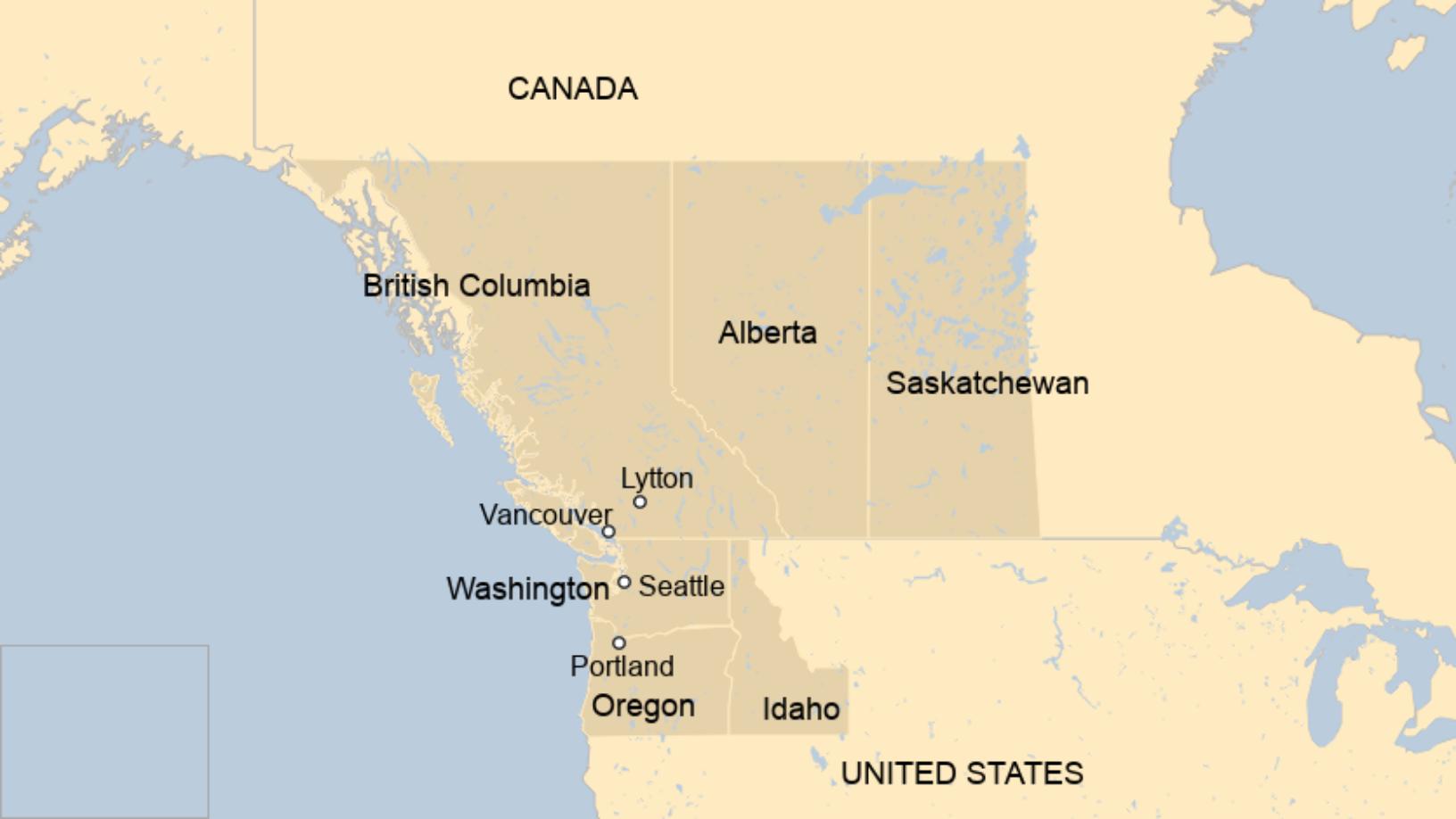
Temperatures have been easing in coastal areas of Canada but there is not much respite for inland regions. The weather system is now moving eastwards over the Prairie provinces – Alberta and Saskatchewan and parts of Manitoba have been placed under Environment Canada heat warnings.

Climate scientists are still trying to determine to what extent climate change may have aggravated the heatwave. One scientist, Zeke Hausfather, said the unprecedented weather was almost certainly a consequence of global warming.

“Climate is sort of steroids for the weather, it’s loading the dice to make these sort of extreme events be more common,” he told AFP news agency.

What is happening in Lytton?

Residents fled on Wednesday, many without their belongings, as smoke and flame engulfed the village about 260km (162 miles) north-east of Vancouver.

“The whole town is on fire,” Mayor Jan Polderman told CBC News after signing the evacuation order at 18:00 (01:00 GMT Thursday).

In one area, he said, “the fire was a wall about three, four feet high coming up to the fence line”.

Winds of up to 71 km/h (44 mph) were pushing the fire north into the community on Wednesday evening, CBC meteorologist Johanna Wagstaffe reported. Hot, dry and windy conditions in the area could mean the fire was moving at 10 or even 20 km/h.
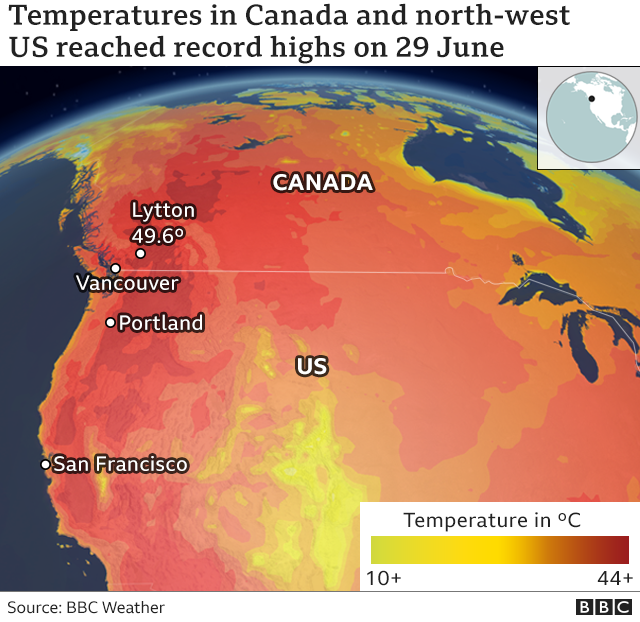

Map showing the hottest areas in Canada and the US north-west
1px transparent line

Residents were being directed to nearby communities where reception centres were being set up, while the British Columbia Wildfire Service was diverting crews and equipment from other areas to respond to the fire.

“You can’t even comprehend it,” Lytton evacuee Edith Loring-Kuhanga told CBC Radio. “Our entire town is gone.”

How dangerous was the heat elsewhere?

In Vancouver, British Columbia’s biggest city, heat is believed to have been a contributing factor in the deaths of 65 people since Friday.

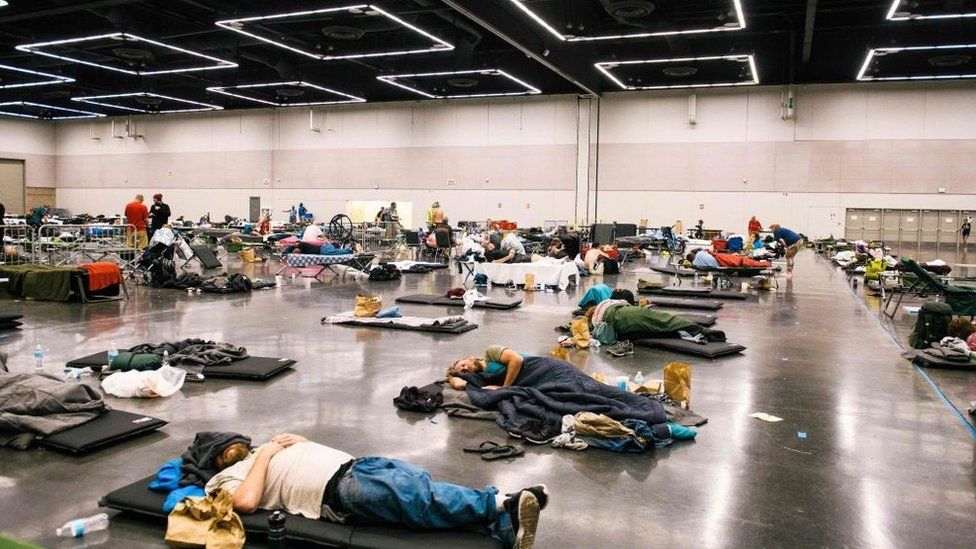
The city has opened 25 air-conditioned cooling centres where people have been resting or working from their laptops.

“I have no air conditioning, only a fan at home – I came here just to work where it’s cool,” one woman, who gave her name only as Lou, told AFP news agency.

In the US state of Oregon, health officials tied more than 60 deaths to the extreme heat while in Washington State, 20 deaths were attributed to the weather, the Associated Press reports.

Seattle, Portland and other cities broke all-time heat records, which climbed above 46C in places.

Both Canadian Prime Minister Justin Trudeau and US President Joe Biden warned of the threat of wildfires, with Mr Biden telling governors of western US states it was as “severe as it’s ever been”.

Can the heat be linked to climate change?

Analysis box by Matt McGrath, environment correspondent

I’ve heard from scientists who say that in just a few days they’ll be able to determine just how much human driven warming has contributed to the searing temperatures seen in British Columbia.

One interesting piece of evidence is the lack of respite that night brings – recent temperatures at midnight in BC have been 2C warmer than the normal summer daytime figure.

Researchers say this combination of day and night-time heat is very dangerous for humans – a study published last year indicated that these compound events are closely linked to emissions of greenhouse gases.

Natural variability and local factors such as sea breezes can raise or limit the impacts of extreme heat. But the bigger picture is the rising thermometer of global heating is impacting all events.

“Every heatwave occurring today is made more likely and more intense by human-induced climate change,” Dr Friederike Otto from the University of Oxford told the BBC.

“Climate change is definitely one of the drivers of the intensity of this Canadian heatwave – but it is not the only one and determining how much it impacts it, is a work in progress.”

Even if they can’t directly attribute this heatwave to climate change, experts say the fingerprints of global heating are all over it.

………………………………………………………………

Thursday, 1 July 2021

Dozens of deaths reported in Canada’s extreme heatwave

Washington. An extreme heatwave has brought record temperatures to western Canada and contributed to dozens of deaths.


On Tuesday, thermometers rose to 49.5 degrees Celsius in Lytton, British Columbia, “breaking the daily and all-time temperature records for the 3rd straight day,” local weather authorities tweeted.

The figures were however preliminary and still subject to updates.

Canadian media reported that dozens of deaths had been reported during the heatwave.

More than 100 sudden deaths have been reported to the police in British Columbia since Friday, with the extreme heat seen as a contributing cause of death in most cases, broadcaster CBC reported.

In the city of Burnaby, east of Vancouver, more than 25 people died within 24 hours, the Royal Canadian Mounted Police said on Tuesday.

The police called on citizens to check on neighbours and especially people at risk, such as the elderly.

“It is imperative we check on one another during this extreme heat,” spokesperson Mika Kalanj said.

Several air-conditioned locations were set up in Vancouver for people to find refuge from the heat.

The extreme temperatures are expected to continue in the coming days.

………………………………………………………………

Netherlands says Russia flew ‘mock attacks’ on warship


Amsterdam/Moscow, June 30, (dpa/GNA) – Netherlands has accused Russia of flying “mock attacks” against one of its warships in the Black Sea last week.


The Dutch Defence Ministry on Tuesday tweeted that Russian jets caused “a dangerous situation in the Black Sea near HNLMS Evertsen last Thursday.”

“The aircraft repeatedly flew dangerously low over and close to the ship and carried out mock attacks,” the ministry said, adding that the electronic equipment of the frigate had also been interfered with.

The Russian Defence Ministry said that SU-30 and SU-24 fighter jets flew at a secure distance to warn the warship.

According to Moscow, the Evertsen was on course for Russian territory, more specifically the Crimean peninsula.

“After the approach of the Russian jets the Evertsen immediately changed its course away from the borders of the Russian Federation,” the ministry said.

The Crimean peninsula was occupied by Russia in 2014, and the international community still views it as Ukrainian territory.

According to the Dutch ministry, the Evertsen was in international waters south-east of Crimea at the time of the incident.

Dutch Defence Minister Ank Bijleveld-Schouten called the Russian operation “irresponsible.”

“There is no justification for this type of aggressive action, which additionally increase the risk for accidents,” she said.

Last week, the Russian Black Sea Fleet stationed in Sevastopol said it had forced a British warship that had come close to Crimea to change course by firing warning shots and dropping bombs.

On Monday, the two-week Sea Breeze manoeuvre began in the north-west of the Black Sea. Soldiers and sailors from Ukraine, the US and about 30 other countries are taking part.

Moscow views the exercise as a security risk and had called on the US to abandon it.
Due to the manoeuvre, Russia also sent the submarine Kolpino to the area for an exercise, the Russia’s Black Sea fleet announced on Wednesday.
GNA

………………………………………………………………

Canada weather: Dozens dead as heatwave shatters records


Dozens of people have died in Canada amid an unprecedented heatwave that has smashed temperature records.

Police in the Vancouver area have responded to more than 130 sudden deaths since Friday. Most were elderly or had underlying health conditions, with heat often a contributing factor.

Canada broke its temperature record for a third straight day on Tuesday – 49.6C (121.3F) in Lytton, British Columbia.

The US north-west has also seen record highs – and a number of fatalities.

Experts say climate change is expected to increase the frequency of extreme weather events, such as heatwaves. However, linking any single event to global warming is complicated.

The heat over western parts of Canada and the US has been caused by a dome of static high-pressure hot air stretching from California to the Arctic territories. Temperatures have been easing in coastal areas but there is little immediate respite for inland regions.

Before Sunday, temperatures in Canada had never passed 45C.

British Columbia Premier John Horgan said the hottest week the province had ever experienced had led to “disastrous consequences for families and for communities”.

The number of heat-related fatalities is likely to rise as some areas say they have responded to sudden death incidents but have yet to collate the numbers.

In Vancouver alone, heat is believed to have been a contributing factor in the unexpected deaths of 65 people since Friday.

Map
1px transparent line

“I’ve been a police officer for 15 years and I’ve never experienced the volume of sudden deaths that have come in in such a short period of time,” police sergeant Steve Addison said. Three or four a day is the normal number.

He said people were arriving at relatives’ homes and “finding them deceased”.

Dozens of officers have been redeployed in the city, while the increased volume of emergency calls has created a backlog and depleted police resources.

British Columbia Chief Coroner Lisa Lapointe said 100 more deaths than normal had been reported in the period from Friday to Monday.

The tiny village of Lytton, about 155 miles (250 km) east of Vancouver – and not much further south than London – has recorded all of Canada’s recent record highs.

Resident Meghan Fandrich said it had been “almost impossible” to go outside.

“It’s been intolerable,” she told the Globe & Mail newspaper. “We’re trying to stay indoors as much as possible. We’re used to the heat, and it’s a dry heat, but 30 [degrees] is a lot different from 47.”

Many homes in British Columbia do not have air conditioning as temperatures are usually far milder during the summer months.

One Vancouver resident told AFP news agency that hotels seemed to be sold out, as people flocked there for air-conditioning, adding: “I’ve never seen anything like this. I hope it never becomes like this ever again.”

The country’s weather service, Environment Canada, has issued heat warnings for the provinces of British Columbia and Alberta, along with areas of Saskatchewan, the Northwest Territories and Manitoba.

Jodi Hughes, weather anchor at Global News Calgary, told the BBC that firefighters were extremely concerned at the possibility of wild fires, possibly sparked by thunderstorms that could occur as the weather pattern changes.

How to ward off the heat

  • Stay cool. It may sound obvious, but if your body hits 40C (104F) heat-stroke can set in, which requires urgent medical help, as it could lead to loss of consciousness, organ failure, even death. Danger signs include sweat stopping – feeling hot, but dry – and breathing difficulties
  • Food and water. Again obviously, drink water (and avoid diuretics like caffeine) – and don’t take your thirst as a guide, as you could still be dehydrating. Food with high water content is good; having to digest heavy meals isn’t
  • Stay in the shade. Indoors if you can. Limit travel to cooler parts of the day if possible. Be careful with exercise
  • Clothing. Try to keep covered, but with fabrics like linen and cotton that are more breathable. Wear a hat, preferably with ventilation
  • Cooling methods. If you find air-conditioning eco-unfriendly or don’t have it, try fans (maybe with ice cubes in front), gels, face sprays, a cold water bottle, a cool shower. Draw the curtains to cool the room temperature

Records fall in western US

In the US Pacific Northwest on Monday, temperatures hit 46.1C in Portland, Oregon, and 42.2C in Seattle, Washington, the highest levels since record-keeping began in the 1940s, the National Weather Service said.

At least a dozen deaths in Washington and Oregon are believed to be linked to the heatwave.

A doctor in a Seattle hospital told the Seattle Times the number of patients streaming in with heat stroke was comparable to the beginning of the Covid-19 pandemic.

Dr Jeremy Hess said some had kidney or heart problems, and one man had third-degree burns from walking on asphalt.

Seattle resident Mark Aldham set up a cooling system in his front yard with free snacks and drinks. “It is super hot here. So my partner and I, we set up some shade that we have from [Nevada festival] Burning Man to help cool off our neighbourhood and keep everyone safe,” he told Reuters.

The heat has been intense enough to melt cables, shutting down the Portland Streetcar Service on Sunday.

An electrical utility in Spokane, Washington, has also introduced rolling blackouts to cope with huge power demand as residents run air conditioners.

Agricultural workers are often now being given the option to start at dawn and finish at noon. But labour contractors say that some stay on to work regardless of the heat.

One worker was found dead in a field at the end of his shift at a farm in Oregon.

One Seattle resident told AFP that the city felt like a desert: “Normally… 60, 70 degrees [Farenheit] is a great day – everybody is outside in shorts and T-shirts – but this is… ridiculous”.

Amazon allowed members of the public into areas of its Seattle headquarters as a cooling-off location on Monday, while people in Portland also flocked to cooling centres.

People rest at the Oregon Convention Centre cooling station in Oregon, Portland
image caption Portland residents have flocked to cooling centres.

……………………………………………………………

A Ciência e a Inteligência Artificial estão a dar vida às memórias!

A Inteligência Artificial já consegue transformar fotografias antigas em experiências visuais surpreendentes Hoje, testemunhamos como a ciên...