What are the lyrics to ‘Time to Say Goodbye’ - and do they make any sense?
Sure, it sounds lovely when Bocelli sings it with oodles of Italian authenticity - but how does the song translate when it’s performed in English?
‘Time to Say Goodbye’ was originally released as a single for Andrea Bocelli in 1995, under the title ‘Con te partirò’ (literally ‘I’ll leave with you’).
A year later, soprano Sarah Brightman was added to the mix for a performance marking boxer Henry Maske’s final match. The duet version was recorded with an English title – and sure enough, it was a commercial success.
The slight catch is that when you translate the phrase ‘Con te partirò’ as ‘Time to Say Goodbye’, the song sort of stops making any sense.
Here’s the chorus in English...
Andrea Bocelli and Sarah Brightman duet together
Time to say goodbye
To countries I never
Saw and shared with you
Now, yes, I shall see them
I’ll go with you
Go on ships across seas
Which, I know,
No, no, don’t exist anymore
It’s time to say goodbye.
In summary: they’re saying goodbye to countries they never saw or shared with each other, but now they are in fact going to go to those countries… except they’re travelling there on ships which don’t exist anymore... so it’s time to say goodbye again.
Hmm. Maybe the lyrics are better appreciated in Italian. Here's the beginning of the song:
Daniel lived in captivity in Babylon along with his friends Shadrach, Meshach, and Abednego. Though they faced pressures to conform to Babylonian society and give up the ways of their people, they stood strong in their faith, and God blessed Daniel with wisdom and the ability to interpret dreams. When he was called before King Nebuchadnezzar, Daniel was able to interpret what his dream meant without even hearing it! The dream foretold the future conquering of the Babylonian kingdom. Because of his interpretation of the dream, Daniel was appointed to be ruler of the province of Babylon and chief prefect over all the wise men of Babylon.
Later, King Nebuchadnezzar had another dream where a giant tree was cut down. Daniel interpreted this dream for him, saying it meant that he would be cast out from society until he recognized that it was God who had given him his glory, and not himself. A year later, the dream came to pass, as Daniel 4:30 details:
Nebuchadnezzar was cast out from human society, he ate grass like an ox, and his body was bathed with the dew of heaven, until his hair grew like the feathers of an eagle, and his nails like the claws of a bird.
The Reign of Belshazzar
When Nebuchadnezzar recognized the God of heaven, he was restored to his throne – seven years after he was cast out– and the rest of his reign was blessed. However, he was soon succeeded by his son Belshazzar, who did not respect the Lord. During a wild drunken feast, he and his guests drunk out of the vessels that his father had taken from the temple in Jerusalem, praising their idols. In response to his dishonorable behavior, a hand appeared and wrote words in an unknown language on the wall. The king was terrified and called Daniel to translate. He told Belshazzar:
“This is the writing that was inscribed: Mene, Tekel, and Peres. These words mean: Mene, God has numbered your kingdom and put an end to it; Tekel, you have been weighed on the scales and found wanting; Peres, your kingdom has been divided and given to the Medes and Persians.”
Then by order of Belshazzar they clothed Daniel in purple, with a chain of gold around his neck, and proclaimed him third in governing the kingdom. That very night Belshazzar, the Chaldean king, was slain. – Daniel 5:25-30
The Lion’s Den
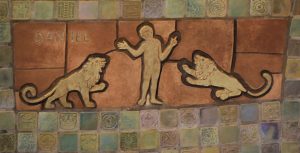
Daniel in the lions’ den depicted in pewabic tile in the Crypt Church
Darius the Mede succeeded Belshazzar as ruler, and soon saw how competent Daniel was. He considered appointing Daniel over the whole kingdom, which provoked the other ministers and satraps to plot against Daniel. They convinced Darius to pass a law condemning to death anyone who worshiped someone other than himself.
After the proclamation had been signed, Daniel continued his practice of praying to God three times a day, and was caught by the satraps. Darius was greatly saddened when he heard what happened, but he could not reverse the decree. Daniel was put into the lions’ den, but through God’s provision, he survived:
The king rose very early the next morning and hastened to the lions’ den. As he drew near, he cried out to Daniel sorrowfully, “Daniel, servant of the living God, has your God whom you serve so constantly been able to save you from the lions?” Daniel answered the king: “O king, live forever! My God sent his angel and closed the lions’ mouths so that they have not hurt me. For I have been found innocent before him; neither have I done you any harm, O king!” This gave the king great joy. At his order Daniel was brought up from the den; he was found to be unharmed because he trusted in his God. The king then ordered the men who had accused Daniel, along with their children and their wives, to be cast into the lions’ den. Before they reached the bottom of the den, the lions overpowered them and crushed all their bones. – Daniel 6:20-25
Darius declared that God was to be revered and feared because He had preserved Daniel.
What We Can Learn from Daniel
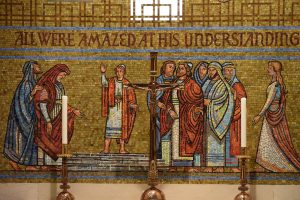
In the Great Upper Church, Daniel is depicted impressing the elders of his time, a parallel to the young Jesus astounding the temple elders in the New Testament
There are many important themes throughout the book of Daniel. First, we see his steadfastness during the time of exile. The nation of Israel was scattered. Daniel was captured and taken to a foreign land, and yet he remained faithful to the God of his people, in spite of the pressure around him to conform to Babylonian culture.
We see Daniel’s faithfulness demonstrated in his commitment to prayer throughout the book of Daniel – both in his daily routine and as he approaches major tasks. Daniel 2:18 describes him asking Shadrach, Meshach, and Abednego to pray that God would reveal the king’s dream, and Daniel 6:11 tells of his habit of prayer: “Even after Daniel heard that this law had been signed, he continued his custom of going home to kneel in prayer and give thanks to his God in the upper chamber three times a day, with the windows open toward Jerusalem.”
A Demonstration of God’s Providence
Most importantly, the story of Daniel is a story of God’s glory and God’s providence for His people. God constantly demonstrated His glory through Daniel, making His name known among the people of Babylon. He exalted Himself above the rulers of Babylon, revealing the limits of their power. He humbled King Nebuchadnezzar by inhibiting his mental capacity after he reveled in his greatness. He smote Belshazzar, dividing his kingdom in two. In His power, He protected Daniel in the lion’s den – when Darius was powerless to do so.
Throughout the whole story of Daniel, God not only provided for Daniel’s needs, but He blessed him with wisdom and knowledge to interpret dreams and help govern the kingdom. He granted him favor with multiple rulers, and preserved his life when others plotted against him. In His providence for Daniel, God brought glory to Himself and showed that He is ultimately in control.
Luanda- The retirement of Raúl Castro, who has just stepped down as head of the Cuban Communist Party (PCC), is part of a normal process of transfer to the party leadership, said the Cuban ambassador to Angola, Esther Gloria Armenteros Cárdenas.
The diplomat was speaking to Angop on the Eighth Congress of the Cuban Communist Party (16-19 April).
She said that the principles of the Revolution and Socialism are secured by the generation that entail a substitute, Miguel Diaz-Canel Bermudez, and other members.
Armenteros described the time as important and historic for her country and fellow countrymen, "adding the process marks the transfer of the leadership of the party from the historical generation to the new ones, born and raised by the Revolution".
The Cuban ambassador denied allegations that the transition means a break-up with the past. “On the contrary, she said, we must speak of unity and continuity. Today, our Socialist Revolution remains more alive, active and decisive, despite the attempts by the enemies to crush it ”.
The diplomat confirmed the negative impact of the economic, commercial and financial blockade imposed by the United States on her country.
She explained that "more than 240 unilateral coercive measures were applied by the United States against Cuba, which cruelly reinforced the economic, commercial and financial blockade, even in an opportunistic way during the pandemic".
Luanda – Angola announced Thursday 392 new cases, 4 deaths and 11 recoveries in the last 24 hours, with Luanda province (320) bearing the brunt of the infections, followed by Cuando Cubango with 42.
The new infections were detected in Luanda with 320, followed by Cuando Cubango with 42.
Also reported new cases Huíla (09), Cabinda (07), Benguela (05), Huambo (03), Namibe (02), Cuanza Sul (02), Malanje (01) and Zaire (01).
The new patients, whose ages range from 20 days to 83 years old, include 224 men and 168 women.
The deaths, Angolan citizens aged 64, 76 and 83 years of age, were reported in the provinces of Luanda and Uíge, with 3 and 1 cases, respectively.
Among the recoveries, five are residents in Luanda, 4 in Huíla and 2 in Huambo.
So far, Angola has 27,921 positive cases, 622 deaths, 24,503 recoveries and 2,796 active patients.
Luanda - The Chief of Staff of the President of Chad Transitional Military Council, Abdel Kerim Déby Itno, Thursday considered Angola as an "important partner" of the Sahel country in the region.
Abdel Kerim Déby Itno was speaking to the press in Luanda, after being received in an audience by the Angolan Head of State, João Lourenço, to whom he provided information about the political, military and security situation in his country.
The situation in Chad worsened at the end of April following the death of the re-elected president, Idriss Déby Itno, who died from wounds sustained during fighting with the armed opposition in the north of the country.
The son of the former Chadian President added that his country will continue to prioritise bilateral cooperation relations, within the framework of the commitments made by Chad.
Abdel Kerim Déby Itno, who is touring a number of Central African countries said that his trip aims to inform and receive advice from Central African heads of state on events in Chad.
"We want to inform and also to hear advice from African leaders," the Transitional Military Council envoy said.
According to Abdel Kerim Déby Itno, the situation in his country is "critical" and he stressed that the new transitional government appointed by the Military Council is doing everything it can to create the conditions for holding new elections.
The ongoing efforts are aimed at bringing peace and security to Chad, said Abdel Kerim Déby Itno, for whom the transitional government will work to re-establish constitutional legality.
Idriss Déby Itno, then the Chadian Head of State, died a day after being declared the winner of the presidential elections of 11 April last.
As part of the general effort to re-open America and provide updated guidance reflecting the evolution of the pandemic, the U.S. Centers for Disease Control and Prevention (CDC) has issued its final two stages of guidance on the steps required to restart cruises from U.S. ports. In a long and detailed process, the CDC mapped out stricter restrictions than are being placed on onshore businesses, but it provided a clear path for cruises to resume from U.S. ports as early as July 2021.
One set of instructions specifically deals with the operation of simulated voyages, which are designed to test the cruise lines’ prepared plans and protocols for everything from check-in and embarkation procedures to revised onboard operations, disembarkation and follow-up medical testing and monitoring for symptoms of the virus. The cruise lines must submit plans at least 30 days in advance of the planned sailing for those simulated voyages; they must carry at least 10 percent of the restricted passenger capacity of the ship, and they must limit the passengers to volunteers who understand that they are testing unproven processes. All the passengers need to be age 18 or older, agree to pre-and post-cruise testing, tracing, and report any symptoms or exposure to the virus.
“Cruise ship operators now have all the necessary requirements and recommendations they need to start simulated voyages before resuming restricted passenger voyages,” the CDC said in announcing the release of the technical instructions. “In the final phase of the CSO (Conditional Sailing Order issued in October 2020), cruise ship operators with an approved COVID-19 Conditional Sailing Certificate application will be permitted to sail with passengers following the requirements of the CSO. CDC does not anticipate releasing any additional documents.”
The CDC is permitting cruise lines to skip the simulated voyages if they attest to having 98 percent of their crew fully vaccinated and limit passengers to 95 percent being verified as fully vaccinated. The ship must still prepare the same plans and protocols to be reviewed by the CDC before they are permitted to begin sailing.
Both passengers and crew will also find a very different onboard experience with strong limitations versus the pre-pandemic cruise operations. The CDC provides a long list of rules impacting nearly every aspect of the cruise and retains the right to conduct inspections of the cruise ship without prior notice.
The CDC is requiring social distancing practices aboard the ships ranging from rearranging or blocking seating or limiting capacity in venues or operating by reservation only. All around the ship passenger flow should be managed and restricted, including even possibly using separate up and down staircases, limiting elevator capacity, and congregation points to limit crowds. From the outdoor pool area to entertainment venues, and service areas such as gyms and the spa, passengers need to remain distanced. All public spaces on the ship, including the outdoor pool and water park areas, also require the use of face coverings along with instructions for the passengers on hygiene and practices limiting the spread of the virus.
Food service also faces restrictions starting with the mandatory elimination of all self-service food and beverage locations. Seating must also be spaced and limited, masks only removed for limited periods, and where possible reduce or eliminate passenger-crew interaction. The CDC also recommends alternative meal service options such as prepackaged grab-and-go-meal for consumption on deck or in individual cabins, as well as encouraging outdoor dining or in-room passenger meal service, or possibly order ahead to limit time spent in restaurants.
Shore operations are also limited with passengers being restricted to excursions operated by the cruise line and no independent or self-guided touring. There should be no interaction of passengers between cruise ships on shore, limiting one cruise ship at a time to the cruise line’s private destinations and the use of face masks and social distancing on the private islands.
The rules also repeat many of the requirements for alternations to the ships such as increasing outdoor airflow in HVAC systems and filters. They instruct the cruise lines were practical to open doors and windows to increase the fresh air flow as well. Medical facilities also need to be enhanced and protocols practiced for the isolation of passengers and crew showing symptoms of the virus.
Even with its litany of restrictions, the announcement of the next phases for resuming cruises warns, “CDC acknowledges that it is not possible for cruising to be a zero-risk activity for the spread of COVID-19. While cruising will always pose some risk of COVID-19 transmission, CDC is committed to ensuring that cruise ship passenger operations are conducted in a way that protects crew members, passengers, and port personnel, particularly with emerging COVID-19 variants of concern.”
The steps released today are also in addition to the prior restrictions the CDC announced that – among other elements – limit cruises to seven days or less and restrict crew movement between ships. They advise that they will continue to update the guidance and recommendations based on the best scientific evidence available.
While the cruise industry welcomed the long-awaited details from the CDC required to restart operations, no statements were issued immediately as the industry reviewed the extensive details provided in today’s releases from the CDC.
The three-count indictment names Derek Chauvin, Thomas Lane, J. Kueng and Tou Thao.
THIS JUST IN — A federal grand jury has indicted the four former Minneapolis police officers involved in George Floyd’s arrest and death, accusing them of violating the Black man’s constitutional rights as he was restrained face-down on the pavement and gasping for air, according to indictments unsealed Friday.
The three-count indictment names Derek Chauvin, Thomas Lane, J. Kueng and Tou Thao. Specifically, Chauvin, Thao and Kueng are charged with violating Floyd’s right to be free from unreasonable seizure and excessive force. All four officers are charged for their failure to provide Floyd with medical care. Chauvin was also charged in a second indictment, stemming from the arrest and neck restraint of a 14-year-old boy in 2017.
Thomas Lane, Tou Thao and J. Kueng appeared via videoconference in U.S. District Court in Minneapolis. Chauvin was not part of the court appearance.
Chauvin was convicted last month on state charges of murder and manslaughter in Floyd’s death and is in Minnesota’s only maximum-security prison as he awaits sentencing. The other three former officers face a state trial in August, and they are free on bond. They were allowed to remain free after Friday’s federal court appearance.
Floyd, 46, died May 25 after Chauvin pinned him to the ground with a knee on his neck, even as Floyd, who was handcuffed, repeatedly said he couldn’t breathe. Kueng and Lane also helped restrain Floyd — state prosecutors have said Kueng knelt on Floyd’s back and Lane held down Floyd’s legs. State prosecutors say Thao held back bystanders and kept them from intervening during the 9 1/2-minute restraint.
Chauvin’s attorney, Eric Nelson, argued during his murder trial that Chauvin acted reasonably in the situation and that Floyd died because of underlying health issues and drug use. He has filed a request for a new trial, citing many issues including the judge’s refusal to move the trial due to publicity.
Floyd’s arrest and death, which a bystander captured on cellphone video, sparked protests nationwide and widespread calls for an end to police brutality and racial inequities.