Translate

Monday, 29 March 2021

PRESIDENT JOÃO LOURENÇO SENDS MESSAGE TO DRC COUNTERPART


Luanda - A message from the Angolan President, João Lourenço, was delivered Saturday in Kinshasa to the Democratic Republic of Congo (DRC) Head of State and acting chairman of the African Union (AU), Félix Tshisekedi.

The Directorate of Information Technology, Institutional Communication and Press of the Ministry of Foreign Affairs said in a statement published today in Luanda that the message handed over by the head of Angolan diplomacy, Téte António.

The content of the message from the Angolan statesman and Acting Chairperson of the International Conference on the Great Lakes Region (ICGLR) has not been made public.

Téte António was accompanied by the director of the Africa, Middle East and Regional Organizations Directorate of the Ministry of Foreign Affairs, Miguel Bembe, and by the Angolan ambassador to DRC, Miguel Costa.

On Saturday, before landing in Kinshasa, the Foreign Minister visited Brazzaville, Republic of Congo, where he met with his counterpart Jean Gakosso, to whom he delivered a message from João Lourenço to President Denis Sassou N'Guesso.

Recently re-elected President of the Republic of Congo, Denis Sassou N'Gussou also holds the rotating presidency of the Economic Community of Central African States (ECCAS), an organisation to which Angola and the DRC also belong.

Angola has excellent relations in several areas with the Democratic Republic of Congo and the Republic of Congo, sharing common interests.


COVID-19: ANGOLA RECORDS 32 NEW INFECTIONS, 20 RECOVERIES


Luanda - Angola announced this Sunday 32 new cases and the recovery of 20 patients, in the last 24 hours.

Figures released by the Ministry of Health (MINSA9) show that 30 cases were diagnosed in Luanda and two in Namibe, age ranging from 18 to 66 years. Among the new patients, 19 are male and 13 are female.

Among those recovered, 19 reside in Luanda and 1 in Lunda Norte.

The general picture of the country shows 22.063 positive cases, with 531 deaths, 20.289 recovered and 1.241 active. Of the active cases, 9 are critical, 7 serious, 37 moderate, 28 light and 1,160 asymptomatic.

There are 81 people in hospitalisation centres, 26 in institutional quarantine.

The authorities have 1,496 contacts of positive cases under medical surveillance.

Sunday, 28 March 2021

God recognizes that it is not good for man to be alone and makes a helper for him out of his own rib.


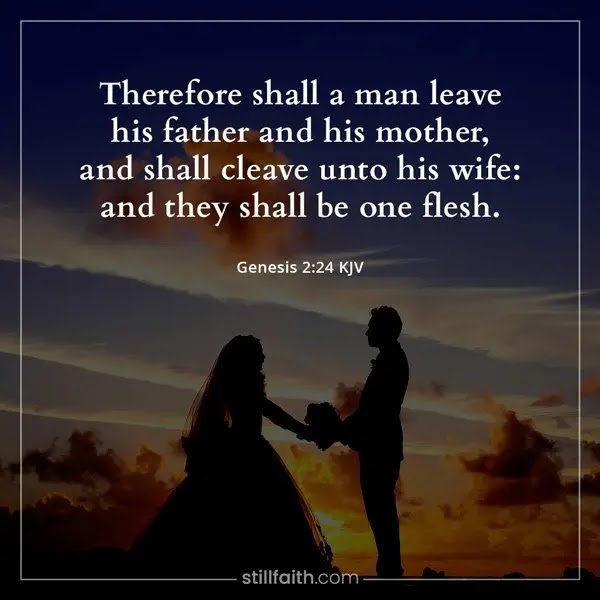
What does Genesis 2:24 mean? [⇑ See verse text ⇑]

The story of Adam and Eve pauses to make an aside to all who read it: we should follow the pattern of marriage as revealed in the rest of God's Word. Men must leave—or "forsake"—both of their parents and hold fast to—or "stick to"—their wives. They must become one flesh together. This is unmistakable, because of the way God designed this relationship between the two of them. Because we know that marriage is from God. Because it is not good for mankind to be alone. Because God saw that need and provided the woman to Adam as helper, companion, and wife. Because she was taken out of man and built from his own rib.

This verse implies significant ideas about how cultures should function. In the ancient world, one of the highest values was allegiance and honor to one's parents. The Bible makes clear, though, that a man's duty is to forsake his parents in the sense that he transfers his loyalty from them to his wife. Providing, living with, and caring for her must take priority in his life over doing the same for his parents.

Second, a man must stick to his wife in a willful and lasting way. The idea of a covenant or contract is implied. The husband's commitment must be iron clad.

Finally, the two will become one flesh. This speaks of their exclusive sexual bond, but also speaks of their family relationship. As one flesh, the husband and wife will become family to each other, with all of the legal and relationship rights and privileges that come with being so closely connected.


Context Summary
Genesis 2:15–25 returns to provide details about the sixth-day creation of human beings. After being crafted out of the substance of earth, man is placed in a garden by God. He is then given responsibility to care for the plants and trees there. God's first and only prohibition to the man is not to eat from the fruit of the Tree of the Knowledge of Good and Evil, in the middle of the garden, on promise of death. Man is also charged with naming the animals, an act reflecting his God-given authority. God recognizes that it is not good for man to be alone and makes woman to be his helper, companion, and wife, establishing the pattern of God's design for human marriage.


Chapter Context
Genesis 2 begins with a description of the seventh day of creation, in which God rested from His work. Then it returns to the sixth day and describes in more detail the creation of man, the garden God placed him into, and the work God gave him to do. God recognizes that it is not good for man to be alone and makes a helper for him out of his own rib. This woman becomes Adam's companion and wife, setting the original example of God's design for marriage. The two exist in pure innocence, naked yet unashamed before sin enters into the world.

It must have been love


It must have been love
But it's over now
Lay a whisper
On my pillow
Leave the winter
On the ground
I wake up lonely
There's air of silence
In the bedroom
And all around
Touch me now
I close my eyes
And dream away
It must have been love
But it's over now
It must have been good
But I lost it somehow
It must have been love
But it's over now
From the moment we touched
Till the time had run out
Make believing
We're together
That I'm sheltered
By your heart
But in and outside
I turned to water
Like a teardrop
In your palm
And it's a hard
Winter's day
I dream away
It must have been love
But it's over now
It was all that I wanted
Now, I'm living without
It must have been love
But it's over now
It's where the water flows
It's where the wind blows
It must have been love
But it's over now
It must have been good
But I lost it somehow
It must have been love
But it's over now
From the moment we touched
Till the time had run out
Yeah, it must have been love
But it's over now
It was all that I wanted
Now, I'm living without
It must have been love
But it's over now
It's where the water flows
It's where the wind blows
It must have been love
But it's over now
It must have been love
But it's over now

2 tugboats speed to Egypt’s Suez Canal as shippers avoid it


SUEZ, Egypt (AP) — Two additional tugboats sped Sunday to Egypt’s Suez Canal to aid efforts to free a skyscraper-sized container ship wedged for days across the crucial waterway, even as major shippers increasingly divert their boats out of fear the vessel may take even longer to free.


The massive Ever Given, a Panama-flagged, Japanese-owned ship that carries cargo between Asia and Europe, got stuck Tuesday in a single-lane stretch of the canal. In the time since, authorities have been unable to remove the vessel and traffic through the canal — valued at over $9 billion a day — has been halted, further disrupting a global shipping network already strained by the coronavirus pandemic.

The Dutch-flagged Alp Guard and the Italian-flagged Carlo Magno, called in to help tugboats already there, reached the Red Sea near the city of Suez early Sunday, satellite data from MarineTraffic.com showed. The tugboats will nudge the 400-meter-long (quarter-mile-long) Ever Given as dredgers continue to vacuum up sand from underneath the vessel and mud caked to its port side, said Bernhard Schulte Shipmanagement, which manages the Ever Given.

Workers planned to make two attempts Sunday to free the vessel coinciding with high tides, a top pilot with the canal authority said.

“Sunday is very critical,” the pilot said. “It will determine the next step, which highly likely involves at least the partial offloading of the vessel.”

Taking containers off the ship likely would add even more days to the canal’s closure, something authorities have been desperately trying to avoid. It also would require a crane and other equipment that have yet to arrive.

The pilot spoke to The Associated Press on condition of anonymity as he wasn’t authorized to brief journalists.

On Saturday, the head of the Suez Canal Authority told journalists that strong winds were “not the only cause” for the Ever Given running aground, appearing to push back against conflicting assessments offered by others. Lt. Gen. Osama Rabei said an investigation was ongoing but did not rule out human or technical error.

Bernhard Schulte Shipmanagement maintains that their “initial investigations rule out any mechanical or engine failure as a cause of the grounding.” However, at least one initial report suggested a “blackout” struck the hulking vessel carrying some 20,000 containers at the time of the incident.

Rabei said he remained hopeful that dredging could free the ship without having to resort to removing its cargo, but added that “we are in a difficult situation, it’s a bad incident.”

Asked about when they expected to free the vessel and reopen the canal, he said: “I can’t say because I do not know.”

Shoei Kisen Kaisha Ltd., the company that owns the vessel, said it was considering removing containers if other refloating efforts failed.

The Ever Given is wedged about 6 kilometers (3.7 miles) north of the canal’s Red Sea entrance near the city of Suez.

A prolonged closure of the crucial waterway would cause delays in the global shipment chain. Some 19,000 vessels passed through the canal last year, according to official figures. About 10% of world trade flows through the canal. The closure could affect oil and gas shipments to Europe from the Middle East. Already, Syria has begun rationing the distribution of fuel in the war-torn country amid concerns of delays of shipments arriving amid the blockage.

As of early Sunday, over 320 ships waited to travel through the Suez, either to the Mediterranean or the Red Sea, according to canal services firm Leth Agencies. Dozens of others still listed their destination as the canal, though shippers increasingly appear to be avoiding the passage.

The world’s biggest shipping company, Denmark’s A.P. Moller-Maersk, warned its customers that it would take anywhere from three to six days to clear the backlog of vessels at the canal. Already, the firm and its partners have 22 ships waiting there.

“The current number (of) redirected Maersk and partner vessels is 14 and expected to rise as we assess the salvage efforts along with network capacity and fuel on our vessels currently en route to Suez,” the shipper said.

Mediterranean Shipping Co., the world’s second-largest, said it already had rerouted at least 11 ships around Africa’s Cape of Good Hope to avoid the canal. It turned back two other ships and said it expected “some missed sailings as a result of this incident.”

“MSC expects this incident to have a very significant impact on the movement of containerized goods, disrupting supply chains beyond the existing challenges posed by the COVID-19 pandemic,” it said.

………………………………………………………………

RAIN IN LUANDA CAUSES DEATH, DESTROYS SCHOOLS, HOSPITALS


Luanda - The death of a woman due to electrocution, in the urban district of Ingombota, the disappearance of two children, falling trees, flooded health and education institutions, homes and streets and traffic congestion is the provisional balance of the rain, which fell on Luanda from 9.15 a.m. to 12.30 p.m. Tuesday.
 

ANGOP learnt that in the municipality of Luanda, the districts of Boavista, Chicala I, area of Porto Pesqueiro, Ilha Bungo (Ingombota), Kamuxiba, Kinanga, area of Kim Ribeiro and Zamba 2 (Samba) street 21 de Janeiro, Prenda, Rocha Pinto, Gamek, Catintom, Huambo and low area of Cassequel (Maianga), were also flooded.

The rain caused also damage in Santo Rosa neighbourhood, Madeira, zone of Bois and Madeira (Sambizanga), in the urban district of Ngola Kiluanje- neighbourhoods of Pedreira de cima and de baixo and Porto pesqueiro and in Neves Bendinha the streets of Pisca, in the limits of the Calemba, Palanca and Havemos de Voltar (Malanginho) neighbourhoods.

Reports from social networks indicate that on Pedro de Castro Van-dunén street, in Kilamba Kiaxi municipality, and Talatona, while it was raining, vehicles were vandalised and robbed.

The two municipalities have the neighbourhoods of Havemos de Voltar (malanginho), Rastas, Golf I, Lixeira, in sub zone 10 (on the border with Catintom) and wet bridge area, Benfica, Dangereux, Cambamba and Cambamba 2 and Honga, totally flooded.

The actress defying cultural norms to tell new stories in Iraq

Born decades and miles apart, Zahraa Ghandour and her mentor, activist Hanaa Edwar, have each broken with tradition to voice the struggles of their respective generations.


Baghdad, Iraq – Zahraa Ghandour had been gone from Iraq for almost a decade when she touched down in Baghdad in 2011. Armed with grit, the then-20-year-old began her upward battle to carve out a niche for herself in the country’s male-dominated film industry. 


“I decided to work in this field when I was 12, and I always imagined it to be in Iraq, to tell stories from here,” she explains. “I left but [Iraq] stayed with me all the time.”

Ghandour, 29, is one of countless young Iraqis born in the midst of catastrophic United Nations-imposed sanctions and whose early teenage years were marred by the violence that accompanied the 2003 United States-led invasion.

By the time she was 13, Ghandour had lived through what most people do not experience in a lifetime, including exile. In 2004, a fast-deteriorating security situation in Iraq forced Ghandour’s mother to leave everything behind and relocate to Damascus, Syria.

Like so many Iraqis in the diaspora, Ghandour yearned for her country and planned an imminent return. But it would take her seven years and a second relocation to Lebanon before she was reunited with her beloved Baghdad.

Today, she is one of Iraq’s most celebrated up-and-coming directors and actors and has cemented herself as a vocal women’s rights activist.

In less than a decade, Ghandour’s work ethic and passion have seen her involved in numerous projects, including documentaries, award-winning films and social initiatives aimed at increasing the presence of women in Iraqi arts and the public sphere.

In her personal life, she has defied cultural expectations through small daily acts of defiance, like living on her own and being unabashedly opinionated. In doing so, she has helped pave the way for other young women.

“There is a positive effect from some of the things that I do for girls of my generation and younger,” she explains.

Women help women

In the same way that Ghandour opens her doors to other women, the young actress found her anchor years ago in one of Iraq’s greatest feminist icons.

Lawyer and activist Hanaa Edwar, 75, is petite but commands respect as few can. Her social work spans more than five decades and includes the co-founding of non-governmental organisations like Al-Amal Association and the Iraqi Women Network, both of which provide support to the country’s most vulnerable.

Edwar has also offered legal counsel to countless women and was involved in implementing a law against honour killing in the Kurdish region and opening the first-ever women’s shelter in the city of Erbil.

Born decades and miles apart, Ghandour and Edwar’s lives have many parallels. Both women were forced out of Iraq, both defied cultural norms and both have been key in voicing the struggles of their respective generations.

In 2012, their paths became inextricably linked by a common goal: furthering women’s rights in Iraq.

“But Zahraa’s style is so calm,” remarks Edwar with a laugh, “Not like me!”

Unlike Ghandour, Edwar speaks quickly and energetically. She cares little for her own personal story, instead, she prefers to discuss her humanitarian work in detail and praise the new generation of Iraqi women, including Ghandour.

“I have seen in her a wonderful feminist who tries to educate herself,” says Edwar. “I felt so in touch with her, not only as a mentor but to be friends with this woman.”

“Zahraa built herself independently,” says Edwar. “It was a struggle, not easy, but she could really achieve this independence in her life, to be the master of her life, this is a wonderful thing which I needed in my youth also.”

But the vast majority of Iraqi women do not have the privilege of having their own living space or independence from their family or husband.

“She is not under the influence of members of her family, that is the privilege for Zahraa, others suffer a lot from family pressure,” explains Edwar, whose own home has turned into a sporadic shelter for women escaping domestic abuse.

‘Hanaa has saved women’

Women and men have equal rights under the Iraqi constitution. But years of economic sanctions and armed conflict, coupled with misconceptions of traditions, tribal laws and a lack of education, have pushed a large portion of the female population into the private sphere.

The marginalisation and vilification of Iraqi women have had devastating effects, including the gunning down of vocal female activists and social media influencers by unknown assailants and the rise in domestic violence amid a countrywide COVID-19 lockdown.

Iraqi society “tries to impose that women are under the control of the patriarchy, as well as the traditions and religious fatwas,” says Edwar, whose knowledge of Iraqi law and tireless sense of justice has helped countless women over the decades.

“Hanaa has literally saved the lives of women,” explains Ghandour of her mentor. “Her outside image is amazing, it’s very powerful, but knowing details about her life and what she went through and [is] still going through just made her way bigger.”

Ghandour is currently working on an independent documentary set to delve into the life of Edwar as well as her own and the parallel struggles faced by both women.

“Some things she went through in the 60s and 70s, I’m still facing now as a woman. The exact same simple things” says Ghandour. “That makes me sad because we didn’t move forward, we just moved backwards on many levels.”

‘I have a stage and I’m using that’

Even in her field, says Ghandour, hypocrisy and sexism prevail. And in a country where pursuing the arts is not seen as an appropriate career path, her quick ascent in the film industry has come at a price.

Her poignant portrayal of Amal in the 2019 film Baghdad in my Shadow saw her become the first Iraq-based actress to shoot an intimate scene, leaving in her wake a barrage of critics.

“They say that I’m showing the wrong image for Iraqi women and I’m not respecting the religion,” says Ghandour. “Almost every actress I know here has problems with her family and her community … I believe the society here will never really open for women to be in the arts field.”

Sometimes, the backlash becomes overwhelming. “Hanaa is the person that I think of when I want to give up – because sometimes it’s just too much.”

Despite the challenges, Ghandour’s voice continues to surge over the noise of a patriarchal society too often bent on silencing women. “I have a stage and I’m using that because it’s so unfair the life we’re living here as women.”

Both have expressed optimism and hope for Iraqi women, particularly since the October 2019 countrywide demonstrations, in which young men and women took to the streets together to demand the overthrow of the government.

Gender shift

A shift in gender dynamic followed the months of demonstrations, which saw men and women share living quarters, forge friendships and even fall in love under the banner of a common cause.

“I feel so inspired by a number of these young activists in Iraq,” says Edwar. “With their courage, they can make a change in our country.”

One of the key events of the months-long social uprising was the first-ever countrywide women’s march in February 2020, when the streets of Iraq’s cities filled with banners and chants as women of all ages demanded their rights. Ghandour, was there to document it.

She filmed the historic moment in the same way that she has been documenting her country and her city for a decade, intent on telling the story of her people.

After seven years far from home, there’s nowhere else Ghandour would rather be than on the warm, chaotic, streets of her Baghdad, battling her causes.

“It’s the energy it’s the life that I see, even in the times that Baghdad is full of death, at the same time it’s full of life.”

SOURCE: AL JAZEERA

………………………………………………………………

A Ciência e a Inteligência Artificial estão a dar vida às memórias!

A Inteligência Artificial já consegue transformar fotografias antigas em experiências visuais surpreendentes Hoje, testemunhamos como a ciên...