Translate

Saturday, 27 March 2021

Canadian High Commission launches projects to support Ghanaian women


Ms. Kati Csaba, the Canadian High Commissioner to Ghana, has called for more opportunities for women to enable them contribute effectively to the economic growth of the country.

She said Ghana could not achieve inclusive economic growth and the Sustainable Development Goals if it failed to fully engage women as economic actors and provided equal participation platform for them.

“Inclusive economic growth in Ghana cannot be achieved without the full and equal participation of women as economic actors,” she said, adding that “Ghanaian women need more opportunities to succeed, and greater control over resources and decision-making. When women are able to develop their full economic potential-whether as business leaders, entrepreneurs, or producers, economies thrive and the benefits of growth reach more people.”

The High Commissioner made the call when she launched four economic empowerment projects in Accra, to support women and girls in Ghana.

The four projects are the Women Innovative for Sustainable Enterprise (WISE), Women’s Economic Advancement for Collective Transformation (WEACT), Innovative for Non-Traditional Education and Skills Training (INVEST) and the Women’s Economic Empowerment (WEE-NORTH).

The initiatives will provide skills training for women and girls while focusing on increasing productivity, profitability and innovation of women-owned businesses in the informal sector.

The projects will directly benefit 31,000 Ghanaian women, from specific urban, peri-urban, and rural areas in eight regions of Ghana.

The Regions are Upper West, Upper East, Savanna, Northern, Western, Western North, Bono, Bono East and Ahafo Regions.

The projects will be implemented by Alinea International, Oxfam Québec, Plan International Canada, and the World University Service of Canada, each working in close collaboration with government partners and civil society organizations in Ghana.

The High Commissioner said the Canadian Government had earmarked GHS138 million (CAD 30 million) for the projects and would be implemented between four to five years.

Ms Csaba said the projects would contribute to improving the understanding of the numerous challenges women faced and helped them to overcome the barriers.

“These projects will give us an opportunity to explore new approaches for women’s economic inclusion,” she said, adding that it formed part of the two countries’ contribution towards addressing issues of gender inequality and promoting women’s economic empowerment.
Speaking on behalf of Oxfam Ghana and Plan International Ghana, implementing organizations for the WISE and WEACT projects, Mr. Tijani Ahmed Hamza, OXFAM Ghana Country Director, commended the Canadian High Commission for the initiatives.

He said the WISE and WEACT projects would provide skills to address barriers women faced and enhance their economic empowerment, wellbeing and inclusive growth.

“The WISE project will directly benefit 12,641 women between ages 19-55 from 150 communities with about 4,000 expected to receive direct training, including 3,230 in agri-business and 810 in green skills,” he said.

On the WEACT project, Mr Hamza explained that a total budget of $CAD 5,950,000 had been allocated for the project, which would benefit 5,400 women and girls directly and 3,510 men and boys (aged 18 – 60), as well as impact the lives of over 790,000 women, men, girls and boys indirectly in the Northern, Savanna, Upper East, Upper West, Western, Western North regions.

Ms Linda Agyei, Director, Vocational for Females Programme, who spoke on behalf of the Alinea and World University Service of Canada, implementing partners for the WEE-NORTH and INVEST projects, said the INVEST initiative, a five-year programme, would build sustainable pathways to enhance the economic and inclusive growth of 5,000 urban poor young women in Accra, Kumasi and Sekondi-Takoradi.
The WEE-NORTH Project on the other hand, she said, would promote industrial trades training for women and girls in the northern part of the country, adding that it was expected to benefit over 2,065 young women and 400 women business owners.

GNA
………………………………………………………………

China targets UK politicians for sanctions over Xinjiang ‘lies’


Foreign ministry says nine individuals and four groups subject to immediate sanctions and threatens further action.


China’s foreign ministry on Friday announced sanctions against individuals and organisations in the United Kingdom for “maliciously” spreading “lies and disinformation” on the situation in the far western region of Xinjiang where the United Nations says the Chinese government is committing rights abuses against the Uighurs and other minority Muslim groups.


The sanctions target nine people and four entities, banning the affected people and their family members from entering mainland China, Hong Kong and Macau, Chinese citizens and institutions from dealing with them.

“China is firmly determined to safeguard its national sovereignty, security and development interests, and warns the UK side not [to] go further down the wrong path,” the ministry said in a statement. “Otherwise, China will resolutely make reactions.”

Those sanctioned include Tom Tugendhat, an MP for the governing Conservative party who chairs Parliament’s Foreign Affairs Committee, former Conservative party leader Iain Duncan Smith, and prominent human rights lawyer Helena Kennedy, who is an opposition Labour peer in the upper house. The sanctions have immediate effect.

Geoffrey Nice, who prosecuted the former Yugoslavian leader Slobodan Milosevic and is chairing the Uyghur Tribunal – an independent tribunal set up to investigate whether the alleged rights abuses in Xinjiang constitute genocide – was also among the nine.

Nice is also a patron of Hong Kong Watch, a Hong Kong group advocating for the rights and freedoms of the Chinese territory. The group said the sanctions marked the end of the so-called “golden era” of UK-China relations.

“A regime that sanctions UK parliamentarians, barristers, academics and activists for the ‘crime’ of voicing out concern over human rights abuse cannot seriously be considered a partner to the UK or a supporter of the international rules-based order,” Hong Kong Watch said in a statement, noting that another of its patrons, David Alton, was also among the individuals sanctioned.

The Uyghur Tribunal, which is due to hold its first hearing in May, was one of the four groups targeted by China alongside the China Research Group, Conservative Party Human Rights Commission (CPHRC), and Essex Court Chambers.

In a tweet, the CPHRC said it was “honoured to have been sanctioned by the Chinese Communist Party regime, in recognition of its tireless work documenting the horrific human rights crisis in China.”

UK Prime Minister Boris Johnson on Friday gave strong backing to those sanctioned by China.

“The MPs and other British citizens sanctioned by China today are performing a vital role shining a light on the gross human rights violations being perpetrated against Uighur Muslims,” Johnson tweeted.

“Freedom to speak out in opposition to abuse is fundamental and I stand firmly with them.”

Earlier this week, the UK joined the US, Canada and the EU in imposing asset freezes and travel bans against Chinese government officials, as well as a Xinjiang security body, for “gross human rights violations” against the Uighurs and other minorities.

“Beijing is trying to send the message that they will not stand idly by with measures that they consider unfair from others,” said Al Jazeera’s Katrina Yu, who is in the Chinese capital. “This is very much a symbolic move.”

The United Nations has said approximately one million Uighurs and other mostly Muslim Turkic-speaking residents of the northwestern region have been held in a network of camps that China has described as vocational skills training centres necessary to counter extremism.

Rights groups said the Uighurs have also been subjected to other abuses including mass surveillance, sterilisation and restrictions on religion.

SOURCE: AL JAZEERA
………………………………………………………………

Black farmers speak out against racism in agriculture


For the first time in US history, members of the House agriculture committee heard from Black farmers on the impact of systemic discrimination by the department of agriculture (USDA).

Thursday’s hearing came on the heels of $5bn being allocated to socially disadvantaged farmers of color earlier this month as part of the coronavirus relief and economic stimulus package. The funding – $4bn for debt forgiveness, $1bn for other forms of support – is meant to account for generations of mistreatment of farmers of color by the USDA.

“This festering wound on the soul of agriculture must be healed,” said congressman David Scott of Georgia, who was born on a farm in South Carolina owned by his grandparents and now serves as the first ever Black person to chair the committee.

Black farmers offered familiar testimonies of racism in the industry and from the USDA. Sedrick Rowe, an organic peanut farmer in Georgia, spoke of crop buyers telling him they are done buying peanuts for the day when he shows up. PJ Haynie of the National Black Growers Council told of Black farmers getting by on non-irrigated land while their white neighbors used USDA assistance to irrigate theirs.

Once making up about 14% of US farmers, Black farmers make up less than 2% today. Many were forced out by racist lending practices by the agriculture department that led to vast losses of land, income, profits and generation wealth.

That wealth cannot be regained. Black farmers will never get the land they lost back. But the USDA seems to be trying to foster a renewed trust in the department.

In addition to Scott’s landmark appointment in December, the USDA, perhaps as an acknowledgment of Tom Vilsack’s second term as agriculture secretary being met with disappointment by many Black farmers and leaders, named Dewayne Goldmon, former executive director of the National Black Growers Council, as the USDA’s first-ever senior adviser for racial equity. And, if confirmed, Jewel Bronaugh will be the first Black woman to serve as deputy secretary for the department.

Still, Black farmers remain skeptical. “That’s all very much good intention. But the foundation of the USDA is crooked,” said Michael Carter, a Virginia farmer, of the seemingly reactive diversity efforts. “You can’t put a new roof on and expect the foundation to be straight again.”

Scott asked Vilsack on Thursday how much of his time will be devoted to getting the $5bn in stimulus funds in the hands of Black farmers. Vilsack responded that he has no doubt his staff understands this is at the top of his list in terms of priorities.

“This is a meeting I’ve been advocating for for 30 years,” said John Boyd Jr . “On behalf of every Black share cropper and Black farmer we thank you for finally hearing our cries.”

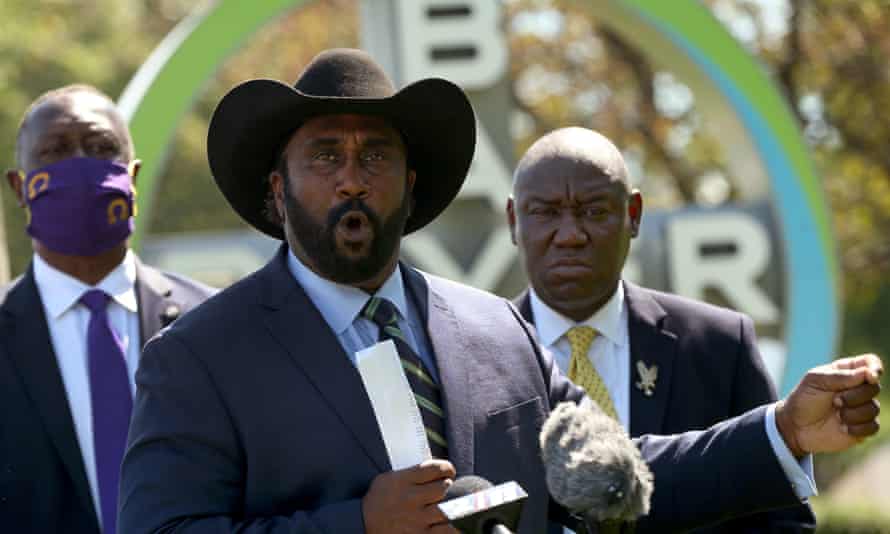
John Boyd Jr., center, president and founder of the National Black Farmers Association, speaks at a press conference on 26 August 2020.
John Boyd Jr., center, president and founder of the National Black Farmers Association, speaks at a press conference on 26 August 2020. Photograph: Christian Gooden/AP

But as president and founder of the National Black Farmers Association, Boyd said his phones were ringing off the hook with farmers asking when they will get the relief. By the end of the four and a half hour hearing, that rollout was still not clear. Boyd, who has advocated on behalf of Black farmers and brought issues of inequality to the forefront for decades, urged swift movement to implement this debt relief.

“This should’ve been doing in the first place,” he said over the phone. Reminded of his own advocacy towards Thursday’s hearing, he remained resolute. “You don’t think about it. You got so many hurdles, so many fights.

………………………………………………………………

Trains collide in southern Egypt, killing at least 32 g at least 32


CAIRO (AP) — Two trains collided on Friday in southern Egypt, apparently after someone activated the emergency brakes, killing at least 32 people and leaving 108 injured, Egyptian authorities said.


Two passenger cars flipped on their side from the force of the collision, the latest in a series of deadly accidents along Egypt’s troubled rail system, plagued by poor maintenance and management.

Video from the scene taken shortly after the collision showed derailed cars turned into twisted piles of metal, with some passengers trapped inside. Some victims seemed unconscious and others could be seen bleeding. Bystanders carried bodies and laid them out on the ground near the site.

Dozens of ambulances rushed to the scene in the southern province of Sohag, Egypt’s health ministry said. The wounded were transferred to four nearby hospitals. Their injuries included bone fractures, cut wounds and abrasions, the statement said.

The ministry said a plane carrying medical supplies and physicians covering different specializations flew from Cairo to Sohag, some 440 kilometers (270 miles) to the south.

Egypt’s Railway Authorities said the accident happened when someone activated the emergency brakes of a passenger train that was headed to the Mediterranean city of Alexandria. The train stopped abruptly and was struck from behind by another train, the statement said. The collision caused two cars from the first train to flip over.

Egypt’s railway system has a history of badly maintained equipment and poor management. Official figures show that 1,793 train accidents took place in 2017 across the country.

President Abdel-Fattah el-Sissi said he was monitoring the situation and that those responsible would receive “a deterrent punishment.”

“The pain that tears our hearts today cannot but make us more determined to end this type of disasters,” he wrote on his Facebook page.

Prime Minister Mustafa Madbouly’s office said he and five of his cabinet members would travel to the scene.

In 2018, a passenger train derailed near the southern city of Aswan, injuring at least six people and prompting authorities to fire the chief of the country’s railways.

The same year, el-Sissi said the government lacks about 250 billion Egyptian pounds, or $14.1 billion, to overhaul the run-down rail system. El-Sissi spoke a day after a passenger train collided with a cargo train, killing at least 12 people, including a child.

A year earlier, two passenger trains collided just outside the Mediterranean port city of Alexandria, killing 43 people. In 2016, at least 51 people were killed when two commuter trains collided near Cairo.

Egypt’s deadliest train crash took place in 2002, when over 300 people were killed when fire erupted in speeding train traveling from Cairo to southern Egypt.

………………………………………………………………

Friday, 26 March 2021

We are delighted to officially announce the launch of our new brand campaign Thought For Food® with Sofonie Dala

We are pleased to announce the launch of our new brand campaign Thought For Food® with Sofonie Dala


Good evening ladies and gentlemen!

My name is Sofonie Dala, I am from Angola. In 2020 I was elected as one of 500+ TFF Ambassadors!

I am the local face of TFF® in my region when contacting internal (Regional Coordinators and Core Team) and external stakeholders.

Our main challenge is to seek all kinds of solutions to address the prevailing question: “How do we feed 10bn people on a hotter planet?”


Thought For Food® is a global non-profit organization dedicated to engaging and empowering the next generation to feed 9+ billion people by 2050.

We are youth  representing many different backgrounds—from science and engineering to design and creative storytelling, from business and entrepreneurship to farming and agronomy.

Hunger in Africa – are you willing to feed the children?


Starvation in Africa is now believed to be the most serious problem of all. Different sources say that every year hunger kills more people than diseases such as COVID-19, AIDS, malaria and tuberculosis combined all together. Many of those people are kids who die at very young age because of lack of food. The situation is very serious and African continent is in a grave danger. Hunger became a grim reaper who takes away countless numbers of lives each and every day.

Reaching street children

Poverty seems to be the most important factor. Many African families simply do not have enough money to buy food. As a result, parents and children are starving and the state is not concerned with their situation.

Shaping the future of food and agriculture

Hunger facts

There are many different causes of hunger but most common are: poverty, environment, harmful economic systems, conflicts, and rapid population growth.

Environment is another problematic issue. People have to face erosion, desertification, deforestation, and of course droughts and water shortages. The agricultural production is sometimes extremely reduced. This reduction has a direct effect on hunger increase.


Singing and performing is an Art 

Ladies and gentlemen, meet our singer Filismina performing the song ''Sitting at the feet of Jesus''

1 Sitting at the feet of Jesus, Oh, what words I hear Him say! Happy place! so close, so precious! May it find me there each day; Sitting at the feet of Jesus, I would look upon the past; For His love of him has been so gracious, It has won my heart at last.
2 Sitting at the feet of Jesus, Where can mortal be more blest? There I lay my sins and sorrows, And, when weary, find sweet rest; Sitting at the feet of Jesus, There I love to weep and pray; While I from His fullness of him gather Grace and comfort every day.


We appeal for donations of sanitary hygiene products, food and any kind of help that you can offer.

Don't miss out on the opportunity!!
We would really appreciate it if you could share this information widely with your youth networks and contacts.

International football returns to Libya after seven-year hiatus


Libya’s national football team lost to Tunisia on Thursday but fans in the eastern city of Benghazi still had reason to cheer as international football returned to Libya after a seven-year hiatus.


International football had been banned in Libya for several years as the North African country was wracked by conflict.

Tunisia, nicknamed the Eagles of Carthage, won 5-2 in an Africa Cup of Nations qualification match played behind closed doors due to the continuing coronavirus pandemic at the Benina Martyrs Stadium, formerly known as Hugo Chavez Stadium under the regime of overthrown leader Muammar Gaddafi.

The loss means Libya cannot qualify for the next Africa Cup of Nations to be hosted in Cameroon in January 2022.

The Libyans opened the scoring in the 22nd minute but were quickly overtaken by the Tunisians’ fast-paced, pressing style, conceding three goals within 30 minutes of their opener.

A second goal early in the second half gave the Libyans some cause for hope, but that was dashed after Tunisia netted fourth and fifth goals towards the end of the game.

Even though the loss hurt, Libyan fans still celebrated the return of football to their home soil, with many turning up in droves to cafes to catch a glimpse of their heroes against their rivals and neighbours Tunisia.

Libyans at a cafe in Benghazi celebrate their team’s opening goal against Tunisia [Abdullah DOMA/AFP]

Libya descended into chaos after Gaddafi was toppled and killed in a 2011 NATO-backed uprising, resulting in multiple forces vying for power.

The Libyan national football league was suspended in 2019 due to the deteriorating security situation.

Fighting only came to a halt last year and a formal ceasefire announced in October was followed by the establishment of a unity government led by interim Prime Minister Abdul Hamid Dbeibah.

The Libyan Premier League resumed play in January.

Ashraf Mazeg, a Libyan fan, said Thursday’s result was expected as the long period of suspension had meant Libyan-based players had limited recent game time.

“The loss was expected in this result due to the stoppage of the league and the players are not physically ready, but I hope the coach will choose better players – there are better players in Libya, but they were not picked,” Mazeg said.

Still, others said the defeat was a tough pill to swallow, irrespective of their players’ lack of recent match experience.

“The Tunisian team is strong, and they have strong clubs, like Espérance and Sfaxien, who compete in the African Champions League, but we did not expect the result to be like this. But this is the material the coach has, and this is what players he has,” said supporter Mahmoud al-Badri, who nevertheless expressed optimism about the team’s upcoming fixtures.

Regardless of the result, many claimed that the lifting of the ban on playing in Libya, which forced the national team to play most of its international games in neighbouring Egypt and Tunisia, was a victory in itself.

“It is a positive thing, which is to allow the play at the Benina Martyrs Stadium, and God willing, the next [match] will be better,” said fan Abdalla al-Shiekhi.

Despite the defeat, many Libyans celebrated the return of international football to their country [Abdullah DOMA/AFP]
SOURCE: AL JAZEERA AND NEWS AGENCIES

………………………………………………………………

Many dead in fire at COVID hospital in India’s Mumbai


A fire has killed at least 10 people in a shopping mall that housed a private hospital treating coronavirus patients in India’s financial capital of Mumbai, officials said.


The fire broke out late on Thursday night inside the mall’s Sunrise Hospital in Mumbai’s Bhandup area, a municipal spokesman said.

Uddhav Thackeray, chief minister of Maharashtra state where Mumbai is situated, said 68 patients had been evacuated and shifted to other hospitals.

Some missing people appear to have gone home and were being tracked, Thackeray said.


Smoke billows after a fire broke out at a COVID-19 hospital in Mumbai [Reuters]
Around 78 people were at the hospital on Thursday, according to its records.

It was not immediately clear how many of the dead were COVID-19 patients, as the bodies were being identified by relatives.

An investigation has been opened into the cause of the fire, which started on the ground floor of the building as smoke filled the hospital on an upper floor, local media reported.

The fire comes amid an upsurge in coronavirus cases in Mumbai, which reported 5,504 new infections on Thursday, its highest number since the outbreak began, according to Reuters news agency.

India’s new coronavirus infections rose 59,118 overnight, the highest daily rise since October 18, health ministry data showed on Friday.

The country’s overall caseload stood at 11.85 million, the world’s third largest after the United States and Brazil.

India reported 257 new deaths from coronavirus, taking the overall tally to 160,949, the data showed.

India to widen vaccination campaign
India plans to widen its coronavirus vaccination campaign soon to include more younger people, the health minister said on Friday.

The world’s biggest vaccine-making nation has held back large exports of the AstraZeneca shot to meet growing domestic demand. But there is no outright ban, a government source said, and vaccine supply will be staggered.

All people above the age of 45 are eligible for vaccination from April 1, the government said, and it is now working to meet a demand by many states for the inclusion of all adults, after new infections nearly quadrupled this month.

“The government is already planning to widen the umbrella of COVID-19 vaccine beneficiaries in the near future to cover other sections of our population,” Health Minister Harsh Vardhan told a virtual summit organised by the Economic Times newspaper.

India has injected 55 million doses, the third-highest figure after the US and Brazil, although much lower as a proportion of its population of 1.35 billion, the website Our World in Data showed.

After criticism mounted over its vaccine exports, India is diverting more supplies from vaccine maker the Serum Institute of India to inoculations at home. Its other vaccine maker, Bharat Biotech, is struggling to boost output.

SOURCE: NEWS AGENCIES
………………………………………………………………

A Ciência e a Inteligência Artificial estão a dar vida às memórias!

A Inteligência Artificial já consegue transformar fotografias antigas em experiências visuais surpreendentes Hoje, testemunhamos como a ciên...