Translate

Saturday, 13 May 2023

Children in Gaza experience ‘trauma beyond their endurance’

Parents say they are at a loss in dealing with the trauma of their children who should be playing, not grieving.


Gaza City, Gaza – Toqa al-Dalo cries relentlessly in a state of shock after hearing about the death of her best friend in Israel’s first air attack on the Gaza Strip on Tuesday.

As the 10-year-old got ready for school that morning, she saw her parents crying quietly. They had received word that Mayar Ezz El-Din, 10, was killed in the bombing of her home in the central Gaza Strip, along with her brother Ali, 7, and father Tariq Ezz El-Din.

“I can hardly believe what happened,” a weeping Toqa told Al Jazeera as she hugged a gift Mayar recently gave her after she broke her hand in an accident. “She was very kind and supported me during my injury. What was her fault and what was her little brother’s fault? Why did they kill her?”

Toqa recalled how they visited each other’s homes and were constantly messaging one other.

“I have known Mayar since we were in the first year of kindergarten, and we continued our friendship as classmates at school. She was my best friend. We were always in touch.”

Israel continued its air attacks on Gaza on Friday with the Palestinian death toll now at 31, including six children and four women. More than 100 people have been wounded as the attacks entered a fourth day. Rockets were also launched from Gaza into Israel.
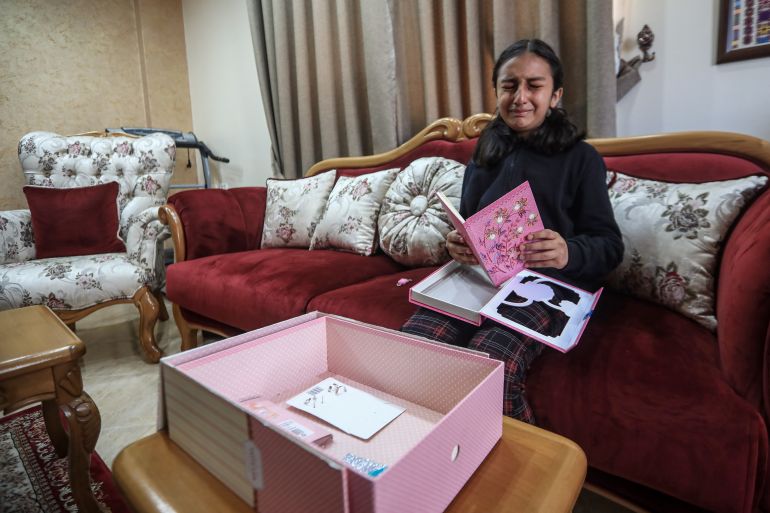
A girl crying over her deceased friend
Toqa al-Dalo reacts after discussing the killing of her best friend

Alaa and Mohammad al-Dalo, Toqa’s parents, tried to calm her down despite their own pain.

“It’s very difficult to see your child go through such a severe state of grief at this early age, when the child is supposed to be playing with friends, and not receiving the news of their horrible killing with their families while they are asleep,” Alaa told Al Jazeera.

“Our children in Gaza are growing up prematurely and are exposed to great traumas that are beyond their age and endurance.

“We parents are confused about how to deal with them,” she added, while wiping her daughter’s tears.

Toqa’s parents are concerned about her intense grief, but mostly fear her return to school where she won’t find Mayar by her side.

“This will greatly worsen her psyche,” said Mohammad.

“Toqa used to spend most of her time at school with Mayar and her brother Ali, who she used to play and chat with constantly because of his kindness and fun. Now there it became a heavy return to school on her heart,” he added.
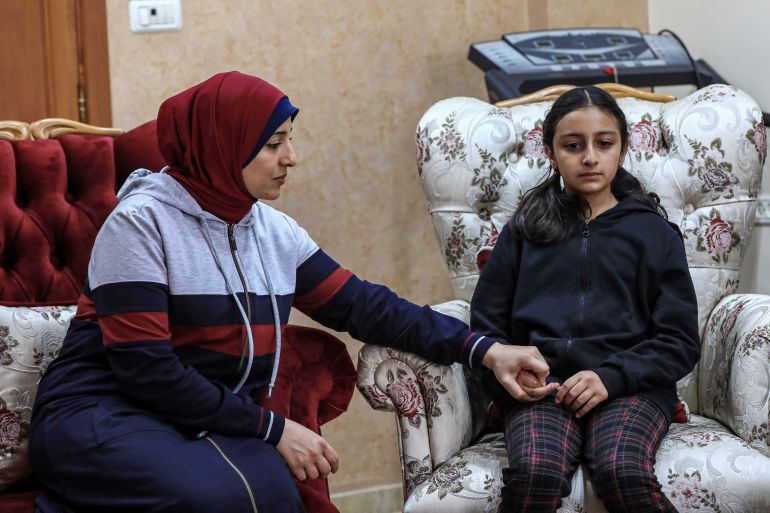
A mother tries to assure her daughter.
Alaa al-Dalo, Toqa’s mum, tries to comfort her

Five-year-old Hajar al-Bahtini was killed along with her father Khalil Al-Bahtini, 45, and mother, Laila, 43, in an Israeli bombing, also on Tuesday, of their home in the Tofah neighbourhood east of Gaza City.

“We were sleeping safely. Suddenly we woke up to destruction, the sound of bombing and dust. I could not move because a wall had fallen on my feet,” said Hajar’s 14-year-old sister, Sara al-Bahtini, after she was discharged from hospital with a splint on her broken foot.

“My brothers were screaming near my parents’ room, which was burning,” she told Al Jazeera.

“When they put me in the ambulance, I saw my brothers screaming and crying. I was trying to deny the idea that it was possible that my parents had been killed, but I was shocked when I learned that Hajar was also killed with them.”

Sara said she sometimes “envies” Hajar because she is with her parents, and will not cry for their separation again.

“Hajar was the fruit of the house. Everyone loved her for her intelligence and wit, and because she was the youngest. What was her fault that she was murdered while she was sleeping?

“I feel like I’m living a catastrophe and an endless nightmare. I lost my mother, father and younger sister in a matter of moments. How will I and my six siblings continue life?” she added, bursting into tears.

Mohammad Daoud, 41, is in a state of shock, still reeling from the death of his four-year-old son, Tamim, who suffered from a heart ailment.

“Tamim woke up terrified because of the heavy shelling. He came running to his mother’s lap crying and trembling with fear,” said the father of two, recalling the attack.

“For a moment I didn’t realise that Tamim’s heart couldn’t stand it. I tried to calm him down, but his heart was beating so hard, as if it was going to fall out of place.”

He rushed Tamim to the children’s hospital for cardiopulmonary resuscitation, but the doctors said the child’s condition had already deteriorated.

“Tamim stayed for hours in intensive care until he passed away late in the day,” Daoud said.

“He’s my only son with a cute smile. Very smart and active. It’s too much for us. It is true that my son was suffering from a chronic heart disease, but the terrifying Israeli strikes on the Strip are beyond bearable,” he said.

“Why should our children endure all this? A normal person trembles in fear of the severity of the bombing, so how about children and the sick?”

The United Nations children’s agency condemned the continuing attacks by Israel, noting six kids had been killed so far.

“This is not acceptable. All children must be protected, everywhere, from all forms of violence and grave violations, according to international humanitarian law,” UNICEF said in a statement.

SOURCE: AL JAZEERA

……………………………………………………


Astronomers identify largest cosmic explosion ever observed

The explosion – AT2021lwx – is a fireball 100 times the size of our Solar System and 10 times brighter than a supernova.


Astronomers have identified the largest cosmic explosion ever observed, a fireball 100 times the size of our Solar System that suddenly began blazing in the distant universe more than three years ago.

While the astronomers offered on Friday what they think is the most likely explanation for the explosion, they emphasised that more research was needed to understand the puzzling phenomenon.

The explosion, known as AT2021lwx, has currently lasted more than three years, compared with most supernovae which are only visibly bright for a few months, according to a study published in Monthly Notices of the Royal Astronomical Society.

Led by the University of Southampton, the astronomers believe the explosion is a result of a vast cloud of gas, possibly thousands of times larger than our sun, that has been violently disrupted by a supermassive black hole.

According to the study, the explosion took place nearly 8 billion light years away, when the universe was about 6 billion years old and is still being detected by a network of telescopes.

Such events are very rare and nothing on this scale has been witnessed before, the researchers say.

Last year, astronomers witnessed the brightest explosion on record – a gamma-ray burst known as GRB 221009A, which was nicknamed BOAT – for Brightest Of All Time.

Although BOAT was brighter than AT2021lwx, it lasted for just a fraction of the time, meaning the overall energy released by the AT2021lwx explosion was far greater.

AT2021lwx has earned the nickname “Scary Barbie” from researchers owing to its “terrifying energy”.

According to Danny Milisavljevic, assistant professor of Physics and Astronomy at Purdue University, AT2021lwx was first assigned a random alphanumeric name when discovered: ZTF20abrbeie. The “Scary Barbie” nickname came from its alphanumeric designation “abrbeie” and “scary” because of its power.

AT2021lwx was first detected in 2020 by the Zwicky Transient Facility in California and subsequently picked up by the Asteroid Terrestrial-impact Last Alert System (ATLAS) based in Hawaii.

But until now the scale of the explosion had been unknown.

Philip Wiseman, research fellow at the University of Southampton, who led the research, said: “Most supernovae and tidal disruption events only last for a couple of months before fading away. For something to be bright for two plus years was immediately very unusual.”

It was only when astronomers, including Wiseman, looked at it through more powerful telescopes that they realised what they had on their hands. By analysing different wavelengths of light, they worked out that the explosion was roughly 8 billion light years away. That is much farther than most other new flashes of light in the sky, which means the explosion behind it must be far greater.

It is estimated to be about 2 trillion times brighter than the Sun, Wiseman said.

Astronomers have looked into several possible explanations. One is that AT2021lwx is an exploding star – but the flash is 10 times brighter than any previously seen “supernova”.

Another possibility is what is called a tidal disruption event, when a star is torn apart as it is sucked into a supermassive black hole. But AT2021lwx is still three times brighter than those events and Wiseman said their research did not point in this direction.

The only somewhat comparable bright cosmic event is a quasar, which happens when supermassive black holes swallow huge amounts of gas in the centre of galaxies. But they tend to flicker in brightness, Wiseman said, whereas AT2021lwx suddenly started flaring up from nothing three years ago and it is still blazing away.

“This thing we have never, ever seen before – it just came out of nowhere,” Wiseman said.

Now that astronomers know what to look for, they are searching the skies to see if other similar explosions have been missed.

SOURCE: AL JAZEERA AND NEWS AGENCIES

………………………………………………………

Russia denies Ukraine push in Bakhmut, UK to send cruise missiles

The UK announced it will provide Storm Shadow long-range cruise missiles to Ukraine for its defence against Russia’s invasion.


Russia has denied that Ukrainian forces have made a breakthrough in the bloody battle for the city of Bakhmut while the United Kingdom has become the first country to supply Ukraine with long-range cruise missiles.

Ukraine has for months requested long-range missiles from its Western allies but has only received shorter-range weapons as supporters feared more advanced weapons would be used to strike targets inside Russian territory and further escalate the conflict.

UK Defence Minister Ben Wallace said on Thursday that Storm Shadow cruise missiles – which have a range of more than 250km (150 miles) compared with the US-provided HIMARS range of some 80km (50 miles) – will be sent to Ukraine.

“We will simply not stand by as Russia kills civilians,” Wallace told members of parliament when announcing that Storm Shadow missiles are being provided to Kyiv.

Wallace said the cruise missiles are being sent for use within Ukrainian territory, implying he had received assurances from Kyiv that they will not be used to hit targets inside Russia.

The Kremlin previously said that the UK’s provision of such missiles would require ”an adequate response from our military”.

Russia’s Defence Ministry on Thursday was forced to deny reports that Ukrainian troops had made advances in the months-long fight for Bakhmut.

“The individual declarations on Telegram about a ‘breakthrough’ on several points on the front line do not correspond to reality,” the ministry said in a statement.

Pro-Moscow military bloggers have suggested that Ukraine’s long-awaited counteroffensive has quietly started while the head of the Wagner Group, Yevgeny Prigozhin, said this week that Russian troops had withdrawn from some areas of Bakhmut and that Ukrainian forces had advanced north and south of the city in what he also said was the start of the offensive.

In a video released on the Telegram messaging app on Tuesday, Prigozhin said Russian troops were fleeing positions in Bakhmut because of the “stupidity” of their commanders.

“Today, everything is being done so that the front line crumbles,” he said

Russia’s Defence Ministry said in the statement that Moscow’s forces had repulsed several Ukrainian attacks in the course of the day, adding that the ongoing battle occurred near Malynivka in the eastern Donetsk region and involved both air power and artillery. Russian forces were “continuing to liberate the western parts” of Bakhmut city, it added.

The Institute for the Study of War, a Washington-based think tank, said the reactions of Prigozhin and Russia’s Defence Ministry to Ukraine’s movements in Bakhmut “reflect increased panic in the Russian information space” about the long-awaited Ukrainian counteroffensive.

“The deployment of low-quality Russian forces on the flanks around Bakhmut suggests that the Russian MoD [Ministry of Defence] has largely abandoned the aim of encircling a significant number of Ukrainian forces there,” the think tank said.

Amid speculation that Ukraine’s counteroffensive may have already started, President Volodymyr Zelenskyy was reported as saying that Ukraine needed more time before beginning the operation against Russia.

“Mentally we’re ready…” Zelenskyy told the BBC. “In terms of equipment, not everything has arrived yet,” he said.

“With [what we have] we can go forward and be successful. But we’d lose a lot of people. I think that’s unacceptable. So we need to wait. We still need a bit more time,” he was quoted as saying on Thursday.

Patrick Bury, a senior lecturer in security at the University of Bath in the UK, said he was not surprised by Zelenskyy’s comments.

“If you are Zelenskyy, you are doing everything you can to make sure you get everything you need” before launching the offensive, he said.

“On the other hand, I would not be surprised at all if it started in the next couple of weeks, depending on the mud. … As of last week it was still one of the wettest springs they’ve had over there in years … It’s just not favourable,” Bury said.

Ukrainian military analyst Oleksandr Musiyenko said Kyiv’s allies needed to understand that a counteroffensive “may not result in the complete eviction of Russian troops and the definitive defeat of Russia in all occupied areas”.

“We have to be ready for the war to continue into next year – or it could end this year,” Musiyenko told Ukrainian NV Radio.

“It all depends on how the battles develop. We can’t guarantee how the counteroffensive will develop.”

SOURCE: AL JAZEERA AND NEWS AGENCIES

…………………………………………………………

Wednesday, 10 May 2023

One dead, 30 injured in new wave of unrest in Senegal

Protesters have taken to the streets in capital Dakar against what they call an increasingly repressive state.


Violence during protests in the Ngor neighbourhood of the Senegalese capital, Dakar, has killed one teenager and wounded 30 people as young protesters took to the streets against an increasingly “repressive state”.

The city witnessed violent protests on Tuesday night when schoolchildren demanding a high school to be built instead of a police station were confronted by police in full gear.

“The government is not listening to us, the president is not listening to us, no one wants to help us, so we are expressing ourselves as we can,” a protester who did not want to give his full name told Al Jazeera.

Checkpoints and security officers were placed to prevent other residents and journalists from entering Ngor. Al Jazeera correspondent Nicolas Haque was harassed and stopped for a few hours before he could resume reporting.

“We have to maintain operations to keep law and order to protect the population,” said Senegal’s government spokesperson Abdou Karim Fofan. “People should be able to demonstrate but people should also be able to go to work and to schools without being stopped by demonstrations,” Fofan said.

But residents of Ngor said police stormed their homes while they were sleeping to arrest and beat dozens of people, Haque reported after he could manage to enter the neighbourhood.

“This is not a political protest, and what is happening is incomprehensible to us we don’t understand. All we want is a high school, not a police station,” Souley Mbengue, deputy mayor of Ngor, told Al Jazeera.

The protest happened hours after a call by Senegalese opposition figure Ousmane Sonko for civil disobedience by his supporters following a court ruling that threatens his candidacy in upcoming presidential elections.

A court on Monday suspended Sonko’s sentence in a libel case that could make the popular politician ineligible to stand in the 2024 presidential vote – the latest twist in a long-running legal saga that has stoked further tensions in Dakar, already shaken by days of unrest.

Sonko rejected the court ruling, pledging instead to pursue his candidacy and calling for a mass protest against President Macky Sall.

Senegal’s constitution allows only two presidential terms, but some fear Sall will use a recent tweak to the constitution to reset his mandate, which ends in 2024, allowing him to run again.

“Nobody can prevent me from being a candidate,” Sonko said in a speech streamed online on Tuesday. “What happened yesterday is not a travesty of justice but judicial banditry.”

“I repeat my call for resistance and ask the Senegalese to stand up and face Macky Sall,” he said.

The authorities have rejected Sonko’s allegations that the justice system is being used to shut him out of the presidential race. The tense standoff has triggered protests and sometimes violent clashes between security forces and his supporters in recent years.

Sonko did not say if he planned to appeal the court ruling at the Supreme Court within the six-day deadline, but called on supporters to attend an opposition rally scheduled for Friday in Dakar.

“We want the 12th [of May] to be a protest like nothing the country has ever seen,” he said.

Friday’s rally is being organised by the F24 platform, a large group of civil society organisations. Members wish to show their opposition to a third term by Sall and allege that the authorities have misused the justice system for political ends.

Aside from the libel case, Sonko is also charged with raping a beauty salon employee in 2021 and making death threats against her. He denies any wrongdoing, but the outcome of that case could also affect his electoral eligibility. The next court hearing is scheduled for May 16.

Tuesday’s deadly demonstration and Sonko’s call for protests on Friday have further heightened tensions and poked holes in the longstanding image of a country largely viewed as one of the most stable democracies in West Africa.

SOURCE: AL JAZEERA AND NEWS AGENCIES

………………………………………………………

UK court rules in favour of Shell in Nigerian oil spill case

 The case is one of a series of legal battles Shell has been fighting in London courts, mounted by residents of Nigeria’s oil-producing Niger Delta.


The United Kingdom’s Supreme Court has ruled that it was too late for a group of Nigerian claimants to sue two Shell subsidiaries over a 2011 offshore oil spill.

On December 20, 2011, an estimated 40,000 barrels of crude oil leaked when a tanker was loaded at Shell’s Bonga oilfield, 120km (75 miles) off the coast of Nigeria’s Niger Delta.

Shell disputed the allegations and said the Bonga spill was dispersed offshore and did not impact the shoreline.

On Wednesday, the Supreme Court upheld rulings by two lower courts that found the plaintiffs had brought their case after the six-year legal expiry date.

Oil spill
Spilled crude oil laps at the shores of the Niger Delta in the village of Bodo in Nigeria’s oil-producing Ogoniland 

A panel of five Supreme Court justices unanimously rejected the claimants’ argument that the ongoing consequences of the pollution represented a “continuing nuisance”.

According to the Reuters news agency, the court did not look at the evidence supporting either side’s assertions or make a ruling on the issue. It only decided the legal point of nuisance.

“The Supreme Court rejects the claimants’ submission. There was no continuing nuisance in this case,” Justice Andrew Burrows said as he delivered the ruling.

“The leak was a one-off event or an isolated escape. The oil pipe was no longer leaking after six hours,” he said.

A group of 27,800 people and 457 communities living in the delta have been trying to sue Shell, saying the leftover oil slick polluted their lands and waterways and damaged farming, fishing, drinking water, mangrove forests and religious shrines.

The average life expectancy in the region is 41 years, 10 years lower than the national average.

UK courts have previously ruled against Shell in another case involving pollution in the Niger Delta.

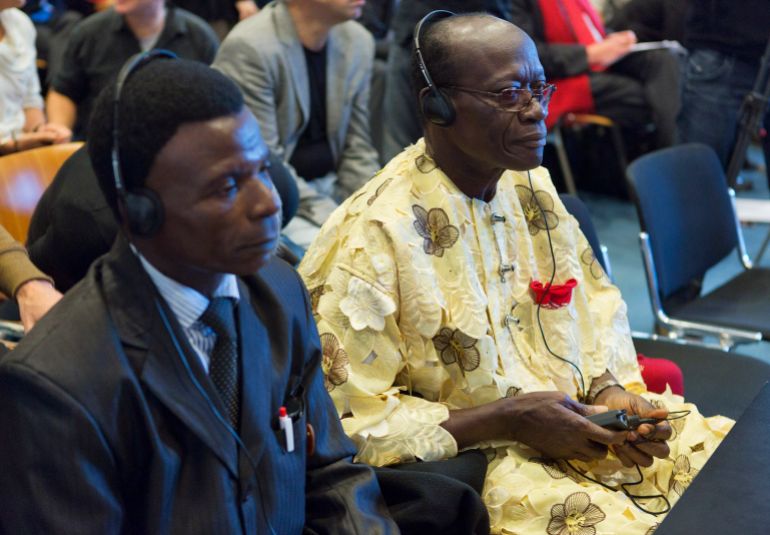
Nigerian representatives from the Niger Delta
Chief Fidelis Oguru, left, and Friday Alfred Akpan, representatives of fishermen and farmers from Nigeria, attend a court hearing in The Hague on October 11, 2012, after taking Shell to court, accusing the company of polluting their lands and waters 

In February 2021, the Supreme Court allowed a group from the Ogale and Bille communities to sue Shell over spills, and that case is currently through the High Court.

At that time, Shell said it was not responsible for most of those spills and said they were caused by illegal third-party interference.

“We believe litigation does little to address the real problem in the Niger Delta: oil spills due to crude oil theft, illegal reining and sabotage, with which SPDC [Shell’s Nigerian subsidiary] is constantly faced and which cause the most environmental damage,” a Shell spokesperson said.

In a separate case in 2015, Shell agreed to pay 55 million pounds ($70m) to the delta’s Bodo community in compensation for two spills after a legal battle in London.

SOURCE: AL JAZEERA AND NEWS AGENCIES

…………………………………………………………

UK tabloid publisher apologises in Prince Harry trial

Harry is one of several high-profile claimants bringing damages against Mirror Group Newspapers over allegations of unlawful information gathering, including phone hacking.


The publisher of United Kingdom tabloid The Mirror, accused by Britain’s Prince Harry and other celebrities of unlawful information gathering, has apologised at the opening of a trial in London.

Harry has been involved in several legal cases against British newspaper publishers since moving to California in the United States and stepping down from royal duties in early 2020.

He is one of several high-profile claimants bringing damages against Mirror Group Newspapers (MGN) over allegations of unlawful information gathering, including phone hacking. The group publishes titles including The Mirror, the Sunday Mirror and Sunday People.

At the start of the trial on Wednesday, the publisher admitted “some evidence” of unlawful information gathering and assured that “such conduct will never be repeated”.

The group admitted that a private investigator was instructed by a journalist at The People to unlawfully gather information about Harry’s activities at a London nightclub one night in 2004. It apologised to Harry “unreservedly” and said he was entitled to “appropriate compensation” without providing further details.

But MGN lawyer Andrew Green said voicemail interception was denied. He also argued that some of the claims were brought too late, with some of the stories in question dating back more than 20 years.

Lawyer David Sherborne, representing Harry and other claimants, submitted that the use of unlawful information gathering by journalists from the titles of MGN was happening “at an industrial scale”.

Harry, who was not present for the start of the hearing, has been selected as one of four test cases for the seven-week trial and is due to give evidence himself in person in early June, the first British royal to do so since the 19th century, according to local media.

“Prince or not, the blatantly unlawful and illegal methods that were used by the defendant to get every piece of information about his life away from royal duties was quite frankly appalling,” Sherborne told the court on Wednesday. “No one should have been subjected to that.”

“It was a flood of illegality,” Sherborne said, adding that “this flood was being authorised and approved of by senior executives”.

Harry, 38, has had a difficult relationship with the media, particularly since he and his wife Meghan Markle, who is American, left the royal family in early 2020.

He is also pursuing claims against two other media companies, the publisher of The Sun and, separately, the publisher of the Daily Mail. Those cases will be decided later this year.

Harry holds the media responsible for the death of his mother Princess Diana, who was killed in a car crash in Paris in 1997 after being pursued by paparazzi photographers.

SOURCE: NEWS AGENCIES

……………………………………………………

Tuesday, 9 May 2023

Missing organs in Kenya cult case – police

 A court document filed by police investigating Kenya cult deaths says autopsies showed some organs were missing from bodies exhumed from shallow graves.


“Post-mortem reports have established missing organs in some of the bodies of victims who have been exhumed,” chief inspector Martin Munene said in an affidavit filed to a Nairobi court.

It said that “it is believed that trade on human body organs has been well co-ordinated involving several players”.

But chief government pathologist Johansen Oduor had earlier ruled out organ harvesting following autopsies on 112 bodies in his final report on Friday.

Interior minister Kithure Kindiki said on Tuesday that “on the issue of missing body parts theory, I think investigations are still going on… I’m advised by the experts that we should not pre-empt the investigations…it’s a theory we are investigating”.

Most of the victims, including children, died of starvation but some were strangled, beaten, or suffocated, according to the pathologist.

The main suspect in the case, Pastor Paul Mackenzie, is alleged to have encouraged his followers to fast to death in order to go to heaven. He has previously denied to have forced them into the fast.

A fresh round of exhumations in the expansive 800-acre forest in the coastal Kilifi county resumed on Tuesday in an exercise supervised by the interior minister.

The Kenyan Red Cross says that 360 people had been reported missing, while the authorities say at least 60 others have been rescued alive.

Source: BBC

…………………………………………………

When Telecommunications Collapse: What Angola's Mobile Network Crisis Teaches Us About Governance, Justice, and National Security

  The recent disruption of Angola's mobile networks has affected banking, digital payments, businesses, emergency communications, and mi...