Luanda – Angola is one of the 40 chosen countries by the World Bank (WB) to be part of the favourable environment ranking for doing business (Business Enabling Environment, BEE).
According to what ANGOP has learnt through a publication on the website of the Ministry of Economy and Planning, the choice fell on Angola due to the set of reforms implemented in the last five years.
The ministerial department’s website says that the BEE is a report that will make a quantitative assessment on the business environment for the development of the private sector, focused within the regulatory framework and in the provision of public services aimed at companies, workers and markets.
The publication in the website also states that in the last five years, the Angolan Government implemented a set of reforms in 10 areas which comprise the life cycle of a company.
The selection of Angola for the first BEE report is seen as recognition of the reform drive of the Angolan government over the past five years.
The World Bank has not published reports on the business environment since 2019.
Saurimo - A diamond cutting factory called “Pollaro” was inaugurated this Friday, at the Saurimo Diamond Hub, Lunda Sul Province, by the minister of Mineral Resources, Oil and Gas, Diamantino Azevedo, aiming to promote the institution.
With the capacity to cut 5,000 carats per month, the 5th factory was built in an area of 750 square metres, with an investment of over USD 5 million, for its construction and to acquire the equipment.
The factory includes areas for treatment, planning, stone scanning, laser cutting, manual and automatic polishing.
On the occasion, the minister of Mineral Resources, Oil and Gas, Diamantino Azevedo, said that the hub would continue to be a priority as it was a sector that contributed most to the national economy.
He expressed his satisfaction for the fact that another one of the many factories that will still be built and also for the fact that it provided jobs for Young finalists of the Training, Evaluation and Diamond Cutting Centre.
The governor of Lunda Sul Province, Daniel Neto, noted that the opening of the new factory would in fact make more diamonds to be cut locally, which would bring more job opportunities for young people.
The president of the factory's executive committee, Hélder David, said that it employs 60 young people, of whom 30 are nationals and 30 foreign citizens.
He informed that the company will continue to make continuous improvements with investment aiming to get better results.
Luanda - Angola's secretary of State for Oil and Gas, José Barroso, said Friday that Sonangol had become more dynamic and organised with the ongoing regeneration process.
Barroso said that the regeneration process saw the emergence of a more agile Sonangol (National Fuel Society) that was better prepared to implement projects and programmes in the Upstream (exploration, drilling and production), midstream (refining) and downstream (transport, distribution and commercialisation), within the framework of the migration of a large part of its "non-core" assets.
Speaking in a press conference held as part of the 47th anniversary of the state-owned oil company, Barroso said the same process has made it possible to redefine the company's organisational model, which was based on an entrepreneurial vision, while preparing to put part of its capital in the stock exchange, based on best international practices.
"We are convinced that the impact that our national oil company has had and will continue to have in the implementation and development of socio-economic projects in several areas of the economy is unique and deserves to be highlighted", Barroso said.
The official added that the restructuring of the oil sector over the last few years led Sonangol to focus on carrying out its business across the sector's value chain, at a national and international level, with a national and international vision, based on the Angolan government's strategy for consolidation of the oil and gas sector.
He underscored that in terms of upstream exploitation the national company approved and should focus on implementing the exploration and production strategy, with the aim to increase its operating quota to 10 percent by 2027, which is currently around 2 percent.
The official added that the Sonangol will have to invest in exploration and development in new fields, while it continues production and revitalisation of existing oil and gas fields in already operated blocks.
In midstream and downstream, the official underscored Sonangol's involvement in refining projects to implement the government's strategy to achieve fuel self-sufficiency by 2027.
For this purpose the Cabinda, Soyo and Lobito refineries inaugurated in 2022 are expected to contribute a lot, as well as the Luanda Refinery Complex with capacity for 1.5 million barrels per day is opened in mid-2022.
Barroso also mentioned other achievements by the national oil company, such as the increasing fuel storage capacity with the execution of the Barra do Dande Ocean Terminal project, which plans to store more than 580,000 cubic metres in its first phase.
Luanda - Angola and the strategic partners of the World Health Organisation (WHO) have renewed, during the 5th global ministerial summit, in Montreux (Switzerland), the commitment on patient safety 2023.
According to a press release issued Friday, in Luanda the participants of the event, which took place on February 23 and 24, agreed on the need for more efforts to ensure that all patients receive appropriate, safe and high quality care.
The 5th Ministerial global Summit of Montreux 2023, discussed patient safety in different technical domains through a broad public health policy perspective.
At the meeting, emphasis was placed on patient safety in the context of COVID-19, highlighting successful and sustainable implementation efforts undertaken in different settings and countries, as well as presenting best practices and reflecting success stories.
The note adds that the global action plan for patient safety represents WHO´s medium-term strategic vision, as it understands that harm to patients from unsafe care is currently a major and growing global public health challenge, and is one of the leading causes of death and disability worldwide.
The aim of the action plan is to provide strategic guidance to all stakeholders in eliminating avoidable harm in healthcare and improving patient safety, across different domains of practice, through policy action on safety and quality of health services.
The report adds that it provides a framework for countries to develop their respective national action plans on patient safety, as well as align existing strategic tools to improve patient safety across clinical and health-related programmes.
In May 2021, the 74th World Health Assembly (WHA) approved decision WHA74 (13) to adopt the first global patient safety action plan 2021-2030 “eliminating preventable harm in health care” as the global roadmap for patient safety over the next 10 years.
This decision of the World Health Assembly obligates WHO to report on progress in implementing the action plan to the assembly in 2023 and every two years thereafter until 2031.
WHO also understands that, most of the time, patient harm is preventable.
As countries strive to achieve universal health coverage and the sustainable development goals (SDGs), the beneficial effects of improved access to health services may be undermined by insecurity of care.
Background
The seventy-second world health assembly in 2019 adopted resolution WHA72.6 on global action for patient safety and recommended the development of a global action plan for patient safety.
This global action plan was adopted by the seventy-fourth world health assembly in 2021, with a vision of “a world in which no one is harmed in health care and all patients receive safe and respectful care, always, everywhere”.
The aim of the action plan is to provide strategic guidance for all stakeholders in eliminating avoidable harm in healthcare and improving patient safety in different domains of practice through policy actions on health service safety and quality, as well as for the implementation of recommendations at the point of care.
Since it was created in 2016, the global ministerial summits on patient safety have succeeded in raising awareness as well as creating and sustaining the momentum of the global patient safety movement, as evidenced by the adoption of the WHA resolution (WHA72.6) “Global Action on Patient Safety” in May 2019, which enabled the first World Patient Safety Day in September 2019.
WHO considers that one of the main challenges facing patient safety today is to ensure the appropriate and sustainable implementation of adequate concepts and proper approaches that are crucial to the success of the WHA resolution.
The 5th global ministerial summit was attended by more than 600 experts, about 80 ministerial delegations and some 30 health ministers from around the world, including the Chairman of the Swiss Confederation, Alain Berset and the Director-General of WHO, Tedros Adhanom Ghebreyesus.
The Angolan delegation was headed by the secretary of State for Public Health, Carlos Alberto Pinto de Sousa, representing the minister of Health.
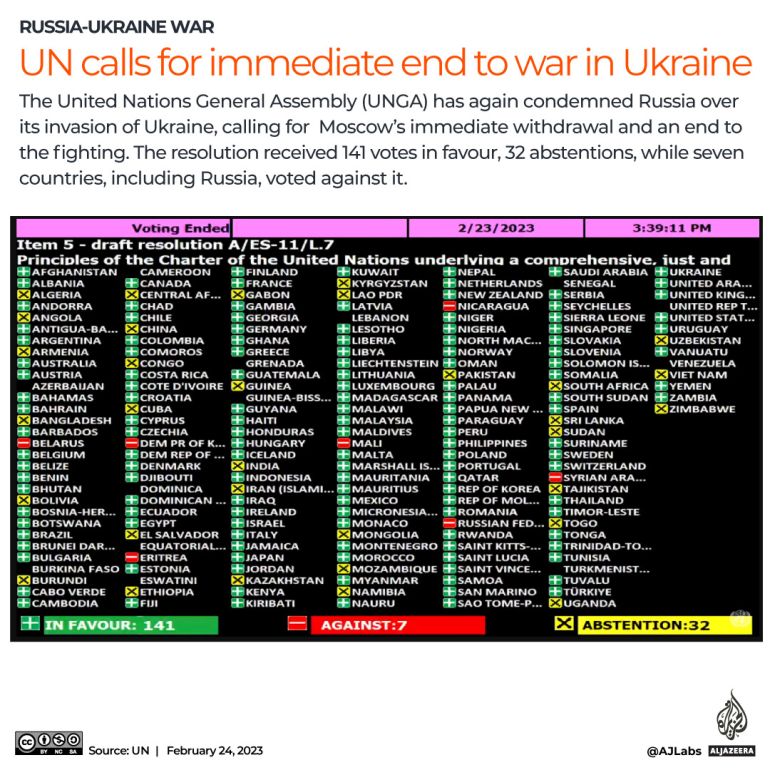
A year since President Vladimir Putin ordered the invasion, which he has called a “special military operation”, 141 countries backed the resolution calling for a “comprehensive, just and lasting peace” in Ukraine. Thirty-two countries abstained from voting, while seven countries, including Russia, voted against.
Here is a breakdown of how each country voted in the UNGA in New York City on Thursday:
For (141):
A: Afghanistan, Albania, Andorra, Antigua and Barbuda, Argentina, Australia, Austria
B: Bahamas, Bahrain, Barbados, Belgium, Belize, Benin, Bhutan, Bosnia and Herzegovina, Botswana, Brazil, Brunei, Bulgaria
M: Madagascar, Malawi, Malaysia, Maldives, Malta, Marshall Islands, Mauritania, Mauritius, Mexico, Micronesia, Monaco, Montenegro, Morocco, Myanmar
N: Nauru, Nepal, Netherlands, New Zealand, Niger, Nigeria, North Macedonia, Norway
O: Oman
P: Palau, Panama, Papua New Guinea, Paraguay, Peru, Philippines, Poland, Portugal
Q: Qatar
R: Republic of Korea (South Korea), Republic of Moldova, Romania, Rwanda
S: Saint Kitts and Nevis, Saint Lucia, Saint Vincent and the Grenadines, Samoa, San Marino, Sao Tome, Saudi Arabia, Serbia, Seychelles, Sierra Leone, Singapore, Slovakia, Slovenia, Solomon Islands, Somalia, South Sudan, Spain, Suriname, Sweden, Switzerland
T: Thailand, East Timor, Tonga, Trinidad and Tobago, Tunisia, Tuvalu, Turkey
U: Ukraine, United Arab Emirates, United Kingdom, United States, Uruguay
V: Vanuatu
Y: Yemen
Z: Zambia
Against (7):
B: Belarus
D: Democratic People’s Republic of Korea (North Korea)
E: Eritrea
M: Mali
N: Nicaragua
R: Russia
S: Syria
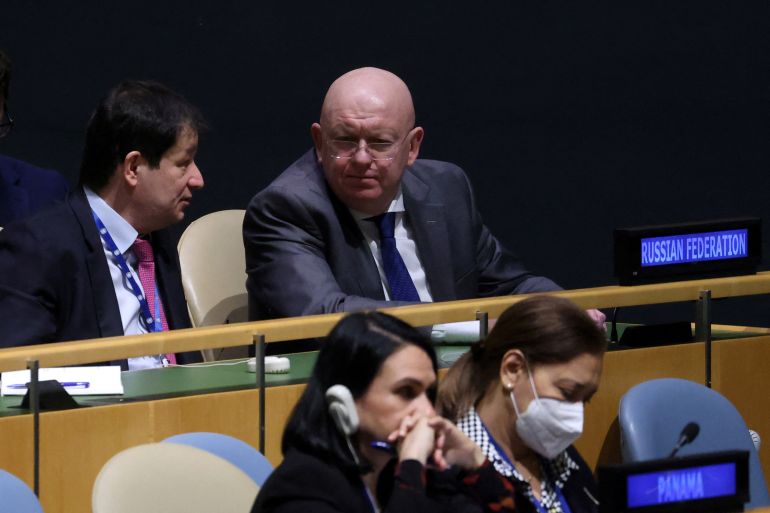
Russian Ambassador to the United Nations Vasily Nebenzya reacts after the UNGA adopted the resolution. Six countries voted with Russia against the resolution
Abstained (32):
A: Algeria, Angola, Armenia
B: Bangladesh, Bolivia, Burundi
C: Central African Republic, China, Republic of Congo, Cuba
China’s plan calls for end to Western sanctions on Russia and humanitarian corridors for civilians to escape fighting.
China has called for a ceasefire between Ukraine and Russia and a gradual de-escalation of the situation that will pave the way for peace talks, as part of a 12-point proposal to end the conflict.
The plan by China, which was released on Friday morning by the foreign ministry and coincides with the first anniversary of Russia’s invasion of Ukraine, urges an end to Western sanctions against Russia, the establishment of humanitarian corridors for the evacuation of civilians, and steps to ensure the export of grain after disruptions caused global food prices to spike last year.
“Conflict and war benefit no one,” the ministry said in a statement.
“All parties must stay rational and exercise restraint, avoid fanning the flames and aggravating tensions, and prevent the crisis from deteriorating further or even spiralling out of control,” it said.
“All parties should support Russia and Ukraine in working in the same direction and resuming direct dialogue as quickly as possible, so as to gradually deescalate the situation and ultimately reach a comprehensive ceasefire.”
The proposal mainly elaborates on long-held Chinese positions, including that all countries’ “sovereignty, independence and territorial integrity be effectively guaranteed”. The plan also called for an end to the “Cold War mentality”, which is Beijing’s standard term for what it regards as global dominance by the United States and its interference in other countries’ affairs.
Beijing — which claims to be neutral in the conflict — has a “no limits” relationship with Russia and has refused to criticise Moscow’s invasion of Ukraine or even refer to it as such. It has also accused the West of provoking the conflict and “fanning the flames” by providing Ukraine with arms.
Beijing’s top diplomat Wang Yi visited Moscow this week and pledged a deeper relationship between the countries, while Putin hailed “new frontiers” in ties with Beijing and signalled that China’s leader Xi Jinping would visit Russia.
Xi is expected to deliver a “peace speech” on Friday, though some analysts have cast doubt on whether Beijing’s efforts to act as a peacemaker will go beyond rhetoric.
The ambassador of the European Union to China, Jorge Toledo, told reporters at a briefing in Beijing on Friday that China had released a position paper not a peace proposal, and the EU will study it.
“If the position paper is a positive sign for Ukraine then it’s a positive sign for the EU, although we are studying the paper closely,” he said.
Ukraine called the “position paper” “a good sign” and said it expects China to be more active in its support of Ukraine.
“We hope they also urge Russia to stop the war and withdraw its troops,” Ukraine’s charge d’affaires Zhanna Leshchynska said at the same briefing.
US State Department spokesman Ned Price had said earlier on Thursday that Washington would reserve judgement on the proposal but that China’s allegiance with Russia meant it was not a neutral mediator.
“We would like to see nothing more than a just and durable peace … but we are sceptical that reports of a proposal like this will be a constructive path forward,” he said.
On Thursday, China abstained from voting when the United Nations General Assembly (UNGA) approved a nonbinding resolution that called for Russia to end hostilities in Ukraine and withdraw its forces.
The UNGA overwhelmingly adopted the resolution that demanded Moscow withdraw from Ukraine and stop fighting.
There were 141 votes in favour of the resolution and 32 abstentions. Six countries joined Russia to vote against the resolution: Belarus, North Korea, Eritrea, Mali, Nicaragua and Syria.
Russia’s Deputy UN Ambassador Dmitry Polyanskiy dismissed the UN resolution as “useless”.
Ukrainian President Volodymyr Zelenskyy wrote on Twitter that the UN vote was a “powerful sign of the unflagging global support” for Ukraine.
Far from the front lines of Ukraine, Russia’s invasion of its neighbour has damaged the world economy and a Cold War chill has set into international relations.
Washington has said China is considering providing weapons to Russia, a move that could intensify the conflict into a confrontation between Russia and China on one side and Ukraine and the US-led NATO military alliance on the other.
Soyuz MS-23 will transport Russian cosmonauts Dmitry Petelin, Sergei Prokopyev and NASA’s Frank Rubio back to Earth later this year.
Russia has launched an uncrewed Soyuz spacecraft on a rescue mission to return two cosmonauts and a NASA astronaut whose trip back to Earth has been hampered after their original space vehicle was damaged by a mini meteorite while parked at the International Space Station (ISS).
The three arrived at the ISS in September 2022 onboard the MS-22 spacecraft and were originally to stay about six months until the end of March. But the MS-22 began to leak coolant in December after an apparent micro-meteorite punctured an external radiator.
The same thing appeared to happen again earlier this month, this time on a docked Russian cargo ship. Camera views showed a small hole in each spacecraft.
MS-23, which took off on Friday, was initially scheduled to launch in mid-March with two cosmonauts and an astronaut on board who would take over from Rubio, Petelin and Prokopyev at the space station. But without the replacement crew on board MS-23, the two Russians and the US crew member will now continue working at the ISS until September.
Officials had determined that it was too risky to bring the three back in their damaged Soyuz MS-22 next month as originally planned. With no coolant, the cabin temperature would spike during the trip back to Earth, potentially damaging computers and other equipment, and exposing the suited-up crew to excessive heat.
NASA said in a statement that the damaged Soyuz MS-22 is scheduled to undock from the ISS in late March and return to Earth “for an uncrewed parachute-assisted landing in Kazakhstan, and post-flight analysis by Roscosmos” – Russia’s space agency.
After delivering people to the space station, capsules stay attached to the orbiting research lab throughout the duration of missions, in case of any emergencies and to eventually ferry their crews home to Earth.
In addition to the three crew awaiting the arrival of MS-23, there are also four others currently on the ISS after arriving on a SpaceX Dragon capsule last October as part of the Crew-5 mission.
They are scheduled to be joined next week by members of the Crew-6 mission – two US nationals, an Emirati and a Russian – who will also arrive on board a SpaceX capsule expected to launch on Monday from Florida. After a few days of overlap, Crew-5 will then return to Earth.