Translate

Wednesday, 9 November 2022

Former FIFA President Sepp Blatter Claims It Was A ‘MISTAKE’ To Award The World Cup To Qatar

 Disgraced former FIFA president Sepp Blatter has claimed it was a ‘mistake’ to hand the World Cup to Qatar because it is ‘too small’ to stage the huge tournament.


Qatar’s awarding of the prized competition back in 2010 was met with huge controversy after allegations the country had paid bribes in order to secure the right to host the tournament – while the start date has been switched to the Winter to avoid players competing in sweltering temperatures.

The hosts have also come under fire due to the country’s human rights record and its anti-LGBTQ laws, with many nations planning to make a stance against discrimination when they arrive in Qatar this November.

Blatter – who was in charge at the top of FIFA from 1998 until 2015 before being banned from football for six years over a corruption scandal – gave his first interview since being cleared of the charges in July.

He said it was a mistake to give Qatar the honour of hosting due to its size and claimed that USA were FIFA’s preferred to stage the 2022 edition before they were given the 2026 format.

‘The choice of Qatar was a mistake,’ Blatter told Swiss outlet Tages-Anzeiger.

‘At the time, we actually agreed in the executive committee that Russia should get the 2018 World Cup and the USA that of 2022. It would have been a gesture of peace if the two long-standing political opponents had hosted the World Cup one after the other.

‘It’s too small a country. Football and the World Cup are too big for that.’

When asked if he felt responsible for handing Qatar the World Cup, he added: ‘For me it is clear: Qatar is a mistake. The choice was bad.

‘What I’m wondering: why is the new Fifa president [Gianni Infantino] living in Qatar? He can’t be the head of the local World Cup organisation. That’s not his job. There are two organising committees for this – a local one and one from Fifa.’

At the start of the year it was claimed in an investigation from SonntagsBlick that Infantino had been living in Qatar since October 2021, renting a house in the capital of Doha.

FIFA later claimed that Infantino splits his time between working in Doha and Zurich -where the organisation are based, and that being in Qatar allows him to put his focus into preparing for the World Cup.

FIFA said in a statement: ‘As communicated in October 2021, the FIFA President informed the FIFA Council that he would divide his presence between Zurich, Doha and across the world, in order to deliver his presidential duties and be closer to the FIFA World Cup,’ FIFA said in a statement.

‘As he did during the FIFA Arab Cup, he will work alongside other FIFA staff in our office in Doha, when required, until the conclusion of the tournament. For the avoidance of doubt, Mr.Infantino has residency, and remains liable to pay taxes, in Switzerland.’

It is not the first time Blatter has claimed that the awarding of the World Cup to Qatar was an error.

In 2014, he said: ‘Yes, it was a mistake of course, but one makes lots of mistakes in life. The technical report into Qatar said clearly it was too hot but the executive committee – with a large majority – decided all the same to play it in Qatar.’

Source: Daily Mail UK

………………………………………………………

Donald Trump warns Ron DeSantis against 2024 presidential bid

 Donald Trump has warned Florida’s Governor Ron DeSantis against running for president in 2024, saying doing so would harm the Republican Party. He also threatened to release unflattering information about the 44-year-old, without providing details.


Mr DeSantis won a landslide victory in Tuesday’s midterms, underlining his popularity and further fuelling speculation he will launch a bid. Mr Trump is also tipped to announce a presidential run in the coming days

He told US network Fox News that the Florida governor should stay out of the race.

“I don’t know if he is running. I think if he runs, he could hurt himself very badly. I really believe he could hurt himself badly,” Mr Trump said. “I don’t think it would be good for the party.”

Mr DeSantis is considered by many to be the most likely candidate to supplant Mr Trump as the Republican candidate to run for president in 2024.

Mr Trump’s comments came just hours before Tuesday’s midterm elections to decide control of Congress.

He also branded the rising Republican star “Ron DeSanctimonious” at a rally over the weekend.

If Mr DeSantis were to announce a presidential bid, Mr Trump said he would reveal “things about him that won’t be very flattering – I know more about him than anybody – other than, perhaps, his wife”.

He did not provide details – but Mr Trump has previously made threats to release damaging information about rivals.

He later described his potential opponent as “a fine guy” and denied there was a dispute between them. “There’s not a tiff with me, and I’m way up in the polls,” he said.

Mr DeSantis is a relative newcomer to politics but rose to national prominence after becoming Florida governor in 2019. He has positioned himself as an enthusiastic champion of conservativism.

He won a landslide victory for a second term as Florida governor in the midterm elections on Tuesday. The scale of his win exceeded almost all expectations, winning by nearly 20 points over his Democrat rival, stoking further speculation that he may run for president in two years’ time.

Four years ago, the race was so close a recount was needed.

Mr Trump – a resident of the state – told reporters gathered outside a polling station earlier in the day that he had voted for Mr DeSantis.

Mr DeSantis has been tight-lipped about a potential presidential run but speculation has been rife. Mr Trump, meanwhile, said on Monday that he would make a “very big announcement” on 15 November.

Source: BBC

…………………………………………………………

DeSantis’s crushing victory will fuel talk of run for presidency

 The word “historic” is being used to describe Republican gains in Florida, a state where races are often decided by a few points.


Just four years ago, Florida Governor Ron DeSantis won by less than half a percentage point.

The huge margin of his victory tonight will further fuel talk of him as a contender for the White House in 2024. He made gains with nearly every demographic group, including women and Latinos – a group he lost by 10 points in 2018.

His victory speech sure sounded like a play for the presidency. He declared that Florida had rewritten the political map and that he’d only begun to fight.

Republicans in Florida disagree about whether DeSantis would take on Donald Trump in a Republican primary. As one GOP (Republican Party) official here told me, going up against a juggernaut like Trump would be a very different race, and DeSantis has never faced that type of opposition.

Source: BBC

……………………………………………………

Australia moves to block pilots from training Chinese military

 Australian parliament told that it costs more than 15 million Australian dollars ($9.75m) to train a jet fighter pilot.


Australia’s Defence Minister Richard Marles has ordered an urgent review of secrecy polices in the military in response to concerns that Australian pilots were among Western military personnel recruited to provide training to the Chinese People’s Liberation Army.


The defence minister said on Wednesday that enough evidence had been provided to warrant a “detailed examination into the adequacy of current defence policies and procedures”, and that to reveal Australian military secrets was a “clear and unambiguous” crime.

“It’s no secret that defence activities, people and assets are targets for foreign intelligence services,” the minister said in a statement.

“But let me be clear: Australians who work or have worked for the government in any capacity, particularly our ADF (Australian Defence Force), who come into possession of the nation’s secrets, have an obligation to maintain those secrets beyond their employment with, or their engagement with, the Commonwealth,” he said.

“This is an enduring obligation and to reveal any of these secrets is a crime,” he added.

Marles ordered the review of Australians training Chinese forces after asking the department of defence last month to investigate reports that China had approached former Australian military personnel to become trainers.

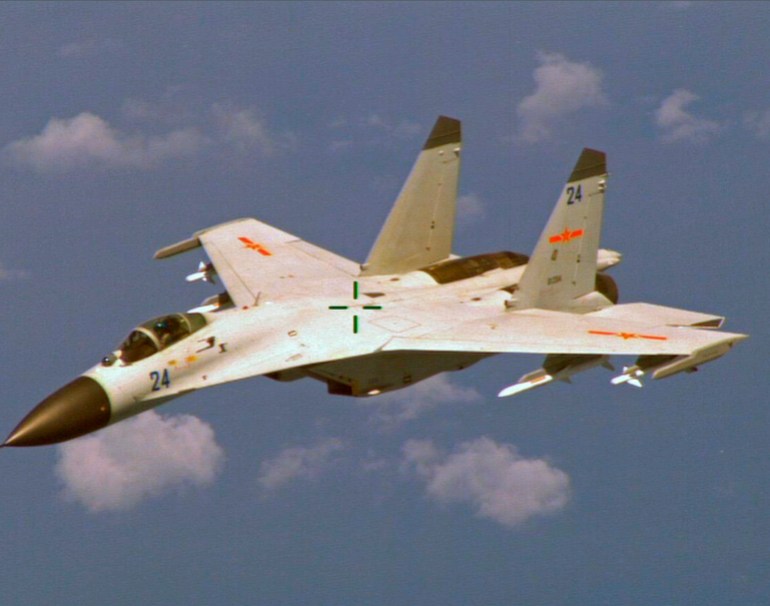
A Chinese J-11 fighter jet flying.
A Chinese J-11 fighter jet is seen flying near a US Navy P-8 Poseidon spy aircraft east of China’s Hainan Island in this US Department of Defence photo from 2014 [File US Navy handout via Reuters]

The minister declined to say whether any Australians had been discovered to have provided military training to the Chinese. He said a joint police-intelligence service task force was investigating “a number of cases” among former service personnel.

“What we are focused on right now is making sure that we do examine the policies and the procedures that are currently in place in respect of our former Defence personnel to make sure they are adequate,” he said.

“And if they are not, and if there are weaknesses in that system, then we are absolutely committed to fixing them.”

An Australian parliament hearing was told by defence officials on Wednesday that it cost more than 15 million Australian dollars ($9.75 million) to train a jet fighter pilot, and any disclosure of official information by a pilot to an unauthorised person after they had left the defence force was an offence.

“Foreign actors will target our people for the unique skills they have,” said Celia Perkins, the Australian defence department’s deputy-secretary for security.

The UK and Canada have also expressed concerns that China is attempting to poach military expertise.

The UK’s Defence Ministry last month issued an intelligence alert warning former and current military pilots against Chinese headhunting programs aimed at recruiting them.

Broadcasters Sky News and the BBC reported that about 30 British former military pilots are currently in China training Chinese military pilots. The reports said the pilots are paid annual salaries of 240,000 British pounds ($272,000) for the training.

The media reports have focused on the Test Flying Academy of South Africa, which responded in a statement on its website saying it “strongly believes that its actions, and those of its employees, do not contravene any UK laws”.

The UK said that it would change its national security laws to stop former military pilots being recruited by third-party agencies to work in China.

Canada’s Department of National Defence was also investigating its own former service personnel, noting they remained bound by secrecy commitments after they leave the Canadian Armed Forces.

New Zealand’s defence minister has also requested advice on whether the its defence force needs laws implemented to stop former military pilots training pilots of foreign militaries, a spokeswoman from the prime minister’s office said.

Four former New Zealand defence personnel have worked for the South African flight training school.

The Australian Defence Department review will report on its findings to the minister by December 14.

SOURCE: AL JAZEERA AND NEWS AGENCIES

………………………………………………………………


Ukraine wants G20 help on Russian deportations of children

Kyiv says thousands of its children have been taken illegally to Russia and that deportations should be investigated as a war crime.


Ukraine wants this month’s G20 summit to address the plight of thousands of its children it says have been deported to Russia, President Volodymyr Zelenskyy’s chief of staff has said.

Global African Family Meeting

“The Russian Federation continues to commit its crimes in connection with Ukrainian children,” Zelenskyy’s office quoted Andriy Yermak as saying on Tuesday at a meeting he chaired of a group of officials responsible for child protection. “The removal of children continues.”

The United States envoy to the United Nations said in early September more than 1,800 children had been transferred to Russia from Moscow-controlled areas of Ukraine in July alone. Ukraine wants such deportations investigated as a war crime.

The statement from Zelenskyy’s office said Ukraine’s National Information Bureau showed 10,500 children had been deported or forcibly displaced. Ukraine’s minister responsible for reintegrating Russian-occupied territories noted at the meeting that only 96 children had been returned.

Last month, Kyiv said it was working to bring back 32 children it said had been forcibly removed from their parents and illegally adopted in Russia.

Yermak was quoted as saying Ukraine could count on UN help but he restated Ukraine’s lack of confidence in assistance from the International Committee of the Red Cross (ICRC).

“Unfortunately, due to the very passive position of international organisations, in particular the ICRC, today we are unable to determine the exact number, how many, and where our children are,” he said.

Yermak said discussions about the return of the children should start at the Group of 20 summit, which starts in Indonesia on November 15. Zelenskyy is expected to attend the meeting remotely, although Ukraine is not a member. It was reported this week that Russian President Vladimir Putin might not attend despite Russia being part of the grouping.

“We really need to draw the world’s attention to what is happening, because this is an absolute genocide of Ukrainians, Ukrainian children, our country,” Yermak said.

Russia has previously said it is offering humanitarian aid to those wishing to flee Ukraine voluntarily, with the Russian ambassador to the UN saying the kidnapping allegations were “a new milestone in the disinformation campaign by Western nations”.

SOURCE: AL JAZEERA, REUTERS

……………………………………………………………

Tuesday, 8 November 2022

COP27 finance: Will richer nations hand over the cash

 At this year’s COP27 UN climate change summit, money will feature high on the agenda and is sure to be a sticking point in negotiations.


Over the last 12 months the developing world has faced severe climate-related crises – from flooding in Pakistan to drought in East Africa.

They want developed nations like the US, UK and those of the EU to pay for the “loss and damage” they’ve suffered.

They also want help to make the switch to cleaner energy and infrastructure. So, will they get the finance?

What do countries want money for?

Money for climate action broadly falls into three buckets. The first is for mitigation – this is money to help developing nations move away from fossil fuels and other polluting activities.

Many countries still have coal power stations that are yet to reach the end of their lives. They need support to build clean energy infrastructure to replace them, such as solar farms.

The second type of funding is for adaptation. This is money that goes toward helping developing nations prepare for the worst effects of climate change.

These impacts vary depending where in the world the country is located but they may include:

  • building stronger flood defences
  • relocating populations at risk
  • developing storm proof housing
  • distributing crops that are more resilient to dry spells

All countries are agreed that funding needs to go towards mitigation and adaptation.

But the third type of finance remains highly controversial. This is known as “loss and damage” finance. This money would go towards helping developing countries recover from the impacts of climate change they are already suffering.

These nations do already receive money for disasters via humanitarian aid – but it can vary from year to year.

Developing nations want guaranteed compensation from developed countries – who they say are historically responsible for climate change.

However, developed countries consider this a red line – and say that to agree would be admitting liability for the disasters.

Will we get an agreement on reparations for loss and damage?

At last year’s COP26 conference, loss and damage did not even feature on the agenda.

Following a series of smaller negotiations this year though, it will now be discussed in Sharm el-Sheikh.

It is unlikely that there will be any agreement on a financial figure but nations could come forward with specific details, such as how the money would be paid.

Some climate activists have used the term “reparations” to describe the payments for loss and damage.

In this context, reparations generally refer to compensation paid by rich countries to poorer ones to make up for their historically greater contributions to global warming and its impacts.

Mitzi Jonelle Tan, the international spokesperson of Youth Advocates for Climate Action Philippines, told the BBC richer countries had a moral duty to help those most affected by climate change.

“They caused the climate crisis and so they need to give reparations for the loss and damage we have already experienced and so we can adapt and mitigate,” she said.

But framing the payments as reparations has proved politically contentious, with developed countries wary of accepting liability for climate change on these terms.

Rishi Sunak’s spokesperson has said the prime minister will not be discussing climate reparations at COP27, pushing back suggestions he was open to the idea.

The spokesperson said that “neither reparations nor liability is what’s being discussed at COP27, it’s about working together to support climate-vulnerable countries”.

The UK is tripling funding for climate adaptation from £500m to £1.5bn in 2025, the spokesman said, while Mr Sunak pledged £65m to the Nature, People and Climate Investment Fund, which supports forest communities.

What money has been given so far?

In 2009, richer countries agreed to provide $100bn (£88bn) a year to developing nations for climate action by the end of 2020. By the end of that year the total had only reached $83.3bn (£73.21) but the goal is expected to be reached in 2023.

The majority, 82%, of this finance came from the public purse whilst the remainder was raised from the private sector, according to the OECD.

But analysis, commissioned by the UN, finds that the private sector could deliver 70% of total investments needed to meet climate commitments.

Following this, last year the Glasgow Financial Alliance for Net Zero (GFANZ) was launched. Now a coalition of more than 550 private firms have committed to directing $130 trillion in assets towards this agenda.

Are developing countries receiving enough money?

Not only are the existing promises of climate finance not currently being met, but developing countries argue that these targets are too low.

At last year’s climate summit in Glasgow, the G77+ China alliance of developing countries called on richer nations to mobilise at least $1.3 trillion (£1.14 trillion) by 2030. They argued that this should be split equally between reducing emissions and preparing for climate change.

Currently, only 34% of climate finance goes towards helping developing countries adapt to climate change, according to the OECD’s latest figures.

Also the majority of the public funding, 71%, is still given in the form of loans rather than direct grants to countries – which can increase the debt burden in poorer nations.

Nafkote Dabi, Oxfam International Climate Policy lead has called this “profoundly unfair”.

He said: “Instead of supporting countries that are facing worsening droughts, cyclones and flooding, rich countries are crippling their ability to cope with the next shock and deepening their poverty.”

………………………………………………

The 2026 AFRICA EDUCATES HER CAMPAIGN REPORT - ANGOLA 6th Anniversary | 2020–2026

  Meet who's behind this cause     Support us:  https://donate-sofonie.netlify.app/           AFRICA EDUCATES HER CAMPAIGN REPORT — ANGO...