Translate

Thursday, 1 September 2022

RWANDA: Disappearance of political foes worrisome – Ingabire

 Today, October 30, 2022 is being marked as “International Day of the Victims of Enforced Disappearances 2022” by a group remembering their “comrades in the struggles for democracy in Rwanda.”


In an exclusive interview with DNT, Victoire Ingabire, a recently released political prisoner who is still denied the chance to leave Rwanda to visit her gravely ill husband in the Netherlands, appealed to international bodies to continue to remember those in Rwanda still fighting for democracy in the country.

Ingabire recounted the disappearance of her colleagues as follows:

“Illuminée Iragena was kidnapped from her place of work. She was a nurse by King Fayçal Hospital in Kigali,it was in morning on 26/3/2016 when unidentified men forced her into a white car parked in the hospital parking according to the testimony of people who were there.”

“Boniface Twagirimana disappeared when he was in prison. A witness to his kidnapping told us that a van entered the prison in front of his cell and that he was forced into it.”

“Eugène Ndereyimana was on way to meet members of our political party he never arrived. Since then nobody knows what happened to him.”

“Venant Abayisenga was my right hand. He had replaced my assistant who had been murdered in March 2018. On 6/6/2020 ,He went out to buy airtime and since then no one has seen him again.”

Asked if shea has heard anything about them from the police, Ingabire said very scant information is provided to them,, and that the story is the same – “we are still searching for them.”

DNT News.

…………………………………………………………

South Africa is not xenophobic – Ramaphosa

 South Africa’s President Cyril Ramaphosa has said the country is “not a xenophobic nation”.


His remarks follows comments made by a provincial health minister to a Zimbabwean patient undergoing treatment, which were viewed as blaming foreign nationals for the country’s ailing healthcare system.

“You are killing my health system,” Dr Phophi Ramathuba was captured in a widely circulated video as saying to a patient who had been in a car accident in neighbouring Zimbabwe, but went to South Africa’s Limpopo province for treatment.

In a question and answer session in parliament, Mr Ramaphosa was asked if he agreed with the conduct of Dr Ramathuba.

The president said the health official raised an important issue on how the provision of services is affected by migration but should’ve used a different platform to raise her concerns.

Mr Ramaphosa also said the country’s home affairs department was working to address challenges brought on by migration to ensure that the rule of law was adhered to.

Meanwhile, the Zimbabwean embassy in Pretoria has contacted the South African government about the comments made by Dr Ramathuba.

The embassy said it watched the video in “shock and disbelief” and conveyed concerns with the relevant authorities.

South Africa’s foreign affairs department has said the matter is being dealt with through diplomatic channels.

……………………………………………………………

Tanzania begins real estate census

 Tanzania has launched a four-day real estate census to determine the number of buildings, ownership, cost and availability of basic infrastructure in the country.


This is addition to the population census that started last week.

The data from the real estate census will assist in improving housing policy, the authorities say.

In the 2012 population census, it was revealed that out of 9.3 million available houses, 6.3 million homes were roofed by corrugated iron sheets and three million were mud roofed.

At least 93% of households had been enumerated in the national population census by Monday.

…………………………………………………………

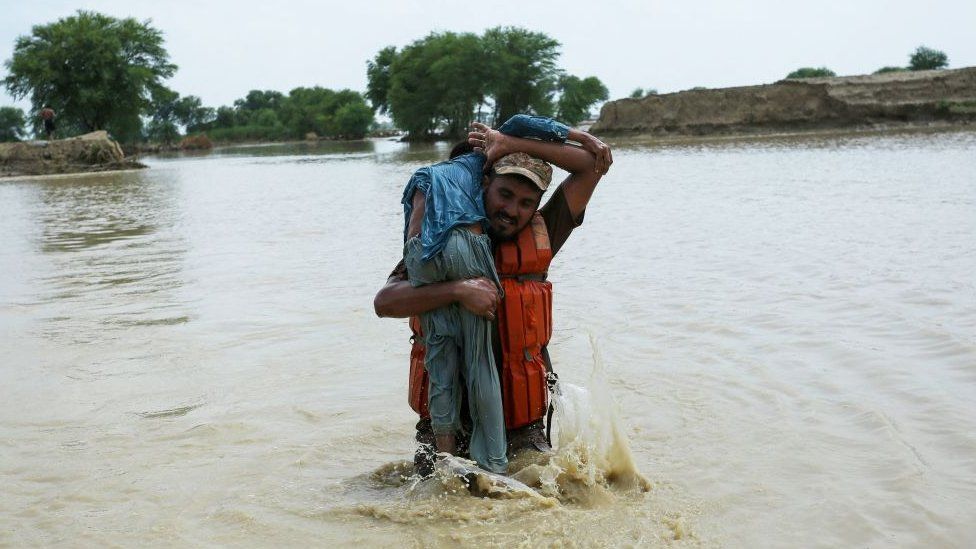
Birmingham MP describes ‘devastating’ Pakistan floods

 A Birmingham MP has described the ongoing floods in Pakistan as “devastating”.


Perry Barr MP Khalid Mahmood was visiting friends and family there before the flooding began and extended his stay to help out.

Currently in Islamabad, he urged people to provide whatever support they could.

The flash floods, caused by record monsoon rains, have killed at least 1,136 people and affected more than 33 million.

They have been described as a “monsoon on steroids” by the UN and Pakistan’s planning minister has said early estimates suggest at least $10bn (£8.5bn) of damage.

Mr Mahmood said he has friends in the Sindh and Balochistan provinces which have both been badly affected.

He also has constituents whose families are in Khyber Pakhtunkhwa and he has been liaising with those back in Birmingham to see how he can help.

The BBC is not responsible for the content of external sites.

“A lot of people are now getting together and putting aid into those areas, providing food, whatever they can, money to the charities that already exist in Pakistan and getting as much as they possibly can to those people,” he said.

“If you look at some of the footage, it is absolutely devastating.

“In Punjab and predominantly in Balochistan and Sindh they are very flat areas – people in those rural areas live essentially in mud houses… which literally are just crumbling under the pressure of the water as it comes through.”

He said they were losing their livelihoods as crops and animals were “washed away”, with many areas cut off and only accessible by helicopter because bridges and roads have been destroyed.

Mr Mahmood, who hopes to return to the UK this weekend, advised those wanting to help to give to aid agencies.

A soldier of Pakistan army rescues a child from the flood affected Rajanpur district, in the Punjab province of Pakistan, on August 2, 2022
More than 33 million people in Pakistan have been affected by the flooding

Zia Salik, the head of fundraising for Islamic Relief UK, has been providing outreach for people in Pakistan.

“The community in the UK has always been generous but obviously we have a huge Pakistani diaspora who have got friends and family back home, so everybody is feeling emotionally connected to this crisis and responding to it in the only way that they can and that is to raise funds,” he said.

…………………………………………………………

U.S. To Suspend Free COVID-19 Test Orders Next Week

 Starting next week, Americans will no longer be able to order free at-home COVID-19 tests from a website set up by the U.S. government due to limited supply arising from a lack of congressional funding.


The COVIDTests.gov website, set up during the Omicron variant record surge in cases, helped U.S. households secure COVID-19 tests at no cost.

President Joe Biden in January pledged to procure 1 billion free tests for Americans, including 500 million available through the website. However, ordering through the program will be suspended on Sept. 2.

The administration will suspend taking orders for free at-home tests through COVIDTests.gov as of Friday, Sept. 2, “because Congress has not provided the COVID-19 funding we need to replenish the nation’s stockpile of tests,” said a senior administration official.

The government will no longer take orders through this program to ensure some tests are still available in the fall in case there is a rise in infections, the official said.

“We have already distributed over 600 million tests through this program, and every household has had the opportunity to place three orders for a total of 16 tests,” White House Press Secretary Karine Jean-Pierre said at a briefing.

Alternative ways of getting at-home tests will remain, the official said, including getting them reimbursed by private health insurance, Medicare, or Medicaid, which collectively cover over 92% of Americans.

The government will continue to distribute free tests directly to long-term care facilities, schools, child care and early learning centers, community health centers, and food banks. The government will also keep supporting around 15,000 free testing sites in pharmacies and libraries.

“If Congress provides funding, we will expeditiously resume distribution of free tests through COVIDTests.gov,” the official said.

……………………………………………………………

Oscar Pistorius: South African ex-Paralympian seeks to force early prison release

 Convicted murderer Oscar Pistorius is going to court to try to force South African authorities to hold a parole hearing for him.


The former Paralympic gold medallist is serving a 13-year sentence for killing his girlfriend in 2013.

Pistorius shot dead Reeva Steenkamp through a locked toilet door, claiming he mistook her for a burglar.

He is seeking an early release over a dispute about when his sentence started.

A series of challenges and rulings by the Supreme Court of Appeal (SCA) has led to confusion about when his sentence became effective.

Pistorius argues that he has already served enough time in prison to be eligible for parole, and therefore authorities should look at whether he can be released early.

In 2017, SCA said that Pistorius should serve 13 years and five months for the murder of Ms Steenkamp – overturning a previous, more lenient punishment of six years for murder.

Last year, the same court ruled that his current term should be backdated to October 2014, when he was initially sentenced for a lesser charge of culpable homicide.

Pistorius argues that this backdating means he became eligible for parole in February last year.

He wants Gauteng’s High Court to order the parole board to convene a hearing for him. If that request is granted, he wants the hearing to be within 30 days of the order saying so.

But Atteridgeville prison, where he is being held, says the court of appeal has given contradictory rulings.

The Department of Correctional Services also says it is seeking a court judgement to establish the date when his sentence effectively began.

Steenkamp’s murder on Valentine’s Day nine years ago shocked the country. In the televised trial, which gripped millions in South Africa and around the world, Pistorius pleaded that he had shot his girlfriend four times because he thought a burglar had entered his Pretoria home.

But a panel of appeal judges found that having armed himself with a high-calibre weapon, Pistorius should have foreseen that whoever was behind the toilet door might die, especially given his firearms training.

……………………………………………………………

Camilo Guevara: Son of Marxist revolutionary Che Guevara dies

 Camilo Guevara March, the 60-year old son of Argentine-born revolutionary leader Ernesto “Che” Guevara, has died.


Cuban officials said he died of a heart attack caused by blood clots in his lungs.

Camilo Guevara dedicated much of his career to documenting the life of his father, who fought alongside Fidel Castro in the Cuban revolution.

He opposed the use of his father’s image – made famous by an Alberto Korda photograph – for marketing purposes.

Camilo is one of four children Che Guevara had with his second wife, Aleida March.

While his older sister Aleida took on the role as spokeswoman for the family, Camilo led the Centre of Che Guevara Studies in the Cuban capital, Havana.

The centre, where Che Guevara’s personal archives are stored, promotes the revolutionary leader’s “life, work and thought”.

Cuban officials said Camilo Guevara died while on a visit to the Venezuelan capital, Caracas.

Cuban President Miguel Díaz-Canel paid tribute to him in a tweet, saying that “with deep sorrow, we say goodbye to Camilo, Che’s son and promoter of his ideas”.

Born in Argentina, Che Guevara arguably became the most famous face of the Cuban revolution after joining brothers Fidel and Raúl Castro in their successful fight to overthrow the government of Fulgencio Batista.

Camilo Guevara was the second of four children born to Che Guevara and his fellow rebel, Aleida March.

He was five years old when his father was shot dead in Bolivia, where he had travelled to set up a guerrilla group.

He studied law but spent much of his life looking after the documents and memorabilia left behind by his father.

Unlike some of Fidel Castro’s close relatives who became vocal critics of the aftermath of the Cuban revolution, such as his sister Juanita Castro and his daughter Alina Fernández, Camilo Guevara remained loyal to the Castro brothers.

Fond of photography, he could often be seen clutching a Leica camera in one hand and a cigar in the other.

He is survived by his 85-year-old mother Aleida, his 61-year-old sister – also called Aleida – who works as a paediatrician, his younger sister Celia, who is a vet, and his younger brother Ernesto, who runs motorcycle tours of the Communist-run island.

He also leaves behind a daughter from his marriage to the late Cuban singer Suylén Milanés and two daughters from his subsequent marriage to Venezuelan Rosa Aliso.

……………………………………………………………

When the Camera Becomes a Threat: Protecting Citizen and Community Journalists in Africa

When the Camera Becomes a Threat: Protecting Citizen and Community Journalists in Africa By Sofonie Dala Angolan Citizen Journalist, Communi...