Translate

Sunday, 6 March 2022

South Korean firm plans to build a naval base in Angola


Luanda - A project for the construction of a naval base in Angola starts to be implemented within a year, AKEDA firm has announced.

The announcement was made on Friday by the secretary general of the South Korea’s comapny, Chung Yes Noo, at the end of an audience granted to him by Angolan president João Lourenço.

Chung Si Noo said that the USD1 billion project will focus on the manufacture of small, medium and large-sized vessels.

The company’s manager said that the audience with the Angolan Head of State served, among other things, to provide information on the progress of the project.

"We chose Angola for the project because we think it is a viable country", said the leader of the South Korean company, stressing that, in a first phase, the project will create 5,000 jobs for young Angolans.

The number of jobs is expected to reach 8,000, said Chung Si Noo, adding that the project is in partnership with Angola oil firm, Sonangol.

The construction of a naval base is not the first project by AKEDA in Angola, which in 2020 invested around USD 2 million  in the construction of an electricity plant in Benguela, is part of a memorandum signed with the Private Investment and Promotion Agency of Exports (AIPEX).


Environmental crisis represents global challenge - minister

Luanda – Angolan minister for Foreign Affairs Téte António said last Friday in Luanda that the environmental crisis posed a challenge to mankind and requires combined effort in the international context.


The minister made the call at opening ceremony of the 17th Justice Minister´s Conference of the Portuguese Speaking Countries held under the motto “Development of the Legal and Judicial Cooperation to Fight the Environmental Crimes, specially the Wild Life´s crime”.


Delivering his speech, Téte António defended coordination of ideas and preventive actions to deal with the practices that cause damage to the environment.


The minister highlighted the fact of the event to discuss aspects on crime that benefit individuals, groups or companies which, according to him, call into question the peace, security and the sustainable development of the States.


The minister mentioned the cross-border factor as being linked to the complexity in the fight against environmental crimes and the wild life.


In turn, the Attorney General (PGR) Hélder Pitta Gróz said that the institution is working with the Ministry of Justice in a joint approach aimed to fight against the environmental crimes.


He noted that there are some proceedings under analysis of environmental crimes in the provinces of Huíla and Luanda, but he would not specify the number.


The meeting aims to lay down legal and judicial cooperation strategies against environmental crimes.


Angola took over the rotating presidency of the Conference of Ministers of Justice of the Community of Portuguese-Speaking Countries (CPLP), represented by the Minister of Justice and Human Rights, Francisco Queiroz.

GUNHCR to negotiate repatriation of DRC refugees in Angola

Dundo – The United Nations High Commissioner for Refugees (UNHCR) announced plans to start in coming days negotiations with the governments of Angola and Democratic Republic of the Congo (DRC) aimed to resume the repatriation process of the refugees located in Lóvua, Angola’s eastern Lunda Norte province, since May 2017.


In August 2019, there was spontaneous repatriation of 14,724 DRC refugees who decided to leave the Lóvua area back to DRC.


The move prompted a tripartite Angola-DRC-UNHCR meeting, whose agreement allowed a new repatriation process of 2,912 refugees to the country of origin.


The process was suspended due to the covid-19.


According to UNHCR representative in Angola, Victor Tani, an assessment has been underway to determine the number of refugees who want to return home and how many want to remain in Angola.


Currently, Lóvua field is home to 6,800 refugees. And over 3,000 scattered in several localities of Dundo city but who are being monitored by UNHCR and by local authorities.

Angolans in Ukraine expected home Sunday

Luanda – Two hundred Angolans who were living in Ukraine are returning to the country this Sunday as of 08pm, the minister of Social Action, Family and Women Promotion, Faustina Alves, announced this on Saturday in Luanda.


The Angolan government will send an aircraft of the flag carrier TAAG to Warsaw, Poland, where the refugees are staying after fleeing Ukraine, due to the conflict with Russia.

Faustina Alves said that Angolan citizens, including children and adults, are currently under the control of the Angolan Embassy in Poland, which is providing humanitarian assistance.

Upon their arrival, the national citizens will be accommodated in two of the Luanda-based hotel units for seven days, as part of the institutional quarantine period imposed by Covid-19.

The minister added that the Executive is monitoring the situation of all Angolans in Ukraine and pledged to provide all necessary information to the family members. 

President João Lourenço visits José Eduardo dos Santos

Luanda – The President of the Republic João Lourenço Friday in Luanda paid a courtesy visit to the former President José Eduardo dos Santos in his Miramar district-based home.


The information is contained in a note posted on the Presidency’s Facebook.

A meeting between the two entities took place on 24 December last year, also at the residence of the former President José Eduardo dos Santos, in Luanda.

Earlier, in September 2021, João Lourenço and José Eduardo dos Santos held a telephone conversation in which they greeted each other.

The former Angolan Head of State returned to the country in September 2021, after spending about two years in Barcelona, ​​Spain.

José Eduardo dos Santos came to power as President of the Republic in September 1979, following the death of António Agostinho Neto, Angola's first president.

He held office for 38 years, until September 2017, when he was succeeded by the current President of the Republic, João Lourenço.

Saturday, 5 March 2022

War in Ukraine: Citizens evacuate town of Irpin as homes are destroyed

 Ukrainian civilians, assisted by the country’s military, are evacuating the small city of Irpin, which sits just 20km (12 miles) north-west of Kyiv.


The route is a difficult one, with many having to travel by foot along shelled roads and damaged bridges.

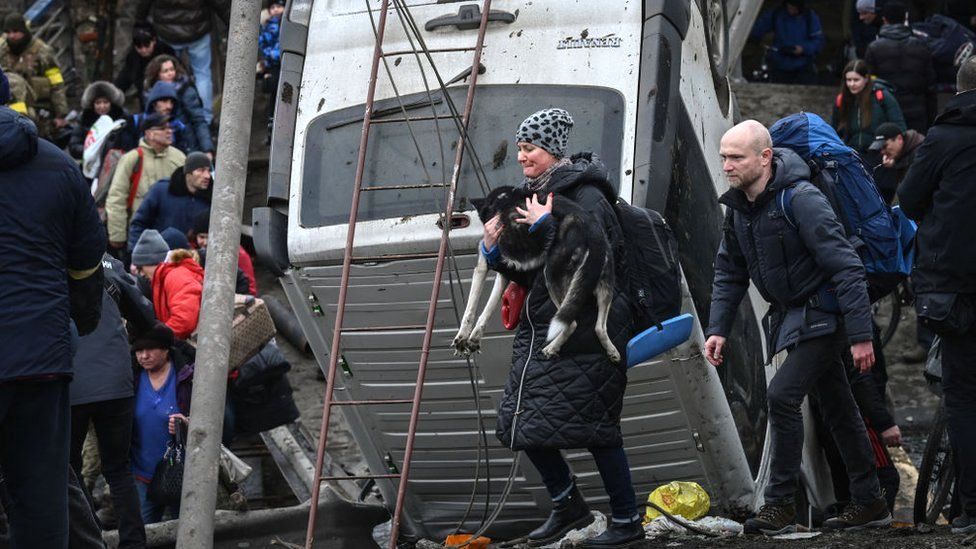
A woman carries a dog while people cross a destroyed bridge in the city of Irpin, northwest of Kyiv, 5 March 2022

Irpin has found itself on the frontline between Russian and Ukrainian forces over the past week.

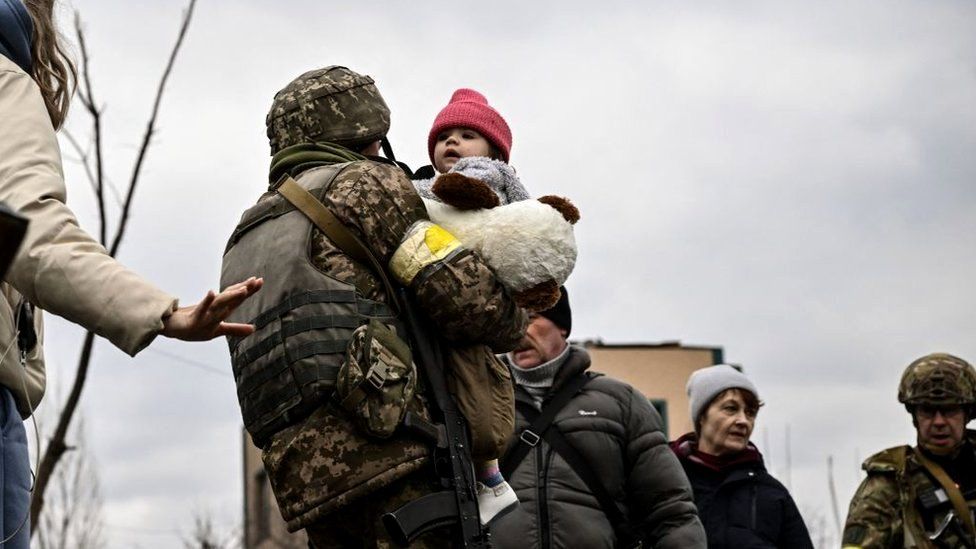
A Ukrainian serviceman carries a child while assisting people to evacuate the city of Irpin, northwest of Kyiv, 5 March 2022

Artillery and air strikes have caused severe damage in the area, with at least one attack leaving a residential tower block almost completely destroyed.

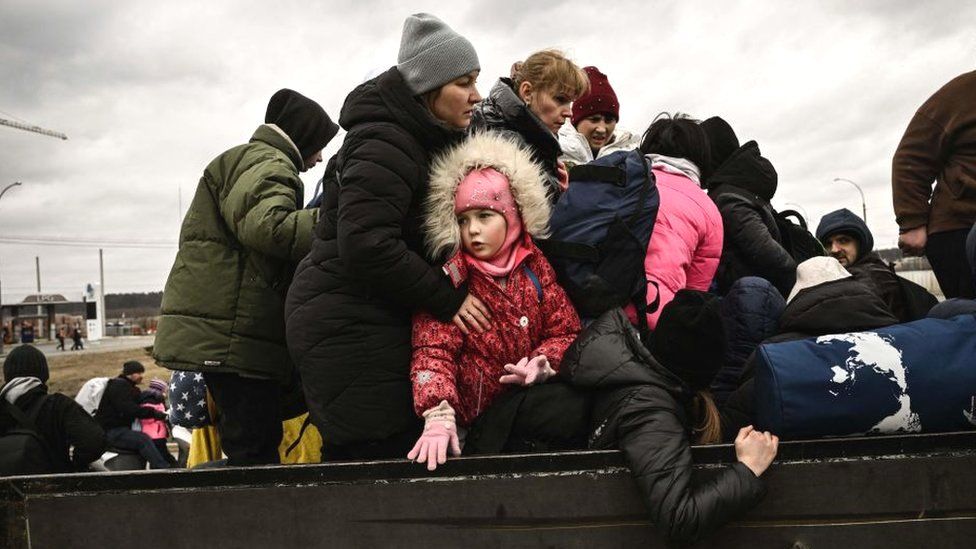
A child looks on as residents evacuate the city of Irpin, northwest of Kyiv, 5 March 2022
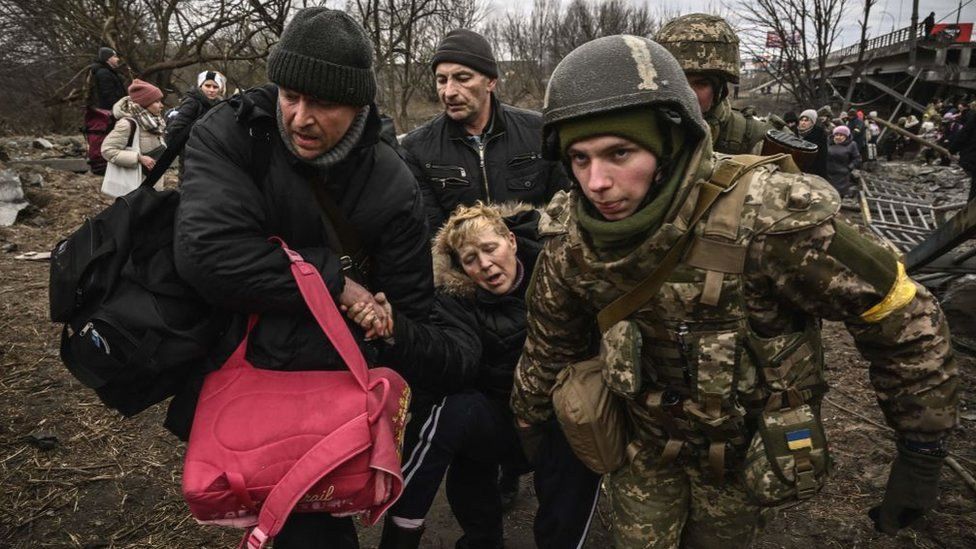
A visibly exhausted woman is assisted while crossing a destroyed bridge in the city of Irpin, northwest of Kyiv

In recent days, trains have been transporting evacuees, mostly women and children, from Irpin on the outskirts of Kyiv into the capital.

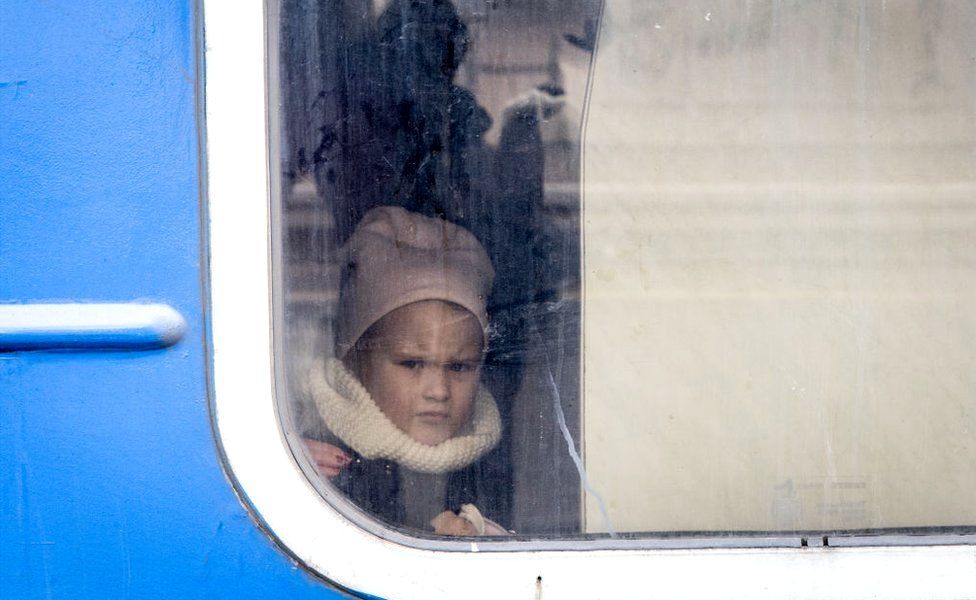
A young girl looks out of a train window before it leaves carrying women and children that fled fighting in Bucha and Irpin from Irpin City to Kyiv, 4 March 2022

Earlier this week, the shelling of a residential block in Irpin was captured in video footage.

……………………………………………………………

From Grozny to Aleppo to Ukraine, Russia meets resistance with more firepower


As I write this, the centre of Kyiv and much of its suburbs are largely untouched. Sirens and alerts punctuate the day.

Everyone here knows that could change, very quickly. By the time you read this, it might have.

Ukraine’s second city, Kharkiv, has already felt some of the force of the Russian way of war. So have Mariupol and other cities in the east.

Russia answers resistance with firepower. Rather than send in men to fight from house to house and room to room, their military doctrine calls for a bombardment by heavy weapons and from the air to destroy their enemies.

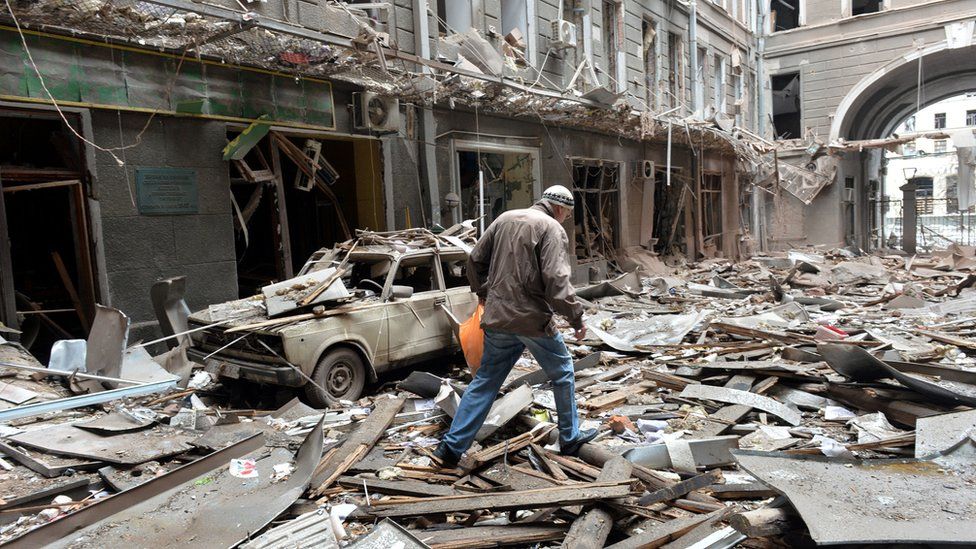
Kharkiv and the other cities and towns have suffered grievous damage, and as far as we know many civilian casualties. The seat of Kharkiv’s local government was badly damaged in a missile strike that was filmed. Russian President Vladimir Putin might be sending a message to Kyiv – look to the east, because this could happen to you.

The depressing conclusion I’ve drawn from other wars in which I have seen Russians in action is that it could get much worse.

‘The ground was shaking’

So far, Mr Putin has not given the order to inflict the kind of damage that Russian forces brought down on Grozny, when the Russian republic of Chechnya rebelled in the 1990s, and in Syria since Mr Putin intervened in force in 2015.

I covered the first Chechen war when it started in the winter of 1994-1995. Just as in Ukraine, the Russian army made serious military blunders in ground operations. Armoured columns were ambushed by Chechen rebels in narrow streets and destroyed. Many conscript soldiers did not want to fight and die.

Before the invasion of Ukraine, military analysts assessed that Russia’s forces were now much more professional. Perhaps they are, but Russia’s invasion has once again been slowed by logistical bottlenecks, tactical mistakes and terrified teenagers who had not been told they were going to war – as well as resistance as fierce as anything the Chechens offered in 1995.

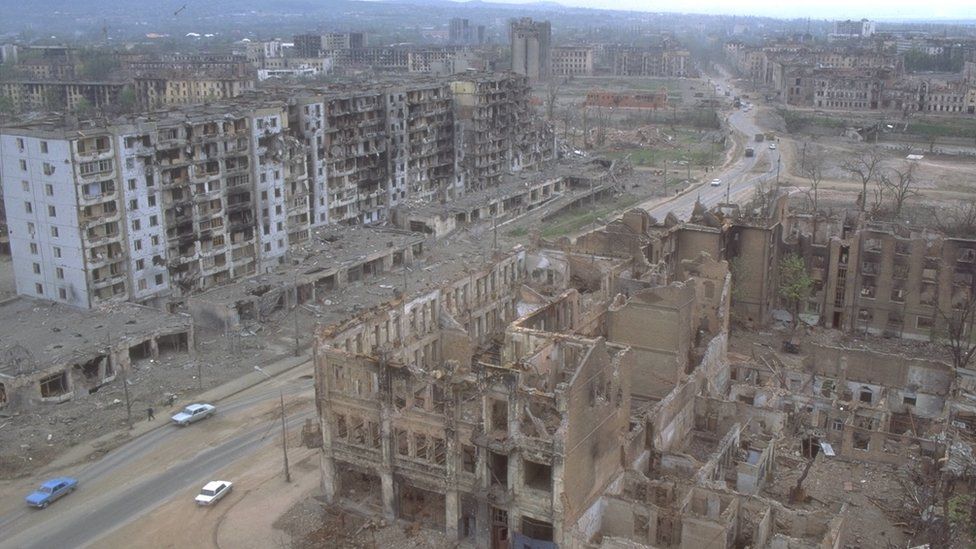
Grozny in ruins in 1995
Chechnya declared independence from the Soviet Union in 1991, and in 1994 Russian forces invaded. The bombing of Grozny was intense
1px transparent line
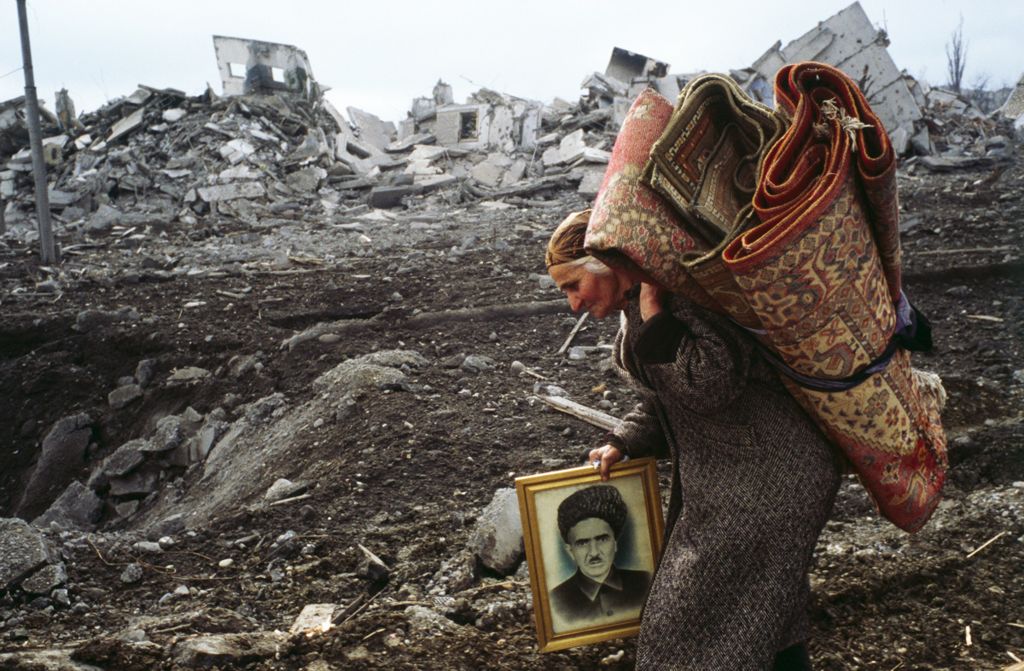
Grozny in ruins - February 2000
In the second Chechen war from 1999-2000, Russian forces again laid siege to Grozny, and intense fighting lasted weeks
1px transparent line
Jeremy Bowen (left) with colleagues Scott Hillier and Steve Lidgerwood in Grozny in January 1995
Jeremy Bowen (left) with colleagues Scott Hillier and Steve Lidgerwood reported from Grozny in January 1995

In Chechnya, Russia’s answer was to use its firepower. In a few weeks, artillery and air strikes reduced the centre of Grozny, a typical concrete and steel Soviet city, to rubble. I was in Minutka Square, a centre of Chechen resistance, on a day when it was hit by repeated air strikes. Civilians were mostly in cellars, risking death every time they went out to find water or food.

In Minutka Square that day, Chechen fighters were killed by cluster bombs, and buildings set on fire. Twenty-four hours later, the entire main avenue of the city was hit by missile strikes and enveloped in smoke and flame. The ground was shaking where we were filming.

Overwhelmed from the air

The most devastated places I have seen in years of war reporting, apart from Grozny, were in Syria. The connection is the destructive power of the Russian military.

Mr Putin’s decision to intervene in Syria saved the regime of Bashar al-Assad and took a big step towards his objective of restoring Russia as a world power. Two decisive victories over rebels in Syria, vitally important for the regime, were delivered by the ruthless use of Russian firepower.

The first was in Aleppo at the end of 2016. The eastern side of the city, which had been held by a variety of rebel factions throughout the war, fell after it was pulverised by shelling and air strikes. The Assad regime did not need any encouragement to shell Syrians, but the Russians brought a much greater level of destructive power. Strategic bombers based at home and in Iran delivered devastating strikes.

The tactic used in Syria was to encircle and besiege rebel-held areas, pound them from the air and from artillery batteries, and in the end exhaust the defenders and any civilians who had not managed to escape. Many of them were killed.

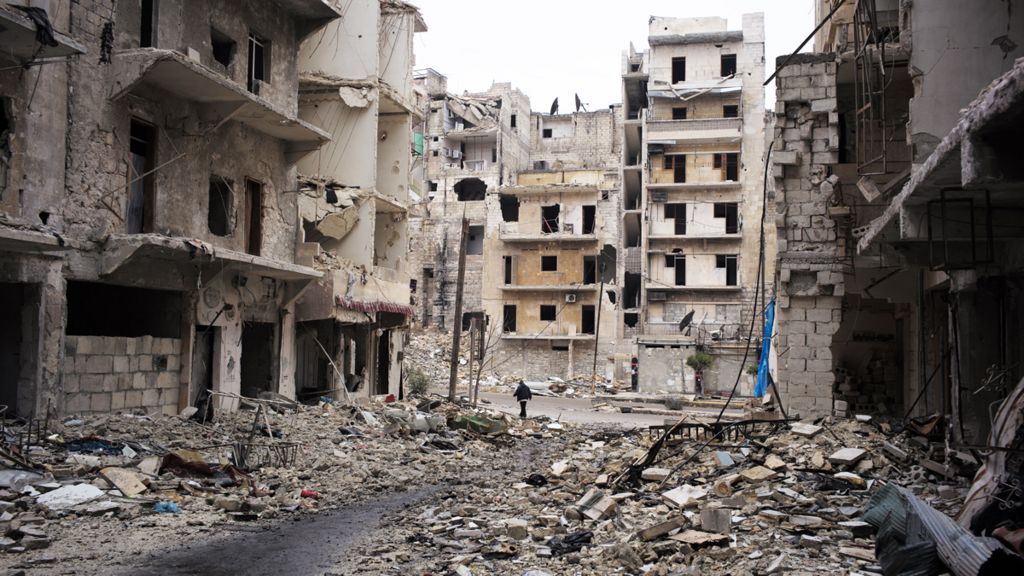
A devastated street in Aleppo, Syria, January 2017
In a devastated street in Aleppo in January 2017
1px transparent line
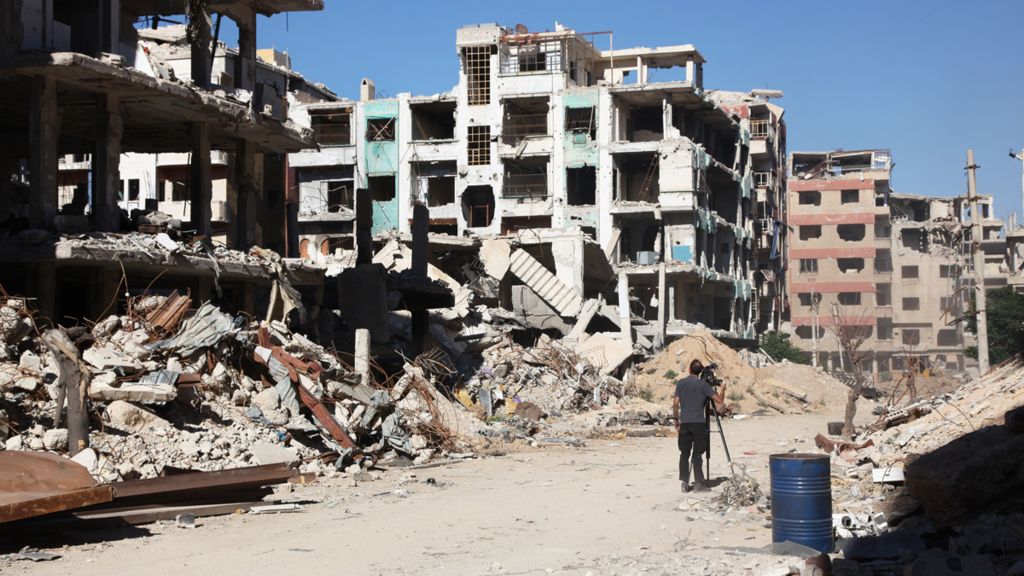
Eastern Ghouta, outside the Syrian capital Damascus, June 2018 - BBC cameraman Nik Millard pictured
In Eastern Ghouta in Syria in June 2018, with BBC cameraman Nik Millard

When I was able to drive through Eastern Aleppo a few weeks after it fell, destruction went on for mile after mile. I couldn’t see a building that was untouched. Entire neighborhoods were left in ruins. Streets were blocked with mountain ranges of rubble.

The same tactics worked in Eastern Ghouta, a string of rebel held towns and farmland on the edge of the Syrian capital. Its capitulation in 2018 was the end of the battle for Damascus, that had looked at first as if it could go the rebels’ way. That changed after the US decided in 2013 not to strike the Assad regime when it used chemical weapons in Douma, one of the area’s towns. The long fight turned decisively in the regime’s favour after Russia entered the war in 2015.

Eastern Ghouta’s defenders dug an underground tunnel city to escape the air strikes and shelling. But siege and overwhelming firepower wins battles. That is because defenders get killed and exhausted, and civilians, however defiant, are subjected to such fear and misery that they welcome the respite that surrender brings.

In Kyiv, one of the big questions on everybody’s minds is whether they are going to get the treatment meted out not only to Kharkiv, Mariupol and the rest, but also to Chechnya and Syria.

Will the sanctity of Orthodox shrines create the restraint that was absent in attacks on Muslims in Chechnya and Syria? Putin himself has written about Ukraine’s significance in Russia’s history. Will he be prepared to destroy Ukraine to regain it? If sanctions and Ukrainian resistance threaten his regime’s stability, will he take more extreme measures?

The record shows that the Russian military compensates for weaknesses in the capabilities of its ground forces by turning to the big guns. Ukrainians are praying that will not happen here.

Ruined buildings in Kharkiv, Ukraine, on 5 March, 2022
Kharkiv residents told the BBC that attacks on civilian targets made them feel like they were living in hell

……………………………………………………………

The 2026 AFRICA EDUCATES HER CAMPAIGN REPORT - ANGOLA 6th Anniversary | 2020–2026

  Meet who's behind this cause     Support us:  https://donate-sofonie.netlify.app/           AFRICA EDUCATES HER CAMPAIGN REPORT — ANGO...