Translate

Saturday, 3 July 2021

LEAP Africa’s Social Innovators Programme (SIPA) 2021/2022 for young changemakers.


Application Deadline: July 25th 2021 

Over the past years, LEAP Africa has partnered with Union Bank Nigeria, other corporate sponsors and development champions, to enable these young change makers transition their social change solutions into scalable social enterprises. Through a careful selection process, 40 highly motivated and young social innovators are chosen across a pool of applicants, to participate in activities outlined for the fellowship year.

Fellows are empowered through a series of training sessions (physical and online), mentorship, access to local & international funding and partnership opportunities, and importantly the opportunity to be a part of a global network of social change agents. These activities culminate into an award ceremony where outstanding Fellows are rewarded with a financial sustainability prize award and their work promoted on media platforms. The social ventures of the Fellows cover various aspects of the society, such as Agriculture, Youth Empowerment, Education, Science & Technology, Health, Law, Human Rights, among others.

Requirements

Seasoned professionals across industry who will provide coaching and mentoring.
Business support services to meet your organizational needs.
Impactful sessions from world class experts to enhance your organization’s sustainability and investment readiness.
Funding opportunities from local and international partners.
A growing vibrant community of social innovators across Africa who are alumni of the Programme.

Click here to apply:https://bit.ly/3xdUtdr

As tension prevails, relatives mourn Eswatini crackdown victims

Africa’s last absolute monarchy has for days been rocked by the largest pro-democracy protests in years.


Khohliwe Mathunjwa is in mourning. She is also stuck.

Her nephew, 35-year-old Sicelo Mathunjwa, was shot in the head on Tuesday evening when police in Eswatini dispersed crowds with gunfire in Matsapha, a small industrial hub about 35km (21 miles) from the capital, Mbabane.

“Sicelo is dead, he died on the spot,” Mathunjwa told Al Jazeera, saying she cannot leave her village of Mazombiswe to head to her nephew’s village of Hosea, some 30km (18 miles) away, and pay her finals respects due to the tensions in the small landlocked country formerly known as Swaziland.

For days, Eswatini, Africa’s last absolute monarchy, has been rocked by the largest pro-democracy protests in years that have seen security forces engage mostly young demonstrators defying an overnight curfew in running street battles.

Mathunjwa said her nephew, a clothes factory worker, was a bystander when police opened fire against protesters who had set fire to a building owned by Eswatini Beverages, a company partly owned by King Mswati III.

“He was near Matsapha brewery that night,” the 59-year-old said in a telephone interview. “My children went to identify the body at the mortuary and they saw a hole in the back of his head.”

Activists from two political movements, the Communist Party of Swaziland (CPS) and People’s United Democratic Movement (PUDEMO), told Al Jazeera at least 40 people have been killed during the crackdown.

But in a statement issued on Thursday, the office of acting Prime Minister Themba Masuku said it was “yet to receive official reports about the alleged deaths. We will investigate the allegations.”

Calls for ‘political plurality, accountability’

While protests demanding political reforms are rare, they are not new in Eswatini.

Tensions have been brewing for months in the mountainous kingdom, where the coronavirus pandemic has exacerbated socioeconomic grievances and whose monarch and his close circles have been criticised for living opulent lives while most of the country’s population live in grinding poverty.

The current protests were sparked by a June 24 decree by the king banning citizens from sending petitions to parliamentarians to demand democratic reforms. It followed a public outcry against the alleged killing by the police of a law student, Thabani Nkomonye, in May.

Businesses in Matsapha have been looted and torched by protesters, but the presence of security forces on the streets have made citizens vulnerable to the use of force.

“Dangerous civil unrest continues in Eswatini, including the use of deadly force by security forces,” the United States embassy in the country said in a statement this week, noting communications disruptions.

A strict night curfew, meanwhile, has emptied the streets, while the airport and the public transport system have been shut down. The CPS said 13 of its members have been detained.

“We are not surprised by the heavy response of the regime,” Mlungisi Makhanya, leader of PUDEMO, told Al Jazeera. “We, the people, are saying we need to open up the constitutional space … for people to make their own choices on how they want to be governed,” he said.

“We need to transition to a new dispensation where there is political plurality and a leadership that is accountable to its people, not one that hardens hearts against the monarchy,” he told Al Jazeera.

Although the tiny kingdom of 1.2 million people supports monarchical rule, Makhanya warned the continued absolutism of Mswati risked escalating calls for a republic.

Crowned as regent at the age of 18, Mswati inherited the throne from his father, King Sobhuza II, who banned the registration of political parties in 1973.

Instead, the country’s system allows candidates to run individually for parliamentary seats, leaving no room for a political party to hold a majority in parliament. The prime minister is appointed by the king, who holds all executive power.

The king has not addressed the protests throughout the week – a tactic, observers say, that is in line with the monarchy’s modus operandi when there is trouble.

“Pro-democracy sentiments in Eswatini are not something new. They are sentiments that folks have held for decades on end and the monarchy has been able to ride things out through a combination of stick and carrot mechanisms,” Menzi Ndhlovu, senior political and country risk analyst at Signal Risk, told Al Jazeera’s Inside Story programme on Thursday.

“In instances of unrest, there is a tendency by the monarchy to keep quiet until things are in order. It is no surprise that the king has kept silent while his generals and his police officials do the work, calm the population, and then when things are a little bit calmer, he’ll probably come out and speak out.”

Earlier this week, Masuku, the acting prime minister, dispelled speculation that Mswati had left the country. He went on to describe the protests as “upsetting and alarming” and told people to “direct their concerns” to the government via email.

He also maintained the deployment of security forces was to ensure order.

“Government has tightened security to regain the rule-of-law, peace and to protect all emaSwati. We will continue not to tolerate the looting, arson, violence, and all other forms of criminality that are directed at businesses and people’s property,” he said in Thursday’s statement.

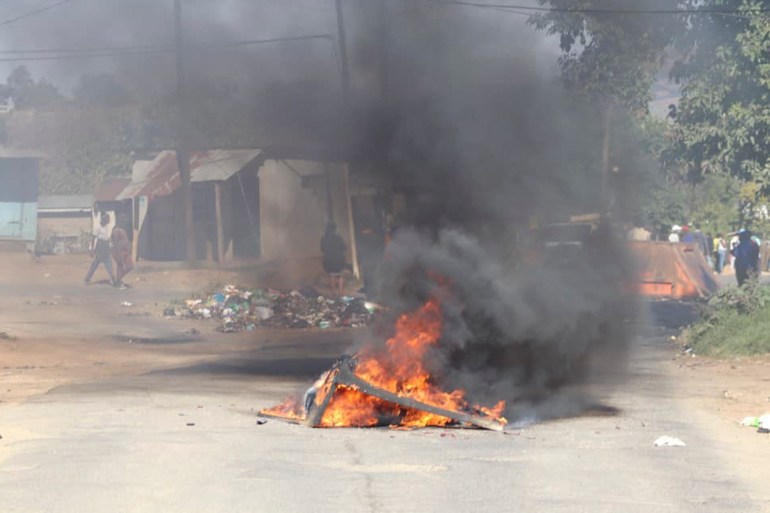
A fire on a road in Eswatini’s capital, Mbabane, on Tuesday [AFP]

Calls for dialogue

Thabani Maseko, a lawyer and activist, said the growing discontent against Mswati’s clampdown on citizens could spiral into a crisis of legitimacy. During his imprisonment in 2015 for criticising the judicial system, Maseko penned an open letter to former United States President Barack Obama, pleading with him to persuade other world leaders to lobby for constitutional change.

However, Maseko believes the only way out of “total mayhem” is dialogue.

“An attempt is being made to reach out to all stakeholders from civil society, labour unions, youth groups, businesses and churches to meet and find consensus. We’re trying to create a platform for negotiations with the government, but it’s difficult since lines of communication are down and movement is difficult,” he said.

“The only way to end this tension is if government sees dialogue is necessary to work out a way forward,” he said.

However, for politicians living in exile, such as CPS Secretary-General Kenneth Kunene, the first condition of dialogue is “the unbanning of political parties”.

Unable to return to Eswatini for fear of persecution, Kunene and scores of members of his party have found refuge in neighbouring South Africa.

The regional heavyweight, South Africa on Thursday expressed “great concern” over the actions of the security forces and called on them to exercise “total restraint and protect the lives and property of the people”.

“We are particularly concerned by reports of loss of life and destruction of properties,” foreign ministry spokesman Clayson Monyela said.

Back in Mazombiswe, Mathunjwa grieves the loss of her nephew and father of three.

“His father died long ago and he had to take up the role,” she said. “He was the only boy in my brother’s house, he’s the only boy in the homestead, now his sisters will have to look after the family,” added Mathunjwa.

“We will remember him as loving person and communicator who united the whole family. This is really painful for us.”

SOURCE: AL JAZEERA

………………………………………………………………

Across Africa in five minutes or less


GHANA


The government is putting in a lot of measures to stimulate job creation in an integrated and inclusive manner throughout the entire gold mining value chain, Vice President Mahamudu Bawumia has indicated.

This integrated, inclusive chain will bring together large scale, small scale, sustainable community miners as well as other stakeholders such as refiners, purchasers and sellers of jewellery in an effort aimed at increasing the value Ghana derives from her raw materials and also bring clarity on the volumes and value of extracted materials.

BENIN

While welcoming the Committee Members, Mr. Mamadou Traore, Acting Commissioner for Education, Science, and Culture of the ECOWAS Commission, whose speech was read by H.E. Blaise Diplo-Djomand, Resident Representative of ECOWAS in Benin, highlighted that out of a total number of 1,121 cultural heritages on the list of world cultural and natural heritages, the ECOWAS Region has 32.

BURKINA FASO

Burkina Faso’s President Roch Kabore has dismissed the country’s defense minister in the wake of widespread protests Saturday against insecurity.

Cherif Sy had been defense minister since the country’s conflict with domestic terror groups started in 2015. His replacement is the president himself, along with a minister delegate, Colonel Major Aimé Simpore, who has been appointed to assist.

SENEGAL

The hashtag #JusticePourLouise has been trending in Senegal in recent days, the latest grim reminder of the country’s failure to deal with the scourge of sexual violence in Senegal’s education system.

In the latest case, a 19-year-old male student has been detained by police and accused of raping a 15-year-old girl, also a student at the same school. The accused reportedly shared a video about the rape that has been widely shared via WhatsApp and elsewhere. The widespread media coverage has included both condemnation of the rape and the accused, as well efforts to vilify and discredit the survivor’s account of the rape

NIGERIA

The Senate has passed the Petroleum Industry Bill (PIB).

The bill was passed after the lawmakers considered the report of the Joint Committees on Petroleum (Upstream and Downstream) and Gas Resources on Thursday.

The passage of the bill as also a sequel to a closed door meeting with the Minister of State for Petroleum, Timipre Sylva and the Group Managing Director of the Nigerian National Petroleum Corporation (NNPC), Mele Kyari.

LIBERIA

Over 350,000 persons are expected to obtain covid-19 vaccination as the World Bank approved additional financing to the Liberia COVID-19 Emergency Preparedness and Response Project.

The gesture is to enable affordable and equitable access to COVID-19 vaccines here.

SIERRA LEONE

The President of Sierra Leone, Dr Julius Maada Bio has in a live television broadcast reimposed a nationwide curfew and shut down congregational worship in the country for one month.  The reintroduction of these measures came after the country has recorded the highest number of covid-19 cases and deaths while experiencing the third wave of the pandemic. Also, the Delta variant, the deadliest of the pandemic has been detected in the country. However, the curfew will run from 11:00 pm to 5:00 am, starting from Monday, June 5, 2021, and the closure of congregational worship will start with immediate effect from tomorrow, Friday, June 2, 2021.

GUINEA

The International Monetary Fund (IMF) concluded the Article IV consultation [1] with Guinea.

Although overall growth was strong, at 7.1 percent of GDP in 2020, buttressed by a buoyant mining sector, the non-mining economy-which employs the vast majority of the population-was significantly affected by the Covid-19 pandemic. Inflation surpassed 10 percent at end- 2020 and has since accelerated to above 12 percent, as a result of rising food prices and freight rates associated with COVID-19-related supply disruptions, as well as the impact of the policies to respond to the pandemic

TOGO

The Human Rights Committee today concluded its consideration of the fifth report of Togo on measures taken to implement the International Covenant on Civil and Political Rights.

During a dialogue held entirely online, Committee Experts praised the quality and clarity of answers provided by the State Party in the report.

EGYPT

Egypt is preparing to announce the inauguration of a new military base on its border with Libya as one of its measured options to confront Turkish influence in Libya and face Ankara’s refusal to withdraw its forces and mercenaries from Tripoli.

ALGERIA

Algerian Finance Minister Aimene Benabderrahmane was named prime minister Wednesday, the presidency said, following legislative elections earlier this month and as the country seeks to curb a deep socio-economic crisis.

SOUTH AFRICA

In South Africa, there have been 21.584 new cases of Covid-19, taking the total reported to 1,995,556. Deaths have reached 61,029 (+382), while recoveries have climbed to 1,754,793, leaving the country with a balance of 179,734 active cases. The total number of vaccines administered is 3,155,717 (+129,081).

ZIMBABWE

One day in April 2016, the Zimbabwean pastor Evan Mawarire was sitting in his office, frustrated at the persistent economic crisis in his country that was making it difficult to provide for his family. So, he decided to vent. He took out his phone, propped it up against the Bible on his desk, and recorded a video in which he spoke about the symbolism of the Zimbabwean national flag, and how the promises of freedom and prosperity that it symbolizes had been violated by the regime of then-President Robert Mugabe. The video quickly went viral, inspiring a hashtag, #ThisFlag, and massive pro-democracy demonstrations. Mawarire was arrested and imprisoned for his activism.

………………………………………………………………

Friday, 2 July 2021

S.African scientist: data show J&J vaccine works well against Delta variant


JOHANNESBURG, July 2 (Reuters) – Data from laboratory studies show Johnson & Johnson’s (JNJ.N) COVID-19 vaccine works well against the Delta variant that now dominates new infections in South Africa, the head of the country’s Medical Research Council said on Friday.


“All the data that we see indicate good immediate and sustained immune response against Delta, and we see surprising durability in the immune response for the single dose J&J right up to eight months,” Glenda Gray told a news conference.

South Africa is using the J&J and Pfizer (PFE.N) vaccines in its immunisation campaign.

…………………………………………………………

India’s death toll from coronavirus crosses 400,000; vaccination drive falters


MUMBAI/AHMEDABAD July 2 (Reuters) – India’s official death toll from the coronavirus topped 400,000 on Friday, though experts say the actual number of dead could have reached one million or even higher, with a possible third wave of infections looming.


India added 100,000 deaths in 39 days, a Reuters tally showed, as a brutal second wave of infections swept across cities and into the vast countryside where millions remain vulnerable without a single shot of vaccines.

Overnight, the country recorded 853 deaths, taking the toll past the 400,000 mark, according to data from health ministry.

India’s death toll is the third-highest globally.

“Undercounting of deaths is something that has happened across states, mostly because of lags in the system, so that means we will never have a true idea of how many people we lost in this second wave,” said Rijo M John, a professor at the Rajagiri College of Social Sciences in the southern city of Kochi.

While still elevated, the number of new infections has eased to two-month lows since hitting a peak of 400,000 a day in May.

The government has shifted its focus to mass immunisations amid warnings from disease experts of a looming third wave as the country slowly re-opens and a new variant, locally called the Delta Plus, emerges.

Prime Minister Narendra Modi’s government began a nationwide campaign last week to inoculate all of the country’s adults for free, and aims to reach 950 million people by the end of the year.

But, the pace of vaccinations has floundered, official data showed.

India administered an average of 3.5 million doses a day this week, compared with 6.6 million doses last week.

Experts have attributed the peak of 9 million doses on June 21 to states stockpiling for a burst of inoculations to fire up Modi’s campaign.

Just 6% of all eligible adults in the country have been inoculated with the two mandatory doses, official data from the government’s Co-Win portal showed.

India has been using AstraZeneca’s (AZN.L) vaccine, made locally by partner Serum Institute of India, and a homegrown shot named Covaxin from Bharat Biotech.

Last month, Serum said it planned to increase monthly production to nearly 100 million doses from July. Bharat Biotech now estimates it will make 23 million doses a month.

STAMPEDES

In two of the country’s biggest states governed by Modi’s Bharatiya Janata Party, police were ordered in to control large crowds outside some vaccination centres, as panic spread over shortages of doses.

In India’s financial capital of Mumbai, vaccination centres were only open for three hours on Friday and the number of doses available was limited, the city’s civic body said.

“I have been standing in line every day for the last 10 days, but every time I return without getting my dose because they don’t have enough of them,” Sayali Kamble, a domestic helper in Mumbai, told Reuters outside one centre.

In Modi’s home state of Gujarat, several vaccination centres shut down in Ahmedabad, the main industrial city.

In Madhya Pradesh, governed by Modi’s Bharatiya Janata Party, the pace of vaccinations fell over 40%. In one district, police were called in to control a stampede after crowds broke through a shuttered gate at a local vaccination camp, NDTV news channel reported.

India has recorded 30.45 million cases of COVID-19 since the outbreak of the pandemic last year, and is the second-most affected country behind the United States, which has 33 million cases.

The United States has reported over 604,000 deaths, while about 518,000 people have died in Brazil.

…………………………………………………

Nobody’s winning as drought upends life in US West Basin


TULELAKE, Calif. (AP) — Ben DuVal knelt in a barren field near the California-Oregon border and scooped up a handful of parched soil as dust devils whirled around him and birds flitted between empty irrigation pipes.


DuVal’s family has farmed the land for three generations, and this summer, for the first time ever, he and hundreds of others who rely on irrigation from a depleted, federally managed lake aren’t getting any water from it at all.

As farmland goes fallow, Native American tribes along the 257-mile-long (407-kilometer) river that flows from the lake to the Pacific watch helplessly as fish that are inextricable from their diet and culture die in droves or fail to spawn in shallow water.
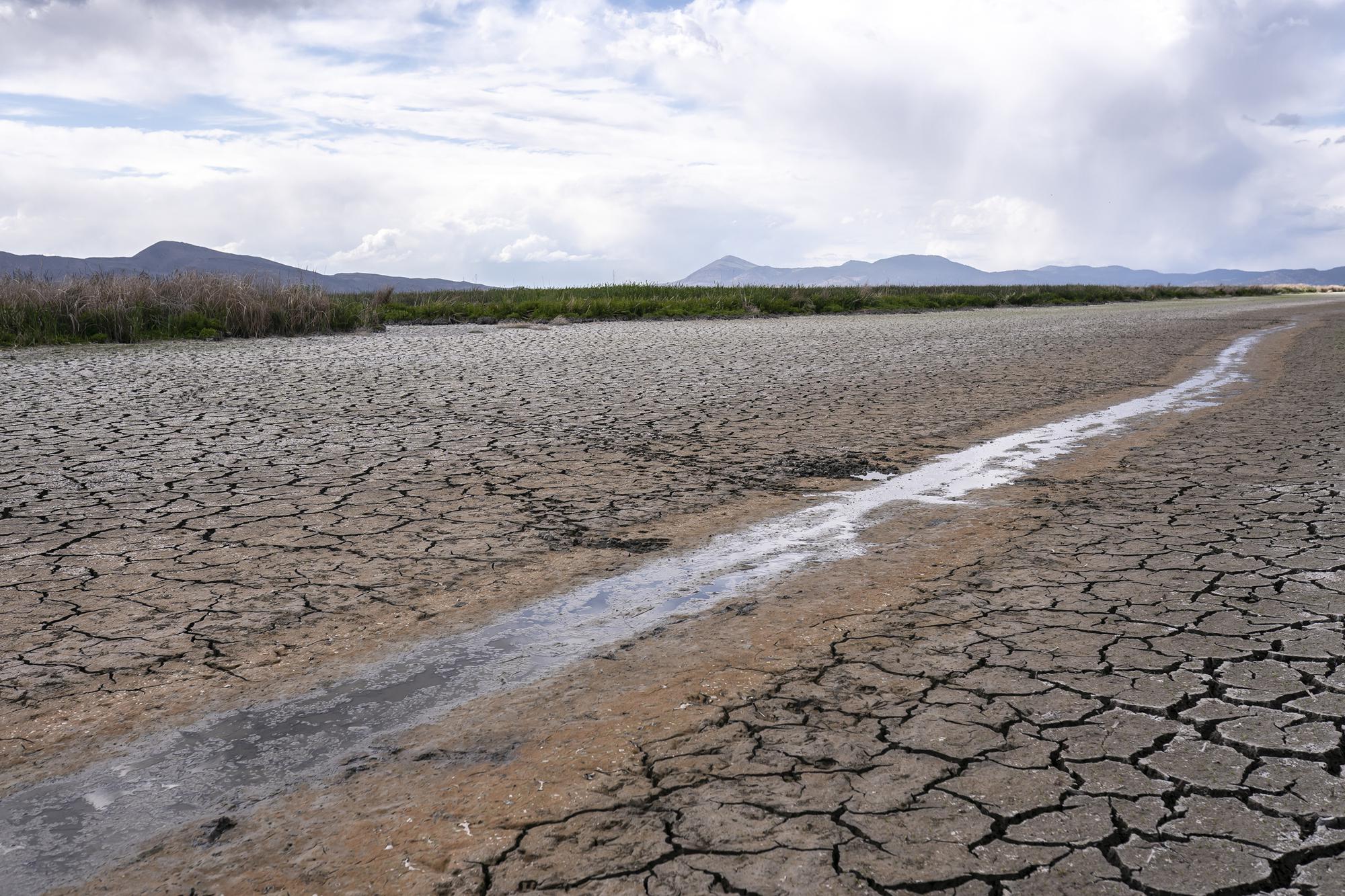
A small stream runs through the dried, cracked earth of a former wetland near Tulelake, Calif., Wednesday June 9, 2021. The area was drained in an effort to prevent an outbreak of avian botulism, which occurs when water levels become too low. (AP Photo/Nathan Howard)

A small stream runs through the dried, cracked earth of a former wetland near Tulelake, Calif., Wednesday June 9, 2021. (AP Photo/Nathan Howard)
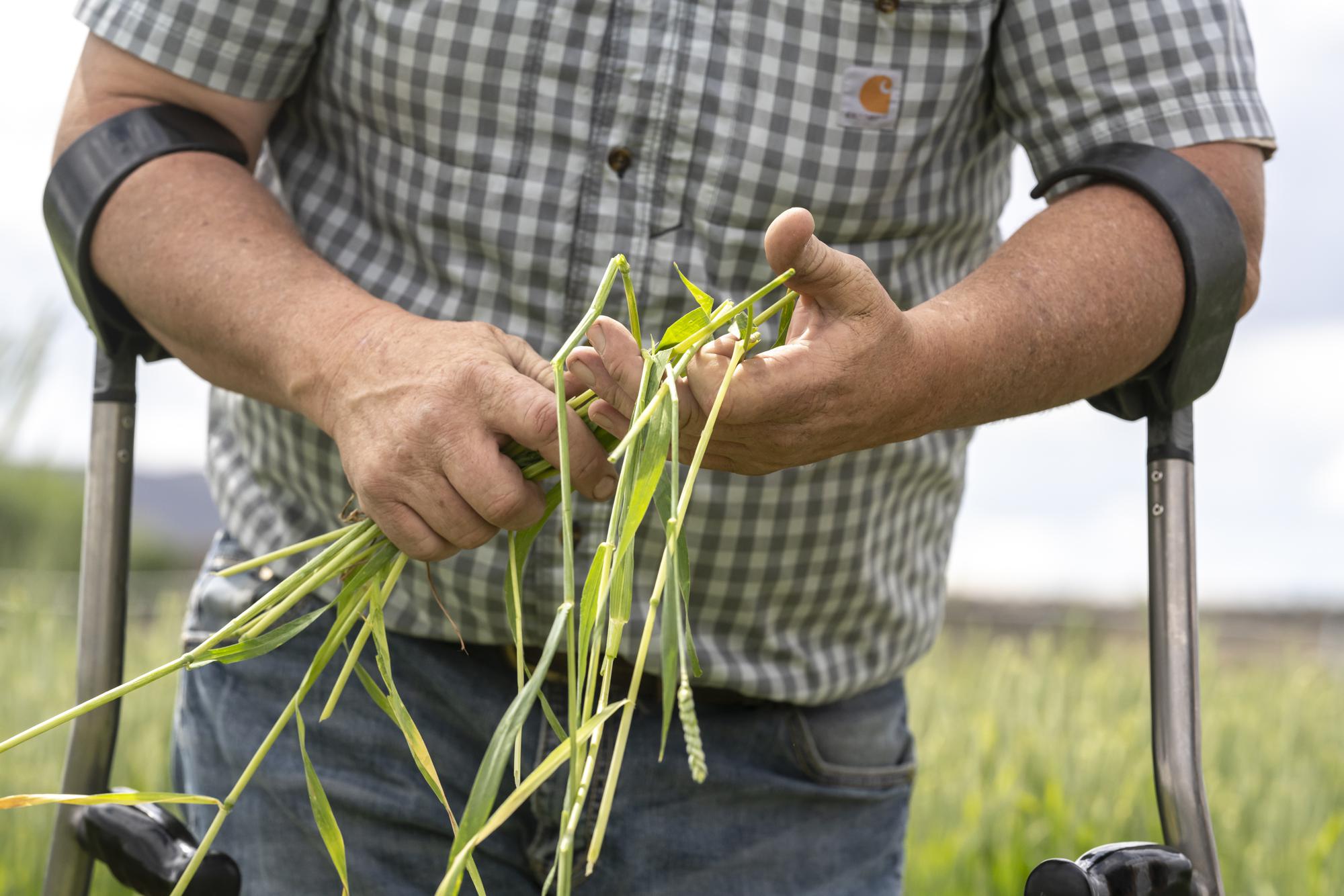
Ben DuVal stands in a field of triticale, one of the few crops his family was able to plant this year due to the water shortage, on Wednesday, June 9, 2021, in Tulelake, Calif. DuVal's family has farmed the land near the California-Oregon border for three generations, and this summer for the first time ever, he and hundreds of others who rely on irrigation from a depleted, federally managed lake aren't getting any water from it at all. (AP Photo/Nathan Howard)

Ben DuVal stands in a field of triticale, one of the few crops his family was able to plant this year due to the water shortage, on Wednesday, June 9, 2021, in Tulelake, Calif. (AP Photo/Nathan Howard)
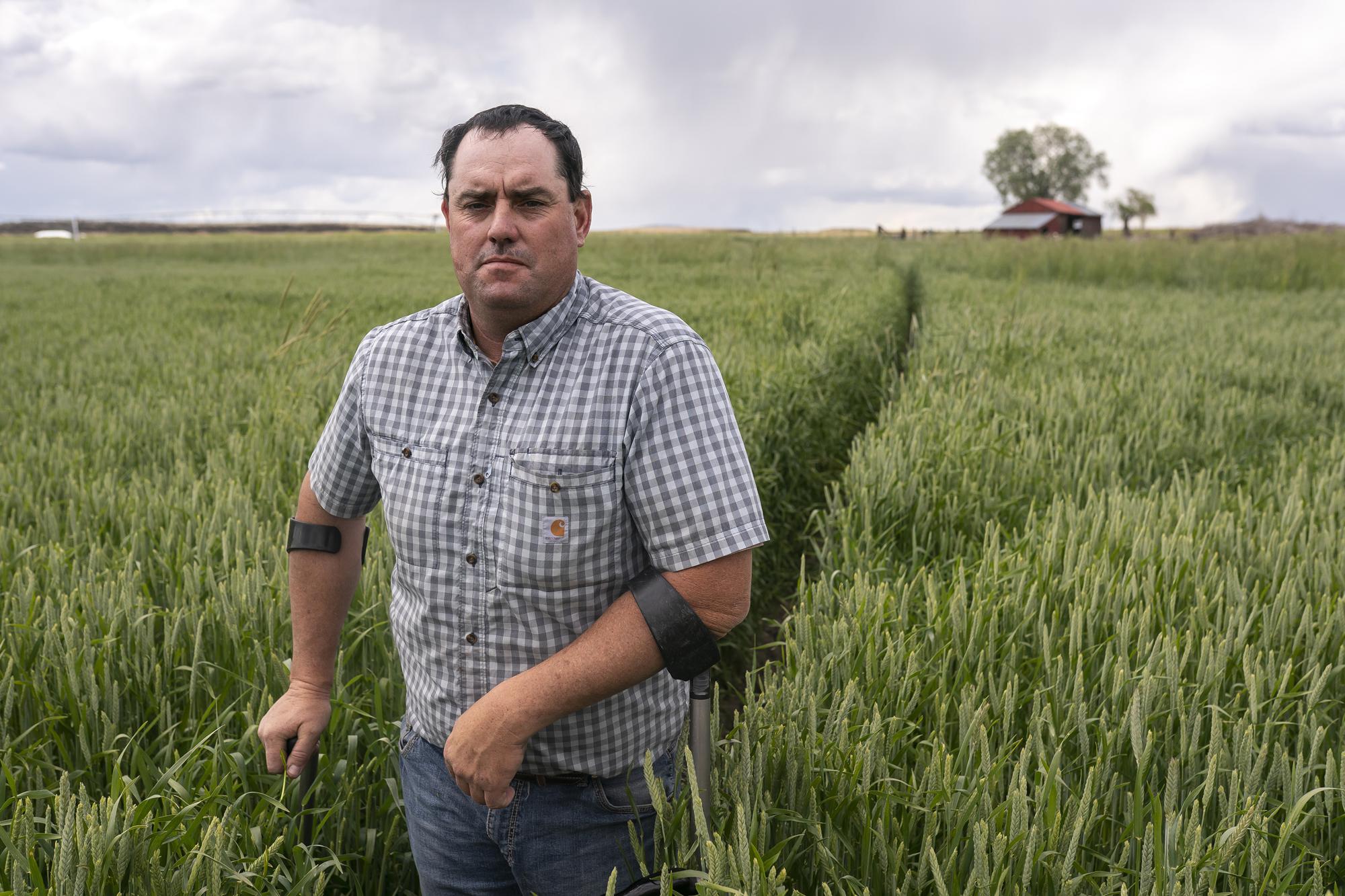
Ben DuVal stands in a field of triticale, one of the few crops his family was able to plant this year due to the water shortage, on Wednesday, June 9, 2021, in Tulelake, Calif. DuVal's family has farmed the land near the California-Oregon border for three generations, and this summer for the first time ever, he and hundreds of others who rely on irrigation from a depleted, federally managed lake aren't getting any water from it at all. Competition over the water in the Klamath Basin has always been intense, but this summer, because of a historic drought there is not enough water for the needs of farmers, Native American tribes and wildlife refuges. (AP Photo/Nathan Howard)

Ben DuVal stands in a field of triticale, one of the few crops his family was able to plant this year due to the water shortage, on Wednesday, June 9, 2021, in Tulelake, Calif. (AP Photo/Nathan Howard)

Just a few weeks into summer, a historic drought and its on-the-ground consequences are tearing communities apart in this diverse basin filled with flat vistas of sprawling alfalfa and potato fields, teeming wetlands and steep canyons of old-growth forests.

Competition over the water from the river that snakes through it has always been intense. But this summer there is simply not enough, and the farmers, tribes and wildlife refuges that have long competed for every drop now face a bleak and uncertain future together.

“Everybody depends on the water in the Klamath River for their livelihood. That’s the blood that ties us all together. … They want to have the opportunity to teach their kids to fish for salmon just like I want to have the opportunity to teach my kids how to farm,” DuVal said of the downriver Yurok and Karuk tribes. “Nobody’s coming out ahead this year. Nobody’s winning.”

With the decadeslong conflict over water rights reaching a boiling point, those living the nightmare worry the Klamath Basin’s unprecedented drought is a harbinger as global warming accelerates.

“For me, for my family, we see this as a direct result of climate change,” said Frankie Myers, vice chairman of the Yurok Tribe, which is monitoring a massive fish kill where the river enters the ocean. “The system is crashing, not just for Yurok people … but for people up and down the Klamath Basin, and it’s heartbreaking.”

ROOTS OF A CRISIS

Twenty years ago, when water feeding the farms was drastically reduced amid another drought, the crisis became a national rallying cry for the political right, and some protesters breached a fence and opened the main irrigation canal in violation of federal orders.

But today, as reality sinks in, many irrigators reject the presence of anti-government activists who have once again set up camp. In the aftermath of the Jan. 6 insurrection at the U.S. Capitol, irrigators who are at risk of losing their farms and in need of federal assistance fear any ties to far-right activism could taint their image.

Some farmers are getting some groundwater from wells, blunting their losses, and a small number who get flows from another river will have severely reduced water for just part of the summer. Everyone is sharing what water they have.

“It’s going to be people on the ground, working together, that’s going to solve this issue,” said DuVal, president of the Klamath Water Users Association. “What can we live with, what can those parties live with, to avoid these train wrecks that seem to be happening all too frequently?”
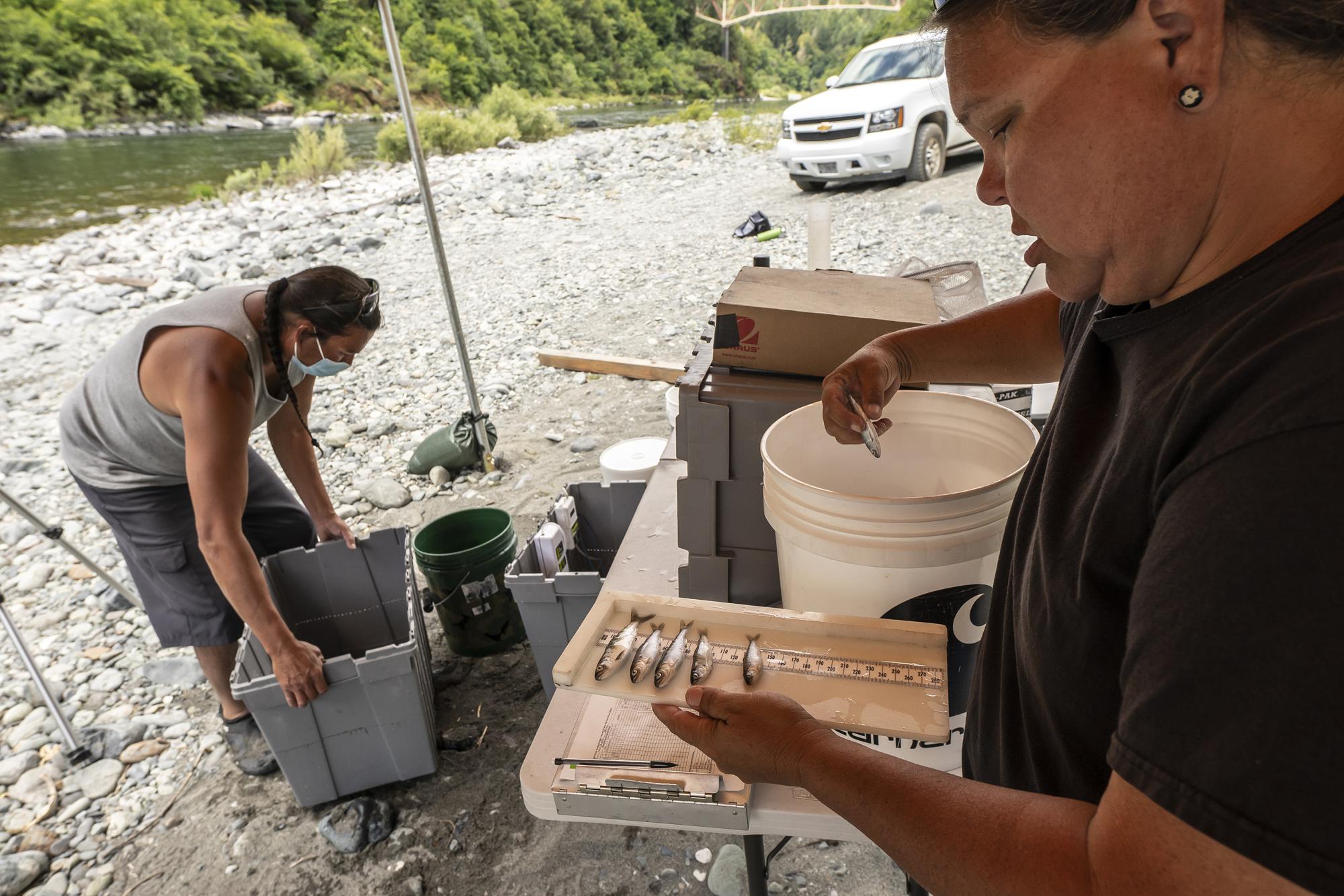
Jamie Holt, lead fisheries technician for the Yurok Tribe, right, and Gilbert Myers count dead chinook salmon pulled from a trap in the lower Klamath River on Tuesday, June 8, 2021, in Weitchpec, Calif. A historic drought and low water levels are threatening the existence of fish species along the 257-mile-long river.

Jamie Holt, lead fisheries technician for the Yurok Tribe, right, and Gilbert Myers count dead chinook salmon pulled from a trap in the lower Klamath River on Tuesday, June 8, 2021, in Weitchpec, Calif. (AP Photo/Nathan Howard)
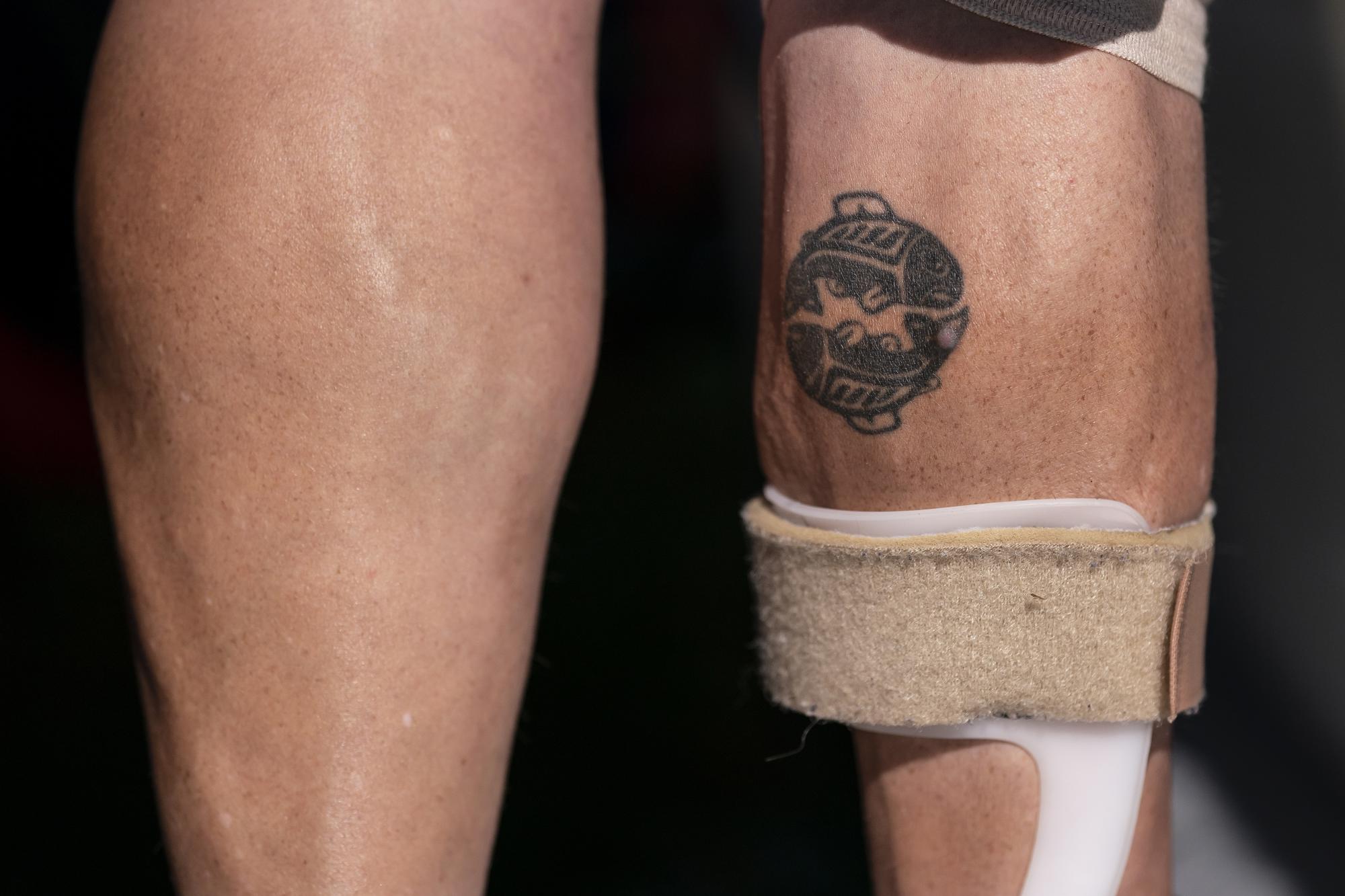
A salmon tattoo is seen on the leg of Jamie Holt, lead fisheries technician for the Yurok Tribe, while documenting chinook deaths in the lower Klamath River on Tuesday, June 8, 2021, in Weitchpec, Calif. A historic drought and low water levels are threatening the existence of fish species along the 257-mile-long river.

A salmon tattoo is seen on the leg of Jamie Holt, lead fisheries technician for the Yurok Tribe, while documenting chinook deaths in the lower Klamath River on Tuesday, June 8, 2021, in Weitchpec, Calif. (AP Photo/Nathan Howard)
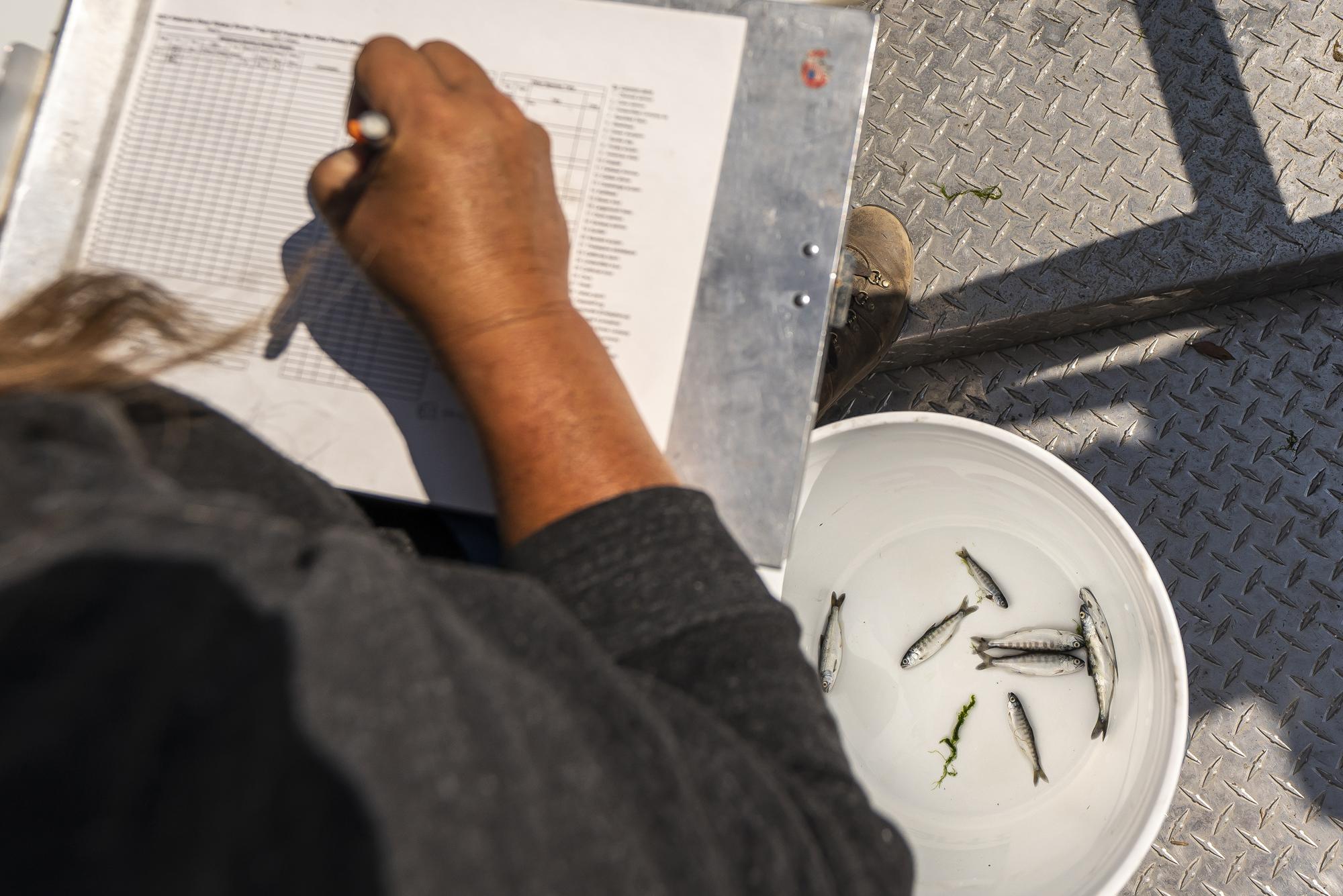
Jamie Holt, lead fisheries technician for the Yurok Tribe, counts dead chinook salmon pulled from a trap in the lower Klamath River on Tuesday, June 8, 2021, in Weitchpec, Calif. A historic drought and low water levels are threatening the existence of fish species along the 257-mile-long river.

Jamie Holt, lead fisheries technician for the Yurok Tribe, counts dead chinook salmon pulled from a trap in the lower Klamath River on Tuesday, June 8, 2021, in Weitchpec, Calif. (AP Photo/Nathan Howard)
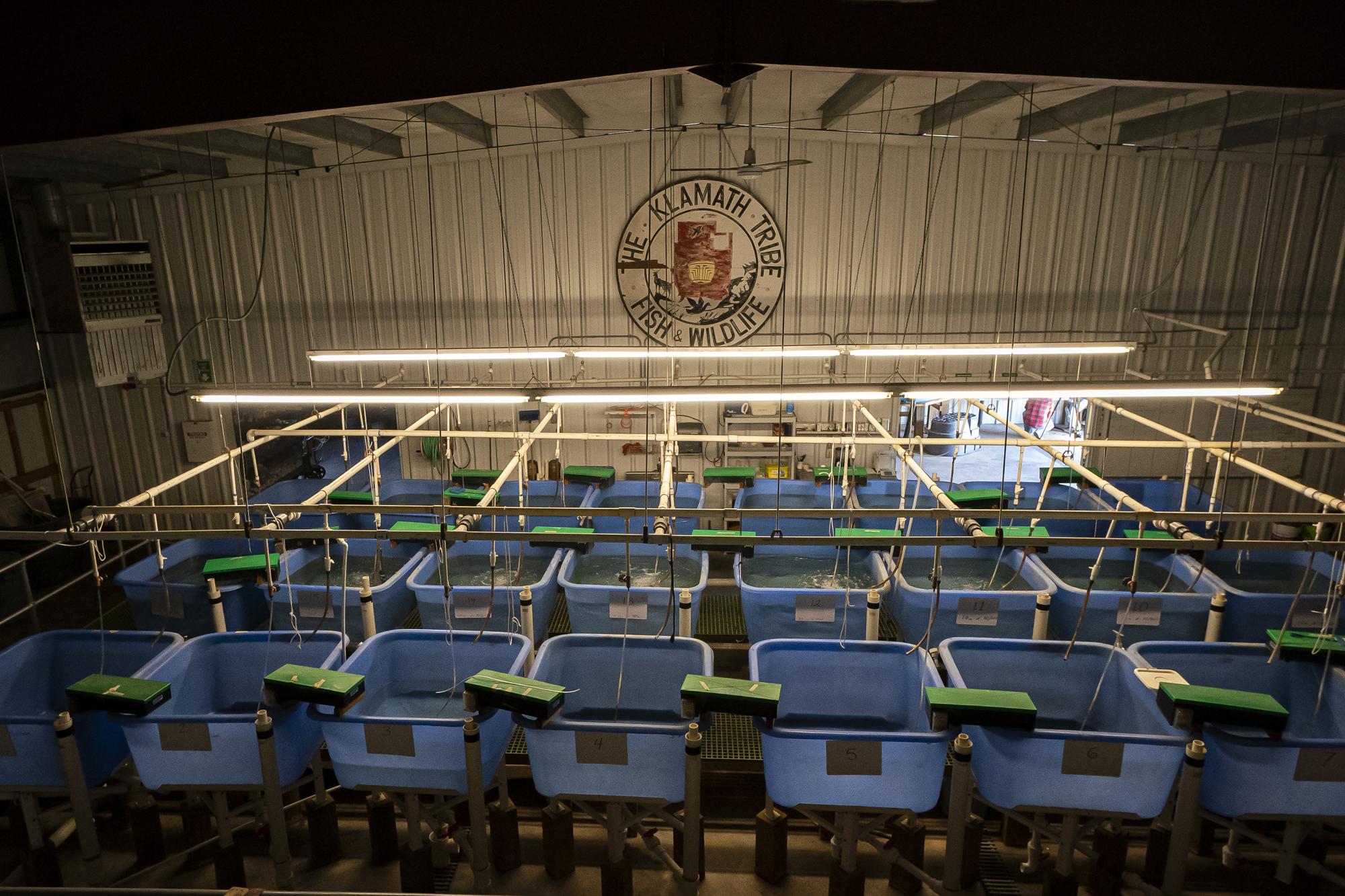
The Klamath Tribes Fish and Wildlife facility, where the health of native suckerfish is tracked, is seen here on Thursday, June 10, 2021, in Chiloquin, Ore. Toxic algae blooms in the Upper Klamath Lake threatens the habitat for the endangered species. (AP Photo/Nathan Howard)

The Klamath Tribes Fish and Wildlife facility, where the health of native suckerfish is tracked, is seen here on Thursday, June 10, 2021, in Chiloquin, Ore. (AP Photo/Nathan Howard)

Meanwhile, toxic algae is blooming in the basin’s main lake — vital habitat for endangered suckerfish — a month earlier than normal, and two national wildlife refuges that are a linchpin for migratory birds on the Pacific Flyway are drying out. Environmentalists and farmers are using pumps to combine water from two stagnant wetlands into one deeper to prevent another outbreak of avian botulism like the one that killed 50,000 ducks last summer.

The activity has exposed acres of arid, cracked landscape that likely hasn’t been above water for thousands of years.

“There’s water allocated that doesn’t even exist. This is all unprecedented. Where do you go from here? When do you start having the larger conversation of complete unsustainability?” said Jamie Holt, lead fisheries technician for the Yurok Tribe, who counts dead juvenile chinook salmon every day on the lower Klamath River.

“When I first started this job 23 years ago, extinction was never a part of the conversation,” she said of the salmon. “If we have another year like we’re seeing now, extinction is what we’re talking about.”
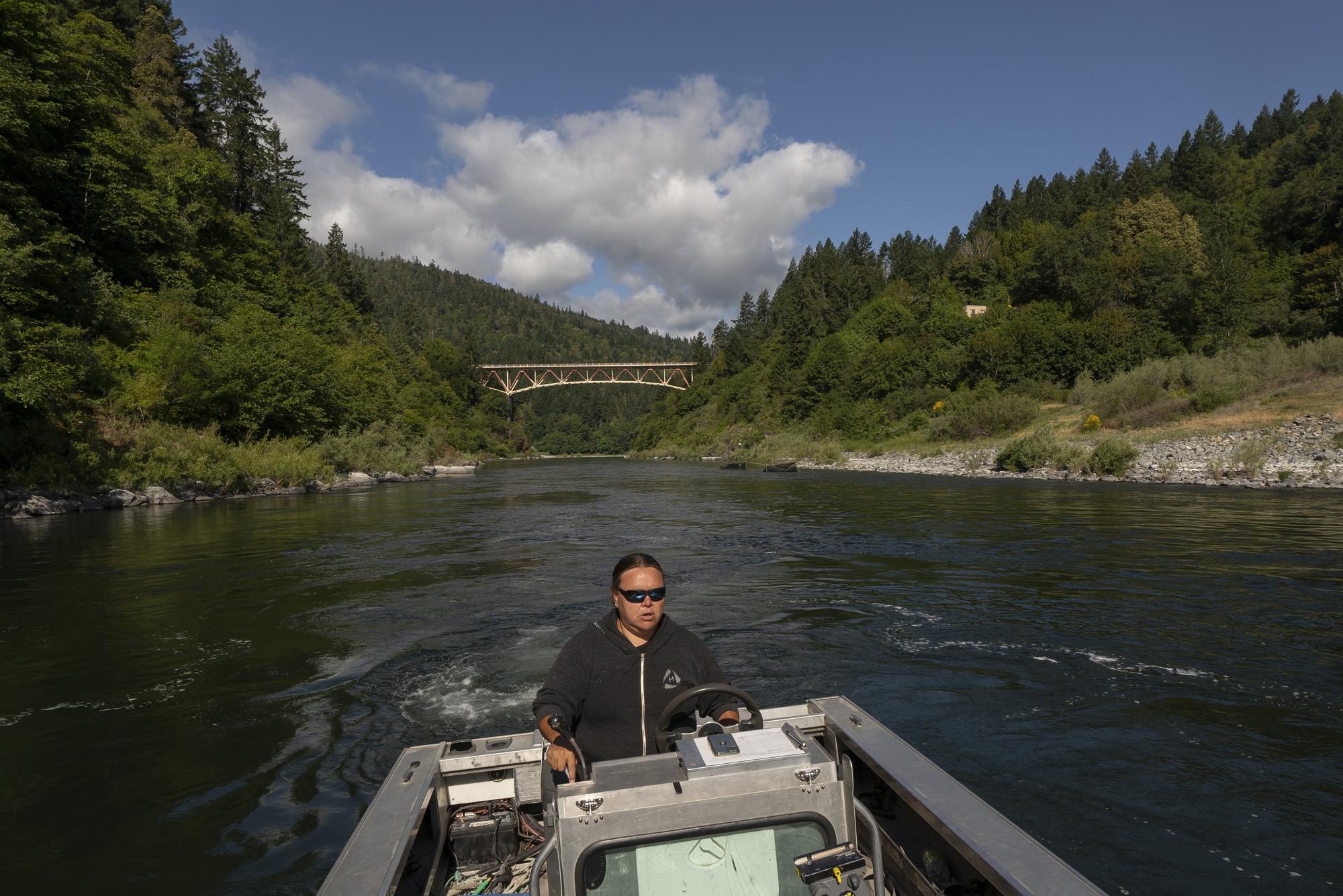
Jamie Holt, lead fisheries technician for the Yurok Tribe, maneuvers a boat near a fish trap in the lower Klamath River on Tuesday, June 8, 2021, in Weitchpec, Calif. A historic drought and low water levels are threatening the existence of fish species along the 257-mile long river.

Jamie Holt, lead fisheries technician for the Yurok Tribe, maneuvers a boat near a fish trap in the lower Klamath River on Tuesday, June 8, 2021, in Weitchpec, Calif. (AP Photo/Nathan Howard)

The extreme drought has exacerbated a water conflict that traces its roots back more than a century.

Beginning in 1906, the federal government reengineered a complex system of lakes, wetlands and rivers in the 10 million-acre (4 million-hectare) Klamath River Basin to create fertile farmland. It built dikes and dams to block and divert rivers, redirecting water away from a natural lake spanning the California-Oregon border.

Evaporation then reduced the lake to one-quarter of its former size and created thousands of arable acres in an area that had been underwater for millennia.

In 1918, the U.S. began granting homesteads on the dried-up parts of Tule Lake. Preference was given to World War I and World War II veterans, and the Klamath Reclamation Project quickly became an agricultural powerhouse. Today, farmers there grow everything from mint to alfalfa to potatoes that go to In ’N Out Burger, Frito-Lay and Kettle Foods.

Water draining off the fields flowed into national wildlife refuges that continue to provide respite each year for tens of thousands of birds. Within the altered ecosystem, the refuges comprise a picturesque wetland oasis nicknamed the Everglades of the West that teems with white pelicans, grebes, herons, bald eagles, blackbirds and terns.

Last year, amid a growing drought, the refuges got little water from the irrigation project. This summer, they will get none.

SPEAKING FOR THE FISH

While in better water years, the project provided some conservation for birds, it did not do the same for fish — or for the tribes that live along the river.

The farmers draw their water from the 96-square-mile (248-square-kilometer) Upper Klamath Lake, which is also home to suckerfish. The fish are central to the Klamath Tribes’ culture and creation stories and were for millennia a critical food source in a harsh landscape.

In 1988, two years after the tribe regained federal recognition, the U.S. Fish and Wildlife Service listed two species of suckerfish that spawn in the lake and its tributaries as endangered. The federal government must keep the extremely shallow lake at a minimum depth for spawning in the spring and to keep the fish alive in the fall when toxic algae blooms suck out oxygen.

This year, amid exceptional drought, there was not enough water to ensure those levels and supply irrigators. Even with the irrigation shutoff, the lake’s water has fallen below the mandated levels — so low that some suckerfish were unable to reproduce, said Alex Gonyaw, senior fish biologist for the Klamath Tribes.
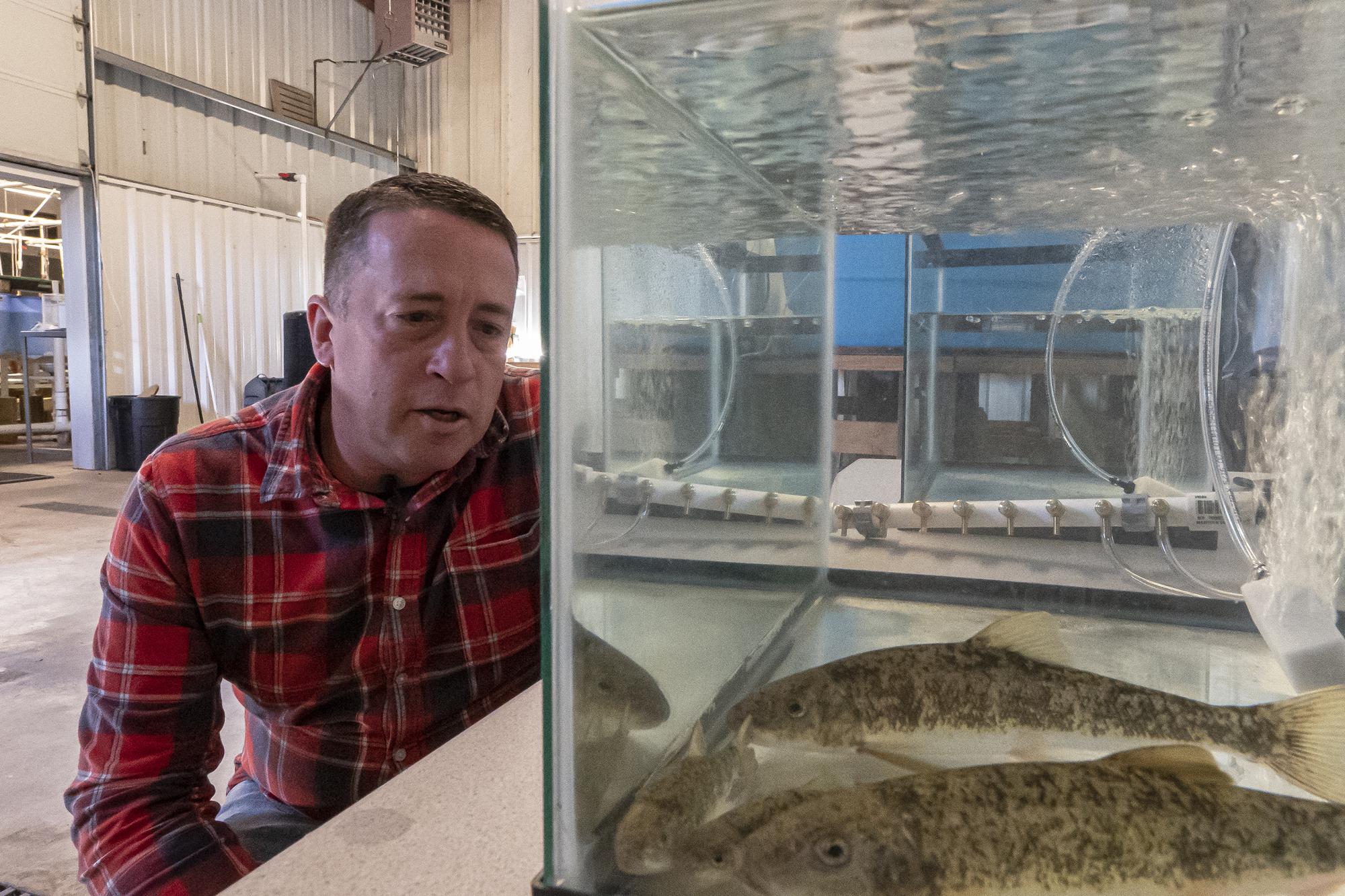
Alex Gonyaw, senior fish biologist for the Klamath Tribes, examines juvenile suckerfish at the tribe's fish and wildlife facility on Thursday, June 10, 2021, in Chiloquin, Ore. Toxic algae blooms in the Upper Klamath Lake threaten the habitat for the endangered species. (AP Photo/Nathan Howard)

Alex Gonyaw, senior fish biologist for the Klamath Tribes, examines juvenile suckerfish at the tribe’s fish and wildlife facility on Thursday, June 10, 2021, in Chiloquin, Ore. (AP Photo/Nathan Howard)

The youngest suckerfish in the lake are now nearly 30 years old, and the tribe’s projections show both species could disappear within the next few decades. It says even when the fish can spawn, the babies die because of low water levels and a lack of oxygen. The tribe is now raising them in captivity and has committed to “speak for the fish” amid the profound water shortage.

“I don’t think any of our leaders, when they signed the treaties, thought that we’d wind up in a place like this. We thought we’d have the fish forever,” said Don Gentry, Klamath Tribes chairman. “Agriculture should be based on what’s sustainable. There’s too many people after too little water.”

But with the Klamath Tribes enforcing their senior water rights to help suckerfish, there is no extra water for downriver salmon — and now tribes on different parts of the river find themselves jockeying for the precious resource.

The Karuk Tribe last month declared a state of emergency, citing climate change and the worst hydrologic conditions in the Klamath River Basin in modern history. Karuk tribal citizen Aaron Troy Hockaday Sr. used to fish for salmon at a local waterfall with a traditional dip net. But he says he hasn’t caught a fish in the river since the mid-1990s.

“I got two grandsons that are 3 and 1 years old. I’ve got a baby grandson coming this fall. I’m a fourth-generation fisherman, but if we don’t save that one fish going up the river today, I won’t be able to teach them anything about our fishing,” he said. “How can I teach them how to be fishermen if there’s no fish?”
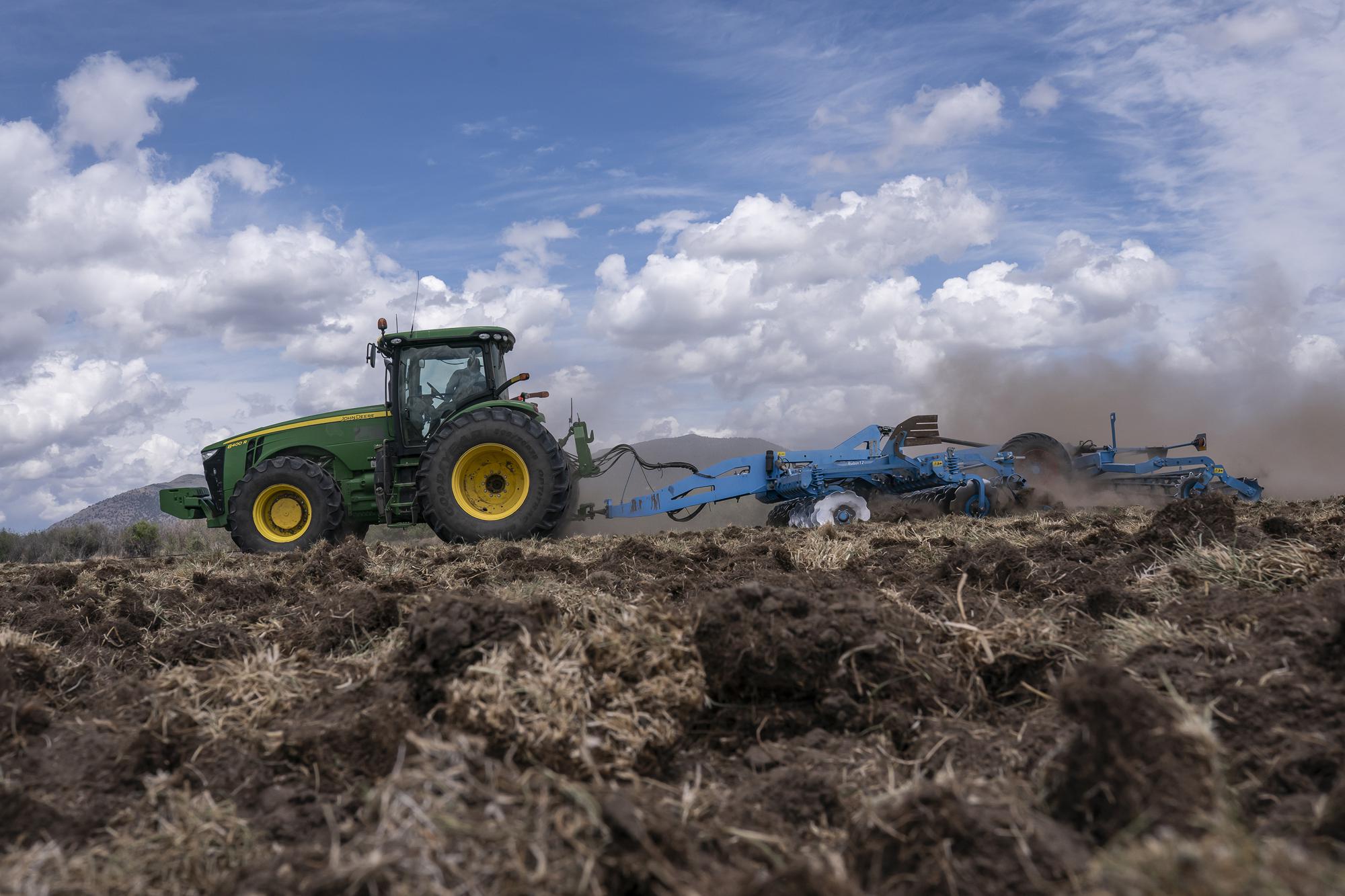
A tractor tears dried dirt on land that was unplanted this year due to the water shortage on Wednesday, June 9, 2021, in Tulelake, Calif. This summer for the first time ever, hundreds of farmers along the California-Oregon border who rely on irrigation from a depleted, federally managed lake aren't getting any water from it at all. Competition over the water in the Klamath Basin has always been intense, but this summer, because of a historic drought there is not enough water for the needs of farmers, Native American tribes and wildlife refuges. (AP Photo/Nathan Howard)

A tractor tears dried dirt on land that was unplanted this year due to the water shortage on Wednesday, June 9, 2021, in Tulelake, Calif. (AP Photo/Nathan Howard)

‘IT’S LIKE A BIG, DARK CLOUD’

The downstream tribes’ problems are compounded by hydroelectric dams, separate from the irrigation project, that block the path of migrating salmon.

In most years, the tribes 200 miles (320 kilometers) to the southwest of the farmers, where the river reaches the Pacific, ask the Bureau of Reclamation to release pulses of extra water from Upper Klamath Lake. The extra flows mitigate outbreaks of a parasitic disease that proliferates when the river is low.

This year, the federal agency refused those requests, citing the drought.

Now, the parasite is killing thousands of juvenile salmon in the lower Klamath River, where the Karuk and Yurok tribes have coexisted with them for millennia. Last month, tribal fish biologists determined 97% of juvenile spring chinook on a critical stretch of the river were infected; recently, 63% of fish caught in research traps near the river’s mouth have been dead.
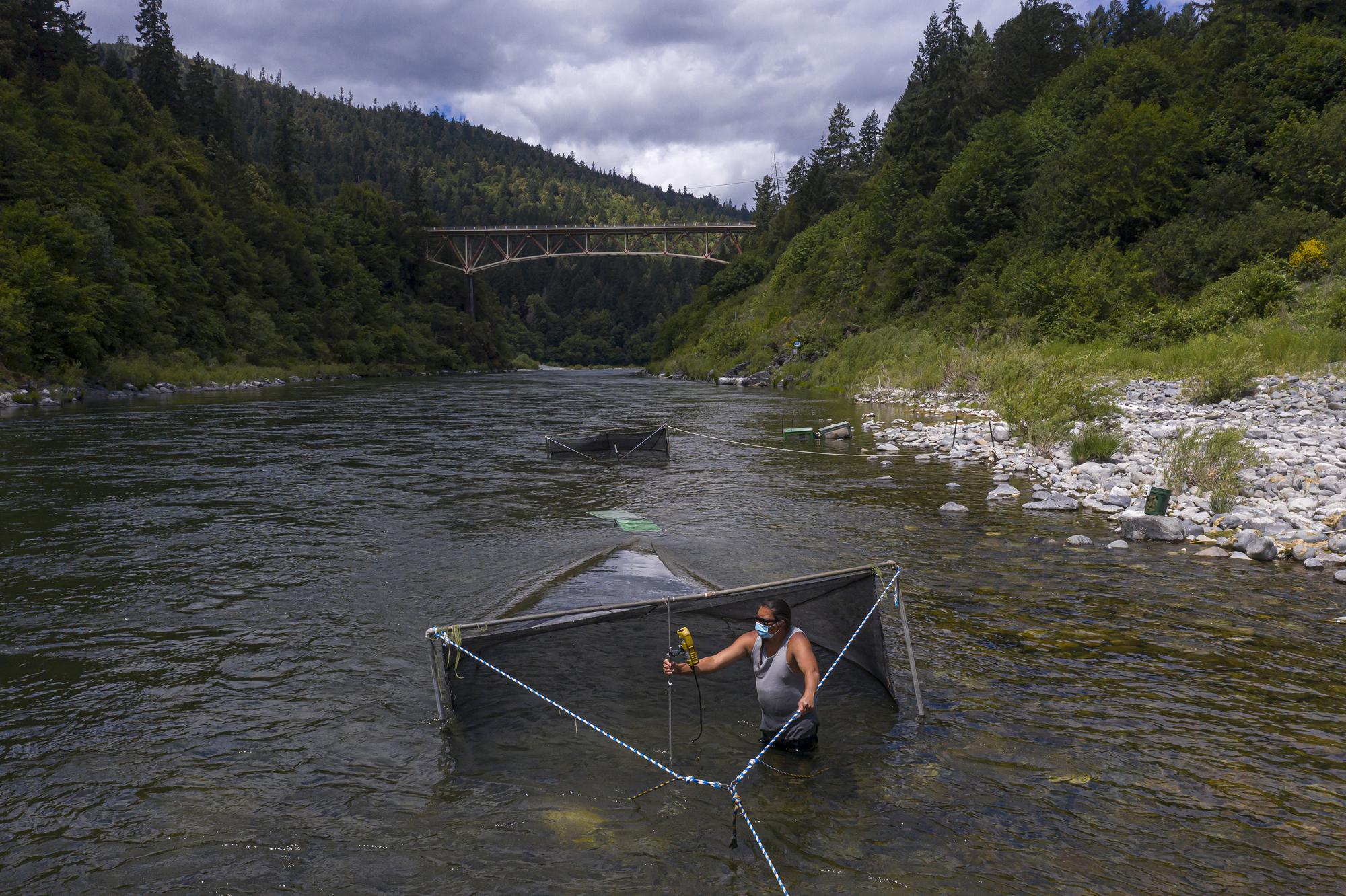
Gilbert Myers takes a water temperature reading at a chinook salmon trap in the lower Klamath River on Tuesday, June 8, 2021, in Weitchpec, Calif. Native American tribes along the 257-mile-long river are watching helplessly as fish species hover closer to extinction because of lower water levels caused by historic drought. (AP Photo/Nathan Howard)

Gilbert Myers takes a water temperature reading at a chinook salmon trap in the lower Klamath River on Tuesday, June 8, 2021, in Weitchpec, Calif. (AP Photo/Nathan Howard)
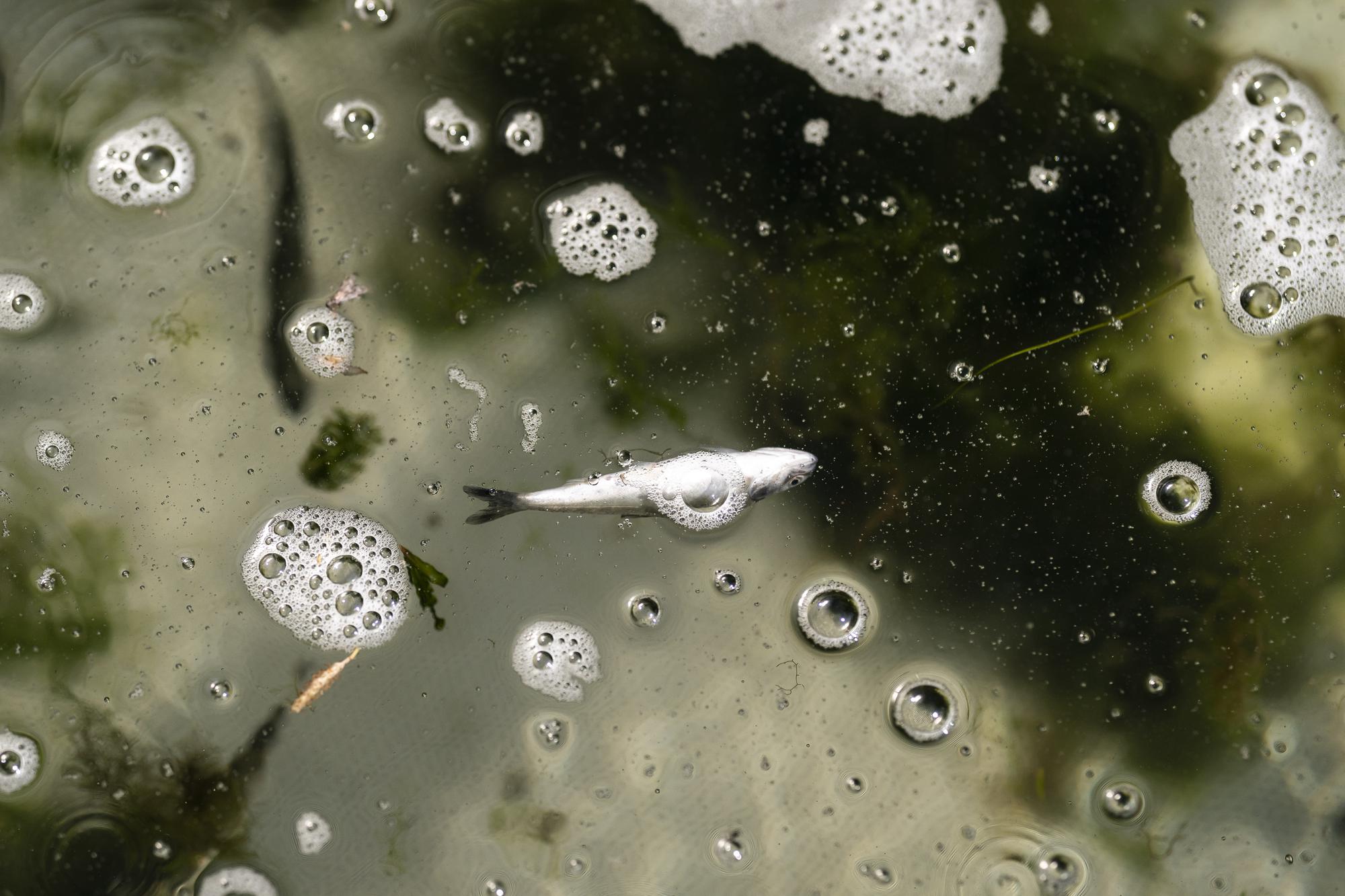
A dead chinook salmon floats in a fish trap on the lower Klamath River on Tuesday, June 8, 2021, in Weitchpec, Calif. A historic drought and low water levels on the Klamath River are threatening the existence of fish species along the 257-mile long river. (AP Photo/Nathan Howard)

A dead chinook salmon floats in a fish trap on the lower Klamath River on Tuesday, June 8, 2021, in Weitchpec, Calif. (AP Photo/Nathan Howard)

The die-off is devastating for people who believe they were created to safeguard the Klamath River’s salmon and who are taught that if the salmon disappear, their tribe is not far behind.

“Everybody’s been promised something that just does not exist anymore,” said Holt, the Yurok fisheries expert. “We are so engrained within our environment that we do see these changes, and these changes make us change our way of life. Most people in the world don’t get to see that direct correlation — climate change means less fish, less food.”

Hundreds of miles to the northeast, near the river’s source, some of the farmers who are seeing their lives upended by the same drought now say a guarantee of less water — but some water — each year would be better than the parched fields they have now. And there is concern that any problems in the river basin — even ones caused by a drought beyond their control — are blamed on a way of life they also inherited.

“I know turning off the project is easy,” said Tricia Hill, a fourth-generation farmer who returned to take over the family farm after working as an environmental lawyer.

“But sometimes the story that gets told … doesn’t represent how progressive we are here and how we do want to make things better for all species. This single-species management is not working for the fish — and it’s destroying our community and hurting our wildlife.”
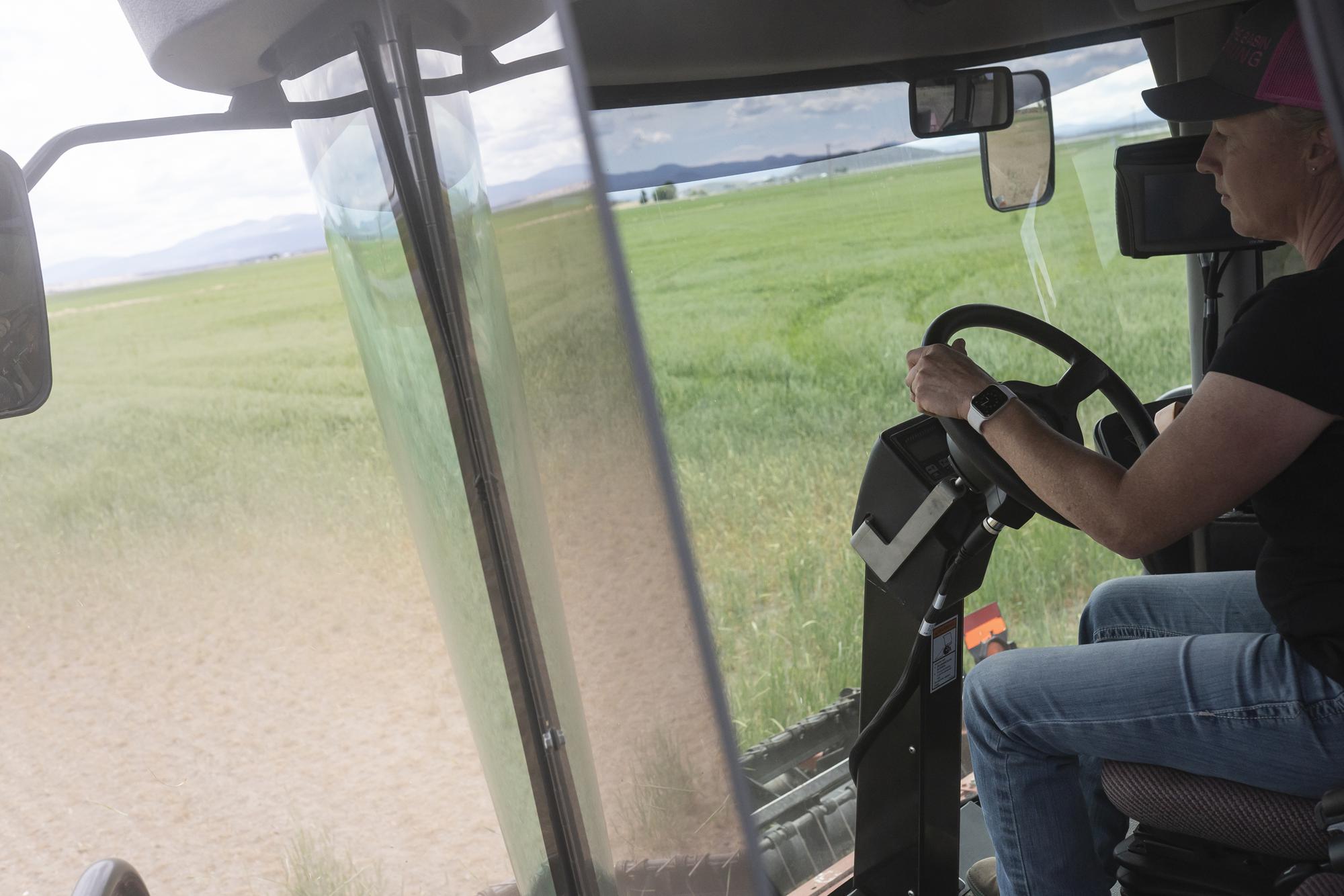
Erika DuVal drives a swather through a field of triticale, one of the few crops her family was able to plant this year due to the water shortage, on Wednesday, June 9, 2021, in Tulelake, Calif. The DuVal family has farmed the land near the California-Oregon border for three generations, and this summer for the first time ever, they and hundreds of others who rely on irrigation from a depleted, federally managed lake aren't getting any water from it at all. (AP Photo/Nathan Howard)

Erika DuVal drives a swather through a field of triticale, one of the few crops her family was able to plant this year due to the water shortage, on Wednesday, June 9, 2021, in Tulelake, Calif. (AP Photo/Nathan Howard)
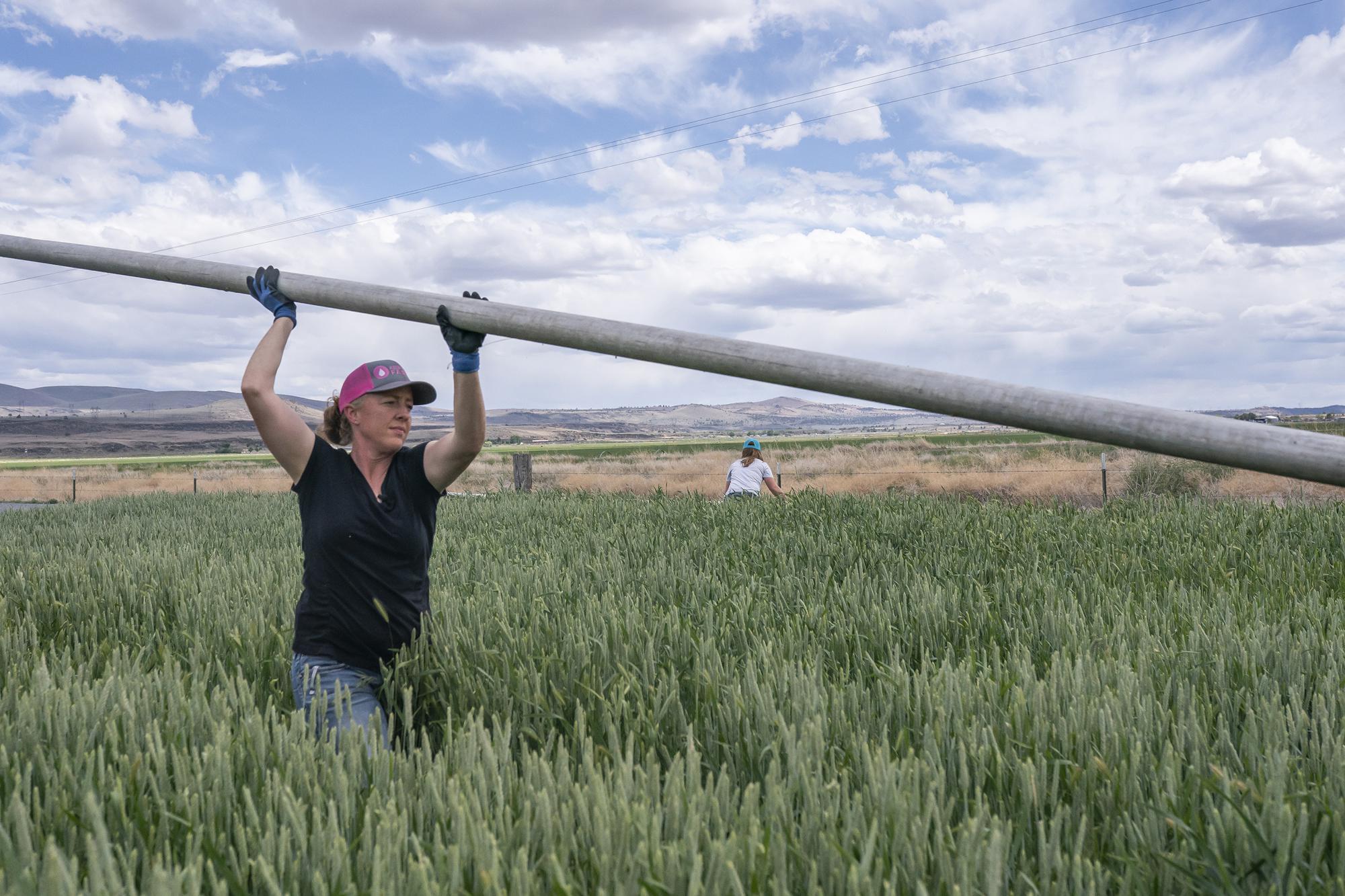
Erika DuVal moves an irrigation pipe through a field of triticale, one of the few crops her family was able to plant this year due to the water shortage, on Wednesday, June 9, 2021, in Tulelake, Calif. The DuVal family has farmed the land near the California-Oregon border for three generations, and this summer for the first time ever, they and hundreds of others who rely on irrigation from a depleted, federally managed lake aren't getting any water from it at all. (AP Photo/Nathan Howard)

Erika DuVal moves an irrigation pipe through a field of triticale, one of the few crops her family was able to plant this year due to the water shortage, on Wednesday, June 9, 2021, in Tulelake, Calif. (AP Photo/Nathan Howard)
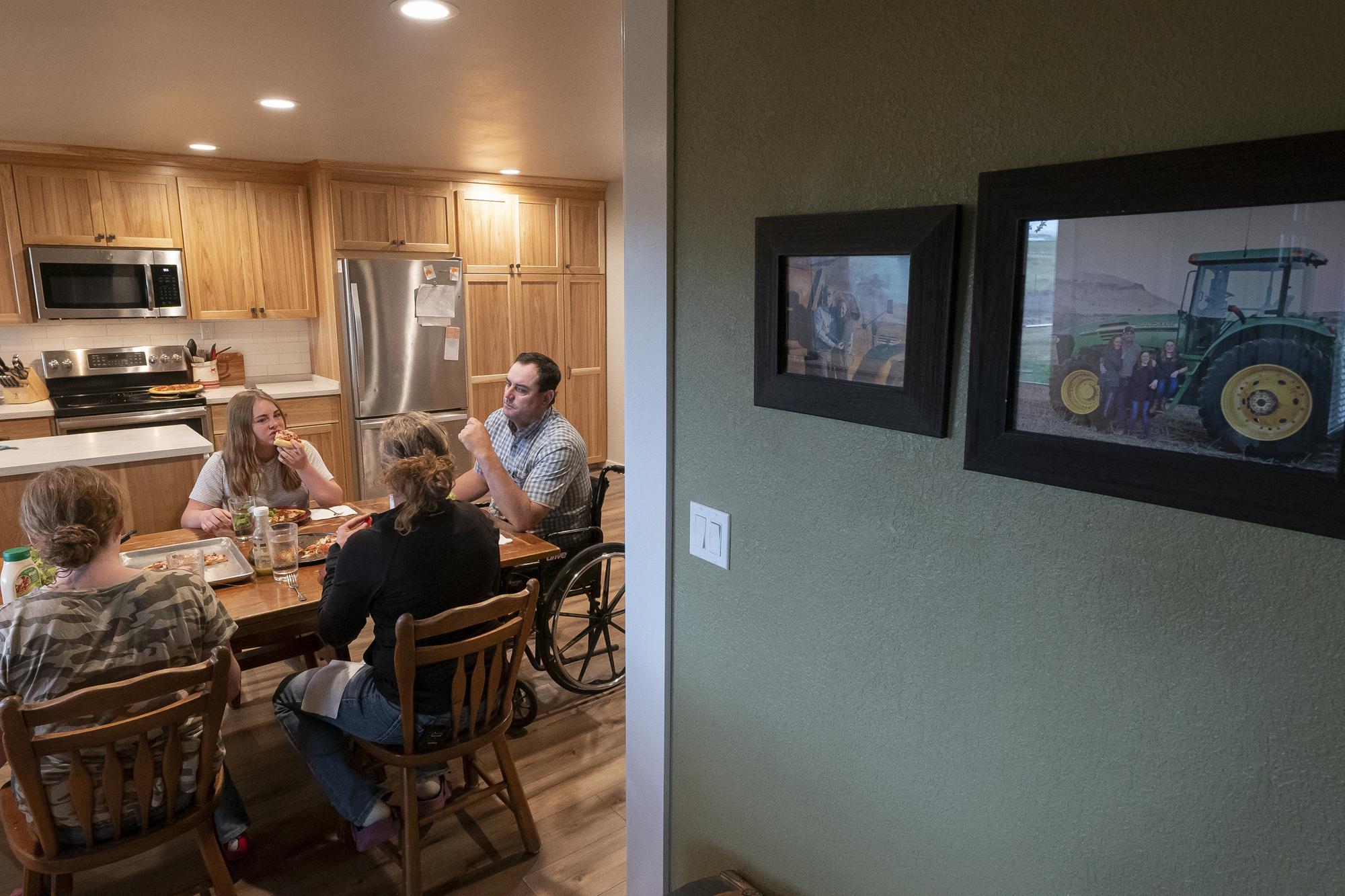
The DuVal family eats dinner together in their farmhouse on Wednesday, June 9, 2021, in Tulelake, Calif. Ben DuVal said he worries the continued water shortage will prevent him from passing on their farming way of life to his kids. DuVal's family has farmed the land near the California-Oregon border for three generations, and this summer for the first time ever, he and hundreds of others who rely on irrigation from a depleted, federally managed lake aren't getting any water from it at all. (AP Photo/Nathan Howard)

The DuVal family eats dinner together in their farmhouse on Wednesday, June 9, 2021, in Tulelake, Calif. Ben DuVal said he worries the continued water shortage will prevent him from passing on their farming way of life to his kids. (AP Photo/Nathan Howard)

DuVal’s daughter also dreams of taking over her family’s farm someday. But DuVal isn’t sure he and his wife, Erika, can hang onto it if things don’t change.

“To me it’s a like a big, dark cloud that follows me around all the time. It’s depressing knowing that we had a good business and that we had a plan on how we’re going to grow our farm and to be able to send my daughters to a good college,” said DuVal. “And that plan just unravels further and further with every bad water year.”
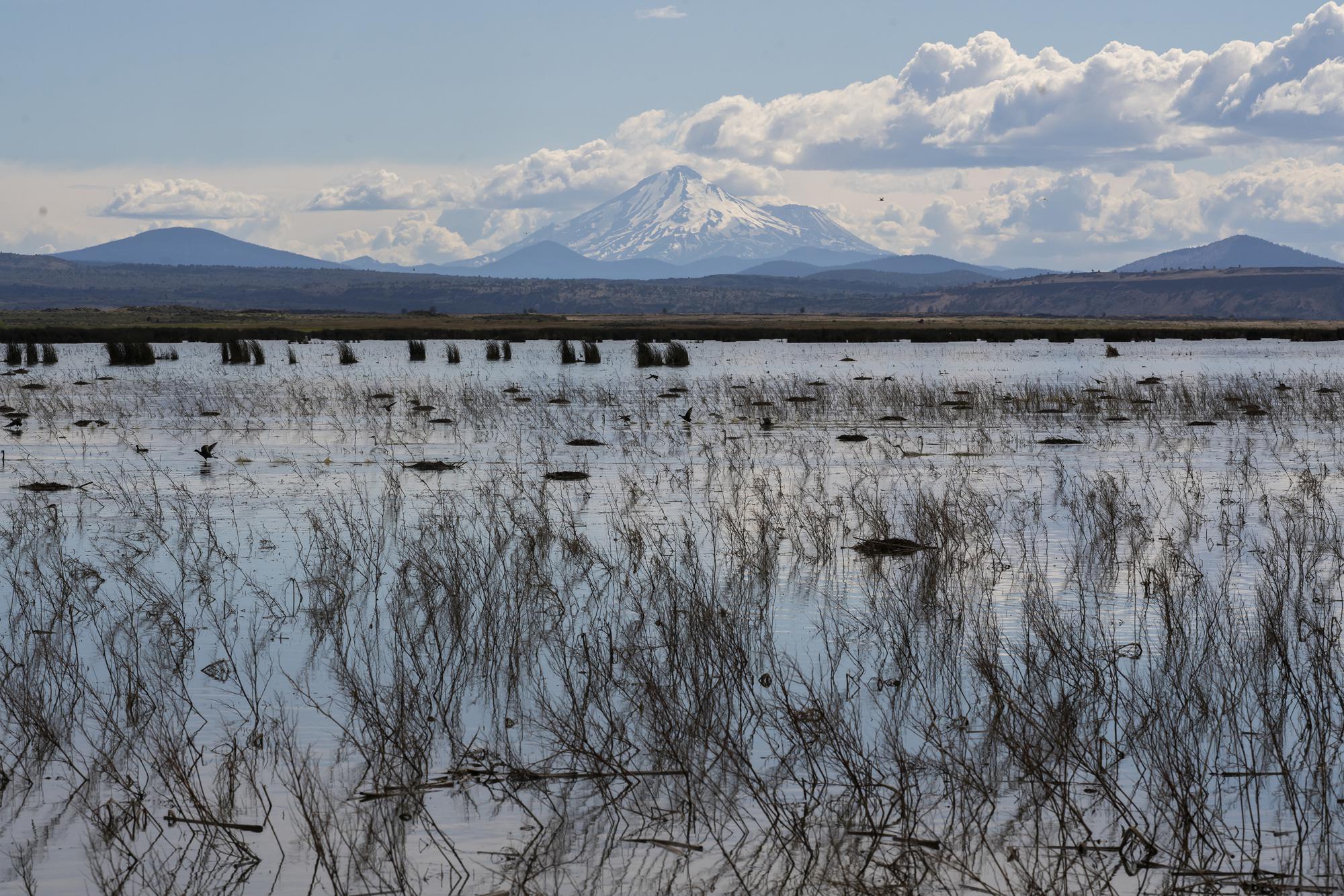
Birds and other wildlife move through a wetland in the Klamath River Basin on Wednesday, June 9, 2021, in Tulelake, Calif. Extreme drought is tearing apart communities in the massive basin, which spans the Oregon-California border. (AP Photo/Nathan Howard)

Birds and other wildlife move through a wetland in the Klamath River Basin on Wednesday, June 9, 2021, in Tulelake, Calif. Extreme drought is tearing apart communities in the massive basin, which spans the Oregon-California border. (AP Photo/Nathan Howard)

………………………………………………………

The 2026 AFRICA EDUCATES HER CAMPAIGN REPORT - ANGOLA 6th Anniversary | 2020–2026

  Meet who's behind this cause     Support us:  https://donate-sofonie.netlify.app/           AFRICA EDUCATES HER CAMPAIGN REPORT — ANGO...