Translate

Tuesday, 25 May 2021

‘Science should be at the centre of all policy making’


Scientists have been front and centre in the battle against coronavirus. It’s a policy making position they should continue to occupy beyond the pandemic, writes Prof Ruth Morgan. But how?

The rate of ice melt, the impact of a global pandemic, the capabilities of artificial intelligence, and the impact of fake news. These are all big challenges where science informs us and pioneers the tools we need to unlock the next steps in tackling them.

Yet in an age where science has never been more advanced, and where our capabilities to collect and analyse data are unsurpassed, we are still having to contend with some of the biggest threats we’ve ever faced.

The role of science has traditionally been reserved for enabling developments. Think about getting humans to the Moon, how we’ve transformed medicine and surgical procedures, or created new ways of communicating and keeping our societies secure; or simply how we’ve come to understand the workings of our planet.

But science will need to become more than this if we are to make the breakthroughs in the global issues we currently face.

Science that understands people and communities must be part of the conversation. At the same time, we also need to be clear about what science can and can’t do as we look for solutions.

It is probably not contentious to suggest that complex global challenges need science involved in the search for those solutions. But good science is just the first step. It is individuals, teams and communities who are the changemakers, and so good science needs to incorporate a clear and nuanced understanding of people.

If people are the key to making change and unlocking the solutions to complex challenges, we need to create environments that bring everyone together – the decision makers (often global leaders, governments and policy makers), along with entrepreneurs, innovators, activists, and scientists.

We need many different (and perhaps disruptive) perspectives to a specific issue to find the right solutions. But it doesn’t end there.

For those solutions to create real change and make a difference, we must never forget that at the heart of every major challenge are the individuals and communities who are connected to that challenge, and impacted by it.

A good understanding of what motivates a community and the values it holds, both individually and as a collective group, needs to be incorporated into solutions so that those solutions don’t just work in a lab, but have traction in reality.

This may sound straightforward and maybe even quite reasonable. Yet, the way we involve science in significant policy decisions, and incorporate both technical knowledge along with understanding the wider impact on the communities affected, is really varied.

It raises a question – is science being looked to at the right times and in the right ways? Is science part of the ongoing conversation as we seek to make the world a better place?

We have seen a range of different responses to the global pandemic and involvement of science in policy decisions, from closing borders and restricting all movement of people to more graded restrictions on household mixing, face mask policy, and the creation of exemptions for certain groups of people.

Crispr schematic Image
image caption New technologies such as Crispr need buy-in from all to gain wide acceptance

In other areas, such as the development of the gene-editing technique Crispr and its application to humans, the regulation of the technology and its interaction with society has been similarly varied in different states and nations.

Global challenges transcend governments, international boundaries, leadership boards, short-term agendas and traditional siloes. Therefore, if science that incorporates an understanding of people is one of the keys to making breakthroughs in these critical global challenges we face, we need to have scientists incorporated into decision-making teams and leadership bodies.

This leaves us with another question – could this really be feasible?

The World Economic Forum’s Young Scientists programme seeks to bring together some of the brightest minds in science from across the world.

As Young Scientists, we have found a role for scientists as ambassadors and communicators, and not just as subject matter experts. It is well known now that increasing diversity generally leads to increased creativity, greater innovation, faster problem solving, better decision making; and in companies, this leads to increased profits and better reputation.

We have seen this in action within the forum as it creates opportunities at physical meetings and in online settings for interactions between scientists and decision makers and global leaders (from across the tech, business and creative industries). This can and should happen in more settings, large and small.

This type of dialogue, often started at specific events, continues throughout the year, and creates conversations. Conversations are key. They bring together the diverse insights and understandings we need, of how people think and are motivated, and point us to the infrastructures that will frame how solutions can be deployed effectively.

Creating spaces for this kind of ongoing interaction makes it possible for science that engages deeply with people, societies and their physical and cultural environments. That kind of dialogue will lead to significant opportunities for decisions based on science to be integrated into strategy, horizon scanning, and in developing the solutions that have real impact.
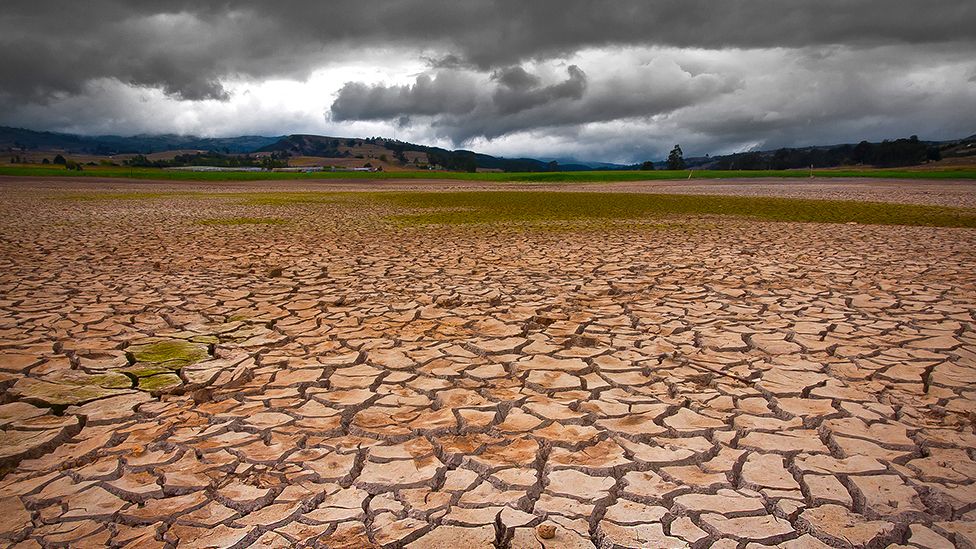
Drought-hit region
image caption Issues like climate change don’t have simple, single-discipline solutions

In the UK, we are seeing the promise of this kind of dialogue that has taken place in the response to the pandemic.

The UK government’s vaccine taskforce has delivered a national rollout of vaccines at a pace that is phenomenal. This success has its roots in many decisions that were made in very early 2020 in a climate of great uncertainty. Those decisions were made by government, healthcare, business and science leaders to not only achieve a viable vaccine, but ensure access to the doses needed, as well as start a broadscale delivery of them to the adult population by the end of the year.

But science isn’t only needed when the challenge we face has a clear scientific dimension like a pandemic or climate change. Science has a contribution to make as we seek to tackle every kind of big challenge, whether that is global poverty, education, equality or securing justice.

As we face these challenges, global leaders need science. Scientists can bring data, insights and transformational discoveries, but they can also bring alternative viewpoints and ways of thinking to tackle the big issues of our time.

These issues rarely have simple, single-discipline solutions that can be identified in one-off events or meetings. They need collective, multidisciplinary, interactive, creative, strategic thinking that incorporates not only economics, politics, policy and business insights, but also science.

In short, science can’t just be brought in when a crisis emerges, we need an ongoing and dynamic conversation between scientists and the leadership teams that are tackling the big complex world challenges.

For real impact and change this needs to become the norm and it needs to be happening across the board, within government, and in business and industry.

We have never lived in a time when creating opportunities for scientists to be incorporated into global leadership and decision making has been more urgent. If we can make it a reality, we will ultimately be able to collectively deliver the solutions that are needed to address the big global threats of today and tomorrow.


………………………………………………………………

Monday, 24 May 2021

Mount Nyiragongo: DR Congo city of Goma empties as thousands flee erupting volcano

Lava from the eruption has flowed on to a major road and has reached the airport on the edge of the city, witnesses say.


DR Congo’s Mount Nyiragongo has erupted for the first time in nearly two decades – but a city directly in the path of the lava flow has so far been spared.


Many thousands of people fled the city of Goma, some heading for its highest point Mount Goma.

Others headed for the nearby Rwandan border, with authorities there saying that around 3,000 people had already crossed over on Saturday night. Some even boarded boats onto Lake Kivu.

Homes on the outskirts of Goma have been destroyed in the eruption and smoke has been rising from smoldering heaps of lava in some areas.

“We have seen the loss of almost an entire neighborhood,” said witness Innocent Bahala Shamavu.

As people attempted to escape, Goma resident Zacharie Paluku told The Associated Press: “Everyone is afraid, people are running away. We really don’t know what to do.”

There was a government evacuation plan but it came hours after the sky had turned a fiery red and power had been cut to the city.

Lava from the eruption flowed on to a major road on Saturday as it reached the airport on the city’s edge, according to a volcanologist based there. However, the airport is now understood to have escaped damage.

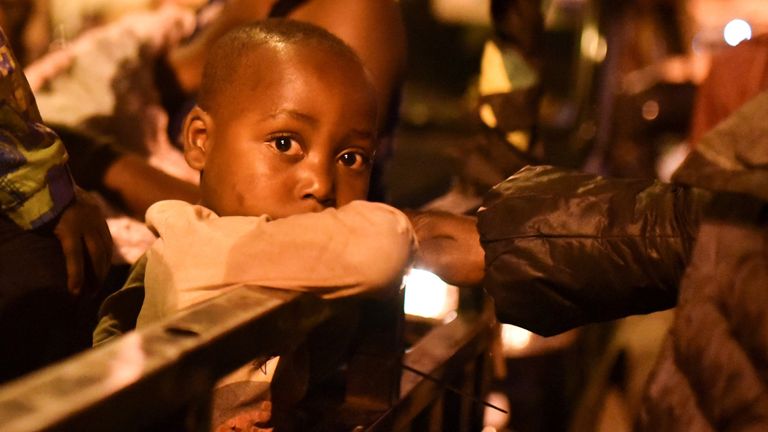
A child looks on as people gather with their belongings following a volcanic activities at Mount Nyiragongo near Goma, in the Democratic Republic of Congo May 22, 2021. REUTERS/Olivia Acland
Image:Thousands of people have fled the city of Goma, many heading for the Rwandan border
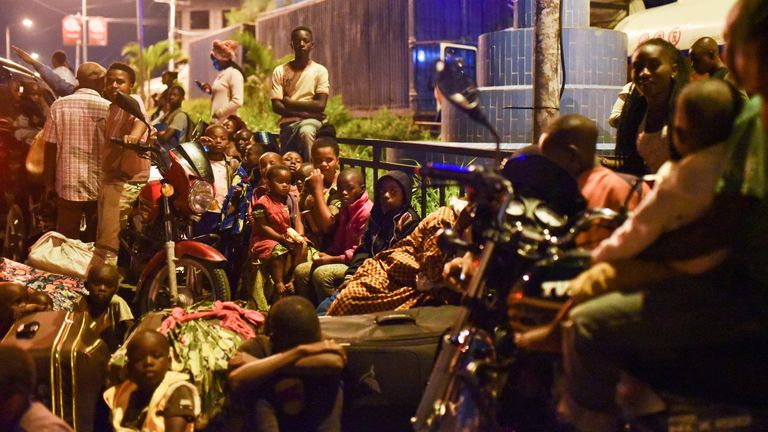
Civilians watch smoke and flames as they gather with their belongings following a volcanic activities at Mount Nyiragongo near Goma, in the Democratic Republic of Congo May 22, 2021. REUTERS/Olivia Acland
Image:Many people fled the city before the government activated its evacuation plan, worried by the bright red the sky

Dario Tedesco told Reuters that new fractures were opening in Nyiragongo, allowing the lava to flow southward towards Goma after initially flowing east toward Rwanda.

“Now Goma is the target,” Mr Tedesco said, adding: “It’s similar to 2002.”

Another Gomo resident told Sky News on Saturday night that the “situation is serious”.

“The fire is becoming complicated. The houses are burnt, the people are suffering and the problems are huge,” he said.

Nyiragongo’s last eruption was in 2002 and it left hundreds of people dead, and coated airport runways with lava.

“I think that the lava is going towards the city centre,” Mr Tedesco said.

“It might stop before or go on. It’s difficult to forecast.”

No casualties have been confirmed as a result of the eruption so far.

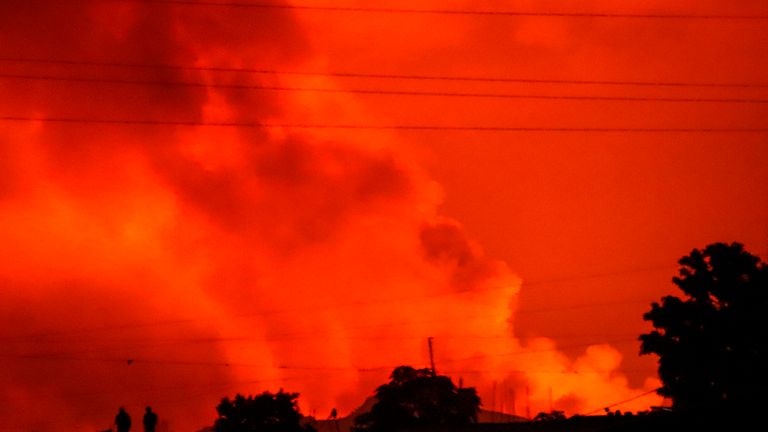
Two people are seen silhouetted against a night sky turned red by the eruption of Mount Nyiragongo, in Goma, Congo Saturday, May 22, 2021. Congo's Mount Nyiragongo erupted for the first time in nearly two decades Saturday, turning the night sky a fiery red and sending lava onto a major highway as panicked residents tried to flee Goma, a city of nearly 2 million. (AP Photo/Justin Kabumba)
Image:The sky over Goma in Congo has turned a fiery red due to the eruption of Mount Nyiragongo
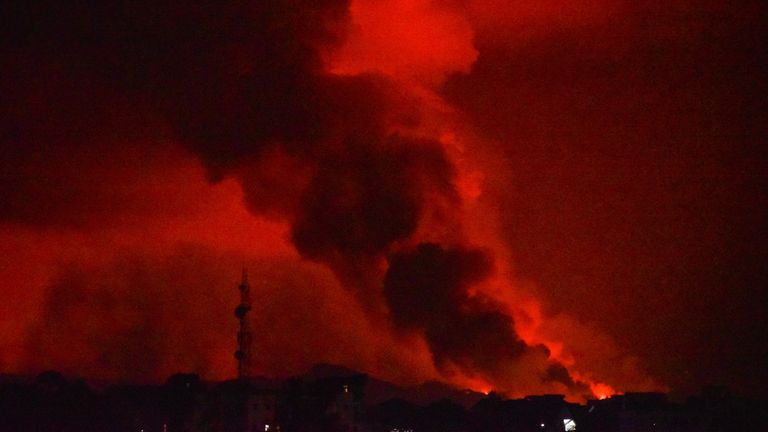
A general view shows smoke and flames at the volcanic eruption of Mount Nyiragongo near Goma, in the Democratic Republic of Congo May 22, 2021. REUTERS/Olivia Acland
Image:The volcanic eruption has sent lava into the air and across at least one major road

“We are doing our best to give you factual information, unfortunately, a part of Gomo is in the dark but I want to assure you your government is doing something,” a government spokesman said.

Goma is a base for UN peacekeeping mission MONUSCO and it was reported that the organisation’s aircraft had been moved to nearby cities.

Nyiragongo is one of the world’s most active volcanoes and is considered among the most dangerous.

There had been concern about the amount of volcanic activity observed in the last five years at Nyiragongo but experts at Goma Volcano Observatory have not been able to check things regularly due to funding issues.

………………………………………………………………

LAVA STOPS SHORT OF CONGO CITY AFTER VOLCANIC ERUPTION


A smoking trail of lava from a volcanic eruption appeared to have halted a few hundred metres from the edge of eastern Democratic Republic of Congo's main city on Sunday morning, said a Reuters reporter at the scene.

Goma, a lakeside city of about 2 million people, was thrown into panic on Saturday evening as the nearby Mount Nyiragongo erupted, turning the night sky an eerie red. Thousands fled with their belongings on foot, some towards the nearby border with Rwanda.

As the sun rose on Sunday, much of the hillside to the north of the town was burned black and houses had been demolished. The sky was again a cloudy gray.

"Local authorities who have been monitoring the eruption overnight report that the lava flow has lost intensity," government spokesman Patrick Muyaya said on Twitter on Sunday.

Nyiragongo's previous eruption in 2002 killed 250 people and left 120,000 homeless. It is one of the world's most active volcanoes and is considered among the most dangerous. Saturday's eruption appears to have been caused when fractures opened in the volcano's side, causing lava flows in various directions.

Experts were worried that the volcanic activity observed in the past five years at Nyiragongo mirrors that in the years preceding eruptions in 1977 and 2002.

The Reuters reporter said the lava flow had stopped short of Goma's airport and the city limits but that surrounding villages were hit.

Lava crossed a main road out of Goma, cutting if off from cities to the north. Traffic was in gridlock in most places as people tried to leave or return to assess the damage to their homes.

It was not possible to estimate material damage or if anyone had died.

A separate lava flow that headed east over unpopulated terrain towards Rwanda also appeared to have stopped, the reporter said.

GOVERNOR CALLS FOR CHURCH ACTION ON BEHALF OF VULNERABLE PEOPLE


Malanje - The provincial governor of Malanje, Norberto dos Santos "Kwata Kanawa", Sunday asked for the strengthening of the churches action in favour of the most disadvantaged people, with emphasis on the street children and the families affected by the drought.

Speaking during a visit to the United Methodist Church of Malanje, as part of his tour to the religious institutions based in the province, the governor highlighted the history of missionary action among the most vulnerable and considered it urgent to strengthen this orientation in order to support the State to mitigate the difficulties that many families face.

In a brief intervention, Norberto dos Santos praised the prompt response that the church has always given to the issues that affect the population, thus reinforcing its partnership with the State in ensuring peace and social welfare.

At the occasion, the pastor of the Central United Methodist Church of Malanje, Reverend Victorino de Almeida, welcomed the visit, as it strengthens the relationship with the State.

He assured that, at this moment, the United Methodist Church in Malanje is carrying out campaigns to collect donations, to help needy people and extended the appeal to other religious institutions and others to join the cause.

The provincial governor of Malanje's tour to the churches in the province, a fortnightly initiative, began on the 15th of this month and has already visited the Seventh Day Adventist Church.

The Provincial Office for Culture, Tourism and Youth and Sports controls 51 religious denominations.

MINISTER STRESSES IMPORTANCE OF CHURCH IN CHILD EDUCATION


Luanda - The Minister of Social Action, Family and Women Promotion, Faustina Alves, reaffirmed Sunday the importance of the partnership between the State and the Angolan church in the realisation of actions linked to education and protection of children.

Speaking to the press, on the sidelines of a service alluding to the Day of the Tocoist Child (20 May), the Cabinet minister said that this contribution of the Church is fundamental to instil in children the culture of respect for moral and civic values.

According to the government official, it is also important to reinforce, within the scope of this partnership, the awareness programmes for parents and carers, aiming at reducing the cases of parenthood denial in Angola.

"Among the various child protection problems, we should highlight that of raising the awareness of society to avoid cases of paternity denial," she stressed.

According to Faustina Alves, the child must be well prepared for the future and, for that reason, the churches, as the moral guardians of society, play a pivotal role.

She announced that the Government is developing a series of programmes, with the purpose of reducing the number of child deaths at birth and to facilitate their access to the education system.

"Children should not be involved in the disagreements that may arise within the homes, since it is their right to be educated in a healthy coexistence, to avoid in the future the existence of men and women traumatised by violence."

COVID-19: ANGOLA REPORTS 292 NEW CASES, 10 DEATHS


Luanda - At least two hundred and ninety-two new cases, ten deaths and three recovered patients is the statistical balance of the last 24 hours, announced this Sunday by the health authorities.

The health bulletin indicates the diagnosis of 229 cases in Luanda, 41 in Huíla, 9 in Huambo, 4 in Namibe, 3 in Cabinda, 3 in Cunene, 1 in Bengo, 1 in Benguela and 1 in Lunda Sul.

Of the new cases, whose ages range from 11 months to 86 years, 166 are men and 126 women.

Of the deaths, of which nine were Angolans and one Brazilian citizen, nine occurred in Luanda and one in Huambo province.

Those recovered, according to the report, reside in Luanda province.

At the treatment centres 271 patients are hospitalised, 44 citizens are in institutional quarantine, whilst 2,302 citizens in contacts of positive cases are under surveillance by the health authorities.

Laboratories have processed, in the last 24 hours, 8,887 samples.

The general picture indicates 32,441 positive cases, with 725 deaths, 26,778 recovered and 4,938 active. Of the active, 11 critical, 47 severe, 184 moderate, 29 mild and 4,667 asymptomatic.

Sunday, 23 May 2021

New COVID-19 cases plummet to lowest levels since last June


New coronavirus cases across the United States have tumbled to rates not seen in more than 11 months, sparking optimism that vaccination campaigns are stemming both severe COVID-19 cases and the spread of the virus.


As cases, hospitalizations and deaths steadily dropped this week, pre-pandemic life in America has largely resumed. Hugs and unmasked crowds returned to the White House, a Mardi Gras-style parade marched through Alabama’s port city of Mobile, and even states that have stuck to pandemic-related restrictions readied to drop them. However, health experts also cautioned that not enough Americans have been vaccinated to completely extinguish the virus, leaving the potential for new variants that could extend the pandemic.

As the seven-day average for new cases dropped below 30,000 per day this week, Rochelle Walensky, the director of the Centers for Disease Control and Prevention, pointed out cases have not been this low since June 18, 2020. The average number of deaths over the last seven days also dropped to 552 — a rate not seen since July last year. It’s a dramatic drop since the pandemic hit a devastating crescendo in January.

“As each week passes and as we continue to see progress, these data give me hope,” Walensky said Friday at a news conference.

Health experts credit an efficient rollout of vaccines for the turnaround. More than 60% of people over 18 have received at least one shot, and almost half are fully vaccinated, according to the CDC. But demand for vaccines has dropped across much of the country. President Joe Biden’s administration is trying to convince other Americans to sign up for shots, using an upbeat message that vaccines offer a return to normal life.

White House health officials on Friday even waded into offering dating advice. They are teaming up with dating apps to offer a new reason to “swipe right” by featuring vaccination badges on profiles and in-app bonuses for people who have gotten their shots.

Ohio, New York, Oregon and other states are enticing people to get vaccinated through lottery prizes of up to $5 million.

Across the country, venues and events reopened after shuttering for much of the last year.

On Saturday, Karen Stetz readied to welcome what she hoped would be a good crowd to the Grosse Pointe Art Fair on Michigan’s Lake St. Clair.

With natural ventilation from the lake and mask and capacity restrictions easing, Stetz was optimistic that artists who make their living traveling a show circuit that ground to a halt last year would begin to bounce back. The event usually draws from 5,000 to 10,000 people.

“I feel like most people are ready to get out,” Stetz said by phone shortly before opening the fair. “It seems like people are eager, but it’s hard to know still. I’m sure there’s a percentage of people that are going to wait until they’re comfortable.”

In Mobile, thousands of joyful revelers, many without masks, competed for plastic beads and trinkets tossed from floats Friday night as Alabama’s port city threw a Mardi Gras-style parade. But only about a quarter of the county’s population is fully vaccinated. Many went without masks, though health officials had urged personal responsibility.

Alabama’s vaccination rate — 34% of people have received at least one dose — is one of the lowest in the country. It’s part of a swath of Southern states where vaccine uptake has been slow. Health experts worry that areas with low vaccination rates could give rise to new virus variants that are more resistant to vaccinations.

“My biggest concern is new strains of the virus and the need to remain vigilant in the months ahead,” said Boston College public health expert Dr. Philip J. Landrigan.

A medical center in Louisiana reported Friday it has identified the state’s first two cases of a COVID-19 variant that has spread widely since being identified in India. The COVID-19 variant has been classified as a “variant of concern” by Britain and the World Health Organization, meaning there is some evidence that it spreads more easily between people, causes more severe disease, or might be less responsive to treatments and vaccines. The variant has also been reported in several other states, including Tennessee, Nebraska and Nevada.

Though Landrigan said the big drop in cases nationwide was “the best news we’ve had on the pandemic” and showed that vaccines are working, he warned that people should remain vigilant for local flare-ups of new cases.

Many states have largely dropped orders to wear masks and stay distanced from other people. Meanwhile, even places such as California — the first state to issue a statewide shutdown as the virus emerged in March 2020 — prepared to remove restrictions on social distancing and business capacity next month.

State health director Dr. Mark Ghaly said Friday the decision was based on dramatically lower virus cases and increased vaccinations.

But in Vermont — the state with the highest percentage of people who have received one shot — Gov. Phil Scott has tied the lifting of restrictions to the vaccination rate. He offered to lift all remaining restrictions before a July 4 deadline if 80% of those eligible get vaccinated.

Landrigan would like to see a nationwide vaccination rate of at least 85% before relaxing restrictions. But for now, the steep drop in cases gave him hope that pandemic-level infection rates will soon be a thing of the past.

“It is getting to the point to where by the 4th of July we might be able to declare this thing over,” he said.

…………………………………………………………

When Telecommunications Collapse: What Angola's Mobile Network Crisis Teaches Us About Governance, Justice, and National Security

  The recent disruption of Angola's mobile networks has affected banking, digital payments, businesses, emergency communications, and mi...