Translate

Tuesday, 6 June 2023

Scientists say world’s oldest-known burial site found in S Africa

The site in the Cradle of Humankind near Johannesburg contains remains of a small-brained distant relative of humans, scientists say.


Palaeontologists in South Africa said they have found the oldest-known burial site in the world, containing remains of a small-brained distant relative of humans previously thought incapable of complex behaviour.

Led by renowned palaeoanthropologist Lee Berger, researchers said on Monday that they discovered several specimens of Homo naledi – a tree-climbing, Stone Age hominid – buried about 30 metres (100 feet) underground in a cave system within the Cradle of Humankind, a UNESCO World Heritage Site near Johannesburg.

“These are the most ancient interments yet recorded in the hominin record, earlier than evidence of Homo sapiens interments by at least 100,000 years,” the scientists wrote in a series of yet-to-be-peer-reviewed and preprint papers to be published in eLife.

Lee Berger
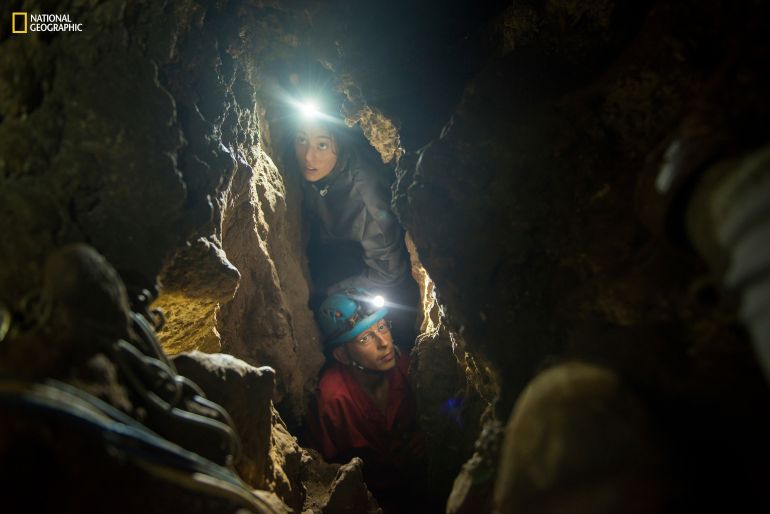
National Geographic’s explorer-in-residence Lee Berger’s daughter, Megan, and underground exploration team member Rick Hunter navigate the narrow chutes leading to the Dinaledi Chamber of the Rising Star Cave in South Africa 

The findings challenge the current understanding of human evolution, as it is normally held that the development of bigger brains allowed for the performing of complex, “meaning-making” activities such as burying the dead.

The oldest burials previously unearthed, found in the Middle East and Africa, contained the remains of Homo sapiens – and were around 100,000 years old.

Those found in South Africa by the research team led by Berger, whose previous announcements have been controversial, date back to at least 200,000 BC.

“Homo naledi tells us we’re not that special,” Berger, a United States-born explorer, told AFP news agency. “We ain’t gonna get over that.”

Homo naledi, a primitive species at the crossroads between apes and modern humans, had brains about the size of oranges and stood about 1.5m (5 feet) tall.

With curved fingers and toes, tool-wielding hands and feet made for walking, Homo naledi was discovered in 2013 by Berger, helping upend the notion that our evolutionary path was a straight line.

The species is named after the “Rising Star” cave system where the first bones were found in 2013.

The oval-shaped interments at the centre of the new studies were also found there during excavations started in 2018.

The holes, which researchers say evidence suggest were deliberately dug and then filled in to cover the bodies, contain at least five individuals.

“These discoveries show that mortuary practices were not limited to H. sapiens or other hominins with large brain sizes,” the researchers said.

The burial site is not the only sign that Homo naledi was capable of complex emotional and cognitive behaviour, they added.

Berger’s earlier discoveries won the interest of National Geographic, which named him “explorer in residence” and featured his work in television shows and documentaries.

The latest research has not been peer-reviewed yet and some outside scientists think more evidence is needed to challenge what we know about how humans evolved their complex thinking.

“There’s still a lot to uncover,” said Rick Potts, director of the Smithsonian’s Human Origins Program, who was not involved in the research.

SOURCE: NEWS AGENCIES

……………………………………………………

Gaddafi’s Son Goes On Hunger Strike In Lebanon – Lawyer

 One of the surviving sons of the former Libyan leader, Muammar Gaddafi, has gone on hunger strike to protest against his prolonged detention in Lebanon, says his lawyer Paul Romanos.


Hannibal Gaddafi has been held in Lebanon for more than eight years after being abducted by Lebanese militants from Syria, where he had taken refuge after the downfall and death of his father, he adds.


Hannibal Gaddafi was subsequently taken by the Lebanese authorities and has been detained ever since in a jail in Beirut without trial, Mr Romanos says.

Source: BBC

…………………………………………………………

Brazil’s President Lula unveils plan to end deforestation by 2030

Lula’s proposal would advance a commitment to deforestation made at the 2021 climate talks in Glasgow, Scotland.


The administration of Brazilian President Luiz InĂ¡cio Lula da Silva has announced its plan to eliminate deforestation by 2030 as part of an international pledge to protect the environment.

Lula and his Environment Minister Marina Silva unveiled the Action Plan for the Prevention and Control of Deforestation in the Amazon on Monday, touting it as the latest step in their aggressive platform to combat climate change.

“Brazil has resumed its leading role in tackling climate change, after four years in which the environment was treated as an obstacle to the immediate profit of a privileged minority,” Lula said in a post on Twitter, alluding to the policies of his predecessor, Jair Bolsonaro.

“But rich countries also need to do their part. They were the ones who over the centuries devastated forests the most.”

Fifteen government ministries collaborated on the plan, which includes advancing techniques for documenting and tracking illegal deforestation.

The plan stipulates increased use of satellite imagery to identify illegal logging, ranching and mining operations. Government databases containing financial intelligence, for example, will also be deployed to track the flow of money from unsanctioned operations in the Amazon rainforest.

Under the terms of the plan, a system will also be developed to certify the origins of wood and agricultural products that might otherwise come from vulnerable or exploited ecosystems.

In addition to its crime-fighting efforts, the plan proposes to standardise land titles and create incentives for sustainable agriculture and other “green” activities.

“Loggers in the country need to be told that, if they want to cut down trees, plant them,” Lula said of the proposed measures.

He also warned there would be no excuse for felling old-growth forests. “In the land of the Brazilian people, we will be very tough in complying with the law.”

Lula’s policies mark a departure from those of Bolsonaro, whose tenure in office, from 2019 to 2022, coincided with record deforestation in Brazil.

Bolsonaro had advocated for more development in the Amazon region, framing the construction as a potential boon for Brazil’s economy and turning a blind eye, according to critics, to illegal operations.

But Bolsonaro’s opponents decried what they saw as an attack on the country’s environmental protections, one that translated into violence against the Indigenous people who call the Amazon home.

In October, the right-wing Bolsonaro was narrowly defeated in a run-off election against the left-leaning Lula, who campaigned on a platform of restoring the Amazon. Parts of the forest, once a major carbon-trapping sink, now release more carbon than they capture as a result of deforestation and fires.

Nevertheless, in November, Lula appeared at the United Nations Climate Change Conference, COP27, in a bid to position Brazil as a leader in the fight against climate change.

“There is no climate security for the world without a protected Amazon,” he told the conference.

Still, Lula has faced an uphill battle. Deforestation dropped by 61 percent in January, his first month in office, only to hit a record high in February.

And Brazil’s opposition-led Congress recently delivered a setback to Lula, voting last week to scale down ministries dedicated to environmental protection and Indigenous peoples.

Monday’s deforestation announcement arrives one year after British journalist Dom Phillips and Brazilian Indigenous expert Bruno Pereira were murdered while reporting on the Amazon.

In announcing Monday’s plan, Lula paid tribute to the two men, who had worked to bring attention to deforestation and illegal operations on Indigenous land.

“A year ago, the brutal murder that made them victims shocked the world, which came to see the Amazon as a land without law and on the verge of destruction,” Lula wrote on Twitter. “Today, the world has returned to look at Brazil with hope.”

The announcement lays the groundwork for Brazil to follow through with a 2021 agreement, forged at the COP26 climate talks in Glasgow, Scotland, to halt deforestation by 2030.

An estimated 145 countries joined in the Glasgow declaration, which would cover approximately 85 percent of the world’s forests and woodlands. Among them, 12 governments pledged $12bn to protect and restore forest ecosystems, with funds set aside for Indigenous populations.

SOURCE: AL JAZEERA AND NEWS AGENCIES

…………………………………………………………

Rwandan president reshuffles top military officers

 Rwanda’s President Paul Kagame has appointed new military and intelligence chiefs in a major reshuffle.


The president appointed Maj Gen Juvénal Marizamunda as the new defence minister, replacing Maj Gen Albert Murasira, who was in the post since 2018.

A new army chief, Lt Gen Mubarakh Muganga, is taking over from GenJean Bosco Kazura who ran the Rwanda Defence Force (RDF) since November 2019..

A reshuffle in which a defence minister and army chief are fired at the same time is not common in Rwanda.

No reasons have been given for the reshuffle. In previous changes to the upper echelons of the military, Mr Kagame would at times publicly hint at the reason.

In the Monday night reshuffle, Mr Kagame also appointed a new army chief of staff ((land forces) as well as head of military intelligence.

In another move, he changed the top commanders of Rwandan troops deployed in Mozambique to help fight militant Islamists.

Source: BBC

…………………………………………………………

Friday, 2 June 2023

NPP Presidential Primaries: 10 Pick Forms To Lead NPP In 2024 Polls

 At the end of the first week of nomination processes in the New Patriotic Party (NPP) for its presidential primaries, fixed for Saturday 4 November 2023, ten aspirants have picked up nomination forms to run for the top slot.


The NPP opened nominations on 26 May and the window for filing is expected to close on Saturday 24 June. All aspirants who picked up forms paid a non-refundable nomination fee of GHC50,000.


All the candidates who have picked up forms are expected to file completed documents on or before Saturday 24 June 2023 and, in line with further requirements, they will pay a filing fee of GHC300,000.

Aspirants
As of today, Thursday 1 June, Boakye Agyarko, the former energy minister, Francis Addai Nimoh, the former MP for Mampong in the Ashanti Region, Kwabena Agyei Agyepong, the former general secretary of the NPP, Dr Kofi Konadu Apraku, an economist and former minister for regional co-operation, and Dr Owusu Afriyie Akoto, a former minister of food and agriculture, have acquired forms to stand in the presidential primaries.

The other people who have also picked up forms are the vice-president, Dr Mahamudu Bawumia, Kojo Poku, an energy expert, Alan Kyerematen, the former minister of trade and industry, Kennedy Agyapong, the sitting MP for Assin Central in the Central Region, and Joe Ghartey, the former minister of railways development and sitting Member of Parliament for Essikado-Ketan in the Western Region.

Super delegates
At the close of nominations on Saturday 24 June 2023, if all the ten aspirants who have picked up nomination forms go ahead to file, the NPP will hold a super delegates’ conference to trim the number of aspirants to five as required by the party’s constitution.

The NPP has already planned to hold a conference of super delegates on 26 August (a Saturday) if need be.

Under Article 12 (5) (b) of the NPP’s constitution, “where there are more than five contestants for nomination as the party’s presidential candidate, a Special Electoral College (super delegates) shall cast their votes by secret ballot for the first five contestants to be shortlisted”.

The provision goes on to list those who constitute the Special Electoral College. They are “the National Council, the National Executive Committee, the Regional Executive Committees, National Council of Elders and Members of Parliament”.

The rest are “three representatives of each of the special organs of the party, past National Officers, three representatives each from every external branch, founding members during the registration of the party at the Electoral Commission and all New Patriotic Party card-bearing ministers when the party is in government”.

Source: asaaseradio.com

…………………………………………………………

Health Shocker: Jamie Foxx Left ‘Paralyzed and Blind’ From ‘Blood Clot in His Brain’ After Receiving COVID-19 Vaccine, Source Claims

 Horrific health details have been revealed regarding Jamie Foxx’s mysterious medical state.


The Django Unchained star is said to be “partially paralyzed and blind,” in addition to a series of other complications after receiving the COVID-19 vaccine, Hollywood journalist A.J. Benza claimed after speaking to a source close to Foxx.

“Jamie had a blood clot in his brain after he got the shot. He did not want the shot, but the movie he was on, he was pressured to get it,” confessed the podcaster — who formally worked as a columnist for the New York Daily News and as a host of the E! series Mysteries and Scandals — during an appearance on Dr. Drew Pinsky’s online show “Ask Dr. Drew.”

“The blood clot in the brain caused him at that point to be partially paralyzed and blind,” Benza alleged, as he insisted his insider was “someone in the room” with first-hand knowledge of Foxx’s hospitalization.

“I am thinking, ‘Is that why he blew up on the set a week before this medical emergency happened?'” the veteran journalist asked Pinsky. “Is that why he fired three or four people because he had had it with these mandates?”

Foxx was admitted to the hospital after suffering a “medical complication” on Thursday, April 11, although specific details on his current health status have been difficult to discover.

The 55-year-old’s medical woes mounted while filming his latest movie Back in Action. The movie, also starring Cameron Diaz, has moved forward with production without Foxx, using a body double in his place.

On Friday, May 12, Foxx’s daughter Corrine announced conflicting information that didn’t align with numerous other reports regarding the actor’s well-being.

“Sad to see how the media runs wild. My dad has been out of the hospital for weeks, recuperating,” Foxx’s daughter insisted. “In fact, he was playing pickleball yesterday! Thanks for everyone’s prayers and support! We have an exciting work announcement coming next week too!”

Benza addressed the family statement on his podcast, calling the pickleball claims “all lies” and “baloney.”

“If you read into what they were saying early on, ‘He is communicating with us.’ That doesn’t mean talking. That could be anything. Writing. Sign language. I know those little code words,” Benza continued to assume of Foxx’s current capabilities.

“Then you tell me your father is playing pickleball, give me a break. There is a great shroud of secrecy around Jamie Foxx,” he added.

Pinsky provided his two cents on the matter, stating: “Blood in the brain is a cerebral bleed. It is not a stroke. A stroke is a blood clot in an artery to the brain that cuts off the blood supply to the brain and the brain dies.”

“It has been widely known that he had a stroke, right? They have said stroke many times. To say it is a blood clot in the brain, it is a stroke. It is a blood clot in an artery that cuts off the supply … that part of the brain is dead,” the television personality continued.

Pinsky concluded: “It has very serious consequences. It depends on which artery and what the anatomy of that artery is to what parts of the brain and what not.”

Story by Rebecca Friedman

…………………………………………………

A ‘Russian love affair’: Why South Africa stays ‘neutral’ on war

South Africa’s public stance of neutrality in the Russia-Ukraine war has been at variance with its decades-long relationship with Moscow. Why is that so?


Cape Town, South Africa – In April, a delegation of senior officials of South Africa’s ruling African National Congress (ANC) undertook what the party said was an invitation from “a long-standing ally”, Russia’s ruling party. It travelled to Moscow to discuss what the ANC said was the “recalibration of the global order”. Among the delegation was Deputy Foreign Minister Alvin Botes.

This month, army chief Lawrence Mbatha was also in Moscow on the invitation of Oleg Salyukov, commander-in-chief of Russia’s ground forces, who described it as a “goodwill visit”. State security minister Khumbudzo Ntshavheni is also to visit Russia in a few days, ahead of President Cyril Ramaphosa as part of an African leaders’ peace mission to Russia and Ukraine.

The flurry of high-profile visits has come even as South Africa insists publicly that it is neutral in the war between Russia and Ukraine despite longstanding ties with Moscow.

And now, ahead of the BRICS summit of Brazil, Russia, India, China and South Africa in August, the extent of that neutrality will be put to the test.

In March, the International Criminal Court (ICC) issued a warrant for the arrest of Russian President Vladimir Putin for forced deportations of children from Ukraine to Russia.

South Africa, a signatory to the ICC, is mandated to execute the warrant if Putin sets foot in the country. The Russian leader has indicated that he will indeed attend, laying the scene for a dramatic diplomatic dilemma.

Indeed, Pretoria has said it is assessing its legal options, including immunity for visiting officials.

“We will explore various options with regard to how the Rome Statute [ICC’s founding treaty] was domesticated in our country including the option to look at extending customary diplomatic immunity to visiting heads of state in our country,” Lamola told parliament on May 2.

Former South African President Thabo Mbeki has already said it is unlikely that Putin will be arrested, echoing sentiments within the ruling party. In April, Ramaphosa said the country was considering withdrawing from the ICC; hours later, his office denied that, saying the stance arose from a communications error.

In 2015, South Africa failed to arrest then-Sudanese leader Omar al-Bashir, who was also the subject of an ICC warrant. But this time, things are slightly different because of what might seem to be an inscrutable relationship between Pretoria and Moscow.

For years, the relationship between South Africa and Russia has baffled pundits and governments in the West.

There are no cultural or linguistic ties between the two countries.

Russia is also not a major trading partner for South Africa; the United States, United Kingdom and European Union account for more than a third of South Africa’s imports while Russia accounts for approximately 0.4 percent.

In October, South Africa abstained, like many other African countries, in a United Nations General Assembly vote condemning the Russian invasion of Ukraine which began in February 2022; there were 143 votes in favour of the resolution. At the time, the South African ambassador said the country “must stand in seeking peace”.

One explanation being bandied about for South Africa’s seeming reluctance to criticise Russia is that its policymakers are keen to see a more multilateral world in which Africa, as well as Asia, get more control on the global stage, including seats on the UN Security Council.

“We don’t want a hegemonic US but that is to make the world fairer,” said Oscar van Heerden, a Johannesburg-based international relations expert. “We are rational international actors, and we can see what is happening in the global space. It is not romanticism … there is a need for change in the global order.”

Pretoria’s bias towards Moscow or the “irrational Russian love affair” as Kobus Marais, shadow defence minister and member of South Africa’s leading opposition party, the Democratic Alliance has described it, are also traceable to the ANC’s roots.

Formed in 1912, the ANC was a liberation movement  – Africa’s oldest – fighting against white minority rule in South Africa. At the height of the Cold War, it relied heavily on support from the Soviet Union.

Ebrahim Rasool, South Africa’s former ambassador to the US, told Al Jazeera the movement received “no warmth from the West, and the USSR was the only ally that would give the party time of day”.

The Soviet Union provided the ANC with much-needed and substantial financial and other support when no one else was willing to do so.

According to the Russian historian Irina Filatov, the Soviets supported the ANC’s armed wing, Umkhonto we Sizwe, in the 1960s “with arms, ammunition and equipment and gave military training to its cadres and leadership”.

“No other country rendered such support to the ANC,” she wrote.

Zwelinzima Ndevu, professor of public leadership at Stellenbosch University, agreed.

The Soviet Union “held the ANC during the dark days of apartheid … in terms of financial help and also with training,” he told Al Jazeera. “Now in 2023, the relationship is still there, and this is why the country is standing on the fence on the Ukraine-Russia conflict.”

But the relationship is a complicated one, some say.

In 2014, during the presidency of Jacob Zuma, a deal for a $100bn nuclear power plant with Russia was concluded. Three years later, a local court order blocked the deal.

The opposition and civil society argued that the deal was an attempt to grant Russia influence in Africa. Zuma, an ANC veteran, was a member of the Umkhonto we Sizwe and intelligence chief for the movement before the end of apartheid and had long-standing networks in Moscow.

“We were suspicious of why he [Zuma] wanted the deal signed,” Rasool said. “We knew something was amiss; there was an attempt to get us into the kleptocracy.”

Even today, Russia seems to have forced South Africa’s hand, analysts say.

Van Heerden told Al Jazeera that the April visit to Moscow was to engage and “get the Russians to understand the dilemma the country is in” and perhaps appeal that Russia sends another senior politician in Putin’s stead.

Indeed, after that visit, Obed Bapela, another of Ramaphosa’s ministers said Russia’s ruling party made it clear that “the arrest of Putin in South Africa will be a declaration of war”.

South Africa’s noncommital stance is already causing friction with one of its biggest political and trading partners, the US.

In May, its ambassador to South Africa, Reuben Brigetty, accused the country of arming Russia, charging that weapons were loaded onto a Russian commercial vessel, the Lady R, docked at a naval base in Simon’s Town,  in December.

Since then, the South African authorities have been on a PR offensive to deny this.

There have also been recent navy drills between South Africa, Russia, and China. All of this has sparked an outcry from opposition parties and brought into question South Africa’s neutral stance on the Russia-Ukraine conflict. “We would like [South Africa to start] practising its non-alignment policy,” Brigetty said in a press conference in May.

“On paper, SA is neutral,” but in reality “and certainly in my view, we are not”, Ndevu the professor told Al Jazeera.

“Their many recent actions show, it is clear, the ANC is firmly aligned with Russia,” said John Steenhuisen, the DA leader, in a recent statement.

The ambiguity, Steenhuisen added, could cause severe economic and social damage to the country, risking thousands of jobs and billions of rands in trade with the West if there were to be foreign sanctions.

In May, days after Brigetty’s comments caused the rand to drop by 2.4 percent to the dollar, the South African Reserve Bank (SARB) warned that the economy could be hurt if the US implemented sanctions in light of the allegations.

The bank warned that any such penalties would make it “impossible to finance any trade or investment flows, or to make or receive any payments from correspondent banks in USD”.

But the resistance from different quarters is yet to change the government’s stance.

“South Africa will continue to support the efforts to end the conflict between Russia and Ukraine, and as a country and global player, we believe that such conflict should be ended through peaceful negotiations and engagement, not through South Africa taking sides,” Ntshavheni said during a recent debate in parliament.

SOURCE: AL JAZEERA

……………………………………………………


The 2026 AFRICA EDUCATES HER CAMPAIGN REPORT - ANGOLA 6th Anniversary | 2020–2026

  Meet who's behind this cause     Support us:  https://donate-sofonie.netlify.app/           AFRICA EDUCATES HER CAMPAIGN REPORT — ANGO...