Translate

Wednesday, 3 May 2023

Afghanistan: ‘Nothing we can do but watch babies die’

 Three-month-old Tayabullah is quiet and motionless. His mother Nigar moves the oxygen pipe away from his nose and puts a finger below his nostrils to check if she can feel him breathing. She begins to cry as she realises her son is fading. At this hospital in Afghanistan, there is not a single working ventilator.


Mothers hold oxygen tubes near their babies’ noses because masks designed to fit their small faces are not available, and the women are trying to fill in for what trained staff or medical equipment should do.

Every day, 167 children die in Afghanistan from preventable diseases, according to the UN children’s fund Unicef – illnesses that could and should be cured with the right medication.

It is a staggering number. But it’s an estimate. And when you step inside the paediatric ward of the main hospital in the western province of Ghor, you will be left wondering if that estimate is too low.

Multiple rooms are full of sick children, at least two in each bed, their little bodies ravaged by pneumonia. Just two nurses look after 60 children.

In one room, we saw at least two dozen babies who appeared to be in a serious condition. The children should have been continuously monitored in critical care – impossible at this hospital.

Yet, for the million people who live in Ghor, this basic facility is still the best equipped public hospital they can access.

Public healthcare in Afghanistan has never been adequate, and foreign money which almost entirely funded it was frozen in August 2021 when the Taliban seized power. Over the past 20 months, we have visited hospitals and clinics across this country, and witnessed them collapsing.

Now the Taliban’s recent ban on women working for NGOs means it’s becoming harder for humanitarian agencies to operate, putting even more children and babies at risk.

Already defeated by a lack of resources, medics at the Ghor hospital used whatever little they had to try to revive Tayabullah.

Dr Ahmad Samadi was called in to check his condition, fatigue and stress visible on his face. He put a stethoscope to Tayabullah’s chest – there was a faint heartbeat.

Nurse Edima Sultani rushed in with an oxygen pump. She put it over Tayabullah’s mouth, blowing air into it. Then Dr Samadi used his thumbs to perform compressions on the boy’s tiny chest.

Watching on looking stricken was Tayabullah’s grandfather Ghawsaddin. He told us his grandson was suffering from pneumonia and malnutrition.

“It took eight hours on rubble roads to bring him here from our district Charsadda,” Ghawsaddin said. The family, who can only afford to eat dry bread for meals, scraped together money to pay for the ride.

For half an hour, the efforts to revive his grandson continued. Nurse Sultani then turned towards Nigar and told her Tayabullah had died.

The sudden silence which had enveloped the room was broken by Nigar’s sobs. Her baby boy was wrapped in a blanket and handed over to Ghawsaddin. The family carried him home.

Tayabullah should be alive – every disease he had was curable.

“I’m also a mother and when I saw the baby die, I felt like I’ve lost my own child. When I saw his mother weeping, it broke my heart. It hurt my conscience,” said Nurse Sultani, who frequently does 24-hour shifts.

“We don’t have equipment and there is a lack of trained staff, especially female staff. When we are looking after so many in serious conditions, which child should we check on first? There’s nothing we can do but watch babies die.”

Minutes later, in the room next door, we saw another child in severe distress, with an oxygen mask on her face, struggling to breathe.

Two-year-old Gulbadan was born with a heart defect, a condition called patent ductus arteriosus. It was diagnosed six months ago at this hospital.

Doctors have told us the condition is not uncommon or hard to treat. But Ghor’s main hospital is not equipped to perform routine surgery that could fix it. It also doesn’t have the medicines she needs.

Gulbadan’s grandmother Afwa Gul held down her small arms, to try to prevent the little girl from pulling down her mask.

“We borrowed money to take her to Kabul, but we couldn’t afford surgery, so we had to bring her back,” she said. They approached an NGO to get financial help. Their details were registered but there’s been no response since then.

Gulbadan’s father Nawroze stroked her forehead, trying to soothe his daughter who winced with every breath she took. Stress etched on his face, he pursed his lips and let out a sigh of resignation. He told us Gulbadan had recently begun to talk, forming her first words, calling out to him and other members of their family.

“I’m a labourer. I don’t have a stable income. If I had money, she would never have suffered this way. At this moment, I can’t even afford to buy one cup of tea,” he said.

I asked Dr Samadi how much oxygen Gulbadan needs.

“Two litres every minute,” he said. “When this cylinder gets empty, if we don’t find another one, she will die.”

When we went back later to check on Gulbadan, we were told that’s exactly what had happened. The oxygen cylinder had run out, and she died.

The oxygen production unit at the hospital isn’t able to produce sufficient oxygen because it only has power at night, and there isn’t a steady supply of raw material.

In a matter of a few hours, two children died of diseases that could have been prevented or cured. It’s a crushing but all too familiar blow for Dr Samadi and his colleagues.

“I feel exhaustion and agony. Every day we lose one or two beloved children of Ghor. We have almost got accustomed to it now,” he said.

Walking around the rooms, we saw an overwhelming number of children in distress. One-year-old Sajad’s breathing was raspy. He’s suffering from pneumonia and meningitis.

In another bed is Irfan. When his breathing became more laboured, his mother Zia-rah was given another oxygen pipe to hold near his nose.

Wiping tears that rolled down her cheeks with her upper arm, she carefully held both pipes as steady as she could. She told us she would have brought Irfan to the hospital at least four or five days earlier if the roads had not been blocked by snow.

So many simply can’t make it to hospital, and others choose not to stay once they get there.

“Ten days ago a child was brought here in a very critical condition,” Nurse Sultani said. “We gave him an injection, but we didn’t have the medicines to cure him.

“So his father decided to take him home. ‘If he has to die, let him die at home’,” he told me.

What we saw in Ghor raises serious questions about why public healthcare in Afghanistan is crumbling so quickly, when billions of dollars were poured into it by the international community for 20 years until 2021.

Where was that money spent, if a provincial hospital doesn’t have a single ventilator for its patients?

Currently there is a stop-gap arrangement in place. Because money can’t be given directly to the internationally unrecognised Taliban government, humanitarian agencies have stepped in to fund salaries of medical staff and the cost of medicines and food, that are just about keeping hospitals like the one in Ghor running.

Now, that funding, already sorely inefficient, could also be at risk. Aid agencies warn that their donors might cut back because the Taliban’s restrictions on women, including its ban on Afghan women working for the UN and NGOs, violates international laws.

Only 5% of the UN’s appeal for Afghanistan has been funded so far.
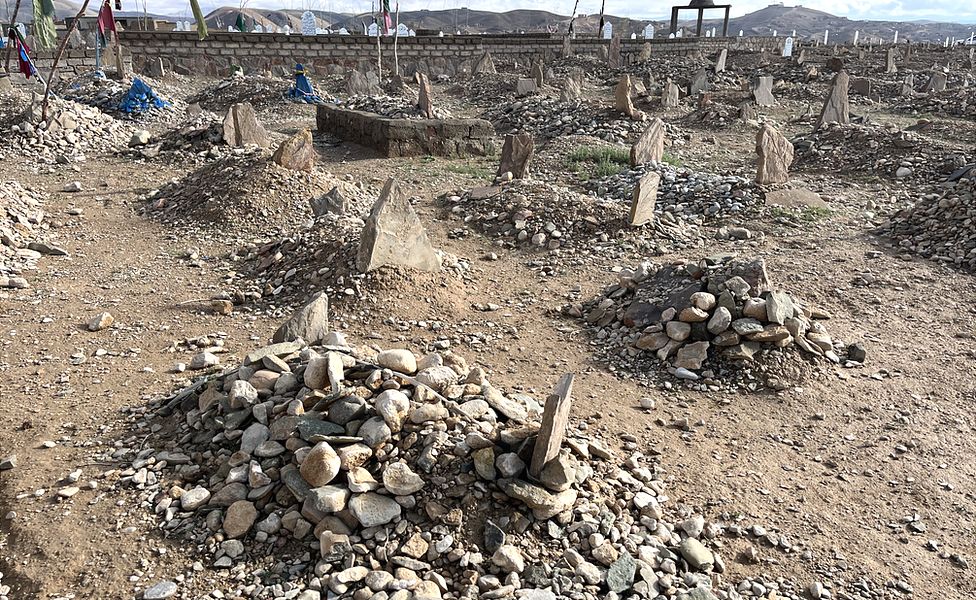
A burial ground in the hills in Afghanistan's Ghor province

We drove up one of the hills near the Ghor hospital to a burial ground. There are no records or registers here, not even a caretaker. So it’s not possible to find out who the graves belong to, but it’s easy to distinguish big graves from small ones.

From what we saw, a disproportionate number – at least half – of the new graves belong to children. A man who lives in a house close by also told us most of those they are burying these days are children.

There may be no way to count how many children are dying, but there is evidence everywhere of the scale of the crisis.

Source: BBC

…………………………………………………………

COVID Vaccine Requirement For Travelers To US Will Be Scrapped On May 11 – Prez Biden Announces

 COVID Vaccine Requirement For Travelers To US Will Be Scrapped On May 11 – Prez Biden Announces


The US government will scrap vaccine mandates for federal employees and international travellers next week.
The Biden Administration announced Monday night that these mandates will go by the wayside starting May 11, when the Covid-related public health emergency ends.


The Department of Health and Human Services (HHS) also announced that the requirements will be scrapped for remaining educators and federally funded health systems still subject to conditions.
‘We are in a different phase of our response to Covid-19 than we were when many of these requirements were put into place,’ the Biden admin said in a statement.
‘These measures are no longer necessary,’ it continued. The measures finally align the US with the rest of the world.
Very few countries, such as Angola and Indonesia still require visitors to have received a Covid vaccine to gain entry.

The White House cited the statistics showing that since January 2021, Covid deaths have dropped by 95 percent, and hospitalizations are down nearly 91 percent.
Recent studies have shown the vaccines, while able to prevent hospitalization and death, are not as effective against transmission of the virus.
A 2022 paper published in the New England Journal of Medicine found that after 25 weeks, the protection the Pfizer vaccine gave to recipients against Omicron infection fell to just nine percent.
A booster shot initially raised this protection to 67 percent before dropping to 45 percent after two weeks.
Experts have previously slammed decisions to keep Covid-era policies in place as ‘out of step’ with the rest of the world.

Very few countries — such as Angola and Indonesia — still require visitors to have received a Covid vaccine to gain entry.

The White House cited the statistics showing that since January 2021, Covid deaths have dropped by 95 percent, and hospitalizations are down nearly 91 percent. Recent studies have shown the vaccines, while able to prevent hospitalization and death, are not as effective against transmission of the virus.

A 2022 paper published in the New England Journal of Medicine found that after 25 weeks, the protection the Pfizer vaccine gave to recipients against Omicron infection fell to just nine percent.

A booster shot initially raised this protection to 67 percent before dropping to 45 percent after two weeks. Experts have previously slammed decisions to keep Covid-era policies in place as ‘out of step’ with the rest of the world. Bivalent boosters specifically target the Omicron variant, unlike the original vaccines which targeted the virus’s initial Wuhan strain.

Scientists argue that this means they provide better protection against severe disease and death from currently circulating strains.

Most countries have already dropped their vaccination requirements for visitors amid mounting evidence that they do not slow the spread of the virus.

The UK dumped its Covid vaccination requirement for visitors in March last year, now more than a year ago. France followed suit in August, while the European Union lifted all its Covid-related travel requirements for its members in December.  In line with most of the rest of the world, China does not require travelers to have a Covid vaccine.  It does, however, say they should have a negative Covid test result at least 48 hours before travel.

There are also far higher levels of immunity in the population now from vaccinations or previous infections than in the early days of the pandemic. About three in four Americans were estimated to have immunity against Covid in February last year by John Hopkins. It is likely that current levels are now even higher.

Back in January, President Biden announced the end to the Covid national emergency on May 11 – eight months after declaring the pandemic was over.

The move to end the national emergency and public health emergency declarations will formally restructure the federal coronavirus response to treat the virus as an endemic threat to public health that can be managed through agencies’ normal authorities.

It will also shift the development of vaccines and treatments away from the direct management of the federal government.

Source: dailymail.co.uk

………………………………………………………

Liberia Minister Sacked For Attending Opposition Rally

 Liberia President George Weah has sacked Cooper Kruah a few days after the telecommunications minister attended an opposition event.


Mr Kruah is said to have gone to the opposition Unity Party political rally last Friday where it named its presidential running-mate ahead of October’s general elections.
The move angered senior members of the ruling Coalition for Democratic Change (CDC) party, who demanded the minister to be dropped from government.


President Weah has nominated Worlea-Saywah Dunah, a veteran public servant, to replace him. His nomination – announced on Monday evening – is awaiting the senate’s approval.
The elections are expected to be hotly contested with the incumbent facing strong challenges from the Unity Party’s Joseph Boaka and Alexander Cummings of the Collaborating Political Parties.

Source: BBC

…………………………………………………………

India Constructs World’s Highest Railway Bridge In Kashmir

 India is now home to the world’s tallest railway bridge. Some 35 meters (over 10 feet) taller than the Eiffel Tower, the Chenab Bridge sits 359 meters (around 109 feet) above the Chenab River in India’s contentious Jammu and Kashmir region.


After decades of construction, the bridge in northern India will be open to visitors by the end of December 2023 or January 2024, the Ministry of Railways said in a March press release.

The 1,315 meter-long (4,314 feet) bridge is part of a broader project to make the Kashmir Valley accessible by the Indian Railway network. In addition to the Chenab Bridge, the Udhampur-Srinagar-Baramulla Rail Link (USBRL) project involves what will become the country’s longest transportation tunnel and Indian Railways’ first cable bridge.

For India’s Prime Minister Narendra Modi, who swept to power in 2014 on a ticket of nationalism and a promise of future greatness, investments in infrastructure like the Chenab Bridge and the broader rail link project can be seen as a powerful tool for social integration and political influence, connecting disparate regions with key cities.

“The bridge and the greater connectivity it’s meant to create will be projected by New Delhi as another big victory for the region’s development,” said Michael Kugelman, director of the South Asia Institute at the Wilson Center.

Linking Kashmir with the rest of India by train will specifically boost the region’s industrial and agricultural sectors by allowing all-weather rail connectivity between the valley and the rest of India, experts say.

Previously, the only land route connecting the Indian-controlled parts of Kashmir with the rest of the country was the winding 300-kilometer (185-mile) Srinagar-Jammu national highway, which closes during part of the winter and is also frequently the site of vehicle accidents.

“We are getting lot of problems going across the road,” Anil Kumar Mehendru, vice president of the New Kashmir Fruit Association, told CNN. “Once we will be connected by train with the rest of India, it will be a big boost to this industry, agriculture as well as fruit.”

Sushant Singh, a senior fellow at the Centre for Policy Research in India, said the bridge also has political implications, as it’s seen as “a means of integrating Kashmir into India.”

According to Singh, “the hope historically” was that the railway link, including the Chenab Bridge, would make Kashmir “feel more as a part of India.”

But Singh told CNN it “remains to be seen” whether the expanded connectivity from the bridge and rail link is seen as a positive by Kashmiris, given that “in recent years, Kashmir has been undermined by policies taken by Prime Minister Modi and his government which have really alienated the Kashmiris.”

In 2019, India revoked a constitutional provision giving the Indian-controlled part of Kashmir the autonomy to set its own laws. The southern and eastern portions of the region known previously as the Indian state of Jammu and Kashmir became two separate union territories, a move Modi claimed would promote stability, reduce corruption and boost the economy.

“New Delhi’s message, following that move, was that it would leverage its greater degree of control over Jammu and Kashmir to bring it greater development benefits,” Kugelman said. “It will use the bridge as a high-visibility, eye-catching data point to argue its strategy is working.”

Although the overall USBRL project was established in 2002 before Modi became prime minister, the Chenab Bridge is already being touted as a prime example of his efforts to expand development in the country.

India’s Minister for Railways Ashwini Vaishnaw said in the press release that “The iconic Chenab Bridge is example of such new chapters and dimensions of development materialized by the inspiring leadership of the Honorable Prime Minister.”

Since coming to power, Modi increased the budget of less than $100 million for the USBRL project by a factor of six to accelerate the bridge’s completion after years of delays, Vaishnaw told a March press conference, according to CNN affiliate News18.

India has invested millions into modernizing its infrastructure. In February, Modi inaugurated the first section of a 1,386-kilometer (861-mile) expressway linking the capital New Delhi to the financial hub of Mumbai. The 246-kilometer section (153-mile) of the expressway alone cost $1.4 billion, the government said in a press release.

Construction is also underway for the Western Dedicated Freight Corridor, which aims to decongest India’s railway network.

Source: CNN

…………………………………………………………

Sunday, 30 April 2023

Jerry Springer, US talk show host and former mayor, dies at 79

 Springer’s tabloid TV show reached millions over a 27-year run, with controversial content that often featured sexual themes and family conflict.


Jerry Springer, the onetime mayor and news anchor whose namesake TV show featured a three-ring circus of dysfunctional families willing to bare all on weekday afternoons including brawls, obscenities and blurred images of nudity, died Thursday at 79.


At its peak, “The Jerry Springer Show” was a ratings powerhouse and a US cultural pariah, synonymous with lurid drama. Known for chair-throwing and bleep-filled arguments, the daytime talk show was a favorite American guilty pleasure over its 27-year run, at one point topping Oprah Winfrey’s show.

Springer called it “escapist entertainment,” while others saw the show as contributing to a dumbing-down decline in American social values.

“Jerry’s ability to connect with people was at the heart of his success in everything he tried whether that was politics, broadcasting or just joking with people on the street who wanted a photo or a word,” said Jene Galvin, a family spokesperson and friend of Springer’s since 1970, in a statement. “He’s irreplaceable and his loss hurts immensely, but memories of his intellect, heart and humour will live on.”

Springer died peacefully at home in suburban Chicago after a brief illness, the statement said

On his Twitter profile, Springer jokingly declared himself as “Talk show host, ringmaster of civilization’s end.” He also often had told people, tongue in cheek, that his wish for them was “may you never be on my show.”

Television personality Jerry Springer arrives at the 34th annual Daytime Emmy Awards in Hollywood, California,
Television personality Jerry Springer arrives at the 34th annual Daytime Emmy Awards in Hollywood, California, June 15, 2007 

After more than 4,000 episodes, the show ended in 2018, never straying from its core salaciousness: Some of its last episodes had such titles as “Stripper Sex Turned Me Straight,” “Stop Pimpin’ My Twin Sister,” and “Hooking Up With My Therapist.”

In a “Too Hot For TV” video released as his daily show neared 7 million viewers in the late 1990s, Springer offered a defence against disgust.

“Look, television does not and must not create values, it’s merely a picture of all that’s out there — the good, the bad, the ugly,” Springer said, adding: “Believe this: The politicians and companies that seek to control what each of us may watch are a far greater danger to America and our treasured freedom than any of our guests ever were or could be.”

He also contended that the people on his show volunteered to be subjected to whatever ridicule or humiliation awaited them.

Gerald Norman Springer was born February 13, 1944, in a London underground railway station being used as a bomb shelter. His parents, Richard and Margot, were German Jews who fled to England during the Holocaust, in which other relatives were killed in Nazi gas chambers. They arrived in the United States when their son was 5 and settled in the Queens borough of New York City, where Springer got his first Yankees baseball gear on his way to becoming a lifelong fan.

He studied political science at Tulane University and got a law degree from Northwestern University. He was active in politics much of his adult life, mulling a run for governor of Ohio as recently as 2017.

He entered the arena as an aide in Robert F Kennedy’s ill-fated 1968 presidential campaign. Springer, working for a Cincinnati law firm, ran unsuccessfully for Congress in 1970 before being elected to city council in 1971.

Talk show host Jerry Springer (C) poses with three actresses from his new film "Ringmaster"
Talk show host Jerry Springer (C) poses with three actresses and fans at the film’s 1998 Hollywood premiere

In 1974 — in what The Cincinnati Enquirer reported as “an abrupt move that shook Cincinnati’s political community” — Springer resigned. He cited “very personal family considerations”, but what he didn’t mention was a vice probe involving prostitution. In a subsequent admission that could have been the basis for one of his future shows, Springer said he had paid prostitutes with personal checks.

Then 30, he had married Micki Velton the previous year. The couple had a daughter, Katie, and divorced in 1994.

Springer quickly bounced back politically, winning a council seat in 1975 and serving as mayor in 1977. He later became a local television politics reporter with popular evening commentaries. He and co-anchor Norma Rashid eventually helped build NBC affiliate WLWT-TV’s broadcast into the Cincinnati market’s top-rated news show.

Springer began his talk show in 1991 with more of a traditional format, but after he left WLWT in 1993, it got a sleazy makeover.

TV Guide ranked it No 1 on a list of “Worst Shows in the History of Television,” but it was ratings gold. It made Springer a celebrity who would go on to host a liberal radio talk show and “America’s Got Talent”, star in a movie called “Ringmaster”, and compete on “Dancing With the Stars.”

“With all the joking I do with the show, I’m fully aware and thank God every day that my life has taken this incredible turn because of this silly show,” Springer told Cincinnati Enquirer media reporter John Kiesewetter in 2011.

Well in advance of Donald Trump’s political rise from reality TV stardom, Springer mulled a Senate run in 2003 that he surmised could draw on “nontraditional voters,” people “who believe most politics are bull”.

“I connect with a whole bunch of people who probably connect more to me right now than to a traditional politician,” Springer told the AP at the time. He opposed the war on Iraq and favored expanding public healthcare, but ultimately did not run.

Springer also spoke often of the country he came to age 5 as “a beacon of light for the rest of world”.

"Dancing with the Stars" judge Carrie Ann Inaba listens as former contestant Jerry Springer is interviewed
“Dancing with the Stars” judge Carrie Ann Inaba listens as former contestant Jerry Springer is interviewed at the “Dancing with the Stars” 100th show party in Hollywood, California May 6, 2008. 

“I have no other motivation but to say I love this country,” Springer said to a Democratic gathering in 2003.

Springer hosted a nationally syndicated “Judge Jerry” show in 2019 and continued to speak out on whatever was on his mind in a podcast, but his power to shock had dimmed in the new era of reality television and combative cable TV talk shows.

“He was lapped not only by other programs but by real life,” David Bianculli, a television historian and professor at Monmouth University, said in 2018.

Despite the limits Springer’s show put on his political aspirations, he embraced its legacy. In a 2003 fund-raising infomercial ahead of a possible US Senate run the following year, Springer referenced a quote by then National Review commentator Jonah Goldberg, who warned of new people brought to the polls by Springer, including “slack-jawed yokels, hicks, weirdos, pervs and whatnots”.

In the informercial, Springer referred to the quote and talked about wanting to reach out to “regular folks … who weren’t born with a silver spoon in your mouth”.

SOURCE: THE ASSOCIATED PRESS

…………………………………………………………

When Telecommunications Collapse: What Angola's Mobile Network Crisis Teaches Us About Governance, Justice, and National Security

  The recent disruption of Angola's mobile networks has affected banking, digital payments, businesses, emergency communications, and mi...