UK Foreign Secretary James Cleverly has once again met US counterpart Antony Blinken to discuss the situation in Sudan, with both raising concerns about the assault on the European Union ambassador to Sudan and the attack on a US Embassy convoy in Sudan’s capital Khartoum.
“Indiscriminate military operations have resulted in significant civilian deaths and injuries, and are recklessly endangering the Sudanese people and diplomats,” Mr Blinken said in a statement.
He reiterated his earlier call for a 24-hour ceasefire to “allow Sudanese to safely reunite with their families and to obtain desperately needed relief supplies”.
The two envoys met and made similar ceasefire calls on Monday.
Mr Blinken is due to have another telephone meeting with Sudan’s de facto leader Gen Abdel Fattah al-Burhan and Rapid Support Forces commander Mohammed Hamdan Dagalo later on Tuesday, about the possibility of a ceasefire to allow residents access to medical care and food supplies.
A soundtrack of explosions, a skyline dominated by bitter, black smoke, a daily existence of fear and uncertainty as bullets, rockets and rumours fly.
Life in Sudan’s capital, Khartoum, and in many other parts of the country, has taken a sudden, very dramatic turn for the worse.
At the heart of it are two generals: Abdel Fattah al-Burhan, the leader of the Sudanese Armed Forces (SAF), and Mohamed Hamdan Dagalo, better known as Hemedti, the head of the paramilitary Rapid Support Forces (RSF). The two worked together, and carried out a coup together – now their battle for supremacy is tearing Sudan apart.
The relationship between the two goes back a long way. Both played key roles in the counter-insurgency against Darfuri rebels, in the civil war in Sudan’s western region that began in 2003. Gen Burhan rose to control the Sudanese army in Darfur. Hemedti was the commander of one of the many Arab militias, collectively known as the Janjaweed, which the government employed to brutally put down the largely non-Arab Darfuri rebel groups.
Majak D’Agoot was the deputy director of the National Intelligence and Security Services at the time – before becoming deputy defence minister in South Sudan when it seceded in 2011. He met Gen Burhan and Hemedti in Darfur, and said they worked well together. But he told the BBC he saw little sign that either would rise to the top of the state.
Hemedti was simply a militia leader “playing a counter-insurgency role, helping the military”, while Gen Burhan was a career soldier, though “with all the ambitions of the Sudanese officer corps, anything was possible”. The military has been running Sudan for most of its post-independence history. The government’s tactics in Darfur, once described by Sudan expert Alex de Waal as “counter-insurgency on the cheap”, used regular troops, ethnic militias and air power to fight off the rebels – with little to no regard for civilian casualties.
Darfur has been described as the first genocide of the 21st Century, with the Janjaweed accused of ethnic cleansing and using mass rape as a weapon of war. Hemedti eventually became the commander of what could be described as an offshoot of the Janjaweed, his RSF. Hemedti’s power grew massively once he began supplying troops to fight for the Saudi-led coalition in Yemen. Sudan’s then-military ruler, Omar al-Bashir, came to rely on Hemedti and the RSF as a counterweight to the regular armed forces, in the hope that it would be too difficult for any single armed group to depose him. In the end – after months of popular protests – the generals clubbed together to overthrow Bashir, in April 2019.
Later that year, they signed an agreement with the protesters to form a civilian-led government overseen by the Sovereign Council, a joint civilian-military body, with Gen Burhan at its head, and Hemedti as his deputy. It lasted two years – until October 2021 – when the military struck, taking power for themselves, with Gen Burhan again at the head of the state and Hemedti again his deputy. Siddig Tower Kafi was a civilian member of the Sovereign Council, and so regularly met the two generals.
He said he saw no sign of any disagreements until after the 2021 coup. Then “Gen Burhan started to restore the Islamists and the former regime members to their old positions”, he told the BBC. “It was becoming clear that the plan of Gen Burhan was to restore the old regime of Omar al-Bashir to power.” Mr Siddig says that this is when Hemedti began to have doubts, as he felt Bashir’s cronies had never fully trusted him. Sudanese politics has always been dominated by an elite largely drawn from the ethnic groups based around Khartoum and the River Nile.
Hemedti comes from Darfur, and the Sudanese elite often talk about him and his soldiers in pejorative terms, as “country bumpkins” unfit to rule the state. Over the last two or three years, he has tried to position himself as a national figure, and even as a representative of the marginalised peripheries – trying to forge alliances with rebel groups in Darfur and South Kordofan that he had previously been tasked with destroying.
He has also spoken regularly of a need for democracy despite his forces having brutally put down civilian protests in the past. Tensions between the army and the RSF grew as a deadline for forming a civilian government approached, focused on the thorny issue of how the RSF should be re-integrated into the regular armed forces.
Uganda’s ruling party has agreed that the anti-gay bill, passed by parliament a month ago, be sent back to the house for reconsideration.
At a meeting with President Yoweri Museveni, who is the party chairman, the MPs resolved on “proposals for improvement” to the bill, according to a statement from the caucus chairperson of the National Resistance Movement (NRM).
The bill prescribes life imprisonment for people identifying as LGBT and the death penalty for what is referred to as aggravated homosexuality, among other clauses. It is not yet clear what amendments the president would like to be made to the proposed law. When legislation is passed by parliament, the president has about a month to sign it, veto it or return it to the MPs for amendment and re-tabling.
On several occasions, President Museveni has said the topic of homosexuality needs more discussion and understanding. The bill was passed with majority support from across the ruling party and the opposition. The ruling party dominates parliament – and their position on any legislation always prevails. Critics have argued that the law promotes homophobia, is against the country’s constitution and that anyone suspected to be LGBT will be affected.
The national team’s push for equal opportunity and support ahead of the World Cup is long overdue, ex-players say.
Montreal, Canada – As the top female football players from around the world prepare to compete in the Women’s World Cup in Australia and New Zealand in three months, the sixth-ranked Canadian team has high hopes.
The squad is coming off a gold-medal victory in 2021 at the Tokyo Olympics and is now pushing for World Cup glory under the leadership of captain Christine Sinclair, international football’s all-time leading scorer for both men and women.
Yet Sinclair and her teammates’ on-field successes have taken a backseat to another fight being waged off the pitch as they demand pay equity and greater support from Canada Soccer, the body that governs football in the country.
“Now is a turning point,” Carrie Serwetnyk, a former Canadian national team player and the first woman inducted into the Canada Soccer Hall of Fame, told Al Jazeera about the team’s very public battle.
The issues that players on the Canadian women’s team have raised in recent weeks – from a lack of funding for training, staffing and other resources ahead of the World Cup to disparities in pay and opportunity compared with the men’s national team – are not new, Serwetnyk said.
But what is, Serwetnyk said, is the players’ willingness to publicly demand a solution to problems that have been going on for decades. “Having just won the Olympics and qualified for the World Cup and then their funding was cut? That was it for them,” she said.
“Finally, they put the brakes on and said, ‘No, we’re not doing this any more.’”
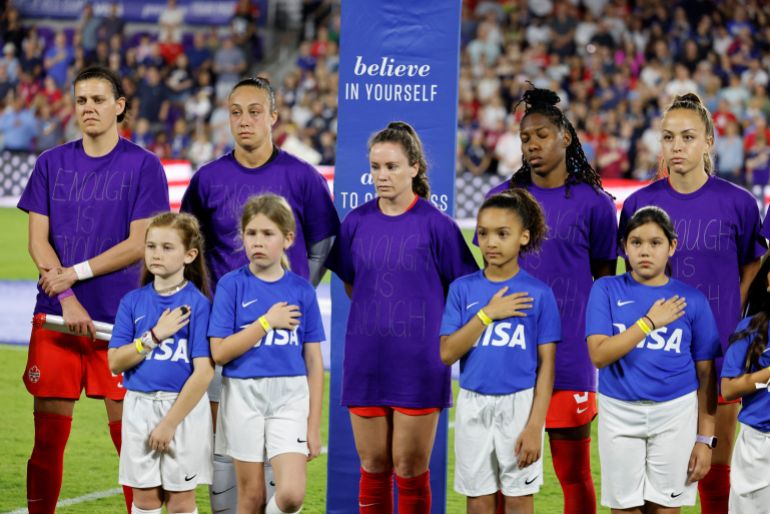
Members of Canada’s women’s football team wear purple protest shirts for equality before their match against the US at the SheBelieves Cup on February 16, 2023
The Canadian women’s national team, which has been without a collective agreement since 2021, took their longstanding frustrations with Canada Soccer public on February 10.
In a statement put out by their union, the Canadian Soccer Players Association, the athletes said they were “outraged and deeply concerned” by news of significant funding cuts and warned that their World Cup preparations were being compromised.
With the tournament set to begin in July, the team said it had been forced to cut training camp windows and the number of players and staff invited while facing “immense uncertainty about compensation”.
The players said they did not benefit from the same level of support as the men’s national team, which last year qualified for its first World Cup in 36 years, and were told “to simply make do with less”.
“We are tired – tired of constantly having to fight for fair and equal treatment, and for a program that will give us a chance to achieve what we know this team is capable of achieving for Canada,” they wrote in announcing a planned strike.
Canada Soccer responded swiftly, saying on February 11 that the team’s strike action was not legal under labour laws in the province of Ontario.
The governing body said it held a meeting with the players union and “took the necessary steps” to ensure they played in the SheBelieves Cup later that month in the United States. “Canada Soccer is heartened that the Women’s National Team Players will play as it committed,” it said.
But the players said they were being forced back onto the pitch under threat of legal action and millions of dollars in damages that could be incurred by their union and the players at camp. “The She Believes is being played in protest,” Sinclair wrote on Twitter.
That protest was expressed during the tournament with the Canadian players donning purple wristbands to renew their call for equality.
They also wore purple warm-up shirts with the words “Enough is enough” ahead of a February 16 match against the US women’s national team, which fought its own years-long battle against gender discrimination – and won equal pay provisions in 2022.
“Although we are now on the other side of this fight and can focus on our play on the field, our counterparts in Canada and elsewhere are experiencing the same pervasive misogyny and unequal treatment that we faced,” the US team said in a statement before kickoff.
The Canadian men’s national team also put its weight behind the women, demanding that Canada Soccer explain how it allocates funding because the process was “cloaked in secrecy”. “This is a once-in-a-generation, perhaps once-in-a-lifetime opportunity to grow the sport in Canada, and the current leadership of Soccer Canada is putting that opportunity at risk,” the men said.
Helen Stoumbos, a member of the Canadian national team in the 1990s and co-founder of the Canada Women’s Soccer Alumni Association, said the federation needs systemic change and that can only happen by first ensuring “accountability and transparency” at Canada Soccer.
Stoumbos said she and her teammates also dealt with problems like the ones raised today but a fear of retribution kept many from speaking out.
“I [knew that] if I spoke up back in the day, I’d be gone. We just keep our mouths shut because [we] just want to play,” she told Al Jazeera, adding that the experience takes a toll on players.
“It really detracts from your preparation,” said Stoumbos, who was the first Canadian football player – male or female – to score a World Cup goal. “You just want to focus on playing. The last thing you want to do is have to worry about anything else.”
She said that while it was disappointing to see members of the team still fighting for equal opportunity 25 years later, the recent wave of public pressure on Canada Soccer has forced the governing body to act.
“They’ve been trying to get a contract for I don’t know how many years now,” she said. “And it took this kind of media attention and [public] attention for them actually to start moving forward on something.”
In late February, Canada Soccer President Nick Bontis resigned after the leaders of Canadian football federations said they had lost confidence in his leadership. “I acknowledge that this moment requires change,” Bontis said in a statement.
Days later, the governing body said an interim deal on funding for 2022 had been reached with the women’s team, and on March 9, it also revealed some details of a new collective bargaining agreement being negotiated with both the men’s and women’s national teams.
The agreement would include equal pay, equal funding awarded for World Cup qualification and the sharing of prize money, it said. “It is time to get a deal done,” Earl Cochrane, Canada Soccer’s general secretary, said in a statement.
“We’ve been negotiating in good faith and want to get to a resolution with our National Teams,” the statement said. “In order to get there, we need both of our National Teams to agree. Our women deserve to be paid equally and they deserve the financial certainty going into the 2023 FIFA Women’s World Cup.”
But questions about alleged mismanagement and a lack of financial transparency at Canada Soccer remain unanswered – and the female players last month took their grievances to a Canadian parliamentary committee that is investigating the goings-on at the federation.
Stoumbos said the success of both the women’s and men’s teams, combined with the fact that Canada will be co-hosting the 2026 men’s World Cup, makes this an opportune time to make meaningful change – although outside pressure will be critical.
“And hopefully, they keep pushing the envelope and making sure that something actually does transpire after all is said and done,” she said.
In the meantime, Serwetnyk – who also co-founded Equal Play, a non-profit advocating for girls in football – said the team’s campaign is sending an important message, especially to young women and girls striving to achieve their goals.
“Not every girl wants to play soccer, but she may have a dream to follow some other path, and when you see other women succeeding, … it helps girls dream bigger for themselves,” she told Al Jazeera.
“What’s great about what the women’s national team has done by going on strike is they’re showing, ‘No, we’re going to fight for this.’ They are fighting for the future generations and it’s really important that they win. They have to win this battle.”
Diaspora Africa Forum (DAF), the first Diplomatic Mission dedicated to Africa’s Diaspora, has appointed Ambassador Harold Doley as Special Envoy.
Speaking to DNT, the Founder & Head of Mission for DAF, H.E Dr. Erieka Bennett expressed how lucky the mission is to have Ambassador Doley on board to bring his wealth of experience and contacts to help institutionalize the work of DAF.
“This is a big boy and a major player in the international circles, and I cannot begin to tell you how proud we are to have (Ambassador Harold Doley) on board,” Ambassador Bennet said.
Ambassador Harold E. Doley, Jr. is an investment banker and former United States ambassador. Ambassador Doley was accorded ambassadorial rank while serving as United States Representative to the African Development Bank and Fund (AfDB), from 1983 to 1985.
The AfDB, headquartered in Abidjan, Ivory Coast, is a multi-lateral development institution owned by the governments of 54 African and 25 non-African countries, with assets of $220 billion.
Ambassador Doley crafted and conveyed U.S. Government positions regarding AfDB financial proposals and policies. He is honored with awards in recognition of his hard work and dedication in his field of work.
Diaspora Africa forum is fully accredited by the Ghanaian government, with full diplomatic privileges and immunities. Our objective has always been to support the aims and objectives of the African Union while mobilizing and deploying Africa’s Diaspora.
The DAF Embassy building is not only remarkable for its aesthetics but also serves as a symbol of a welcoming home for the over Two-Hundred and Fifty Million of African Diasporans outside of the Continent.
The United States is preparing to send additional troops to nearby Djibouti in case an evacuation of Americans from Sudan is needed. Play Video
The United States is preparing to send a large number of additional troops to its military base in Djibouti in case of an eventual emergency evacuation from Sudan of American citizens.
Forces commanded by two previously allied leaders of Sudan’s ruling council began a violent power struggle last weekend that has so far killed more than 330 people, tipping a nation reliant on food aid into what the United Nations calls a humanitarian catastrophe.
“We are deploying additional capabilities nearby in the region for contingency purposes related to securing and potentially facilitating the departure of US embassy personnel from Sudan, if circumstances require it,” the Pentagon said in a statement on Thursday.
Djibouti, a tiny nation of about one million people, has become essential to US operations in Africa and the Middle East. The US secured a 10-year lease for the base in 2014 and pays $63m annually.
White House spokesperson John Kirby said President Joe Biden ordered the pre-positioning of military forces to be ready, adding he was closely following developments.
Kirby said there are no indications Americans are being targeted but it was a dangerous situation in Sudan.
The best thing that can happen is for the two sides to lay down arms, abide by a ceasefire, and let humanitarian aid get to the people in Khartoum, he added.
The State Department previously told US citizens in Sudan to remain sheltered in place indoors. Washington does not provide numbers of US citizens living in or travelling to a particular country.
The US embassy in Khartoum also issued a statement on Thursday saying because of the security situation and closure of the airport, “it is not currently safe to undertake a US government-coordinated evacuation of private US citizens”.
The fiercest battles between the army and the paramilitary Rapid Support Forces (RSF) have been around Khartoum, one of Africa’s largest urban areas, and in Darfur, still scarred by a brutal conflict that ended three years ago.
Sudan’s military ruler, General Abdel Fattah al-Burhan, heads a ruling council installed after the 2021 military coup and the 2019 removal of veteran autocrat Omar al-Bashir.
Paramilitary leader General Mohamed Hamdan Dagalo, widely known as Hemedti, who analysts say may command more than 100,000 fighters, was his deputy on the council.
The latest violence was triggered by disagreement over an internationally backed plan to form a new civilian government. Both sides accuse the other of thwarting the transition.
A group of four countries known as the Quad – the United States, the United Kingdom, the United Arab Emirates and Saudi Arabia – have pushed international efforts to find a political solution in Sudan, along with the United Nations, the African Union and the African trade bloc, Intergovernmental Authority on Development (IGAD).
Thousands of civilians have fled Khartoum and large numbers of people have also crossed into Chad to flee fighting in Darfur.
The Florida State Board of Education voted Wednesday, April 19, to prohibit classroom instruction on gender identity and sexual orientation through 12th grade.
The expansion of the Parental Rights in Education Act, known as “Don’t Say Gay” by critics, allows an exemption for sexual education or health lessons, “for which a student’s parent has the option to have his or her student not attend.”
Board members said there are misconceptions about the rule, which they say is only a clarification of Florida standards for teachers. The new rule is part of a broader rightward push on cultural issues championed by DeSantis, who is widely expected to run for president in 2024.
The board, whose members are appointed by the governor, unanimously approved prohibiting lessons on gender identity or sexual orientation in grades four through 12, unless the instruction is required by state standards or is part of a health class that parents can opt their children out of. “This really isn’t a complicated thing,” said board member Esther Byrd. But LGBTQ+ advocates say the rule is an “assault on freedom.”
“Free states do not wage war on LGBTQ+ people to score cheap political points for a man desperate to be president,” said Joe Saunders, senior political director for Equality Florida. “This policy will escalate the government censorship that is sweeping our state, exacerbate our educator exodus, drive hardworking families from Florida, and further stigmatize and isolate a population of young people who need our support now more than ever.”
The move is the latest in Gov. Ron DeSantis’ attack on what he calls “woke gender ideology.” During this year’s session, the Florida Legislature discussed bills that would prohibit children from attending drag shows, require people to use the bathroom that corresponds to their sex at birth, and would ban gender-affirming care for minors


.jpg)


.jpg)


