Translate

Thursday, 13 April 2023

Ghana becomes first country to approve Oxford’s malaria vaccine

 For years, scientists have been trying to develop vaccines for the disease which kills more than 600,000 people annually – most of them in Africa.


Ghana has become the first country in the world to approve a new malaria vaccine from Oxford University, with children under the age of three in line to benefit, although it is unclear when the rollout will begin.


The mosquito-borne disease kills more than 600,000 people each year, most of them children in Africa, and scientists have been trying for years to develop vaccines.

Childhood vaccines in Africa are typically paid for by international organisations such as Gavi and UNICEF after they have been backed by the World Health Organization (WHO), which is still assessing the vaccine’s safety and effectiveness.

However, Oxford scientist Adrian Hill said Ghana’s drug regulator has approved it for the age group at the highest risk of death from malaria – children aged five months to 36 months. It has a deal with the Serum Institute of India to produce up to 200 million doses a year.

This is the first time a major vaccine has been approved first in an African country before rich nations, Hill said.

It was unusual that a regulatory authority in Africa had reviewed the data quicker than the WHO, he added.

“Particularly since COVID, African regulators have been taking a much more proactive stance, they’ve been saying … we don’t want to be last in the queue,” Hill said.

The first malaria vaccine, Mosquirix from British drugmaker GSK, was endorsed by the WHO last year after decades of work. But a lack of funding and commercial potential thwarted the company’s capacity to produce as many doses as were needed.

But research has found that the effectiveness of GSK’s vaccine is approximately 60 percent, and significantly wanes over time, even with a booster dose.

Oxford’s R21/Matrix-M vaccine, meanwhile, was found to be 77 percent effective at preventing malaria in research published last year – the first time the WHO’s goal of 75 percent had been met.

Ghana, Kenya and Malawi were all involved in the pilot programme for the rollout of Mosquirix, and have begun distributing it more widely in recent months.

Since it began in 2019, 1.2 million children across the three countries have received at least one dose of the vaccine, and WHO said last month that in the areas where the vaccine has been given, all-cause child mortality has dropped by 10 percent, a sign of its impact.

Mid-stage data from the Oxford vaccine trial involving more than 400 children were published in a medical journal in September.

Vaccine effectiveness was 80 percent in the group that received a higher dose of the immune-boosting adjuvant component of the vaccine, and 70 percent in the lower-dose adjuvant group, at 12 months following the fourth dose.

The doses were administered before peak malaria season in Burkina Faso.

Data from a continuing phase III clinical trial in Burkina Faso, Kenya, Mali and Tanzania, which has enrolled 4,800 children, is expected to be published in a medical journal in the coming months.

However, late-stage data – which suggests a similar vaccine performance as in the phase II trial – has been shared with regulatory authorities over the last six months, Hill said.

SOURCE: NEWS AGENCIES

…………………………………………………………

Joe Biden calls on Northern Ireland’s leaders to compromise

US president urges a return to power sharing in Belfast on visit to mark 25 years of peace.


US President Joe Biden has called for political compromise in Northern Ireland during a brief visit to promote the benefits of enduring peace and investment in the region.


Biden spent just over half a day in Northern Ireland, where he met British Prime Minister Rishi Sunak, before travelling south to the Irish Republic for two and a half days of speeches and meetings with officials and distant relatives.

“It took long, hard years of work to get to this place,” Biden said in a speech at the new Ulster University campus in Belfast on Wednesday, remarking how the city had been transformed since he first travelled there as a young senator.

“Today’s Belfast is the beating heart of Northern Ireland and is poised to drive unprecedented economic opportunity,” he said. “There are scores of major American corporations wanting to come here, wanting to invest.”

Biden said power sharing remained critical to the future of Northern Ireland and an effective devolved government would “draw even greater opportunity in this region”.

“I hope the assembly and the executive will soon be restored. That’s a judgement for you to make, not me, but I hope it happens,” he told an audience that included the leaders of Northern Ireland’s five main political parties, 25 years on from a peace agreement brokered by the US government.

That deal, called the Good Friday Agreement, ended 30 years of sectarian conflict and instituted shared governance between the overwhelmingly Protestant unionists, who want Northern Ireland to remain part of the United Kingdom, and the overwhelmingly Catholic nationalists, or republicans, who want it to become part of the Republic of Ireland.

The US president visited at a time when power sharing has broken down and left Northern Ireland without its own government.

Biden said on Tuesday that the priority for his trip was “to keep the peace” in Northern Ireland. He credited people who were willing to “risk boldly for the future” for reaching the agreement, reminding the audience that “peace was not inevitable.”

But senior figures in the pro-UK Democratic Unionist Party (DUP), which is under pressure to resume local power sharing, were strikingly undiplomatic about the US president.

Sammy Wilson, a DUP member of the UK Parliament in Westminster, branded Biden “anti-British”, accusing the second Catholic US president of having “made his antipathy towards Protestants in particular very well-known”.

Another DUP lawmaker, Nigel Dodds, suggested any mediation efforts would prove futile.

“Pressure from an American administration which is so transparently pro-nationalist constitutes no pressure on us at all,” he told the Daily Telegraph newspaper.

Neil Given, a civil servant who lives in Belfast, welcomed Biden’s visit but said his “expectations are not great” that it would unblock the political deadlock.

“We have prevaricated for well over a year now, and ever since the signing of the Good Friday Agreement, there have been numerous stoppages of the institutions of Stormont,” he said.

“Whether or not Mr. Biden’s visit can in 24, 48 hours pull people together and perhaps get a message we really do need to get back to government, I don’t know, but hopefully, he can do that,” Given said. “I know there is no more powerful person certainly to be over that can give out that message.”

Devolved government in Belfast is a key plank of the 1998 Good Friday Agreement, but it collapsed 14 months ago over the DUP’s opposition to post-Brexit trade arrangements in Northern Ireland.

Despite the UK and the European Union agreeing to overhaul them this year, the party is yet to back the new trading terms and allow the restoration of Belfast’s Stormont legislature.

Nonetheless, Biden’s visit marked the “tremendous progress” made since the peace agreement was signed, the White House said.

Biden’s defenders noted that his delegation includes Joe Kennedy III, a scion of the Irish-American Kennedy clan, who was appointed special envoy for economic affairs in Northern Ireland. He will remain in Belfast for several days.

“I think the track record of the president shows that he’s not anti-British,” Amanda Sloat, National Security Council senior director for Europe, told reporters on Wednesday.

“The president has been very actively engaged throughout his career, dating back to when he was a senator, in the peace process in Northern Ireland,” she said.

Fewer than 24 hours after arriving in Northern Ireland, Biden was heading on to Ireland, which he says is “part of my soul”. He plans to pay visits to the hometowns of his 19th-century ancestors.

SOURCE: NEWS AGENCIES

……………………………………………………………

Dozens raped as migrant workers deported from Angola to DR Congo

Congolese civilians, Angolan forces responsible for abuse of women and children, doctor says, as thousands of undocumented workers expelled.


Women and children have been raped and subjected to other abuses during a mass expulsion of migrant workers from Angola to the Democratic Republic of the Congo, a doctor, officials and the United Nations say.


Angola has deported thousands of workers in recent months, according to UN figures, echoing previous purges over the past 12 years, during which abuses also occurred, according to human rights groups and the UN.

The size of the latest expulsion is not yet known, but 12,000 workers have passed through one border crossing near the DRC town of Kamako in the past six months, according to previously unreported figures from the UN’s migration agency, the International Organization for Migration (IOM).

Last month, UN staff visited the area and wrote an internal preliminary report on the situation, according to the Reuters news agency.

“Girls and women are arrested wherever they are, without the necessary needs, detained and then separated from their children and husbands, subjected to inhuman and degrading treatment, sometimes raped,” the report said.

The report, which is yet to be published, did not explicitly identify the perpetrators. A doctor working in the area blamed civilians in the DRC and Angolan security forces.

A spokesperson for Angola’s migration authority, Simão Milagres, said there had been an increase in expulsions in the past few weeks but denied that rapes and other abuses had occurred.

“That’s not true,” he said. “I can guarantee that there isn’t an institutional attitude promoting violence against migrants.”

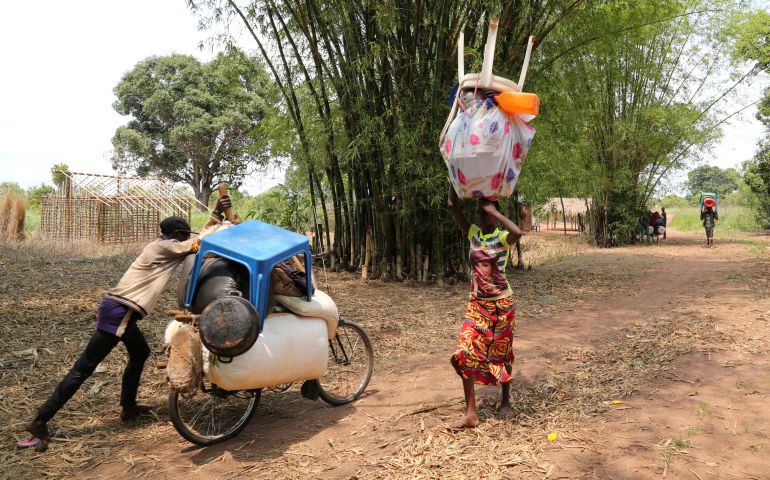
Congolese migrants expelled from Angola push a rented bicycle to transport their belongings along the dirt road to Tshikapa, Kasai province near the border with Angola, in the Democratic Republic of the Congo
Workers expelled from Angola push a rented bicycle loaded with their belongings along a dirt road to Tshikapa in the DRC near its border with Angola 

The UN report did not say how many cases of abuse there were. But Victor Mikobi, a doctor who specialises in treating victims of sexual violence at a health centre in Kamako, said local clinics had recorded 122 cases of rape this year, unprecedented levels for the town, he said.

“These are women or girls expelled from Angola, some of them under 10 years old, without any means of subsistence and very vulnerable to this type of violence,” he said. Instances of gang rape have caused medical complications, he said.

Based on accounts from patients treated at his health centre, he estimated that at least 14 rapes were committed by Angolan security forces. Dozens of others were committed by civilians in the DRC, he said.

A DRC immigration official who spoke to Reuters on the condition of anonymity said that in meetings, officials had talked about dozens of rapes on both sides of the border.

Dieudonne Pieme Tutokot, governor of the Kasai region in southern DRC, said he was aware of rapes and had opened an investigation.

Angola’s diamond-rich Lunda Norde region has long attracted thousands of migrant workers from the DRC’s isolated, poor south. Many come and work illegally, according to the UN report. Only 20 percent of the deported workers had permits.

Kamako has become an “open-air migrant camp”, the head of the IOM’s mission in the DRC, Fabien Sambussy, told journalists.

Abbé Trudon Keshilemba, president of a group of civil society organisations in Kamako, said: “The Congolese end up occupying whole villages in Angola, and the Angolans feel that they will disappear.”

Milagres said Angola carried out its crackdown on undocumented workers as it sought to promote legal migration through an online visa application process.

Mass deportations from Angola to the DRC happen every few years. The largest, in 2018, led to the expulsion of 330,000 workers. Over the course of two months in 2010, the UN estimated that more than 650 people had suffered sexual violence during expulsions from Angola.

“We are witnessing this without being able to do anything due to a lack of resources,” the DRC immigration officer said.

SOURCE: REUTERS

………………………………………………………

US appeals court preserves limited access to abortion pill

Decision puts on hold part of order by US District Judge Kacsmaryk that suspended FDA approval for abortion pill mifepristone.


The abortion pill mifepristone will remain available in the United States for now but with significant restrictions, including a requirement for in-person doctor visits to obtain the drug, a federal appeals court ruled late on Wednesday.


The New Orleans-based Fifth US Circuit Court of Appeals put on hold part of last Friday’s order by US District Judge Matthew Kacsmaryk in Amarillo, Texas, that had suspended the US Food and Drug Administration (FDA) approval for the drug while he hears a lawsuit by anti-abortion groups seeking to ban it.

The Biden administration and the maker of brand-name mifepristone, Danco Laboratories, had quickly asked for an emergency stay of that order.

However, the appeals court declined to block portions of Kaczmarek’s order that effectively reinstate restrictions on the pill’s distribution that had been lifted since 2016. In addition to a requirement of in-person doctor visits to prescribe and dispense the drug, those restrictions include limiting its use to the first seven weeks of pregnancy, down from the current 10.

Kaczmarek’s order is set to take effect on Friday.

Wednesday’s ruling came from a panel of three Fifth Circuit judges, two appointed by then-President Donald Trump and one by George W Bush, both Republicans. Judge Catharina Haynes, the Bush appointee, partly dissented, saying she would have temporarily blocked Kaczmarek’s order entirely.

The emergency stay is meant to remain in place until the Fifth Circuit can hear the Biden administration’s appeal of Kaczmarek’s order more fully. That appeal may be heard by a different panel.

The administration, the anti-abortion groups or both could also seek to appeal immediately to the US Supreme Court.

The FDA and lawyers for the groups could not immediately be reached for comment.

Kaczmarek’s ruling apparently conflicts with a different federal judge’s decision, also issued last Friday, ordering the FDA to maintain access to mifepristone with no new restrictions in 17 states and the District of Columbia. The Biden administration has asked the judge in that case to clarify his order in light of Kaczmarek’s.

The lawsuit before Kacsmaryk was filed against the FDA in November by four anti-abortion medical associations led by the recently formed Alliance for Hippocratic Medicine and four anti-abortion doctors. They contend the agency used an improper process when it approved mifepristone in 2000 and did not adequately consider the drug’s safety when used by girls aged under 18 to terminate a pregnancy.

Both judges’ rulings last week were preliminary injunctions meant to remain in effect while the lawsuits are pending, and are not final.

However, Kacsmaryk said he thought the anti-abortion groups were likely to succeed on the merits, writing that the FDA “acquiesced on its legitimate safety concerns – in violation of its statutory duty – based on plainly unsound reasoning and studies that did not support its conclusions” when it approved mifepristone.

The Fifth Circuit majority on Wednesday said that the groups’ challenge to the original 2000 approval had been filed too late. However, it said the challenges to the FDA’s later actions, including the changes in 2016 and its recent decision to allow mifepristone to be prescribed by telemedicine and dispensed by mail, were timely.

It said that the government’s arguments for an emergency stay of the ruling focused on the potential harm of pulling mifepristone from the market entirely but that it was “difficult to argue” that the 2016 changes “were so critical to the public given that the nation operated – and mifepristone was administered to millions of women – without them for sixteen years”.

The court agreed with Kacsmaryk that doctors and groups had standing to bring the lawsuit.

“As a result of FDA’s failure to regulate this potent drug, these doctors have had to devote significant time and resources to caring for women experiencing mifepristone’s harmful effects,” the panel majority wrote.

Hundreds of biotech and pharmaceutical company executives on Monday signed an open letter calling for the reversal of Kaczmarek’s ruling, saying it undermines the FDA’s authority and ignores decades of scientific evidence on the drug’s safety.

The other ruling, ensuring access to mifepristone, was issued by US District Judge Thomas Rice in Spokane, Washington. It arises from a lawsuit brought by a group of Democratic-led states challenging federal safety restrictions for mifepristone.

Dozens of legal briefs have been filed in the two cases, with mainstream medical associations like the American Medical Association and American College of Obstetricians and Gynecologists, abortion rights groups and Democratic politicians supporting the drug’s approval, and anti-abortion groups and Republican politicians opposing it.

Mifepristone is part of a two-drug regimen, administered in combination with misoprostol, for medication abortions in the first 10 weeks of pregnancy. The drugs account for more than half of all abortions in the country.

Some abortion providers have said that if mifepristone is unavailable, they would switch to a misoprostol-only regimen for a medication abortion, which is not as effective. It is not yet clear how widely available it would be.

Some Democratic-led states have begun stockpiling the drugs since Kaczmarek’s ruling.

Abortion has emerged as a potent political issue in the US since the Supreme Court overturned its landmark 1973 Roe v Wade ruling recognising a constitutional right to abortion, leaving the issue for states to decide.

Polls show that support for abortion rights helped Democrats outperform in November’s midterm elections, an anti-abortion amendment to the Kansas state constitution failed in August and Wisconsin voters last week flipped the state’s supreme court to a liberal majority after a campaign that featured abortion.

SOURCE: REUTERS

……………………………………………………

Child inclusion requires improvement of social conditions

 Luanda - The secretary of State for Social Action, Lúcio Amaral, said Wednesday in Luanda that the process of children inclusion involves improving the social conditions of families.


Speaking at a meeting on "The Inclusion of Children with Disability: Current Situation and Perspective", the official said the government has created policies in the areas of education, with the expansion of inclusive schools, social protection and assistance with various technical means to support associations in favour of these children.

"A transversal, multi-sectoral and multidisciplinary work is necessary to respond to the aspirations and longings of families and carers", Amaral said.

Lúcio Amaral highlighted the importance of a change in mentality, as a way to eliminate inequalities that hinder the inclusion of children with disabilities in the social sphere.

For the president of the Angolan Federation of the Associations of People with Disability (FAPED), Venceslau Muginga, the situation of the child with disability in Angola lacks the practical execution of the projects outlined, since many drop out of school due to financial difficulties.

Muginga  said that many children with disabilities do not have the social assistance they should have, specifically those with intellectual, sensory and physical disabilities.

Regarding intellectual disability, Venceslau Muginga said that there's still little development in the teaching and learning process, with a lack of specialists in teaching children with autism.  

"Children with disabilities are excluded in the process of first training, such as nursery schools, where they rarely accept children with disabilities, especially those with autism, visual and hearing problems," Muginga said. 

As for cultural and sports activities, the FAPED president said disabled children have been very far from enjoying these rights.  

Muginga appealed that the General State Budget (OGE) should look after the children with disabilities, with the creation of projects that guarantee real inclusion at the level of education, day-care centres and scholarships.  

According to data from the 2014 General Census of Population and Housing, Angola has 656, 258 people with disabilities, which represents 2.5 percent of the population, of this number 164, 112 are children aged between 0 to 14.

University students called to continue investing in entrepreneurship

 Luanda - The minister of Higher Education, Science, Technology and Innovation, Maria Bragança, said Wednesday in Praia City, Republic of Cabo Verde, that the stimulation of young people´s entrepreneurship has promoted self-employment in Angola.


To the minister, this is so mainly at Universities that welcome and support the materialization of innovative ideas, in internal teaching and learning environment, especially for students and teachers.

“But it also ensures the university and society connection, including the linking with companies, with positive reflections on the articulation between theory and practice in the training process”, she assured.

From 12th to 13th March, Maria Bragança is attending the 2nd edition of the Francophone University Agency (AUF) Pan African Interregional Conference: Scientific and Plurilingual Africa, that is taking place in Praia City, Cabo Verde.

According to a press release, the main objective of the Francophone University Agency conference is the “Employability and Entrepreneurship of Students”.

The document adds that the event will have the rector of the Francophone University Agency, Slim Khalbous, Cabo Verde´s Secretary of State for Higher Education, Eurídice Monteiro, and ministerial and university delegations from eight countries, as the main guests.

Angola, Cabo Verde, Gambia, Guinea, Guinea-Bissau, Mozambique, Senegal and São Tomé and Príncipe, are participating in the conference.

The topic of this 2nd Conference will be focus on the major reforms undertaken by the stakeholders in this field, including the adoption of the National Student Entrepreneur Statute (NSES) in Senegal and Guinea, and the planned inauguration of Francophone Employability Centers (CEF) in Banjul (Gambia) and Praia (Cabo Verde).

The conference intends to share experiences and identify partnership opportunities between the countries and the African continent Higher Education Institutions for the promotion of the employability and entrepreneurship of students.

Angolan president, DRC counterpart address situation in eastern region

 Luanda – Angolan head of State João Lourenço Wednesday in Luanda discussed with his counterpart from the Democratic Republic of Congo (DRC) Félix Antoine Tshisekedi the security and peace process in the Eastern region of this country, which faces an internal armed conflict.


Félix Tshisekedi, who had been in Luanda for a few hours,  discussed with President João Lourenço, among the matters, the cantonment of the M23 forces, according to the understandings reached as part of the mediation exercised by the Angolan Head of State.

The Angolan mediation of the conflict in the East of the Democratic Republic of Congo (DRC) resulted in a ceasefire agreement in that region, since March 7 this year.

The Angolan National Assembly approved last month, at the request of the President of the Republic, unanimously, the deployment  of a contingent of 500 soldiers from the Angolan Armed Forces (FAA) to the DRC for a 12-month period.

The staff integrates a battalion of the FAA and their respective components, as well as financial means estimated at 11.2 billion kwanzas,  within the framework of the budget of Defence and Security sector.

A contingent of the Angolan army should secure the cantonment areas of the M23 rebels and protect the members of the ad hoc verification mechanism,  following the ceasefire between government troops and the rebels.

At a mini-summit on peace and security in the Great Lakes region, held in Addis Ababa, Ethiopia, on February 17, 2023, the African Heads of State and Government mandated" Angola, in coordination with the former President of Kenya, Uhuru Kennyatta, a facilitator appointed by the East Africa Commission, to hold contacts with the leadership of the March 23 Movement (M23) rebel group.

The M23 was created in 2012 when DRC soldiers revolted over the loss of power of their leader, Bosco Ntaganda, accused by the International Criminal Court (ICC) of war crimes and for alleged breaches of the peace agreement of March 23, 2009, which gives the name to the movement. AFL/SC/ADR

The 2026 AFRICA EDUCATES HER CAMPAIGN REPORT - ANGOLA 6th Anniversary | 2020–2026

  Meet who's behind this cause     Support us:  https://donate-sofonie.netlify.app/           AFRICA EDUCATES HER CAMPAIGN REPORT — ANGO...