Translate

Monday, 10 April 2023

Sex Is A ‘Beautiful Thing’, Pope Says In Documentary

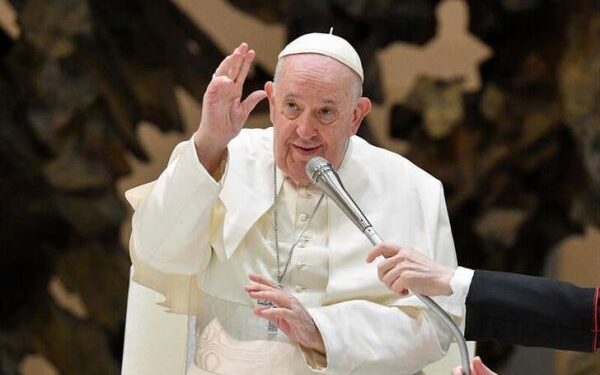
 Pope Francis has praised the virtues of sex in a documentary released on Wednesday, describing it as “one of the beautiful things that God has given to the human person.”


The 86-year-old pontiff made the comment in the Disney+ production “The Pope Answers”, which captures a meeting he had last year in Rome with 10 people in their early 20s.


Francis was quizzed by them on a variety of topics, including LGBT rights, abortion, the porn industry, sex, and faith and sex abuse within the Catholic Church.

“Sex is one of the beautiful things that God has given to the human person,” he said in the documentary.
“To express yourself sexually is a richness. So anything that detracts from real sexual expression lessens you and depletes this richness,” he said, referring to masturbation.

Francis was also asked whether he knew what a “non-binary person” is, and he replied affirmatively. He repeated that LGBT people must be welcomed by the Catholic Church.
“All persons are the children of God, all persons. God does not reject anybody, God is a father. And I have no right to expel anyone from the Church,” he said.

On abortion, Francis said priests should be “merciful” towards women who have terminated a pregnancy, but said the practice remains unacceptable.
“It good to call things by their name. It is one thing to accompany the person who had one (abortion), quite another to justify the act,” he said.

The pope’s remarks were published by L’Osservatore Romano, the official Vatican newspaper, which described his conversation with the young people as an “open and sincere dialogue”.

Source: Reuters

………………………………………………………

President Yoweri Museveni Calls On Africa To ‘Save The World From Homosexuality’

 The president of Uganda has called on Africa to ‘save the world from homosexuality’ just days after a controversial bill to jail all gay people was passed through the Ugandan parliament.


President Yoweri Museveni will sign the bill, which imposes the death penalty for ‘aggravated homosexuality’, into Ugandan law. Ugandans will be banned from ‘promoting and abetting’ homosexuality as well as from conspiring to engage in same-sex relationships under the law, which human rights groups have condemned as ‘appalling’.


Speaking on Sunday April 2, Museveni said that homosexuality was ‘a big threat and danger to the procreation of human race’.
‘Africa should provide the lead to save the world from this degeneration and decadence, which is really very dangerous for humanity,’ the president said. ‘If people of opposite sex stop appreciating one another then how will the human race be propagated?’

The anti-homosexuality bill was passed late on March 21 inside a packed parliamentary chamber in the capital Kampala.
Amnesty International subsequently have urged Museveni to veto the anti-gay bill, warning it was ‘a grave assault’ on LGBTQ people.

Source: peacefmonline

…………………………………………………………

US job growth strong in March, unemployment falls to 3.5 percent

The strong job numbers could lead the Fed to continue to raise interest rates.


The US economy continued to churn out jobs at a brisk pace in March, pushing the unemployment rate down to 3.5 percent, signs of persistent labour market tightness that could see the Federal Reserve hiking interest rates again next month.

Nonfarm payrolls increased by 236,000 jobs last month, the Department of Labor said in its closely watched employment report on Friday. Data for February was revised higher to show 326,000 jobs were added instead of 311,000 as previously reported.

Some of the slowdown in hiring reflected the fading boost from the unseasonably mild weather in January and February.

Economists polled by Reuters had forecast payrolls rising 239,000. Estimates ranged from 150,000 to 342,000. The economy needs to create roughly 100,000 jobs per month to keep up with growth in the working-age population.

As with most recent economic data, it was too early for financial market stress, triggered by the failure of two regional banks in March, to show up in the employment report.

The unemployment rate fell to 3.5 percent from 3.6 percent in February. Average hourly earnings rose 0.3 percent in March after gaining 0.2 percent in February. That lowered the annual increase in wages to 4.2 percent from 4.6 percent in February, which was still too high to be consistent with the Fed’s 2 percent inflation target. Fed officials will now await inflation data later this month to gauge the effectiveness of their year-long monetary policy tightening campaign.

Financial markets were leaning towards the US central bank increasing rates by another 25 basis points at the May 2-3 policy meeting, according to CME Group’s FedWatch tool.

The Fed last month raised its benchmark overnight interest rate by a quarter of a percentage point, but indicated it was on the verge of pausing further rate hikes in a nod to financial market stress. It has hiked its policy rate by 475 basis points since last March from the near-zero level to the current 4.75 percent-5.00 percent range.

But the labour market is losing its shine. The Department of Labor’s annual revisions to the weekly claims and continuing claims data published on Thursday showed significant upgrades to both series.

Surveys from the Institute for Supply Management this week offered a downbeat assessment of the labour market. Job openings fell below 10 million at the end of February for the first time in nearly two years, though there were 1.7 job openings for every unemployed person that month, government data showed.

The labour market is expected to considerably loosen up starting in the second quarter as companies respond more to slowing demand caused by the higher borrowing costs.

Credit conditions have also tightened, which could make it harder for small businesses and households to access funding. Small businesses, like restaurants and bars, have been the main drivers of job growth since the recovery from the pandemic.

Some economists have predicted that payrolls will turn negative in the second half of the year, a development which they said would compel the Fed to start cutting rates to avoid plunging the economy into a deep recession. Fed Chair Jerome Powell has pushed against this assumption.

Economists who have forecast a rate cut this year argued that parts of the economy, like housing, are already in recession, while tighter lending standards adopted by banks mean credit is going to be more restricted in the economy.

They also noted that business sentiment was at recessionary levels, while consumer confidence remained lacklustre. (Reporting by Lucia Mutikani; Editing by Paul Simao and Chizu Nomiyama)

SOURCE: REUTERS

…………………………………………………………

Israel strikes Lebanon and Gaza after major rocket attack

 The Israeli military has carried out air strikes on targets belonging to the Palestinian militant group Hamas in southern Lebanon and the Gaza Strip.


The military said the attacks were a response to a barrage of 34 rockets fired from Lebanon into northern Israel on Thursday, which it blamed on Hamas.Militants in Gaza fired dozens more rockets after the strikes began.Tensions are high following two nights of Israeli police raids at the al-Aqsa mosque in Jerusalem earlier this week.

The raids triggered violent confrontations with Palestinians inside the mosque, which is Islam’s third holiest site, and caused anger across the region.Hamas did not say that it fired the rockets from Lebanon, which was the biggest such barrage in 17 years.

But its leader Ismail Haniyeh, who was visiting Beirut at the time, said Palestinians would not “sit with their arms crossed” in the face of Israeli aggression.

Hours after the Israeli strikes, two Israeli sisters were killed and their mother was seriously injured in a shooting attack near a settlement in the occupied West Bank, Israeli officials said.

Overnight, there were two or three explosions around the Rashidieh Palestinian refugee camp, 5km (3 miles) south of the Lebanese coastal city of Tyre.

Lebanese media also reported strikes on the outskirts of the village of al-Qulaila, another 4km further south. Photographs appeared to show that a small bridge was destroyed.

The Israel Defense Forces (IDF) tweeted that its warplanes struck “terrorist infrastructures belonging to Hamas” in Lebanon.

“The IDF will not allow the Hamas terrorist organization to operate from within Lebanon and hold the state of Lebanon responsible for every directed fire emanating from its territory,” it warned.Hamas said it strongly condemned “the blatant Zionist aggression against Lebanon in the vicinity of Tyre at dawn today [Friday]”.

In Gaza, more than 10 Hamas targets were hit, including a shaft for an underground site to construct weapons, three other weapons workshops and an underground “terrorist tunnel”, the IDF said.During the strikes, at least 44 rockets were fired from Gaza towards southern Israel, Israeli media reported.

Most were intercepted by Israel’s Iron Dome defence system or fell in open areas, but at least one house in the city of Sderot was hit.There were no immediate reports of any casualties from either the strikes or the overnight rocket fire.

A man was injured by shrapnel in northern Israel on Thursday afternoon as a result of the rocket fire from Lebanon, which the Lebanese army said originated from the outskirts of al-Qulaila and two other border villages near Tyre – Maaliya and Zibqine.The Israeli military said 25 of the 34 rockets were intercepted, but that five hit Israeli territory.In the north-western border town of Shlomi, the rockets left craters in the road, and damaged vehicles and a bank. A car was also damaged in the village of Fassuta.The attack came hours after the Lebanese militant group Hezbollah, which controls much of southern Lebanon, said it would support “all measures” taken by Palestinian groups against Israel.

Prime Minister Benjamin Netanyahu promised on Thursday night that Israel’s response would “exact a significant price from our enemies”.

An Israeli military spokesman told reporters following the overnight strikes in Lebanon and Gaza that the operation was over for the moment.”Nobody wants an escalation right now,” Lt Col Richard Hecht said. “Quiet will be answered with quiet, at this stage I think, at least in the coming hours.”

The memory of Israel’s 2006 war with Hezbollah is fresh in minds on both sides of the border.

Back then, a cross-border operation by Hezbollah infiltrators to capture Israeli soldiers spiralled into a month-long ground war inside Lebanon between the militant group and Israeli forces.

Analysts say both sides were left bruised by that conflict, and neither is seen as wanting another war now.

For Israel, there is the added risk of pulling in Hezbollah’s Iranian backers.

Israel’s response this time is seen as wanting to avoid re-igniting that conflict – targeting sites linked to Hamas, rather than punishing Hezbollah for hosting them in southern Lebanon.

But the path to conflict is often paved with mistake and miscalculation; if rocket fire killed civilians inside Israel, the response would almost certainly be different.

Meanwhile, the tit-for-tat exchanges with Palestinian militants in Gaza continue.

The next couple of weeks are especially risky, as the Jewish Passover holiday and the Muslim holy month of Ramadan overlap, adding sensitivity to any incidents around the holy sites in Jerusalem.

Source: BBC

…………………………………………………………

UAE court dismisses S Africa request to extradite Gupta brothers

The Guptas, arrested in the UAE in 2022, are accused of siphoning state funds using connections with ex-President Zuma.


A United Arab Emirates court has dismissed South Africa’s request to extradite Atul and Rajesh Gupta, brothers who face charges of political corruption, Justice Minister Ronald Lamola said on Friday.

The Indian brothers, arrested in the UAE in June 2022, are accused of using their connections with Jacob Zuma, president of South Africa from 2009 to 2018, to win contracts, influence cabinet appointments and siphon off state funds. Zuma and the Guptas have denied all wrongdoing.

South Africa received diplomatic communication from the UAE on April 6 that a court there had made the decision on February 13, Lamola said.

“In the evening of the 6th of April 2023, we were provided with a note verbale from the UAE in which we learnt with shock and dismay that an extradition hearing had been concluded in the UAE courts on the 13th of February 2023 and our extradition request was unsuccessful,” Lamola told reporters.

The court had ruled that the UAE had jurisdiction to prosecute the Guptas for money laundering offences allegedly committed in the UAE and South Africa, Lamola said.

He added that South Africa would “promptly appeal” the decision.

Cathleen Powell, associate professor of public law at Cape Town University, told Al Jazeera that there is frustration in the country about how slow the extradition process and “recovering what has been lost” has been, because of the daily impact of corruption in South Africa.

“There will be a lot of anger that the UAE has refused to extradite the Guptas and a lot of that anger will be directed at South Africa [authorities] rather than the UAE,” she said on Friday.

An inquiry was established in 2018 to examine allegations of corruption during Zuma’s nine years in power from 2009, which was riddled with scandals, overshadowing his presidency.

In July 2021, Interpol issued a red notice, a global alert enabling law enforcement to arrest a person sought for prosecution or to serve a custodial sentence, and arrest them pending extradition, for the Guptas.

Interpol said they were being sought in connection with a 25 million rand ($1.6m) contract paid to a Gupta-linked company, Nulane Investment, to conduct an agricultural feasibility study.

SOURCE: AL JAZEERA AND NEWS AGENCIES

……………………………………………………………

Wednesday, 5 April 2023

I’m happy to retire and become a journalist – Kagame

 President Paul Kagame of Rwanda has said he is looking forward to retiring and handing over power after 23 years in office.


Speaking at a joint press briefing with his Kenyan counterpart, William Ruto in the Rwandan capital, Kigali, Mr Kagame said a succession plan was being actively discussed by the ruling party, terming his retirement an “inevitability”.

Mr Kagame said he was not necessarily interested in choosing his successor but rather creating an environment that would give rise to people who can lead.

“We have been having this discussion within our [ruling] party since 2010 but circumstances, challenges and history of Rwanda tend to dictate certain things,” he said.

He said his retirement is an issue that has to be discussed “sooner or later”.

“I’m sure one day I may join journalism in my old age. I’m looking forward to that,” Mr Kagame said.

His comments come days after the country’s ruling party, the Rwandan Patriotic Front (RPF-Inkotanyi), elected its first woman vice-chairperson.

President Kagame retained the chairmanship position. He has led the party since 1998.

This was not the first time Mr Kagame has talked about retirement. In December 2022, he said he had no problem becoming an ordinary senior citizen.

Mr Kagame has been president of the East African nation since 2000. A controversial referendum in 2015 removed a two-term constitutional limit for presidents.

The president last year told a French TV channel he would stand for president again at the next election in 2024.

Source: BBC

……………………………………………………

France’s Macron visits China seeking breakthrough in Ukraine war

French president is expected to push Chinese counterpart Xi not to side with Russia while shoring up economic ties.


Taipei, Taiwan –French President Emmanuel Macron and European Commission President Ursula von der Leyen are set to arrive in China on Wednesday for a three-day state visit that will see them meet with Chinese President Xi Jinping.


Macron will be accompanied by a delegation of more than 50 CEOs and meet with the French business community, but all eyes will be on how he and von der Leyen discuss the war in Ukraine with the Chinese leadership.

“The primary issue that Macron and von der Leyen will probably want to push on is to help get some support from China in dealing with Russia and to help advance on that front,” Zsuzsa Anna Ferenczy, an associate research fellow at Sweden’s Institute for Security and Development Policy, told Al Jazeera.

“Realistically, I don’t think we can expect much, but I think clearly everyone agrees that that’s the priority.”

China is officially neutral on the war but has propped up Russia economically and diplomatically in the face of Western sanctions. Xi also has the ear of Russian President Vladimir Putin, with whom he shares a close friendship spanning more than a decade. In March, the duo signed a Sino-Russian strategic partnership during Xi’s state visit to Moscow.

At the G20 summit in November, Macron called for China to play a “greater mediation role” in the war but Beijing has yet to advance its role beyond issuing a 12-point peace plan that has received a lukewarm response in Kyiv and Western capitals.

Macron’s trip is his first to China since the COVID-19 pandemic erupted in early 2020, when Beijing effectively shut its borders to travel. The French leader last visited the country in 2019.

His trip follows one made by German Chancellor Olaf Scholz in November but it has already taken a different tone.

Scholz’s trip was widely criticised in Europe as too conciliatory towards Beijing, with the German leader’s efforts to shore up the country’s business interests taking precedence over pushing China to join the negotiating table over Ukraine.

This time, however, Xi can expect pushback.

Macron and United States President Joe Biden agreed in a telephone call ahead of the French leader’s trip to engage China to hasten the end of the war in Ukraine, the Elysee Palace said on Wednesday.

“The two leaders have mentioned their joint willingness to engage China to accelerate the end of the war in Ukraine and take part in building sustainable peace in the region,” Macron’s office said in a statement.

During a speech in Brussels last week, von der Leyen publicly criticised Beijing’s “no limits” ties with Moscow in the face of an “atrocious and illegal invasion of Ukraine”.

“Any peace plan which would in effect consolidate Russian annexations is simply not a viable plan. We have to be frank on this point,” von der Leyen said, while also taking aim at China’s increasingly assertive posture on the South China Sea, the Chinese-Indian border and Taiwan.

“How China continues to interact with Putin’s war will be a determining factor for EU-China relations going forward,” she said.

Beijing said it was “disappointed” by her speech, according to its European Union ambassador Fu Cong.

Against such a tense backdrop, Macron is expected to ask China to not supply Russia with weapons. Beijing is not known to have supplied weaponry to Russia despite requests from Moscow, although US officials have warned of the possibility.

Macron’s trip is not likely to produce a watershed moment but his diplomacy could produce wins down the road for European security, said Matthieu Duchâtel, the director of international studies at France’s Institut Montaigne.

“It’s really about moving it a little bit in a positive direction and not bearing the unrealistic expectation that China can mediate,” Duchâtel told Al Jazeera, describing the European view of China as being a “swing state” in the Ukraine war.

If China were to supply Russia with weapons, it could tip the scales in Moscow’s favour as the war drags on, Duchâtel said, while the opposite would be true if Beijing were to lean towards Ukraine.

Macron will need to play a careful game, said Antoine Bondaz, a researcher at the French think tank, La Fondation pour la Recherche Stratégique. A poorly worded statement could unintentionally signal support for Beijing’s position and score a win for the Chinese Communist Party, he said, instead of impressing on China the dangers the war poses to European security.

One point of cooperation, however, could be the issue of nuclear weapons, Bondaz added.

France, like China, is a nuclear power but the country does not take part in NATO nuclear exercises. Both also oppose the sharing of nuclear technology, said Bondaz, which means France is in a “legitimate” position to “ask China for an official reaction to Russia’s announcement of its intention to deploy nuclear weapons in Belarus, and to try to prevent such a deployment.”

Whether Macron can achieve these goals will depend on whether China fears further sanctions from the EU and the risk of deepening “transatlantic coordination” between Europe and the US on issues like Ukraine, he added.

Some analysts believe Xi could try to drive a wedge between the US and Europe, the latter of which has traditionally adopted a less hawkish approach to bilateral relations.

Despite being a founding member of NATO, France is not part of US-led security blocks like AUKUS – made up of Australia, the United Kingdom and the US – and the QUAD – featuring Australia, India, Japan and the US – both of which are widely seen as aimed at countering China.

Still, EU-China relations have deteriorated sharply in recent years.

Apart from disputes over China’s claims in the South China Sea and crackdowns in Xinjiang, Tibet and Hong Kong, Beijing’s attempts to punish EU member states like Lithuania for engaging with Taiwan and tit-for-tat sanctions on European parliamentarians have not gone over well. In 2021, the 27-country bloc put a significant trade and investment deal with China on ice amid growing tensions between the sides.

Macron and von der Leyen’s trip could be a first step towards improving those ties, said Ferenczy, the associate research fellow at the Institute for Security and Development Policy.

“Bilateral ties have been deteriorating, and I think there’s also an effort from Beijing to rebuild relations,” Ferenczy said, adding that EU leaders understand they have “actual leverage over China and that we need to speak more from that position”.

“China wants to continue cooperation and business, trade relations with the EU.”
SOURCE: AL JAZEERA

………………………………………………………

When Telecommunications Collapse: What Angola's Mobile Network Crisis Teaches Us About Governance, Justice, and National Security

  The recent disruption of Angola's mobile networks has affected banking, digital payments, businesses, emergency communications, and mi...