Translate

Wednesday, 8 February 2023

Rage, fear in India’s Azamgarh over land acquisition for airport

 Months-old protest becomes a ‘fight for survival’ as mainly marginalised residents of eight villages resist government’s move.


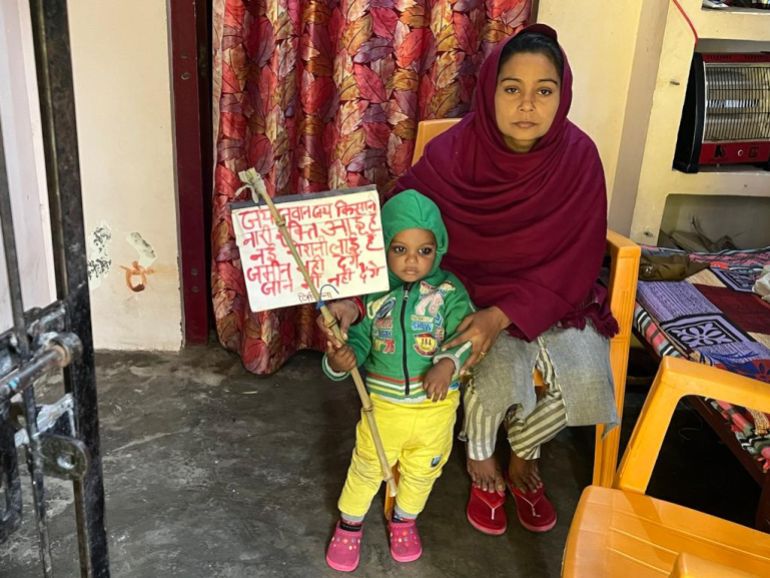
Azamgarh, India – Cradling her toddler in one arm, Arti Sharma adjusts her saree with another as she picks up the placard that says: “Zameen nahi denge, jaan bhi nahi denge [We will neither give our land nor our lives].”

It is a placard her husband Deepak Sharma had made, days before he succumbed to a heart attack at 31.

Oblivious to the reality, the toddler tries to wipe his mother’s tears as she marches to Khiria Bagh in Uttar Pradesh state’s Azamgarh district, where a protest against the acquisition of land for expansion of an airport has been going on for months.

Arti clutches the placard close to her chest. “It keeps our struggle warm with his memories,” she tells Al Jazeera.
India Azamgarh

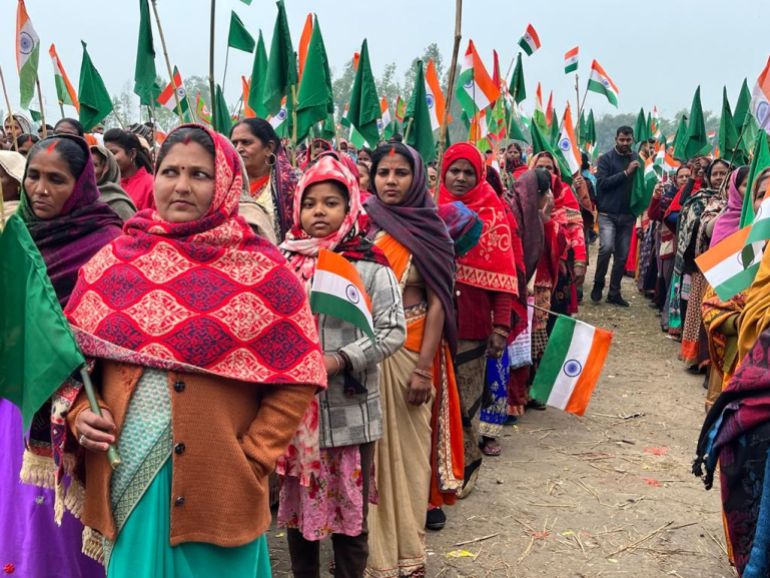
Tens of thousands of people residing in eight villages of Azamgarh call their protest a “fight for survival” and it looks like one. On January 26, as India celebrated its 74th Republic Day which marks the adoption of its constitution in 1950, hundreds of villagers were protesting at Khiria Bagh park.

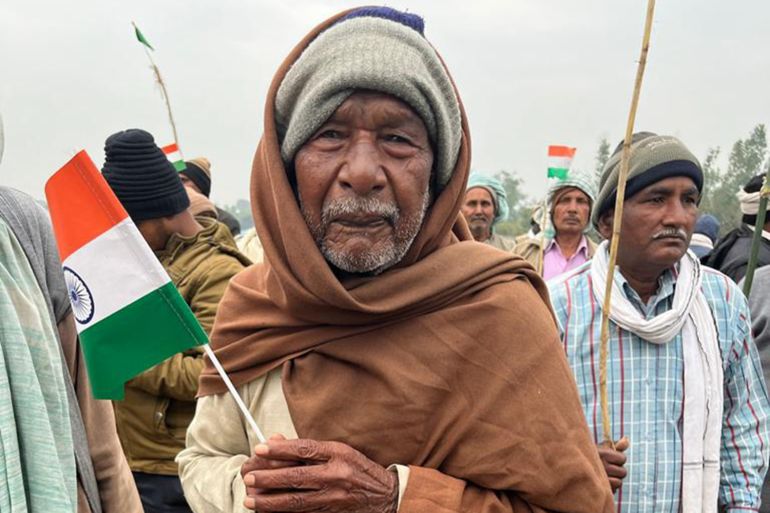
A 90-year-old man, his frail legs shivering with cold, held a small tricolour – the national flag – in his hand as he declared, “We will fight till our last breath. We won’t move until they bring the bulldozer and run it over us.”

There was an air of desperation at the park. A man in his 30s dragged his wheelchair with a tricolour tied to its handle. A woman held a placard as she ran barefoot on the damp mud. A handful of coins clunk to the walls of the rusty tin box meant to collect donations for the protest – meagre savings from meals skipped to feed the movement.

Children had skipped school, women left their chores half-done, daily wage workers who had not earned for months, farmers forced to postpone weeding of their crops – all stood under the sea of tricolours waving over their heads, protesting against the land acquisition for the proposed international airport at Azamgarh.
India Azamgarh

In 2004, an airstrip was built in this eastern district of Uttar Pradesh. It was not used until November 2018 when state Chief Minister Yogi Adityanath announced its expansion and building of an international airport under an ambitious scheme aimed at upgrading India’s underserved air routes.

A budget of nearly $2.4m was allocated the following year for the proposed airport. According to the statements by Vishal Bharadwaj, the district magistrate of Azamgarh, about 270 hectares (670 acres) of land were meant to be acquired from eight villages – Gadanpur, Hichchanpatti, Jigna Karmanpur, Jamua Hariram, Jamua Jolha, Hasanpur, Kadipur Harikesh, Jehra Pipri, Manduri, and Baldev Manduri – for the project.

Of the residents facing displacement due to the project, an overwhelming 90 percent belong to the Dalit and Other Backward Castes (OBCs) communities with an average family of five earning less than $1,200 annually. Dalits, the former “untouchables”, and OBCs fall at the bottom of India’s complex caste hierarchy and have been historically marginalised.

The area is also the basin of the Tamsa River and is known for its diverse crops, including mangoes, high-quality pulses, jackfruit, potato and pigeon peas.
India Azamgarh

India’s Land Acquisition Act, 2013 recommends a social impact assessment before any land is acquired by the government. After the local government’s approval of the project, a notification regarding the acquisition is published in the official gazette and in at least two local newspapers.

The elected members of local village councils are then notified of the proposed acquisition, and at least 60 days are given to people to raise their objections. After the physical survey of the land, claims regarding the acquisition are addressed and a report is submitted to the government.

But the Azamgarh administration bypassed all these procedures on October 12 last year as district officials, accompanied by armed police, barged into one of the villages without any prior notice to the village head, activist Rajiv Yadav of local NGO Rihai Manch told Al Jazeera.

Since then, the area has been on a boil.

Sunita Bharti, a 22-year-old resident of Jamua Hariram village protesting at Khiria Bagh, recalled the horror.

“They claimed they had come to check the quality of crops. When I asked why they had brought chains and measuring tapes, the subdivisional magistrate shouted at me: ‘Which caste are you from?’”

Bharti, the only person in the eight villages to have reached post-graduation, said she stood her ground.

“I said ‘I am a chamaar, sir’,” she recalled, referring to a social group within Dalits, who are also known as Jatavs.

“To this, he replied, ‘Being a chamaar, you have the audacity to talk to me?’ I was dragged into the police van, threatened and abused. I want to remind him today that it was a Dalit who gave India its constitution.”

India’s first law minister, Bhimrao Ambedkar, who was born a Dalit but converted to Buddhism in his last days in protest against the caste system, is hailed as the architect of the country’s constitution.

Kismatti, 46, from Jigna Karmanpur village, said the villagers were beaten by the police when they protested against the measuring of their land.

“They fractured the hand of a 65-year-old and broke the legs of another man. Four pradhans [village heads] were picked up and falsely charged with consumption of drugs,” she alleged.

India Azamgarh

Vikas, a high school student from Hasanpur, said he had a message for the district magistrate. “You must have read the constitution. If you had really believed in it, you wouldn’t have done this to us.”

“The district magistrate says the survey was done via drones and official land records. This is completely unlawful,” activist Yadav told Al Jazeera.

District Magistrate Bharadwaj denied the allegations, calling them “concocted”.

“People are putting all these allegations without any proof. It is something they might have now come up with. The survey was conducted only to find out how much, whose and what type of land is required as per the master plan of the airport authority,” he told Al Jazeera.

“We have made it very clear that no one’s land or property will be taken without their consent. There is no need for people to agitate.”

The protests in Azamgarh saw some of India’s prominent activists, including farmer leader Rakesh Tikait, anti-big dam crusader Medha Patkar and Ramon Magsaysay awardee Sandeep Pandey, extending their support.

“This is vinash [destruction] in the name of vikas [development]. It is a blatant abuse of power by the government which is trying to snatch away the land of poor farmers,” Patkar told Al Jazeera.

“Despite two-three international airports being close to Azamgarh, this project is being forced upon the people … Why this sudden need for an international airport?” she asked.

Azamgarh is about 260km (160 miles) from Uttar Pradesh’s capital Lucknow and nearly 800km (500 miles) from the national capital of New Delhi.

Yadav said activist Pandey was detained on December 24 during a march from Uttar Pradesh’s Varanasi town to Azamgarh.

“When we were returning from Varanasi, my brother and I got down to drink water near the Cholapur station. Some people in civil uniform attacked us, snatched our mobiles and dragged us into a numberless white Tata Sumo car. They were shouting, ‘Where is your pistol? Who funds you?’” he said.

“On the way, the kidnappers were receiving a call by the name ‘SSP Azamgarh’. We later got to know that they were from the Special Task Force, Crime Branch. I was dropped at Kandhrapur police station late at night,” he added.

On February 2, two activists belonging to the Purvanchal Farmers Union were attacked by goons who pointed a gun at them. “They said, ‘You are farm leaders. We will kill you,’” the activists said.

So far, three rounds of talks with the administration have remained inconclusive. Also, the police have not registered any report against the attackers.

In a speech on November 22, local parliamentarian Dinesh Lal Yadav “Nirahua”, belonging to the ruling Bharatiya Janata Party (BJP), said the people of Azamgarh “have lost their minds”.

“There are only three ways to deal with them: fracture their knees, jail them or kill them,” he allegedly said.

Arti recalled her husband Deepak listening to the speech and struggling to control his anxiety over the loss of his land. “He used to say if they take our land, where will we go? We will be forced to beg,” she said.

Devi (name changed), Deepak’s neighbour, added: “When he went to sleep, he felt immense chest pain. He couldn’t move his limbs. We rushed him to the hospital but lost him on the way.”

“Today, the family is dependent on Deepak’s father’s meagre pension of 1,000 rupees [$12]. All they have is 2.5 biswa [0.07748 acres] of land. If the government snatches it, all of them will die of starvation.”

Residents say at least 20 people from the eight villages, including seven women, have succumbed to the shock and pain of losing their land and livelihoods since October.

“We will die if they snatch our land. Then why not die fighting for it? We are farmers. Land is our first love. They are demanding that we, the poorest of the poor, sacrifice our land. How dare they?” Devi said.

As the dusk fell at Khiria Bagh, Bharti, the postgraduate student, was seen painting a placard that read: “Naari shakti aayi hai, nayi roshni laayi hai [The woman power is here, it has brought a new light].”

“Since I am at the forefront of the protest, my mother worries about my marriage,” she said. “I don’t care about marriage. I have to save my land, my rights and most importantly, my people.”

SOURCE: AL JAZEERA

…………………………………………………

Dozens dead over Ethiopia church schism

 More than 30 followers of the Ethiopian Orthodox Church have been killed over the last several days by security forces in the Oromia region amidst tension sparked by a breakaway faction, the privately owned Borkena news site reports.


The circumstances of the trouble are unclear, but local news site Addis Standard, quoting the police, reports that 19 people were killed during a confrontation with security forces.

The church’s leadership had called on followers to dress in black and observe three days of fasting and prayers after three archbishops in Oromia region dissented and announced the formation of a “new holy synod”.

This new synod went ahead and anointed 26 bishops in Oromia.

More than 20 priests and those supporting the position of the main church were arrested in Oromia region’s Arsi Negele Zone, privately owned Addis Maleda online TV reported on Monday.

The main church has sued the Oromia regional government, the federal and Oromia police commissions to stop the setting up of a separate holy synod.

A federal court is expected to make a ruling on Wednesday over the matter.

The Ethiopian Orthodox Church has also accused the government of “meddling” in its internal affairs after Prime Minister Abiy Ahmed instructed his cabinet ministers to keep out of the matter, saying the church should solve the problem through its internal mechanisms.

The church had wanted the government to take its side.

There is anxiety about the future of one of the world’s oldest churches, as both the holy synod and the breakaway group have called for separate rallies in the capital, Addis Ababa, next Sunday.

Source: BCC

……………………………………………………

Tuesday, 7 February 2023

Turkey earthquake: Survivors in streets as rain hampers rescue


In the southern province of Hatay, the Reuters news agency reported that a woman’s voice was heard calling for help under a pile of rubble.


“They’re making noises, but nobody is coming,” a resident who gave his name as Deniz said while weeping.


“We’re devastated, we’re devastated. My God… They’re calling out. They’re saying, ‘Save us,’ but we can’t save them. How are we going to save them? There has been nobody since the morning.”


In the Turkish city of Osmaniye, near the epicentre, pouring rain hampered rescuers. The city was without power as the cold and rain set in.


One family camped on the street, scared of the aftershocks – despite the freezing temperatures. Every time they felt an aftershock, the family moved closer into the middle of the street.


A hotel owner in the city told the BBC that of 14 guests staying that night, only seven had been found.


Countries around the world are sending support to help the rescue efforts, including specialist teams, sniffer dogs and equipment.


But the earthquake has caused significant damage to three airports across Turkey, also creating challenges for aid deliveries.


At least 1,400 people are now known to have been killed in Syria, where millions of refugees live in camps on the Turkish border.


Following an international appeal for help, Turkey’s President Recep Tayyip Erdogan said 45 countries had offered support.


The European Union is sending search and rescue teams to Turkey, while rescuers from the Netherlands and Romania are already on their way. The UK has said it will send 76 specialists, equipment and rescue dogs.


France, Germany, Israel and the US have also pledged to help. Russian President Vladimir Putin has offered help to both Turkey and Syria, as has Iran.


Turkey lies in one of the world’s most active earthquake zones.


In 1999 a quake killed more than 17,000 in the north-west, while in 1939, 33,000 people died in the eastern province of Erzincan.


This earthquake was powerful enough to be felt as far away as Cyprus, Lebanon and Israel.


By Quentin Sommerville in Adana and Anna Foster in Maras area


………………………………………………………


Friday, 3 February 2023

Ex-policeman gets death penalty for Kenya lawyer’s murder

 A Kenyan court has sentenced to death a former Kenyan policeman for the killing of a prominent human rights lawyer and two other people more than six years ago.


Two other ex-policemen and a civilian were sentenced to between 15 and 39 years in prison for the murder of lawyer Willie Kimani, his client and a taxi driver in June 2016.

The four were last year each found guilty of three counts including murder.

All the four can appeal their conviction and sentencing within 14 days.

In her judgement, Justice Jessie Lessit said evidence produced during the trial had shown that the murders were premeditated and the victims brutally tortured and killed.

The bodies of Willie Kimani, Josephat Mwendwa and Joseph Muiruri were found after they had been dumped in a river on the outskirts of the capital, Nairobi.

Mr Kimani was defending motorbike taxi driver Josephat Mwenda who had accused policeman Fredrick Leliman – one of the three officers found guilty – of shooting him for no reason at a traffic stop in 2015.

Mr Kimani, Mr Mwenda and their taxi driver Joseph Muiruri were last seen on 23 June 2016 at a police station.

Their mutilated bodies were recovered two weeks later in a river almost 100km (62 miles) from the city.

Source: BBC

……………………………………………………………

Nigeria elections: UK agency disowns letter on Tinubu

 The UK’s National Crime Agency (NCA) has disowned two letters making the rounds among social media users in Nigeria on the alleged activities of presidential candidate Bola Tinubu.


The agency said the two letters were forgeries.

The first letter surfaced on Twitter in late January and is a purported reply to an enquiry to the agency on the alleged activities of Mr Tinubu.

It was viewed hundreds of thousands of times by Twitter users in the country.

The NCA told the BBC that it had denied the letter when it was drawn to their attention.

The second letter appeared to “challenge” the first letter.

It suggested that the NCA was threatening to take legal action against a rival presidential campaign team, which it claimed, forged the first letter.

The NCA has confirmed to the BBC that the second letter did not come from them.

The NCA is a law enforcement agency in the UK that focuses on local and international cybercrime, human trafficking, drug trafficking, organised crime, economic crime and weapons trafficking.

A recent investigation by the BBC disinformation unit found that political parties and campaigns in Nigeria were using social media influencers to spread disinformation to discredit their political rivals.

Nigerians will go to the polls on 25 February to elect a new president.

Source:BBC

…………………………………………………………

US tracking suspected Chinese surveillance balloon

 The US is tracking a suspected Chinese surveillance balloon that has been spotted flying over sensitive sites in recent days. Defence officials said they were confident the “high-altitude surveillance balloon” belonged to China. It was most recently seen above the western state of Montana.


The military decided against shooting it down in case debris falls. China warned against speculation and “hype” until the facts are verified.

Canada said on Friday that it was monitoring “a potential second incident” involving a surveillance balloon, but did not say which country could be behind it. It said in the statement that it is working closely with the US to “safeguard Canada’s sensitive information from foreign intelligence threats”.

The object flew over Alaska’s Aleutian Islands and through Canada before appearing over the city of Billings in Montana on Wednesday, officials said.

A senior defence official speaking on condition of anonymity said the government prepared fighter jets, including F-22s, in case the White House ordered the object to be shot down.

Top military leaders, including Defence Secretary Lloyd Austin and General Mark Milley, chairman of the US Joint Chiefs of Staff, met on Wednesday to assess the threat. Mr Austin was travelling in the Philippines at the time.

Montana, a sparsely populated state, is home to one of only three nuclear missile silo fields in the country, at Malmstrom Air Force Base, and officials said the apparent spy craft was flying over sensitive sites to collect information.

But they advised against taking “kinetic action” against the balloon because of the danger falling debris might pose to people on the ground.

The defence official, however, said there was no “significantly enhanced threat” of US intelligence being compromised because American officials “know exactly where this balloon is and exactly where it’s passing over”.

He added that there was also no threat to civilian aviation as the balloon was “significantly” above the altitude used by commercial airlines.

The official said the balloon is unlikely to give much more information than what China can already collect using satellites.

The US had raised the matter with Chinese officials in their embassy in Washington DC and in Beijing, the official added.

China’s foreign ministry spokesperson Mao Ning said Beijing is currently attempting to verify the reports of the surveillance balloon, adding that “until the facts are clear, making conjectures and hyping up the issue will not help to properly resolve it.”

During Thursday’s briefing at the Pentagon, officials declined to disclose the aircraft’s current location. They also refused to provide more details of the object, including its size.

“There have been reports of pilots seeing this thing even though it’s pretty high up in the sky,” the unnamed defence official said. “So you know, it’s sizable.”

They added that such surveillance balloons had been tracked in the past several years, but this one was “appearing to hang out for a longer period of time this time around”.

It confused social media users in Montana, with some posting images of a pale round object high in the sky. Others reported seeing US military planes in the area, apparently monitoring the object.

Billings office worker Chase Doak told the Associated Press news agency that he noticed the “big white circle in the sky” and went home to get a better camera.

“I thought maybe it was a legitimate UFO,” he said. “So I wanted to make sure I documented it and took as many photos as I could.”

Chinese state media has not reported on the incident, but it is being widely discussed on Chinese social media, with many amused at the reported use of balloons for surveillance.

“We have so many satellites, why would we need to use a balloon,” wrote one user on Weibo.

Senator Marco Rubio, the top Republican on the Senate Intelligence Committee, slammed China’s alleged balloon.

“The level of espionage aimed at our country by Beijing has grown dramatically more intense & brazen over the last 5 years,” he tweeted.

Montana Governor Greg Gianforte, a Republican, said in a statement that he had been briefed on the “deeply troubling” situation.

Speaking at an unrelated event in Washington DC on Thursday, CIA Director William Burns made no mention of the balloon, but called China the “biggest geopolitical challenge” currently facing the US.

The alleged spy craft is likely to increase tensions ahead of US Secretary of State Antony Blinken’s visit to China next week. It will be the first visit to the country by a Biden administration cabinet secretary.

The top US diplomat will be in Beijing to hold talks on a wide range of issues, including security, Taiwan and Covid-19.

He will also meet Chinese President Xi Jinping, the the Financial Times reported on Thursday.

Balloons are one of oldest forms of surveillance technology. Compared to other air surveillance devices, they can be operated cheaply without personnel, while remaining airborne for long periods of time.

Source: BBC

……………………………………………………

Fight over Israel’s judiciary as Palestinians look on

Protests continue against PM Netanyahu’s moves to weaken the Supreme Court, as violence escalates in occupied West Bank.


Jerusalem –Every Saturday evening for the past month, thousands of Israelis have taken part in anti-government protests across the country.


Their handmade signs reveal the focus of the demonstrations: “Democracy for everyone” read one, in Hebrew and English. Others spelled out the participants’ support for the Israeli Supreme Court, with its independence under threat from the far-right government of Prime Minister Benjamin Netanyahu.

And yet, despite the growing movement against Netanyahu’s government, there had been talk of postponing the most recent protest, held last Saturday.

Violence in the occupied West Bank and east Jerusalem has reached fever pitch, with an Israeli raid on Jenin killing nine Palestinians last Thursday, and a Palestinian gunman killing seven Israelis in an East Jerusalem settlement on Friday, followed by further killings of Palestinians by Israelis, and attacks on Israelis carried out by Palestinians.

The Israeli government has attempted to create a rally-around-the-flag effect in the wake of the violence, and push through legislation that has been labelled as “collective punishment” targeting Palestinians.

What the return to the forefront of the Palestinian occupation will have on the protests remains to be seen.

Some demonstrators, including Palestinians, have taken the opportunity the protests have presented to call for an end to the occupation, and denounced government policy towards Palestinians.

But ultimately, the focus of most of the protesters has been on the debate over the Israeli judiciary, Netanyahu’s own legal troubles, and the growth of right-wing religious movements within government.

That has frustrated many Palestinians, who, while agreeing with the need to push back against Netanyahu, refuse to whitewash Israel’s political system.

“Note that very few [Palestinian] Arabs participate in the protests, because the protests are only about Jewish democracy not substantive democracy,” Ahmad Tibi, a Palestinian member of the Israeli parliament, and the head of the Ta’al Party, told Al Jazeera. “The demonstrators demand not to harm the courts, not to harm the legal advisers, not to harm the committee to appoint judges. But they don’t call for equality between Jews and Arabs. There is no such call by the protesters. Or to end the occupation or against the Jewish Nation State Law or against racism.”

“Nevertheless, I repeat that we oppose the judicial revolution of the Netanyahu government.” The focus of the protests has primarily been on the government’s plans to overhaul the judiciary.

The highly controversial plan unveiled in January by justice minister Yariv Levin includes a bill that will radically limit the Supreme Court’s power to overturn any Knesset (parliament) legislation and government decisions, an “override clause” enabling a simple majority of one vote to relegislate, a bill to change the selection process for judges by effectively giving it to the government, and a bill preventing the court from using a test of “reasonableness” to gauge Knesset legislation and government decisions.

Levin has also proposed that legal advisers in government ministries be personally appointed by government ministers.

The changes are necessary, according to Levin, because the Supreme Court was harming democracy, as it was “interfering” in government decision-making and parliament legislation, which harms the government’s ability to govern.

“We go to the ballot box and vote but time after time, people we didn’t elect make the decisions for us,” Levin said.

The proposals have been opposed by liberal and left-wing Israelis, as well as some within the religious camp.

At one recent protest, Tom Arad stood among a group of religious Jewish men wearing kippahs on their heads and women wearing long skirts.

“I went to demonstrate because I care about democracy and I care about human rights,” Arad said. “I’m afraid that a radical current will take over the country like in Hungary and Poland. I’m very afraid of religious coercion in the country and harm to the citizens’ freedoms.”

According to international and constitutional law expert Professor Amichai Cohen, the government’s proposals will turn Israel into an autocracy, with power in the hands of a few.

“In Israel, there are very few people who hold the power,” said Cohen. “They are the heads of the coalition parties, [normally] between five to eight people. In this government, they are seven people. Once they agree, there is no other political power that can stop them.

“We don’t have two [legislative] houses, we have no president with veto power, our local governments are very weak compared to other democracies, we are not part of a supranational organisation,” Cohen added. “The only limitation of political power in Israel is judicial review … [This issue] goes to the heart of the Israeli democracy. Absent the authority of the court to invalidate legislation there will remain no limit on the power of this small group of people.”

The Israeli opposition, which lost November’s elections, the fifth held in less than four years, says the main reasons for the legal overhaul were the personal interests of two of the government’s members, led by Netanyahu.

He is on trial for corruption, a charge he denies, but that could disappear if the government has more control over the judiciary.

Meanwhile, one of Netanyahu’s coalition partners, Shas party leader Aryeh Deri, hopes to get his jobs back as interior minister and health minister, after he was removed from them last month at the behest of the Supreme Court over a suspended prison sentence.

The characterisation of the Supreme Court as a challenge to Israel’s right has been pushed back against by pro-Palestinian advocates, who point to the many instances where the court has failed to rule in favour of the human rights of Palestinians.

For example, the court allowed the Israeli military to fire lethal weapons at Palestinian demonstrators in Gaza during the Great March of Return in 2018 and 2019, and has also ruled in favour of the displacement of Palestinian communities in the occupied West Bank.

“The judicial system in Israel, including the Supreme Court, has not usually given aid to Palestinians on both sides of the Green Line … on cardinal issues,” said Tibi. “For example, the Supreme Court legalised the occupation, expulsions, targeted killings, settlements, the eviction of the people of Khan al-Ahmar. And it legalised the Jewish Nation State Law, [and] the (community) Admissions Committees.”

“So there isn’t a lot of empathy or a fateful connection between the Palestinian minority in Israel and the Supreme Court and the judicial system.”

But, as Tibi and others argue, the possibility that the Supreme Court is neutered puts Palestinians in Israel and the occupied territories in greater danger, with nothing stopping the government from passing laws that could harm human and civil rights.

“We oppose the [judicial] reforms because, in the end, it is possible that the Supreme Court will be the last resort for minorities and weak groups on certain issues,” Tibi said. “It doesn’t always help, but it’s the last resort.”

If the judicial revolution is passed, Netanyahu’s opposition says, there will be no stopping the government from passing laws that harm human and civil rights.

And with a government composed of ultra-Orthodox Jews and ultra-nationalist pro-settlement Jews, this would allow for religious coercion and harm to minorities, such as Palestinian citizens of Israel and the LGBTQ community. It could also allow the government to approve the annexation of the West Bank.

“Weakening the power of the court in and of itself is not the point,” said Cohen. “The point is the implication of centralised political power having no limits. The ultra-Orthodox will promote their agenda. The extreme right wing will promote its agenda.”

Indeed, there are already plans for a bill aimed at disqualifying Arab parties and a bill to ban bringing certain foods into hospitals during the Passover holiday and to stop public transport from operating in Tel Aviv on the Sabbath.

If the demonstrations do not have an effect on Netanyahu, many hope the economic threats will.

The chief of the Bank of Israel has reportedly warned Netanyahu that any overhaul to the judiciary will hurt the economy, scaring away investors and harming Israel’s credit rating.

Meanwhile, some investors have already announced that they are moving their money out of Israel.

While this has left Israeli politics in an uncertain position, Cohen believes that the battle over the judiciary has had a positive effect.

“The opposition in Israel after the [November] election was in turmoil,” said Cohen. “They had no ideology. ‘Just not Bibi’ is not an ideology,” said Cohen, in reference to Netanyahu’s nickname and the slogan that united right-wing and left-wing parties in previous elections.

Cohen also argues that the opposition to Netanyahu’s government, and the protest movement that it has engendered, has pushed more Jewish Israelis to rethink their position towards Palestinians, despite the previous centrist government’s regular raids in the West Bank, in which more than 170 Palestinians died, as well as a brief assault on Gaza in August that killed at least 49 Palestinians

“If you look at Israel in terms of your position in regards to the Palestinian issue then it’s clear the right wing has a political majority,” Cohen said. “But … once you describe these dangers [of right-wing policy], people say, ‘We don’t want the most extreme parties to promote their agendas. And if your identity is liberal democratic and if you don’t want to live in a dissonance between your position in regards to the general democracy and [towards] the Palestinians then [the latter] will also move. Political identities are dynamic. It makes people rethink their positions.”

However, Palestinian political analyst and vice president for advancement of Birzeit University, Ghassan Khatib, argues Netanyahu’s ability to play on hatred for Palestinians to increase his popularity reveals the reality of Israel’s domestic politics.

“The internal tension between the different Israeli political groups and parties and the fierce political competition and confrontation within Israel is reflecting itself in attempts to show tough Israeli positions vis-a-vis Palestinians as a way of increasing his popularity inside Israel,” Khatib said.

SOURCE: AL JAZEERA

………………………………………………………

When Telecommunications Collapse: What Angola's Mobile Network Crisis Teaches Us About Governance, Justice, and National Security

  The recent disruption of Angola's mobile networks has affected banking, digital payments, businesses, emergency communications, and mi...