Translate

Saturday, 21 January 2023

Africa foresees rapid expansion of agricultural production

 Berlin- African Union (AU) Commissioner Josefa Correia Sacko said in Berlin that the transformation agenda for Africa's food systems outlined rapid expansion of agricultural production and productivity to ensure access to nutritious food for the continent.


The African diplomat, who was speaking at the Global Forum on Food and Agriculture (GFFA), taking place on January 18-21, spoke of the importance of boosting financing for investment to strengthen and harness Africa's growing food market.

Josefa Sacko underlined that priority areas call for targeting small and medium enterprises (SMEs) and the informal sector in agri-food value chains, especially those operated by women.

 "It is our collective responsibility to outline, define specific policies to ensure SMEs' access to technologies and innovation, better seeds, mechanisation, irrigation, digitalisation and access to information on inputs, prices, markets, climate and land use," Sacko said.

Josefa Sacko spoke of the importance of a fact-findings to aid strengthen the two-decade ambition of the African Union, to boost financing for public and private investment in agriculture, through the Comprehensive Africa Agriculture Development Programme (CAADP) an initiative instituted by the African Heads of State and Government.

The fact-findings, the AU commissioner said, would require foreign funding to progressively move towards direct investments in the form of capital, technology transfer and market share.

 "We need more funding for public-private investment in specific infrastructure for agricultural and food systems, including rural roads, mobile technologies, water and power generation and distribution," Sacko  said.

 The Angolan diplomat added that initiatives to increase consumption of micronutrient-rich foods, such as biofortification of staple foods and industrial fortification and home school feeding are to be promoted and expanded.

Sacko said the African Union is focused on the promotion and enforcement of food safety standards in formal and informal markets.

Josefa Sacko pointed out as one of the main focuses of the AU intervention, the strengthening of national and regional research and development capacities for sustainable production, processing, marketing and consumption of traditional and indigenous food crops, which have proven to be climate resilient over the years.

 The AU commissioner acknowledged that the interconnected shocks of the Covid-19 pandemic, the worsening effects of climate change and conflicts, including the ongoing Russia-Ukraine war are aggravating a situation that endangers the goals of sustainable development by the year 2030.

She said despite the crisis, the African Union Commission and the Federal Republic of Germany have reached an agreement to expand and intensify cooperation on sustainable food systems. 

The agreement will focus on the global challenges of climate change, agriculture and agriculture-sensitive nutrition, transformation of food systems, agri-food processing standards, as well as strengthened partnerships between German and African actors in food systems.

 The Global Forum for Food and Agriculture (GFFA) is the leading international conference on key future issues facing global agriculture and the food industry. The event is hosted by the German Federal Ministry of Agriculture and takes place under the motto "Creating the future of food systems together".

Angolan President accredits nine ambassadors

 Luanda – Angolan head of State João Lourenço Friday in Luanda accredited nine ambassadors, including three residents.


João Lourenço received Credentials from Lukas Gasser of Switzerland, Kakala Mayiba (Democratic Republic of Congo) and Suzuky Toru of Japan.


The non-resident ambassadors accredited include Miguel Gonzalez of the
Dominican Republic, Lennart Larsson (Kingdom of Sweden), Claude Morel (Seychelles) and Francisco Branco of Republic of East Timor.


The list also features Abdi Eybe and Romana Konigsbrun, from the Republics of Djibouti and Austria respectively.


Speaking to the press, the Swiss ambassador reiterated his country's support in the fight against corruption and the recovery of Angola’s assets through legal cooperation between the two States.


With 29-years of career, Lukas Gasser said that the understanding signed about a year and a half ago secures the continuation of legal cooperation in the fight against corruption.


The ambassador, who has already worked in Caracas, Warsaw, Yerevan and
Amman, also praised the presence of Swiss companies in the development
of the Angolan economy, foreseeing an increase in trade between the two
countries.
 

Graduated in Social Communication, the new DRC ambassador praised the performance of the Angolan Head of State in the search for solutions to restore peace in the region, with emphasis on the East of his country.


He considered the conflict in eastern DRC as a war imposed on the peaceful Congolese people.


The Congolese diplomat referred that relations between the two countries are very good, aimed at consolidating socio-cultural, scientific and university exchanges.
 

The new head of the Japanese diplomatic mission, who has already
worked in Norway and Australia, pledged to promote a greater presence
of private investment, to strengthen the Angolan economy.

US, European allies pledge more military firepower for Ukraine

 Heavy weaponry is promised to support Kyiv’s ‘heroic resistance’ against Russia, despite Moscow’s threats.

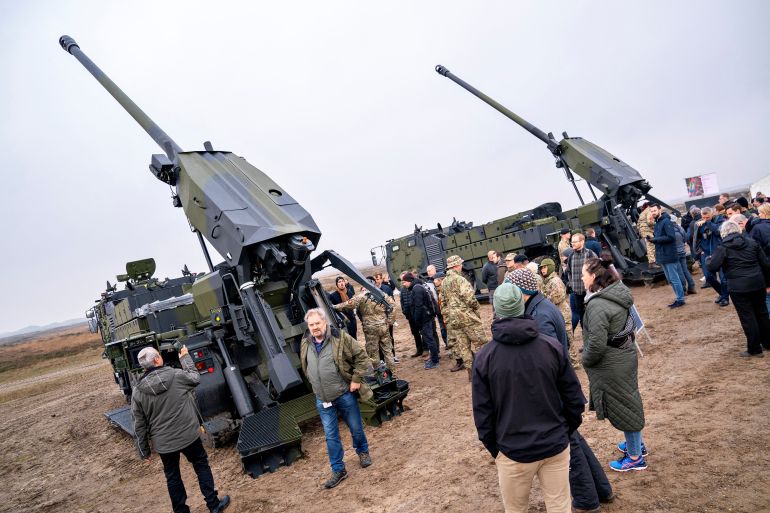
Two Caesar howitzer systems being displayed by the Danish army. Their guns are pointing towards the sky and there are men million about.

The United States and some of its European allies have announced significant new arms donations to Ukraine, including armoured vehicles and heavy weaponry, ahead of a crucial meeting on bolstering the country’s defences nearly a year after Russia invaded.

The US said its package of military support – which includes armoured personnel carriers, air defence systems and tens of thousands of rockets and artillery rounds – was worth some $2.5bn. There will be 59 Bradley Fighting Vehicles and 90 Stryker Armoured Personnel Carriers, the US Defense Department said in a statement on Thursday.

Secretary of State Antony Blinken said it was a “significant new security assistance package to help Ukraine continue to defend itself against Russia’s brutal war.” The latest package brings US military assistance for Ukraine to some $27.4bn, he added.

Earlier, the United Kingdom, in a joint statement with defence ministers and representatives of nine European countries, said it would send 600 Brimstone missiles to Kyiv, while Denmark promised 19 French-made Caesar howitzers, and Sweden its Archer artillery system, a modern mobile howitzer Ukraine has been requesting for months.

“We recognise that equipping Ukraine to push Russia out of its territory is as important as equipping them to defend what they already have,” the statement said.

“Together we will continue supporting Ukraine to move from resisting to expelling Russian forces from Ukrainian soil. The new level of required combat power is only achieved by combinations of main battle tank squadrons, beneath air and missile defence, operating alongside divisional artillery groups, and further deep precision fires enabling targeting of Russian logistics and command nodes in occupied territory.”

The announcements came ahead of a meeting of defence and other officials from some 50 countries, including all 30 members of NATO, at the Ramstein Air Base in Germany to discuss support for Kyiv amid brutal battles in Ukraine’s east and Russia’s continued air attacks on its cities.

Looking ahead to the German talks, Ukrainian President Volodymyr Zelenskyy said late on Thursday that Kyiv expected “strong decisions” from the meeting.

“We are, in fact, now waiting for a decision from one European capital, which will activate the prepared chains of cooperation regarding tanks,” Zelenskyy said in a video address.

“We are preparing for the Ramstein meeting tomorrow. We are expecting strong decisions. We are expecting a powerful military aid package from the United States,” he added.

Pressure on Germany to provide its modern Leopard 2 tanks is intensifying, with Chancellor Olaf Scholz’s government so far appearing reluctant to authorise their transfer for fear of provoking Moscow. Germany has veto power over any potential transfer.

The Kremlin warned on Thursday that sending heavy weapons capable of striking Russian territory would be construed as an escalation.

“Potentially, this is extremely dangerous,” Kremlin spokesperson Dmitry Peskov told reporters. “It will mean bringing the conflict to a whole new level which, of course, will not bode well from the point of view of global and pan-European security.”

Ukraine and Russia have both relied primarily on Soviet-era T-72 tanks, which have been destroyed in their hundreds during the war that began on February 24 last year when Russian President Vladimir Putin sent troops across the border in what he continues to call a “special military operation”.

Two Caesar howitzer systems being displayed by the Danish army. Their guns are pointing towards the sky and there are men million about.
Denmark is among nine European countries, all NATO members, offering more heavy weaponry to Ukraine. The Danes said they would send the Caesar howitzer weapon system [File: Henning Bagger and Ritzau Scanpix/AFP]

Fearing the colder months will give Russian forces time to regroup and unleash a significant attack, Ukraine has stepped up calls on its allies to increase assistance.

During his trip to Washington, DC in December, Zelenskyy told the US Congress that supporting Ukraine was not charity but an investment in democracy.

Berlin on Thursday appeared to leave open the prospect of allowing allies to supply Ukraine with the requested tanks, saying the situation would “become clear in the next few hours or tomorrow morning”.

Lithuania’s defence minister, Arvydas Anusauskas, told the AFP news agency that “some countries will send” Leopard tanks to Ukraine, promising “more news tomorrow” at the talks.

Ukraine’s Western allies have been reluctant to transfer heavier weapons to avoid NATO appearing to confront Russia directly, but officials in Kyiv say tanks are crucial if Ukraine is to recapture land occupied by the Russians and defend itself from further attacks.

“From Washington to London, from Paris to Warsaw, you hear one thing: Ukraine needs tanks. Tanks are the key to ending the war properly. It is time to stop trembling before Putin and take the final step,” Zelenskyy adviser Mykhailo Podolyak said in a tweet.

Meanwhile, CIA Director William Burns travelled in secret to Kyiv to meet Zelenskyy, a US official told the Reuters news agency on Thursday, declining to say when the visit took place.

The Washington Post, which first reported Burns’s trip, said the CIA director was in Ukraine at the end of last week and briefed Zelenskyy on how the US sees Russia setting its military plans in the coming weeks and months.

Fighting continued to be most intense in the eastern industrial region known as the Donbas, Ukrainian military officials said on Thursday night.

The General Staff of the Ukrainian Armed Forces said Russian forces shelled the town of Bakhmut, Russia’s main focus in the Donetsk province, which combined with the Luhansk province form the Donbas region.

Soledar, about 20 km (12 miles) from Bakhmut, also came under fire. Russian forces say they control the town, which is renowned for its salt mines, while Ukraine says its military is still fighting there.

Nearby towns also were shelled by Russian forces – including Klishchiivka, just south of Bakhmut, the Ukrainian military said. Yevgeny Prigozhin, head of the Wagner Russian mercenary army, said his forces have taken control of Klishchiivka, a claim contested by Ukraine.

SOURCE: AL JAZEERA AND NEWS AGENCIES

……………………………………………………………

Friday, 20 January 2023

Tear gas fired at Peru protesters as thousands try to ‘take Lima’

 Police estimate some 3,500 people participated in the protests in Lima though others doubled that estimated number.


Firefighters have been working to put out a raging inferno that broke out in a building near a protest site in Peru’s capital Lima where police fired tear gas as thousands of protesters poured into the city to demand the removal of President Dina Boluarte.

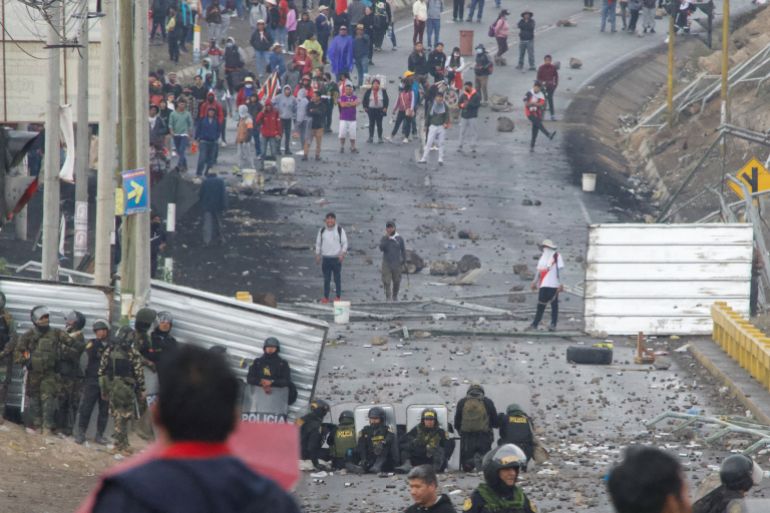
Demonstrators gathered on Thursday in Lima’s historic downtown area where scuffles broke out with the security forces who battled to stop the protesters from reaching key government buildings, including Congress, as well as business and residential districts of the capital.

A relationship between the fire which raged late into Thursday night and the demonstrations was not immediately clear. Images showed people rushing to get their belongings out of the building that was close to several government offices. The National Police of Peru shared dramatic footage of the fire on social media and called on people to stay away from the area.

For much of the day on Thursday, the protesters played a cat-and-mouse game with police, some of whom threw rocks as they tried to get through police lines while officers responded with volleys of tear gas that sent protesters fleeing.

Police estimated that about 3,500 people participated in the protests, but others claimed the figure was double that estimate.

Al Jazeera’s Mariana Sanchez, reporting from Lima, said many people protested peacefully but some clashed with police during the demonstration that participants said was to “take Lima”.

“This is the march of the taking of Lima, and that’s exactly what President Dina Boluarte said: They could come to take Lima but peacefully and that she would be waiting for them at the presidential palace,” Sanchez said.

The protesters were angry as they “want justice” for the nearly 50 people killed in the protests so far and have committed to continue their demonstrations until Boluarte resigns.

The mounting death toll from the protests, which broke out last month, now stands at 45, according to the government ombudsman. Another nine deaths have been attributed to accidents related to the demonstrations, which were sparked by the December 7 removal of Peru’s left-wing former President Pedro Castillo after he tried to illegally shutter Congress and consolidate power.

By bringing the protests to Lima, demonstrators hope to add weight to the movement that began when Boluarte was sworn in to replace Castillo.

Though the protesters are demanding that she step down, Boluarte was defiant on Thursday night in a televised speech alongside key government officials in which she thanked police for controlling the “violent protests” and promised to prosecute those responsible.

The president also criticised the protests for “not having any kind of social agenda that the country needs”, and accused them of “wanting to break the rule of law” and raised questions about their financing.

Police block demonstrators from getting closer to the airport during a protest to demand the resignation of Peru's President Dina Boluarte, new snap elections, the closure of Congress and a new constitution, in Arequipa, Peru January 19, 2023. REUTERS/Oswald Charca NO RESALES. NO ARCHIVES
Police block demonstrators from getting closer to the airport in Arequipa, Peru, on January 19, 2023 

A total of 22 police officers and 16 civilians were injured on Thursday throughout the country, Interior Minister Vicente Romero Fernández said.

A video posted on social media showed demonstrators trying to storm the airport in southern Arequipa, Peru’s second city. They were blocked by police and one person was killed in the ensuing clashes, Peru’s ombudsman said.

That was one of the three airports that suffered attacks from protesters on Thursday, Boluarte said, adding it was not “a mere coincidence” they were stormed on the same day.

The weeks of nationwide protests have marked the worst political violence in more than two decades and highlighted the deep divisions between the urban elite largely concentrated in Lima and the poor rural areas.

Last week, Boluarte’s government extended a state of emergency in Lima and the southern regions of Puno and Cusco, curtailing some civil rights.

Boluarte maintains the situation in the country is “under control” and has called for dialogue, but she has also dismissed calls to resign.

Human rights groups have accused the police and army of using deadly firearms in the protests. The police accuse the protesters of using weapons and homemade explosives.

SOURCE: AL JAZEERA AND NEWS AGENCIES

…………………………………………………………

Rwandan government critic died in road crash – police

 A widely known journalist and government critic died in a road accident in the capital, Kigali, police have told his family.


John Williams Ntwali – who was the editor of The Chronicles news site – died on Tuesday night when a motorbike taxi he had boarded was hit by a car in Kimihurura area, his brother Emmanuel Masabo was told by the police.

Mr Masabo said he was called by police on Thursday afternoon to confirm the identity of the body in a mortuary.

“When I arrived, they took me to the mortuary. I saw that it was him and I confirmed to them,” Mr Masabo told the BBC.

He added: “They did not provide with me more details… maybe they will later. I also had no energy to ask for more [at that moment].”

The Chronicles news site has also confirmed the death of the 43-year old journalist in a tweet. He had been the publication’s editor since 2021.

Mr Ntwali was critical of the government and the ruling party in his reports that focused on injustice and social issues facing Rwandans through his YouTube channel, Pax TV-Ireme news.

Government sympathisers criticised him of being “an extremist” and repeatedly attacked him on social media.

Journalists and friends have expressed shock over his death.

He is survived by a wife and a daughter.

Source: BBC

………………………………………………………

Google Parent To Lay Off 12,000 Workers

 Alphabet Inc (GOOGL.O) is eliminating 12,000 jobs, its chief executive said in a staff memo shared with Reuters.


The cuts mark the latest to shake the technology sector and come days after rival Microsoft Corp (MSFT.O) said it would lay off 10,000 workers.


The job losses affect teams across the company including recruiting and some corporate functions, as well as some engineering and products teams.

The layoffs are global and impact U.S. staff immediately, Google said.

The news comes during a period of economic uncertainty as well as technological promise, in which Google and Microsoft have been investing in a fledgling area of software known as generative artificial intelligence.


Sundar Pichai, Alphabet’s CEO, said in the note, “I am confident about the huge opportunity in front of us thanks to the strength of our mission, the value of our products and services, and our early investments in AI.”

Reuters was first to report the news.

LONDON: Ghanaian Woman Dies At Home Following Two-Hour Wait For Ambulance


A mother died after waiting nearly two hours for an ambulance, before her nine-year-old daughter spent hours desperately trying to wake her up.


Victoria Louisa Maame Yamphet, 40, died at home in Dagenham, east London, last week after complaining of stomach pain as her terrified daughters, aged nine and 18, watched on.

Her daughter Emmanuela, 18, said her mother came home with a flu on Sunday, January 8, before her condition rapidly declined.

‘My mum complained about her ribs and belly hurting. I offered to call an ambulance because she isn’t really a sick person and I knew it was bad,’ Emmanuela said.

Victoria Louisa Maame Yamphet, 40, died in her home in Dagenham, east London, last week, in front of her terrified daughters aged 9 and 18

Her daughter Emmanuela (right), 18, said her mother came home with a flu on Sunday, January 8, and rapidly declined (pictured from right: Emmanuela, nine-year-old Emily, her mother Maame and her half-sister Priscilla)

During the night, Maame, as she was known to friends and family, became sicker, and at 6.09am on Tuesday, January 10, her daughter called for an ambulance.

Emmanuela (pictured) called the ambulance service four times before paramedics reached her mother, but it was too late. She said: ‘She just stopped breathing in front of me and my little sister. ‘I put her in a recovery position, I did CPR on her. I called the ambulance screaming and crying for them to get here quicker’

Emmanuela was initially told the ambulance was six to ten minutes away, but 20 minutes later there was still no sign of it.

The nationwide ambulance strike began the next day on January 11.

‘I called again and all of a sudden it was an hour wait’, she said.

‘I told them my mum can’t wait that long. I was in distress because I didn’t know what to do.’

She was told at 7.15am – more than an hour after her first call – that a taxi would be sent to her house to take her mother to the hospital.

‘Before the taxi got to us, her pain got worse. She just stopped breathing in front of me and my little sister,’ Emmanuela said.

‘I put her in a recovery position. I did CPR on her. I called the ambulance screaming and crying for them to get here quicker.

‘They literally got here within a minute, and it made me feel like when I really need them to come, they can, but they didn’t until I started screaming and crying.

‘When they came, they did everything they could but it was a bit too late. Because my mother was left for an hour and 45 minutes to be in pain, sadly … she didn’t make it.’

Emmanuela believes her mother suffered cardiac arrest and could not breathe properly.

Maame worked as a support worker for over 20 years. Her daughter said: ‘It’s very unfair. My mum was a support worker, she always looked after people, but when it was her turn, she wasn’t taken care of’

Maame worked as a support worker for more than 20 years. Her daughter said: ‘It’s very unfair. My mum was a support worker, she always looked after people, but when it was her turn, she wasn’t taken care of.’ 

There have been three ambulance strike days already in recent weeks. Last month, they took place on December 21 and 28, and this month on January 10.

The next strikes have been announced for January 23, February 6, February 20 and then again on March 6 and March 20.

The dispute between the unions (Unison and GMB) and the Government concerns pay, staffing and retention of staff in the health service.

Ambulance workers have been offered a 4 per cent pay increase by the Government – amounting to an additional £1,400 per head a year – but the unions have rejected it, with inflation at 10.7 per cent.

The unions do not believe the current pay offer increase is acceptable.

On top of her disappointment in the ambulance service, Emmanuela said she was very distressed when her mother’s body was left at the house with her and her nine-year-old sister Emily for six hours.

She said: ‘My little sister was on the floor next to our mum the whole time. She was crying, shaking her and trying to wake her up.’

Their father, who works in the NHS, rushed home to his children. When he was told his partner Maame ‘didn’t make it, he literally started breaking down’, his daughter said.

Maame’s daughters, who are both receiving counselling via their schools, are currently staying with their aunt Sally Andrews in south London.

Maame’s death comes after ambulance services announced further walkouts in February that are due to bring further chaos amid long NHS waiting times.

Dr Fenella Wrigley, chief medical officer for London Ambulance Service, said: ‘We are deeply sorry for the delay in responding to Mrs Yamphet.

‘We are investigating our response to this 999 call and the care provided, and as part of this thorough review, will contact Mrs Yamphet’s family to understand the circumstances of this incident.

‘On behalf of London Ambulance Service, I offer my sincere condolences to the family and loved ones of Mrs Yamphet.’

The cause of Mrs Yamphet’s death is yet to be determined. In the meantime, her daugher Emmanuela has set up a fundraising page for her mother’s funeral: ‘We want to give her a befitting burial’, she said.

Source: dailymail

…………………………………………

When Telecommunications Collapse: What Angola's Mobile Network Crisis Teaches Us About Governance, Justice, and National Security

  The recent disruption of Angola's mobile networks has affected banking, digital payments, businesses, emergency communications, and mi...