Translate

Sunday, 13 November 2022

Global food import bill to jump to record $1.9 trillion: FAO

 Global spending on food imports is expected to rise to record levels in 2022 due to the strong dollar and the Russia-Ukraine war.


The world food import bill is expected to surpass $1.9 trillion in 2022, a 10 percent increase compared with last year’s record level, the United Nations Food and Agriculture Organization (FAO) has said.

The figure, released in a report (PDF) on Friday, marks “an all-time high” due to the depreciating values of currencies against the US dollar – the main currency of exchange on international markets – as well as Russia’s ongoing war in Ukraine.

“The bulk of the increase in the [global food import] bill is accounted for by high-income countries, due mostly to higher world prices, while volumes are also expected to rise,” the report said.

Consequences will be more dramatic for economically vulnerable countries, it added.

“For instance, the aggregate food import bill for the group of low-income countries is expected to remain almost unchanged even though it is predicted to shrink by 10 percent in volume terms, pointing to a growing accessibility issue for these countries,” the FAO said.

Sub-Saharan Africa, already hard-hit by malnutrition, is expected to spend $4.8bn more on food imports, despite a decrease in volumes.

“These are alarming signs from a food security perspective,” FAO said.

Russia and Ukraine together accounted for 30 percent of the world wheat trade and 78 percent of sunflower oil exports before Russia launched a full-scale invasion of its neighbour on February 24. The ongoing conflict has caused grain prices to spike.

The opening of a secure maritime corridor has allowed more than 10 million tonnes of agricultural products to leave Ukraine in recent months, leading to a cautious decline in market prices.

Another easing factor is that world wheat production “should reach a record level of 784 million tons in 2022/23”, the FAO said, driven in particular by the Russian and Canadian crops.

But other factors are weighing heavily on the balance of poor importing countries, warns the FAO, like the global import bill for agricultural inputs.

In particular, fertiliser imports are expected to reach $424bn in 2022, a nearly 50 percent increase compared with the previous year.

Russia is one of the world’s leading exporters of gas and nitrogen fertilisers, and prices have tripled in one year.

“As a result, some countries may be forced to reduce input applications, almost inevitably resulting in lower agricultural productivity and lower domestic food availability,” the FAO said.

It also warned of “negative repercussions for global agricultural output and food security” in 2023.

In the 2022-23 season, the agency sees wheat production jumping 0.6 percent year-on-year to a record 784 million tonnes, but notes increases are expected mostly in China and Russia, leaving inventories down 8 percent in the rest of the world.

Production of coarse grains like corn, barley and sorghum is meanwhile seen falling 2.8 percent in the season.

On the plus side, however, the FAO said oilseeds output is seen rebounding 4.2 percent to hit an all-time high, sugar output is seen rising 2.6 percent, while rice output is expected to remain at overall average levels, in part due to resilient plantings in Asia and recovering output in Africa.

SOURCE: NEWS AGENCIES

………………………………………………………………

Court rejects Nigeria’s $1.1bn damages request against Eni, Shell

 The main case revolved around a deal in which Eni and Shell acquired the OPL 245 offshore oilfield in 2011 in Nigeria.


An appeals court in Milan has rejected Nigeria’s $1.1bn compensation request against Italian energy group Eni and British oil and gas company Shell in civil proceedings relating to a $1.3bn oilfield deal.

The decision was read out in the court on Friday.

In July, prosecutors had dropped related criminal proceedings, clearing Eni and Shell, as well as top managers, including Eni Chief Executive Claudio Descalzi, in one of the global oil industry’s biggest alleged corruption cases.

“We are pleased that these civil proceedings have been dismissed,” Shell said in an emailed comment to the Reuters news agency.

“This follows the Milan criminal tribunal’s finding that there was no case to answer for Shell or its former employees when they were fully acquitted in 2021, a decision that was upheld in July 2022, when criminal proceedings ended,” it added.

Eni had no immediate comment.

The main case revolved around a deal in which Eni and Shell acquired the OPL 245 offshore oilfield in 2011 for $1.3bn, to settle a longstanding dispute over ownership.

Prosecutors alleged that about $1.1bn of the total amount was siphoned off to politicians and middlemen in Nigeria, then Africa’s largest oil producer.

The oil bloc was initially owned by a local company where controversial former Petroleum Minister Dan Etete had major stakes.

A lawyer representing Nigeria in the proceedings added the country was still deciding whether to appeal the decision at Italy’s top administrative court.

Documents explaining the reasons behind Friday’s decision will be made available in 90 days.

SOURCE: NEWS AGENCIES

……………………………………………………………

Divers discover Challenger space shuttle wreckage at the bottom of the Atlantic

 Divers have discovered the wreckage of the Challenger space shuttle off the Florida coast.


A large section of the destroyed space shuttle was found buried in sand at the bottom of the Atlantic, more than three decades after the tragedy that killed a schoolteacher and six others.


NASA’s Kennedy Space Centre announced the discovery on Thursday, saying in a statement that they were contacted by the divers after spotting a large, clearly modern object at the bottom of the ocean and bearing the shuttle’s distinctive tiles.

“This discovery gives us an opportunity to pause once again, to uplift the legacies of the seven pioneers we lost, and to reflect on how this tragedy changed us,” NASA administrator Bill Nelson said.

Michael Ciannilli, a NASA manager in charge of the remains of both lost shuttles, Challenger and Columbia, said: “Upon first hearing about it, it brings you right back to 1986.”

He said it was one of the biggest pieces of Challenger ever found in the decades since the accident.

The remnant uncovered is more than 15ft by 15ft and may be bigger – part of it is remains covered with sand.

NASA verified through video that the piece was part of the shuttle that erupted into a ball of flame 73 seconds after lifting off from Kennedy Space Center on January 28 1986.

The fragment remains on the ocean floor just off the Florida coast near Cape Canaveral, as the space agency determines the next step.

All seven on board were killed during the incident over 35 years ago, including the first schoolteacher bound for space, Christa McAuliffe.

Subsequent investigations blamed the disaster on compromised O-Ring seals on a solid rocket booster, worsened by unusually cold temperatures.

It remains one of the worst disasters in the history of the US space program.


…………………………………………………………

Russia orders troop withdrawal from Ukraine’s Kherson city

 An adviser to Ukrainian President Volodymyr Zelenskyy said Ukraine does not pay attention to Russia’s words.


Russia has ordered its forces to withdraw from the Ukrainian city of Kherson, the only regional capital seized by President Vladimir Putin’s troops since the war began.


The announcement on Wednesday followed weeks of Ukrainian advances towards the city and signalled a potentially huge blow to Russia’s military campaign in Ukraine, which it invaded in late February.

In televised comments, General Sergei Surovikin said it was no longer possible to keep Kherson city supplied.

“Having comprehensively assessed the current situation, it is proposed to take up defence along the left [eastern] bank of the Dnieper River,” said Surovikin, standing at a lectern and indicating troop positions on a map whose details were greyed-out for the TV audience.

“I understand that this is a very difficult decision, but at the same time, we will preserve the most important thing – the lives of our servicemen and, in general, the combat effectiveness of the group of troops, which it is futile to keep on the right bank in a limited area.”

Russian Minister of Defence Sergei Shoigu also echoed the comments and said, “I agree with your conclusions and proposals. Proceed with the withdrawal of troops and take all measures to transfer forces across the river.”

The announcement came hours after the Russian-installed deputy head of Kherson, Kirill Stremousov, was reportedly killed in a car crash after weeks of urging residents to evacuate the area.

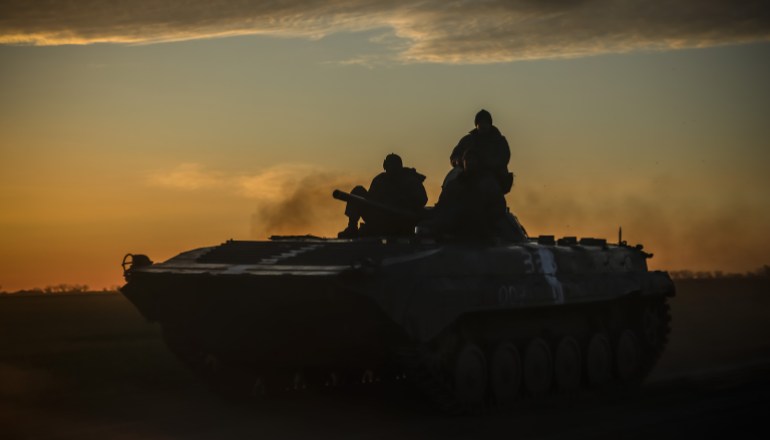
Ukrainian soldiers
‘Words and actions differ’

Commenting on Russia’s announcement, Ukrainian presidential adviser Mykhailo Podolyak said “actions speak louder than words”.

“We see no signs that Russia is leaving Kherson without a fight,” he said in a Twitter post.

Podolyak added that “a part” of the Russian forces was “preserved in the city, and additional reserves are charged to the region. Ukraine is liberating territories based on intelligence data, not staged TV statements.”

Kherson is one of four Ukrainian regions that Putin proclaimed in September he was incorporating into Russia “for ever” after referendum condemned as illegal by Ukraine and its allies.

However, there has been mounting speculation in recent weeks that Moscow could either withdraw its forces from the west bank of the Dnieper or dig in for a bloody battle.

Earlier on Wednesday, the main bridge on a road out of Kherson city was blown up. Photos posted online showed the span of the Darivka bridge on the main highway east out of Kherson completely collapsed into the water of the Inhulets River, a tributary of the Dnieper.

Ukrainians who posted photos of the destroyed bridge speculated that it had been blown up by Russian troops in preparation for a retreat.

Vitaly Kim, the Ukrainian governor of the Mykolaiv region, which borders Kherson, suggested Ukrainian forces had pushed some Russians out.

“Russian troops are complaining that they have already been thrown out of there,” Kim said in a statement on his Telegram channel.

The withdrawal announcement was lamented by Russia’s influential war bloggers, who described it as a bitter blow.

“Apparently we will leave the city, no matter how painful it is to write about it now,” said the War Gonzo blog, which has more than 1.3 million subscribers on Telegram.

“In simple terms, Kherson can’t be held with bare hands,” it said.

“Yes, this is a black page in the history of the Russian army. Of the Russian state. A tragic page.”

SOURCE: AL JAZEERA AND NEWS AGENCIES

……………………………………………………………

Friday, 11 November 2022

Ghana To Receive Up To $50m; As Lands Minister Calls For Bridging Climate Financing Gap

 Ghana is set to receive up to Fifty Million United States Dollars (US$50,000,000.00) from the World Bank for reducing carbon dioxide emissions between 2019 and 2024. This was disclosed by the Climate Change Manager of the World Bank, Mr. Erwin De Nys, on Wednesday, 9th November 2022. The amount is in return of some ten million tons of carbon dioxide emissions expected to be reduced by 2024 within a six-million-hectare stretch of the West African Guinean Forest.


Mr. De Nys was speaking at an event on Ghana’s Forest Solutions to Climate Change, organised by the Ministry of Lands and Natural Resources at the ongoing twenty-seventh session of the Conference of Parties (COP27) of the United Nations Framework Convention on Climate Change (UNFCCC), in Sharm El Sheikh, Egypt.

He said Ghana has been an important and active member of the Forest Carbon Partnership Facility since its establishment in 2008 and is one of the first countries to transition to emission reduction programmes and results-based payments.

Mr. De Nys said the country will soon receive US$4.8 million, representing over nine hundred and seventy thousand (970,000) tons of verified and validated emission reductions between June and December 2019. He said the payment will be used to reward stakeholders in emission reduction, and boost confidence in Ghana’s REDD+ process.

In addition to this payment, Mr. De Nys said Ghana will also benefit from the Enabling Access to Benefits while Lowering Emissions (EnABLE) Programme of the World Bank, to further reduce emissions and ensure social inclusion.

On his part, the Minister for Lands and Natural Resources, Hon. Samuel A. Jinapor, MP, called for strategic collaboration to bridge the climate financing gap. He said existing financing options are inadequate to deal with the enormity of the problem; and having missed the one hundred billion dollars ($100 billion) climate finance pledge made in Copenhagen, there is an urgent need for stakeholders to work together to bridge the gap between ambition and action.

Mr. Jinapor called on governments and all actors to deliver action beyond pledges and declarations. “We are at a stage in the climate struggle where mere talk, commitments, declarations and/or pledges are not enough. Consistent with the clarion call of COP27, this is the time the world must “walk the talk” and get on with action and implementation of the many years of unfulfilled climate action promises”, the Minister said.

He said Ghana was committed to forest and nature-based solutions to climate change, which is evidenced by the over 547,000 hectares of degraded forests cultivated between 2017 and 2021, and the over thirty million trees planted under the Green Ghana Project, as well as the verified and validated emission reduction under the Ghana REDD+ Strategy. He expressed his confidence in COP27, which has been termed action and implementation COP, to deliver real action towards limiting global warming to the one point five degrees Celsius (1.5ºC) target set out in the Paris Agreement.

The UNDP’s Principal Advisor on Climate and Forests, Tim Claris, who also spoke at the event, commended Ghana for her forest solutions to climate change and said the country deserves to be rewarded for actions being taken in the forestry sector.

Source: Peacefmonline.com/Ghana

…………………………………………………………

Man arrested on COVID ward in Scotland is American rape suspect who faked his own death, court rules

 Sheriff Norman McFadyen dismisses Nicholas Rossi's claims of mistaken identity as "scandalous" and "implausible and fanciful".


A court has ruled for the first time that a man arrested on a COVID ward in Scotland is an American rape suspect who faked his own death.


The court sheriff has decided that the man calling himself Arthur Knight is in fact Nicholas Rossi.

Sheriff Norman McFadyen said: “I am ultimately satisfied on the balance of probabilities, by the evidence of fingerprint, photographic and tattoo evidence, taken together, supported by the evidence of changes of name, that Mr Knight is indeed Nicholas Rossi, the person sought for extradition by the United States.”

He rejected the 35-year-old’s claims of mistaken identity as “scandalous” and “implausible and fanciful”.

Fugitive Rossi is wanted in connection with sex attacks on three different women in Utah, and is also alleged to have committed a number of other crimes across the US.

Authorities say he fled the US to avoid prosecution and attempted to trick investigators into believing he was dead, even attempting to hold a fake memorial mass to commemorate his passing.

But he was tracked via an Interpol arrest warrant to a hospital in Glasgow where he was undergoing treatment for COVID-19 in December 2021.

Since his arrest he has insisted he is a victim of mistaken identity – that his name is Arthur Knight, and that he is an Irish orphan who has never visited the US.

But today officials at Edinburgh Sheriff Court ruled this story was false and that he was indeed the man wanted by US authorities.

Three days of evidence were heard this week as lawyers tried to get to the truth of the man’s identity.

Advocate Depute Paul Harvey called 10 witnesses including hospital staff, police officers and fingerprint experts who were all adamant the man they had encountered in Glasgow was the man identified by the Americans as Rossi.

Two fingerprint experts from Police Scotland identified unique characteristics of prints from “Arthur Knight” which they said were “identical” matches for prints taken from Rossi.

A nurse, from Glasgow’s Queen Elizabeth University Hospital, described “distinctive” tattoos on her patient’s biceps, which were the same as images released by Interpol as part of the manhunt.

During the course of his defence, the wanted man made a series of bizarre claims to explain away the biometric evidence put before the court.

He told the sheriff that he did not have any tattoos before his admission to hospital and that he “awoke” from a coma to find his body had been tattooed while he was unconscious.

In another strange twist, he alleged the fingerprints on the Interpol warrant only matched his own because they were taken by an NHS employee in Glasgow. He claimed a man known only as “Patrick” took the prints while he was sedated and then sent them to a corrupt official in Utah who in turn circulated them to Interpol.

Sheriff McFadyen said Rossi’s claim that he had regained consciousness from a coma to find that he had been tattooed “was equally… if not more implausible and fanciful” than his assertion that his fingerprints were taken from him by an NHS worker on behalf of US prosecutors while he was in intensive care.

On Rossi’s insistence that he was Arthur Knight and not the man wanted in the US, the sheriff added: “It seems to me highly suspicious that the change of names went through a number of permutations. That seems to me consistent with someone who was hiding from someone or something.”

Rossi’s series of bizarre stories, excuses and stalling tactics were branded “entirely fanciful” and “outlandish” by the prosecutor, who suggested there was no doubt the man in court was Rossi himself.

At one point in the proceedings Rossi appeared to cry and wheeze, describing his experience of Scottish prison as “challenging and dystopian”.

He mouthed “I love you” at his wife Miranda, who has stood by him and maintains that her husband Arthur is a victim of mistaken identity.

US extradition bid

This case, which has been plagued with delays, is one of the most bizarre to be heard in a Scottish court.

Today’s ruling by Sheriff Norman McFadyen brings to an end the relentless fight over the identity, removes any suggestion of the existence of alias “Arthur Knight” and paves the way for full extradition proceedings which are likely to get under way next year.

American officials want him extradited to stand trial.

By Connor Gillies, Scotland correspondent, at Edinburgh Sheriff Court

……………………………………………………………

Ukraine war: Russia says troops have begun leaving Kherson as Kyiv stays sceptical

 Moscow says it has started pulling its troops out of the southern Ukrainian city of Kherson.


Russia’s defence ministry said on Thursday that the “manoeuvre of units of the Russian group” had begun to the other side of the Dnipro River.

It comes after Ukrainian officials cautioned that Russia’s announcement of a withdrawal from Kherson could be part of a misinformation campaign.

Mykhailo Podolyak, an adviser to President Volodymyr Zelenskyy, said they had seen no signs that Russia was completely leaving the city.

“Which means that these statements may be disinformation.”

“A part of the Russian group is preserved in the city, and additional reserves are charged to the region. Ukraine is liberating territories based on intelligence data, not staged TV statements,” he said.

Russia’s military claimed Wednesday that it will withdraw from the only Ukrainian regional capital it captured. Defence Minister Sergei Shoigu said he had ordered Russian troops to withdraw from the west bank of the Dnipro River in the face of Ukrainian attacks near the southern city.

The announcement marks one of Russia’s most significant retreats and a potential turning point in the war, now nearing the end of its ninth month.

In a nightly video address, Zelenskyy didn’t comment directly about Russia’s withdrawal announcement, saying only that: “Our emotions must be restrained — always during war. I will definitely not feed the enemy all the details of our operations […] when we have our result, everyone will see it.”

In recent months, Kyiv’s forces have zeroed in on Kherson, a city with a pre-war population of 280,000 people.

They’ve cut off supply lines in recent weeks as part of a larger counteroffensive in eastern and southern Ukraine that has pushed Russian troops out of wide swaths of territory.

In addition to the largely successful counteroffensive, Ukrainian resistance fighters behind the front line have worked inside Kherson, with sabotage and assassinations of Moscow-appointed officials.

Recapturing Kherson could allow Ukraine to win back lost territory in the Zaporizhzhia region and other southern areas, including Crimea, which Russia illegally seized in 2014.

A Russian retreat is almost certain to raise domestic pressure on the Kremlin to escalate the conflict.

Yaroslav Yanushevych, Kherson’s Ukrainian-appointed governor, called on residents “not to give in to euphoria” just yet. Another Ukrainian-appointed Kherson regional official, Serhii Khlan, told reporters that Russian forces had blown up five bridges to slow Kyiv’s forces.

Military analyst Oleg Zhdanov said that Russia’s announced retreat “could very well be an ambush and a Russian trap to force the Ukrainians to go on the offensive, force them to penetrate the Russian defenses, and in response to strike with a powerful blow from the flanks.”

By Euronews  with AP

………………………………………………………

The 2026 AFRICA EDUCATES HER CAMPAIGN REPORT - ANGOLA 6th Anniversary | 2020–2026

  Meet who's behind this cause     Support us:  https://donate-sofonie.netlify.app/           AFRICA EDUCATES HER CAMPAIGN REPORT — ANGO...