As he stood on stage alongside Russia’s foreign minister, Uganda’s President Yoweri Museveni said his country would continue to do business with Russia, despite pressure from Western allies to take a stance against Moscow over the ongoing conflict in Ukraine.
Sat under a white tent in the gardens of State House, Sergei Lavrov and President Museveni emphasised their long history of mutual support. Both reflected on the part the USSR had played during the independence struggle in Africa. Moscow established its embassy in Uganda on 13 October 1962 – just four days after the country had won its independence.
Mr Lavrov is currently on a charm offensive tour of Africa, visiting Egypt, Congo-Brazzaville, Uganda and Ethiopia.
The event was carefully stage-managed, with journalists required to submit their questions in advance.
Very few journalists were allowed in to the press conference Image caption: Very few journalists were allowed in to the press conference
But President Museveni was bullish: in reply to one Russian journalist about whether he had felt any pressure not to accommodate Mr Lavrov or have photos taken with him, he said people would be “stupid” if they were to ask him not to have his picture with whoever he wishes.
I also got a similar picture from a Ugandan official who spoke to me at the event. He said Uganda’s leaders and those of countries like Tanzania, Zimbabwe and Zambia – the so-called frontline states in the fight against apartheid – could never turn against Moscow because of the part the USSR had played in their fight for liberation.
Mr Museveni reminded journalists that during the Cold War he was often asked whether Uganda was pro-West or pro-East, but he always answered: “We were pro-ourselves.”
In an interview for BBC Africa Daily, Foreign Minister Jeje Odongo was more conciliatory though, saying that Uganda was soon to assume the chairmanship of the Non-Aligned Movement forum of 120 developing countries originally set up to stop their members becoming pawns in Cold War power games.
As such the East African nation had a responsibility to ensure that all members of the international community were engaged in dialogue, he said.
Gen Odango has now been invited to visit Moscow in October in a bid to further consolidate the relationship between the two nations.
It will mark 60 years since Moscow first recognised Uganda as an independent state.
More than 3,800 monkeypox cases have been reported in the US, the most of any country around the globe, government health data shows.
The rising number of cases has reportedly prompted the Biden administration to mull declaring a national health emergency.
The virus has already been classified as a global health emergency by the World Health Organization (WHO).
To date, more than 18,000 cases have been reported in 75 countries.
According to data published online by the US Centers for Disease Control and Prevention (CDC), as of 25 July, there were 3,846 confirmed or suspected monkeypox cases in the US.
The figure – which comes amid expanded testing in addition to the growing outbreak of the virus – is now ahead of that of Spain, where 3,105 cases have so far been reported.
The two other countries with the highest number of infections, Germany and the UK, have reported 2,352 and 2,208 cases, respectively.
With cases in the US rising, the Washington Post on 25 July reported that the Biden administration was considering declaring a public health emergency.
The measure would allow the government to use federal funds to combat the outbreak, raise public awareness and better collect relevant health data.
Additionally, the administration is reportedly preparing to name a coordinator to oversee the government’s response to monkeypox from the White House.
On July 21, 50 Democratic lawmakers sent an open letter to President Joe Biden, urging him to declare a public health emergency and send millions of vaccine doses to the US from manufacturing facilities overseas.
While officials have said that gay and bisexual men – as well as healthcare workers – have so far been most at risk, fears are mounting that the virus could spread to other segments of the population.
On 22 July, the US confirmed the first cases of monkeypox in children.
The US response to the virus has so far been plagued by vaccine shortages and a slow start to testing, leading some to compare the situation to the beginning of the Covid-19 pandemic in early 2020.
In Washington DC, for example, officials have warned that a “rapid increase in cases”, coupled with a “very limited” supply of vaccines, means that authorities must prioritise high-risk residents.
The city currently has the highest per capita total of infections, with 172 cases reported in the district.
Most monkeypox cases are mild, with initial symptoms including high fever, swollen lymph nodes and a blistery, chickenpox-like rash or lesions.
So far, no deaths from the virus have been reported in the US.
Russia delivered less gas to Europe on Wednesday in a further escalation of an energy stand-off between Moscow and the European Union that will make it harder, and costlier, for the bloc to fill up storage ahead of the winter heating season.
The cut in supplies, flagged by Gazprom (GAZP.MM) earlier this week, has reduced the capacity of Nord Stream 1 pipeline – the major delivery route to Europe for Russian gas – to a mere fifth of its total capacity.
A day earlier, EU countries approved a weakened emergency plan to curb gas demand after striking compromise deals to limit cuts for some countries, hoping lower consumption will ease the impact in case Moscow stops supplies altogether.
While Moscow has blamed various technical issues for the supply cuts, Brussels has accused Russia of using energy as a weapon to blackmail the bloc and retaliate for Western sanctions over its invasion of Ukraine.
On Wednesday, physical flows via Nord Stream 1 tumbled to 14.4 million kilowatt hours per hour (kWh/h) between 0700 and 0800 GMT from around 28 million kWh/h a day earlier, less than a week after the pipeline restarted following a scheduled 10-day maintenance period.
Klaus Mueller, head of Germany’s network regulator, said the country could still avoid a gas shortage that would prompt its rationing.
Germany, Europe’s top economy and its largest importer of Russian gas, has been particularly hit by supply cuts since mid-June, with its gas importer Uniper (UN01.DE) requiring a 15 billion euro ($15.21 billion) state bailout as a result.
Uniper and Italy’s Eni (ENI.MI) both said they received less gas from Gazprom than in recent days.
Mueller issued another plea to households and industry to save gas and avoid rationing.
“The crucial thing is to save gas,” Mueller said. “I would like to hear less complaints but reports (from industries saying) we as a sector are contributing to this,” he told broadcaster Deutschlandfunk.
German industry groups, however, warned companies may have no choice but cut production to achieve bigger savings, pointing to slow approval for switching from natural gas to other, more polluting fuels.
Germany is currently at Phase 2 of a three-stage emergency gas plan, with the final “emergency” phase to be launched once rationing can no longer be avoided.
“If you asked me whether it (a gas shortage) is imminent, then I would say that if flows remain at 20% and if we can still add to storage facilities in the coming days and weeks, then we do not yet have a physical gas shortage, which would be the prerequisite for Phase 3,” Mueller said.
At least five people were killed and about 50 wounded in anti-United Nations protests in Democratic Republic of Congo’s eastern city of Goma on Tuesday, a government spokesman said.
A Reuters reporter saw U.N. peacekeepers shoot two demonstrators dead.
The violence took place on the second day of protests against the peacekeeping mission MONUSCO for failing to protect civilians in a region marred by decades of militia violence.
“At least 5 dead, around 50 wounded (in Goma),” government spokesman Patrick Muyaya said in a tweet,
without saying who was responsible.
Hundreds of demonstrators attacked and looted a MONUSCO warehouse in Goma on Monday demanding that the mission leave the country and the protests flared again on Tuesday. read more
The Reuters reporter at the scene said peacekeepers fired tear gas and live bullets at a largely peaceful crowd, killing two and wounding at least two others.
Army and police officers deployed to the scene did not open fire. A soldier and a policeman in a bulletproof vest were also hit by bullets, he added.
A MONUSCO spokesman was not available for comment.
The mission has been gradually withdrawing for years.
Resurgent clashes between local troops and the M23 rebel group in east Congo have displaced thousands. Attacks by militants linked to Islamic State have also continued despite a year-long state of emergency and joint operations against them by the Congolese and Ugandan armies.
MONUSCO – the United Nations Organization Stabilization Mission in the Democratic Republic of Congo – took over an earlier peacekeeping operation in 2010.
It had over 12,000 troops and 1,600 police deployed in Congo as of November 2021.
Turkish Defence Minister Hulusi Akar on Wednesday unveiled a centre in Istanbul to oversee the export of Ukrainian grains after a landmark U.N. deal last week, with the first shipment expected to depart from Black Sea ports within days.
Russia and Ukraine signed the deal, brokered by Ankara and the United Nations, on Friday to reopen grain and fertilizer exports that have been blocked by war to ease an international food crisis. read more
The joint coordination centre (JCC) in Istanbul will oversee departures from three Ukrainian ports in which ships must circumvent mines, and will conduct inspections of incoming ships for weapons.
The first South African captain to win the Women’s Africa Cup of Nations (Wafcon) hopes the team’s stunning success in Morocco can bring together a nation undergoing social hardships back home.
Banyana Banyana won 2-1 against the hosts in the Moroccan capital on Saturday to finally lift the trophy after previously losing four finals.
With South Africans facing regular power cuts for the past six weeks and record unemployment levels, captain Refiloe Jane says she hopes the football success can bring some relief.
“I would say to all the South Africans out there we hope that this will unite the nation,” the 29-year-old midfielder told BBC Sport Africa.
“We hope that this bought back smiles in people’s faces and brought back hope.
“There’s so many things happening in our country, so I think today was one of those days where we saw a united South Africa. We’re hoping going forward we’ll get more and more people supporting Banyana Banyana.”
Jane, who says she “cried her lungs out” at the final whistle, is one of three women who shared the captaincy between them in Morocco, with goalkeeper Andile Dlamini – who went over six hours without conceding – and veteran Janine van Wyk also assuming the roles.
Triumph dedicated to injured Kgatlana
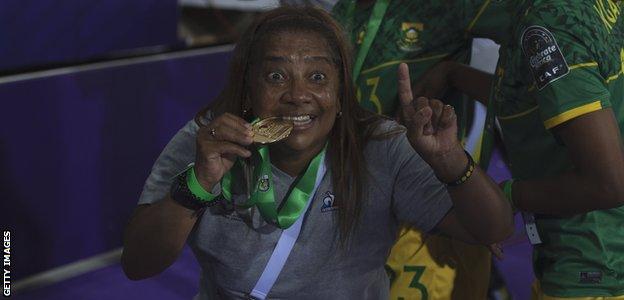
South Africa coach Desiree Ellis tasted success after losing Wafcon finals as a player and a coach
Coach Desiree Ellis, who played in the country’s first women’s international in 1993 and was part of the side that lost the first of their four finals, in 2000, picked up Jane’s theme, with one particular South African in mind.
“This is for the fans back home; the fans who have been behind us, who have sent messages, and some didn’t even get a chance to watch it, so this is for them,” said the three-time African coach of the year.
“This is also for Thembi [Kgatlana]. We haven’t forgotten about you, Thembi, we did this for you as well. We said we were going to do it.
“You said to us when you got your injury, that the job is not done.”
Kgatlana, who starred at the last Wafcon tournament when finishing as both top scorer and best player, was denied the chance to atone for the 2018 final defeat when she was ruled out of the tournament with an Achilles injury in the group stages.
In the two games she did manage to play, she showed her blistering pace and sharp skills in the confidence-boosting opening 2-1 win over Nigeria and then when scoring in the 3-1 win against Burundi.
Midfielder Noxolo Cesane, meanwhile, hopes that the fact that South Africa finally managed to get over the line – after taking home silver medals in in 2000, 2008, 2012 and 2018 – can kick-start a new era of success for Banyana Banyana.
Unlike many of her team-mates – some of whom had played in the 2008 loss, such as veteran defender Noko Matlou – Cesane is unburdened by failure after winning the tournament at the very first attempt.
“This is the first step to start setting more targets, so that this can become a normal thing,” she told BBC Sport Africa.
A ‘beautiful atmosphere’ in Rabat
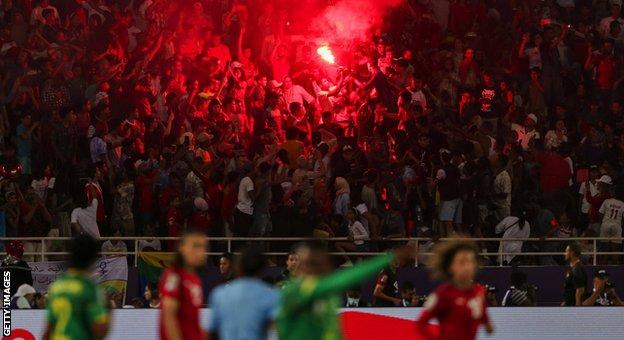
A capacity crowed in Rabat replicated the support seen at men’s club and international matches in Africa
Whether the atmosphere in which the players played in will remain so vibrant remains to be seen, after the 53,000-seater Stade Prince Moulay Abdellah was packed out and lit up by flares throughout an absorbing final.
“We want to give thanks to the supporters, who came out in numbers,” AC Milan midfielder Jane added.
“When we played toward the game, we thought we were going to be lasered and there would be firecrackers, smoke and all those things. Even if they did that a little bit, it didn’t affect us so much, so we also want to give credit to the supporters of women’s football.
“At the end of the day, they came in numbers to support and it goes to show that Africa is on the rise. You know, we showed the world that Africa can do it.
“It was a beautiful atmosphere out there. They showed us love also, and we want to say thank you for that.”
Veteran Van Wyk, who played just the one game given her advancing years, also congratulated Morocco, saying the tournament they hosted was ‘probably the best Wafcon I’ve ever been to’.
Like Jane and many others in the team, the defender burst into tears at the final whistle in the 99th minutes – “probably the longest nine minutes of my career”- at the realisation of a “dream come true”.
All the players, who spoke to South Africa President Cyril Ramaphosa by Zoom on the day before the final, are now theoretically $24,000 richer, after being promised that amount should they lift the trophy.
The work of the first edition of the annual consultative dialogue of young African leaders kicked off in Morocco’s capital city of Rabat on Wednesday and successfully ended on Sunday.
The inaugural youth dialogue that attracted young leaders from over 40 African countries ran under the theme “Consolidating our achievements: Forging partnerships for the program of the African renaissance.”
Initiated by the Pan African Youth Union (PYU), in partnership with the Ministry of Youth, Culture and Communication, the event aims to provide a climate conducive to assessing the challenges and expectations of member states.
It further aims to define a clear vision and a roadmap to achieve a resilient, inclusive and solution-oriented approach to the results presented by member countries.
The consultative dialogue is also about reflecting on how to forge effective partnerships to address the fundamental challenges facing youth.
The opening of this conclave was attended by the Minister of Youth, Culture and Communication, Mohamed Mehdi Bensaid, the President of the UPJ, Moumouni Dialla, and several African and UN officials.
Speaking at the occasion, Bensaid stressed that this dialogue must be a space for debate at the heart of the challenges facing the youth of Africa. He said the conference presents opportunities that are open to the continent. The Minister highlighted that Africa is currently at the centre of international competition because of its vast natural resources, enormous human resources, including its 400 million young Africans.
“It is our responsibility as decision makers and representatives of African youth, to ensure the economic construction, to set the stage for the new rise of Africa that undeniably serves the interests of the continent and its people,” he said.
For his part, the president of the UPJ, Moumouni Dialla underlined that this event aims to bring African youth together and unite them to build the African continent and solve the present challenges. He added that Africa is a continent that represents the future of the world.
“This event represents a framework for dialogue and exchange in order to find appropriate solutions for the problems that plague our countries,” Bensaid said.
Dialla highlighted the need to see African youth mobilise in the face of various humanitarian and food crises. He called on young people to play a big role in the development of the continent.
Discussions at the conclave focused on five thematic plenary sessions including consolidation of gains, mitigation of the migration crisis in Africa, peacebuilding and security, climate challenges, as well as economic inclusion through the African Continental Free Trade Area (ACFTA).
The Pan African Youth Union (PYU), whose new headquarters was inaugurated last February in Rabat, is committed to promoting its values and principles, including those related to peace, democracy and sustainable development in order to achieve African integration.