Translate

Monday, 14 February 2022

UK discourages travel to Ukraine and asks citizens there to leave

 The Foreign Office updates its travel advice for Ukraine as Prime Minister Boris Johnson tells fellow world leaders he "fears for the security of Europe" over the threat of a Russian invasion.


Britons are being advised against all travel to Ukraine and those already in the country are being told to leave while they can.

The action came as Boris Johnson told world leaders he “feared for the security of Europe” over the threat of a Russian invasion of Ukraine.

And the White House on Friday stated its belief that Russian military aggression against its neighbour could begin “any day now” – including during the current Winter Olympics, which are scheduled to end on 20 February.

On Friday evening, the Foreign Office issued updated travel guidance to advise UK citizens “against all travel to Ukraine”.

“British nationals in Ukraine should leave now while commercial means are still available,” the updated advice added.

“Since January 2022, the build-up of Russian forces on Ukraine’s borders has increased the threat of military action.

“Due to this increased threat, the FCDO has taken the decision to further withdraw embassy staff from Kyiv.

“The embassy remains open but will be unable to provide in-person consular assistance. British nationals should leave while commercial options remain.”

The action copies that taken by the US government, who were already advising Americans against travelling to Ukraine due to “the increased threats of Russian military action”.

The State Department is also urging all those US citizens currently in Ukraine to leave the country now.

PM tells allies he ‘fears for security of Europe’

In a virtual meeting on Friday evening, the prime minister spoke with the leaders of the US, Italy, Poland, Romania, France, Germany, the EU, and NATO.

“The prime minister told the group that he feared for the security of Europe in the current circumstances,” a Downing Street spokesperson said.

“He impressed the need for NATO allies to make it absolutely clear that there will be a heavy package of economic sanctions ready to go, should Russia make the devastating and destructive decision to invade Ukraine.

“The prime minister added that President [Vladimir] Putin had to understand that there would be severe penalties that would be extremely damaging to Russia’s economy, and that allies needed to continue with efforts to reinforce and support the Eastern frontiers of NATO.

“He urged the leaders to work together to deliver economic and defensive support to Ukraine.”

But the spokesperson added that world leaders had agreed, if Mr Putin “deescalated”, there would be “another way forward” as they “pledged to redouble diplomatic efforts in the coming days”.
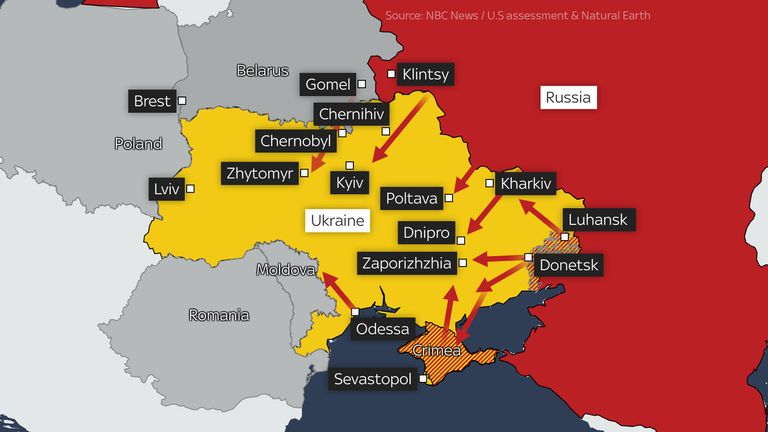
An NBC News map shows the possible routes for Russia to invade Ukraine, according to US Intelligence
Image:An NBC News map shows the possible routes for Russia to invade Ukraine, according to US intelligence

White House warns Russian invasion could begin ‘any day now’

After the virtual meeting between Mr Johnson, US President Joe Biden and other world leaders, White House national security adviser Jake Sullivan said Russia now had enough forces to conduct a major military operation against Ukraine.

An assault could begin “any day now” and “could occur before the Olympics have ended”, Mr Sullivan told a televised briefing as he urged any American still in Ukraine to leave in the next 24-48 hours.

“The risk is high enough and the threat is now immediate enough that prudence demands that it is the time to leave now,” he said.

“We are not saying that a decision has been taken by President Putin.

“What we are saying is that we have a sufficient level of concern based on what we are seeing on the ground, and what our intelligence analysts have picked up, that we are sending this clear message.”

Russia is currently holding massive war games in Belarus, which borders Russia, Ukraine and Poland.
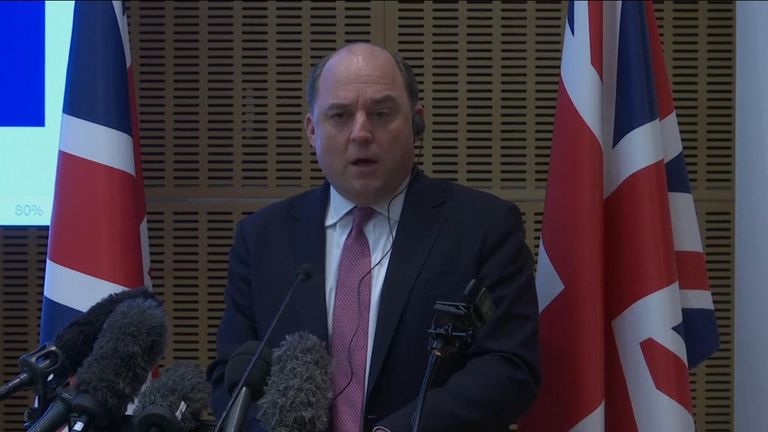
UK has ‘above 0% trust in Russia’

UK-Russia relations ‘above zero’


Earlier in the day, Defence Secretary Ben Wallace had continued those diplomatic efforts as he held talks with his Russian counterpart in Moscow.

Mr Wallace described the discussions as “constructive and frank” and said that relations between Russia and Britain were “above zero” following the first meeting between a UK defence minister and Russia’s Sergei Shoigu since 2013.

Stressing the need for talks to prevent “miscalculation and escalation”, Mr Wallace expressed his hope that Friday’s meeting had contributed to a “better atmosphere” between the two sides.

“When they say to me they are not going to invade Ukraine we will take that seriously but, as I also said, we will look at the actions that accompany it,” the defence secretary said.

Mr Wallace also agreed with a US assessment that a Russian invasion of Ukraine could happen “at any time”, amid the ongoing joint military drills between Russia and Belarus.

“The disposition of the Russian forces that we see – over 100,000 in both Belarus and Ukraine – obviously gives that size of force the ability to do a whole range of actions, including an invasion of a neighbouring country at any time,” he said.

“We obviously have made it very clear in NATO that an invasion would have tragic consequences and we are here, and I’m here today for example, to seek a way of whatever we can to deescalate that tension.

“I heard clearly from the Russian government that they had no intention of invading Ukraine. And I also heard some of their concerns.”

Sky News

……………………………………………………………

In Sierra Leone’s swamps, female farmers make profits and peace

 After a conflict with mining companies, some female farmers have adapted to work on an overlooked yet abundant ecosystem.


Matagelema, Sierra Leone – Not long after daybreak in Matagelema, a village in the south of Sierra Leone’s Moyamba District, a jubilant chorus rings out from a stretch of a once-neglected swamp surrounded by tropical forest.

“When we are ploughing, people are getting jealous,” dozens of women farmers sing gleefully, ankle-deep in mud in a sprawling paddy field.

Through their backbreaking work – carving out rice paddies from thickly-forested swamp land – peace and prosperity are gradually coming to the conflict-ridden corner of West Africa.

Mamie Achion, the group’s charismatic 45-year-old leader, gestures at orderly blocks of bunds and canals that form the new irrigation system.

“We cut the trees by hand. It was tough, there was pain,” she says. “But it was an opportunity for us and we have used it to better our lives.”

For many years, these women tilled the region’s uplands, mostly cultivating the root vegetable cassava.

But conflict regularly flared up between farmers and miners, who are extracting Moyamba’s rich deposits of rutile, a mineral used to make a bright white colour in ceramics and paint.

The struggle for resources led to violent tensions, with protests against mining including roadblocks by angry locals and even a local chief’s home being burned.

“We weren’t getting benefits from mining,” adds Achion. “The miners’ dredging created water pools in our fields, damaging the crop. They relieved us of our land.”

Born and raised in Matagelema, Achion – like many of the women – has also dealt with a lot of adversity besides conflict with mining companies.

Forced to drop out of school to support her farmer parents, Achion later lost her husband to Ebola, the deadly hemorrhagic fever that swept across the region in 2014.

“I wanted us [women] to come together,” she says. “Some don’t have fathers, mothers, brothers, husbands. Many of us are widows, because of Ebola and war.”

In 2020, about 150 women in Matagelema formed a women’s association and moved to work on inland valley swamps, an overlooked yet abundant ecosystem that has the potential for very high agricultural yields.

The women farmers in MatagelemaThe World Food Programme, supported by the UN Peacebuilding Fund, is working with nearly 70 communities like those in Matagelema across six districts in Sierra Leone [Peter Yeung/Al Jazeera]

‘A stable foundation’

Sierra Leone relies heavily on agriculture, which employs more than 60 percent of the population (PDF) and accounts for almost half of the gross domestic product (GDP). Women represent about 70 percent of Sierra Leone’s agricultural workforce.

But farmers typically rely on shifting, upland agriculture, which results in low yields, food loss and environmental damage. Earlier, farmers in Matagelema would cut down trees without de-stumping them, burn the land, and “broadcast” the seeds in a scattershot method.

The flaws in that agricultural system have contributed to a shortage of food in Sierra Leone – worsened by inflation, COVID-19 pandemic and climate change – grow from 49 percent in 2010 to only 57 percent in 2020, according to Food Security and Nutrition Working Group data.

But the inland swamps are already proving much more effective.

Sierra Leone is naturally endowed with an estimated 260,000 hectares (642,500 acres) of inland valley swamps, which when irrigated can be harvested three times a year for rice as well as legumes, maize, peanut and okra. Crucially, given the growing amount of drought and crop failure brought on by climate change, the swamps have a year-round water supply.

According to the Ministry of Agriculture, the yield in Matagelema’s swamps is 2 metric tonnes of rice per hectare – more than triple the 0.6 metric tonnes average for uplands.

“It’s challenging but sustainable and they produce much more food,” says Al Haji Juana Brima, a front-line extension worker for the Ministry of Agriculture.

In the Matagelema association’s first meeting, the women agreed to contribute 5,000 leones ($0.44) each to register with the National Farmers’ Federation. They further invested 10,000 leones ($0.88) each to buy seeds and fertilisers to cultivate the 10 hectares (25 acres) of swamps that the group secured. All income is divided equally and the women have already built a community storage warehouse with the proceeds.

Mamie Feika, a 39-year-old divorcee with five children, says the harvests have allowed her to buy school books and uniforms.

“There’s a big improvement,” she says. “This can let us uplift ourselves. The labour is hard work, but it’s joyful being together. That’s the beauty of it.”

The World Food Programme (WFP) provided training for the group in using the swamps for agriculture.

Supported by the United Nations Peacebuilding Fund, the WFP is working with nearly 70 communities like those in Matagelema across six districts in Sierra Leone under the project. More than 4,000 farmers are now cultivating irrigation schemes across 890 hectares (2,200 acres) of these inland valley swamps, which to qualify must be only five minutes walk from the village and located on community-owned land.

The WFP provides cash and in-kind food as an incentive for completing various stages of the programme, including clearing bushes and building bunds and canals. The WFP is also providing training on reducing post-harvest food losses, improving governance structures and how to practise profitable group marketing.

“It’s gruelling work to prepare the terrain,” says William Hopkins, a WFP programme officer for agriculture activities in Sierra Leone.

“But once that is complete, the community really begins to benefit from the fruits of their labour. It can provide a stable foundation for the rest of their lives.”

Resolving conflicts

In theory, the model also has long-term sustainability as inland valley swamps have not been subject to conflict over natural resources, which in Sierra Leone dates back to the British colonial period and later in the country’s brutal civil war between 1991 and 2002.

To this day, land grabbing in other areas continues, particularly in the rural south, where powerful local chiefs often make deals with foreign companies without the consent of communities.

“The fact that many communities don’t benefit from mining and other industries is still a massive issue,” says Kieran Mitton, research director of the Conflict, Security & Development Research Group at King’s College London.

“There must be a way to resolve conflict in a way that is fair and impartial. But it’s precisely projects that address this problem, like in Matagelema, that can succeed.”

Mamie Achion, a female farmer in Sierra Leone, stands in a fieldMamie Achion, 45, was born and raised in Matagelema [Peter Yeung/Al Jazeera]

Osman Lahai, community relations and social development manager at Sierra Rutile, the largest company operating in the region, says the conflict has subsided in the surrounding villages.

“There’s always competition between farming and mining,” he says. “But now it’s trickled to a halt.”

Under Sierra Leonean law, authorities can allow mining to take place on any land on the condition that companies compensate the community. Last year, in addition to that basic compensation, Sierra Rutile provided $153,000 for infrastructure projects in Moyamba, such as installing water wells, building schools and distributing farming tools.

Yet some concerns remain. Rutile mining has flooded land across the region. By law, mines must be rehabilitated once they have been decommissioned.

And no project will be able to completely eradicate conflict, which has deeply-rooted origins. Consultation with communities over significant issues is seen as key to mitigating future disagreements, which will inevitably flare up from time to time. As part of the programme, the UNDP has created local grievance redress committees that provide an outlet for any frustrations to be voiced and then addressed in a formal manner.

That appears to be working well and miners are now seen as a potential market for women’s rice.

“We had a lot of problems with the miners before,” says Mohammad Ndoko, chief of Matagelema. “The women struggled. But this has brought jobs and prosperity. We are happy, we want more.”

In the future, Matagelema’s women could also provide rice and pulses to local schools as part of a “homegrown” scheme – currently in discussions – that would both secure demand for farmers and fight against child malnutrition.

Yet, plenty of hard work lies ahead. In parts of the swamps, fallow, sandy soil and reddish, iron-heavy water means farming can be challenging.

“Crops other than rice must be grown to improve fertility,” says WFP’s Hopkins.

While inland valley swamps are abundant, the realities of the geography of the region mean that some communities might not have any within close proximity.

And the agricultural schedule can be unforgiving. If the women are not sowing seeds, they must weed crops or carry out reparations. Once harvested, the rice must then be thrashed, dried, willowed and milled, before being bagged up for sale. “A delay in even a week could cause problems for the whole year,” he adds.

But for Achion and the other women farmers in Matagelema, their newfound autonomy and independence far outweigh any of the hard work, providing hope for the years ahead.

“I feel very happy,” says Achion, who bounds around the rice paddies, singing and chanting encouragement to her fellow farmers.

“The joy is so much more at the end of the day because we are working for ourselves.”

SOURCE: AL JAZEERA

……………………………………………………………

Sunday, 13 February 2022

Tributes to victims of DR Congo market electrocution

The 25 people who were fatally electrocuted by a falling power cable last week in a busy market in the Democratic Republic of Congo are being laid to rest.


Tributes were held on Friday at the Velodrome stadium in the capital, Kinshasa.

Their deaths at nearby Matadi Kibala market were caused by a high-voltage cable snapping and falling onto houses and people. Many of those who died were female market traders.

The market was closed to the public afterwards and the retailers relocated.

It is not yet clear what caused the power cable to break.

Several districts of the capital are prone to flooding due to poorly maintained colonial-era drainage systems.

One trader said the market often flooded when it rained, with workers and shoppers having to wade through water.

Officer in white uniforms march with the caskets.
A car bonnet emblazoned with a poster in memory of one of those who died, called Bilonda Kalambayi.

………………………………………………………………

Biden to Americans in Ukraine: “Leave now” – but “there’s no panic in Ukraine”

BREAKING: United States president Joe Biden, painting a grim assessment of the situation in Ukraine, is urging Americans in Ukraine to leave now because “things can go crazy quickly.”


Biden sounded this alarm in an interview with NBC’s Lester Holtz shortly before getting on a zoom call with NATO Allies in anticipation of a possible Russia invasion of Ukraine.

Asked in what scenario would he put American troops in Ukraine to rescue American citizens, Biden replied: “There’s not. That’s a world war. When Americans and Russians start shooting at one another, we’re in a very different world than we’ve ever been in.”

Biden went on to say “American citizens should leave – should leave now. We’re dealing with one of the largest armies in the world.”

The US State Department has recently been urging Americans in Ukraine to leave the country saying “there will not be the capability to evacuate US citizens” when war with Russia begins.

But the situation in Ukraine does not reflect what appears to be the alarm being sounded by the United States government.

In a phone interview, DNT correspondent Magdalene Nonkwia paints a rather calm Ukraine where the people are going about their normal business.

Asked if the news or talk around town indicated  fear and panic of a Russia invasion, Nonkwia said: “never, I’m telling you that everything is normal in Ukraine. In my city and every other city there is nothing going on in the streets; there is no panic.”

The report makes Ukrainians some of the calmest people in the world with Russia known to have built up thousands of troops along the Ukrainian border.

DNT News with Correspondence report from Magdalene Nonkwia, Kharkov City, Ukraine

………………………………………………………………

Rwandan blazing a trail for women in construction

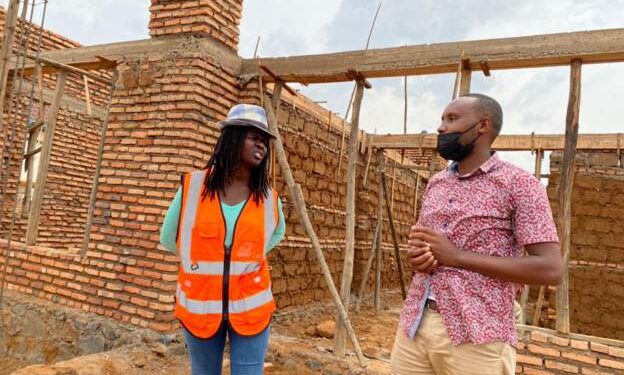
 Enatha Cyuzuzo is one of very few women site engineers in Rwanda’s booming construction sector.


At only 26, you will find her on sites supervising the men and women she employs, some far older than herself.

As a civil engineer, she ventured into construction in 2019 after graduating, setting up a company that bids for housing projects in eastern Rwanda.

One of her employees, 39-year-old Martine Nyiraharwa, says Ms Cyuzuzo is humble and respectful to her employees, which “makes it smooth working with her”.

Ms Nyiraharwa says her boss’s work has even inspired one of her children, and “now he wants to be an engineer just like her”.

Fidela Tuyishime, another employee, says she is “proud of working on a site supervised by a woman like me”.

Fidela Tuyishime
Fidela Tuyishime is proud of being supervised by a woman like herImage caption: Fidela Tuyishime is proud of being supervised by a woman like her

Ms Cyuzuzo draws house plans and leads their construction on sites.

She says this is a job that has been “very challenging” – because of a mindset that it is a male job and some men’s behaviour towards women.

“Some think that you cannot deal with a girl on a job only… You need to act like a man to be able to work with men and show them that you are a smart girl,” she says.

She wants to inspire more girls to join engineering and change the gender imbalance on construction sites.

………………………………………………………………

Canada removes anti-vax protesters from border bridge with US

WINDSOR, Ontario (AP) — Canadian police moved in to remove protesters Saturday at a bridge border crossing that has disrupted Canada-U.S. trade.


Protesters at the busiest border crossing between the United States and Canada remained despite new warnings to end the blockade that has disrupted the flow of goods between the two countries and forced the auto industry on both sides to roll back production.

A city bus and school bus arrived on the scene Saturday morning and police moved in formation toward them. One of the protesters used a megaphone to alert others that police were coming for the demonstrators, who are protesting against Canada’s COVID-19 mandates and restrictions. There is also an outpouring of fury toward Prime Minister Justin Trudeau.

“The Windsor Police & its policing partners have commenced enforcement at and near the Ambassador Bridge. We urge all demonstrators to act lawfully & peacefully. Commuters are still being asked to avoid the areas affected by the demonstrations at this time,” police tweeted.

Police move into position to enforce an injunction against a demonstration which has blocked traffic across the Ambassador Bridge by protesters against COVID-19 restrictions, in Windsor, Ontario.
VIA ASSOCIATED PRESS

About 20 protesters milled about outside early Saturday, while others remained in their pickup trucks and other cars. A judge on Friday ordered protesters at the Ambassador Bridge over the U.S.-Canadian border to end the blockade that has now entered a sixth day.

On Friday, Ontario Premier Doug Ford declared a state of emergency in the province that will allow his cabinet to impose $100,000 fines and up to one year in jail as punishments against people who continue to illegally block roads, bridges, walkways and other critical infrastructure.

Chief Justice Geoffrey Morawetz of the Ontario Superior Court issued an injunction giving protesters blocking cross-border traffic until 7 p.m. Friday to clear out. However, the deadline came and went.

Truckers and supporters block the access leading from the Ambassador Bridge, linking Detroit and Windsor, as truckers and their supporters continue to protest against COVID-19 vaccine mandates and restrictions, in Windsor, Ontario on Friday.
VIA ASSOCIATED PRESS

Windsor police immediately warned that anyone blocking the streets could be subject to arrest and their vehicles could be seized.

The news was met earlier with defiance by protesters.

At the Ambassador Bridge, an unidentified person grabbed a microphone and addressed the crowd, asking if they wanted to stay or leave when the deadline rolled around. By a show of applause, it was agreed they would stay. “OK,” the man said. “Let’s stand tall.” The protesters responded by singing the Canadian national anthem.

The Ambassador Bridge is the busiest U.S.-Canadian border crossing, carrying 25% of all trade between the two countries. The standoff comes at a time when the auto industry is already struggling to maintain production in the face of pandemic-induced shortages of computer chips and other supply-chain disruptions.

Protesters and supporters wave flags at a blockade at the foot of the Ambassador Bridge, sealing off the flow of commercial traffic over the bridge into Canada from Detroit.
COLE BURSTON VIA GETTY IMAGES

While the Canadian protesters are decrying vaccine mandates for truckers and other COVID-19 restrictions, many of the country’s infection measures, such as mask rules and vaccine passports for getting into restaurants and theaters are already falling away as the omicron surge levels off.

Pandemic restrictions have been far stricter in Canada than in the U.S., but Canadians have largely supported them. The vast majority of Canadians are vaccinated, and the COVID-19 death rate is one-third that of the United States.

Gillies reported from Toronto.

……………………………………………………………

When Telecommunications Collapse: What Angola's Mobile Network Crisis Teaches Us About Governance, Justice, and National Security

  The recent disruption of Angola's mobile networks has affected banking, digital payments, businesses, emergency communications, and mi...