Translate

Friday, 31 December 2021

Harry M. Reid, pugnacious Senate majority leader, dies at 82


Harry M. Reid, a Nevada Democrat who rose from a hardscrabble mining town to become one of the longest-serving Senate majority leaders in history and a political force during the presidencies of George W. Bush and Barack Obama, died Dec. 28 at his home in Henderson, Nev. He was 82.

The death was confirmed by David Krone, a former chief of staff. Mr. Reid was diagnosed with pancreatic cancer in 2018.

A combative but soft-spoken former amateur boxer, Mr. Reid displayed an economy of personal magnetism and embraced the art of the scrappy insult. Columnist Molly Ivins called him ­“charismatically challenged.” Obama, a friend and political ally, euphemistically remarked on his “curmudgeonly charm.”

Mr. Reid was never a commanding presence before a crowd or on television. Sometimes he was barely audible, and he tended to litter his speeches with awkward pauses. But he was the consummate inside player, exercising his political and legislative skills behind the scenes.

He was Senate majority leader from 2007 through 2014. Since the position’s creation in the 1920s, only two senators have held it longer: Democrats Mike Mansfield of Montana, from 1961 through 1976, and Alben W. ­Barkley of Kentucky, from 1937 through 1946.

After overcoming long odds to achieve political leadership, Mr. Reid was not one to apologize for being who he was.

Mr. Reid in 2010. (Melina Mara/The Washington Post)

“I didn’t make it in life because of my athletic prowess,” he said in his 2016 retirement speech, at the end of five terms in the Senate. “I didn’t make it because of my good looks. I didn’t make it because I’m a genius. I made it because I worked hard.”

Acknowledged even by Republican adversaries as a wily tactician and master of the Senate’s arcane rules, Mr. Reid notched his greatest legislative achievement in 2009, when he steered a landmark health-care bill through the Senate over solid GOP opposition.

In an effort to secure a filibuster-proof 60 votes, Mr. Reid spent hours behind closed doors, massaging the complex legislation and cutting deals with moderate Democrats. To ease the concerns of Sen. Ben Nelson (D-Neb.), for example, Mr. Reid agreed to a generous Medicaid reimbursement provision, specifically for Nebraska — a deal critics labeled the “Cornhusker kickback.”

Washington Post columnist David Broder called Mr. Reid’s dealmaking “crass and parochial,” but it worked. On Dec. 24, 2009, the Senate’s 58 Democrats and two independents voted to approve the Patient Protection and Affordable Care Act, commonly called Obamacare. After it passed the House of Representatives, Obama signed the bill into law in 2010.

2016: Take a tour of Las Vegas with Harry Reid
In this 2016 video, former Senate majority leader Harry Reid talks about his fight against the mob, an attempted car bombing, and his love of palm trees. (Dalton Bennett/The Washington Post)

As Senate minority leader under Bush, Mr. Reid was instrumental in blocking one of the president’s major second-term domestic initiatives, the partial privatization of Social Security. Although his animosity toward Bush was undisguised — he once called him a “loser,” for which he later apologized, and a “liar,” for which he did not — Mr. Reid as majority leader worked with the administration in 2008 to pass the $700 billion Emergency Economic Stabilization Act to shore up banks and other financial institutions threatened by the subprime mortgage crisis.

In the first two years of the Obama presidency, Mr. Reid shepherded a raft of major legislation through the Senate, including the $787 billion American Recovery and Reinvestment Act, to stimulate spending and job growth in the aftermath of the recession, and the Dodd-Frank law, to strengthen regulation of Wall Street and bolster consumer protection.

Mr. Reid’s legislative achievements tended to be overshadowed by the partisan rancor that increasingly gripped Congress during his time as majority leader. But despite the acrimony and gridlock, Post congressional reporter Paul Kane wrote in 2015, “His legacy will be defined just as much by his deft parliamentary maneuvers to push forward sweeping laws that might not have passed under different leadership.”

Mr. Reid, center, meets with President-elect Barack Obama and Vice President-elect Joe Biden in 2009. (Gerald Martineau/The Washington Post)

A trial lawyer, lieutenant governor and two-term member of the U.S. House before winning his Senate seat in 1986, he was certainly a competitor. But the trim, slightly stooped Mr. Reid was low-key in demeanor, and he professed a desire for bipartisan collaboration.

He liked to refer to his days in the ring, where he fought more than a dozen amateur middleweight matches while in college. “I know how to dance. I know how to fight,” he said when he was elected Democratic leader in 2004. “I’d rather dance than fight.”

But there was more Rocky Marciano than Fred Astaire in his political methods. As majority leader, he kept an increasingly tight rein on Senate proceedings, and his tactics drew angry criticism from Republicans that he abused his authority and smothered the rights of the minority.

One complaint was that instead of allowing Senate committees to write legislation, Mr. Reid too often oversaw the drafting process in his office and brought a measure to the floor as a take-it-or-leave-it package, using a parliamentary maneuver to prevent unwanted amendments.

He defended his tightly controlled approach as necessary to counter what he described as Republicans’ “mindless, knee-jerk obstruction” of the Obama agenda. His tactics also enabled Democrats to avoid casting votes on controversial measures that could be troublesome at election time.

“I was never running to be popular with Republicans,” he told reporters at the end of his Senate tenure. “I’ve had a job to do with President Obama. I’ve done the best that I can.”

In a letter Obama wrote to Reid before his death and released Tuesday evening, the former president said: “I wouldn’t have been president had it not been for your encouragement and support, and I wouldn’t have got most of what I got done without your skill and determination.”

Former Senate historian Donald Ritchie said Mr. Reid exercised as much influence as he could under Senate rules, a strategy aided by an increasing concentration of power in the majority leader’s office that began in the 1990s.

Mr. Reid meets with staff on Capitol Hill in 2005. (Melina Mara/The Washington Post)

Mr. Reid’s most controversial — and arguably most consequential — move came in 2013, after Republicans filibustered a series of Obama nominees. Under his guidance, Democrats pushed through a rules change lowering the threshold for confirmation (except for Supreme Court nominees) from 60 votes to a simple majority. Republicans railed against what Sen. Charles E. Grassley (R-Iowa) called a “complete and total power grab,” but Mr. Reid insisted that GOP intransigence left no other option.

Whatever the merits, Mr. Reid’s use of the “nuclear option” shifted power from the minority to the majority — and four years later allowed the Trump administration to move contested Cabinet and judicial picks through the GOP-controlled Senate. While Mr. Reid exempted Supreme Court nominees from the lowered threshold, the Republican majority, citing his rule change as precedent, extended the simple-majority requirement to the high court, leaving Democrats powerless to block the nominations of Neil M. Gorsuch, Brett M. Kavanaugh and Amy Coney Barrett. “God bless Harry M. Reid,” the late conservative columnist Charles Krauthammer, a Gorsuch supporter, wrote in 2017.

Adding Mr. Reid’s two stints as minority leader (2005 through 2006 and 2015 through 2016) to his eight years as majority leader, he led Senate Democrats for a dozen years. Some members of his party bristled at his strict management style. But he got high marks for keeping his fractious caucus united, and his hold on the leadership of the Democratic caucus was never seriously challenged.

To outsiders, he may not have been an obvious choice for the position. He lacked the smooth manner that plays well on Sunday TV talk shows, and although he moved leftward during his leadership years, he stood to the right of many in his party, especially on social issues. He opposed the 1994 assault weapons ban, favored outlawing so-called partial-birth abortions and voted to authorize the 1991 and 2003 U.S. wars against Iraq.

Mr. Reid, right, with Sen. Thomas A. Daschle of South Dakota in 2001. (Susan Biddle/The Washington Post)

But in six years as whip under Senate party leader Thomas A. Daschle of South Dakota, he had forged strong ties with fellow Democrats. After Daschle lost his 2004 reelection race, Mr. Reid moved quickly to succeed him as leader, nailing down enough support that his only potential competitor, Christopher J. Dodd of Connecticut, dropped out before the balloting.

A bleak upbringing

Harry Mason Reid was born Dec. 2, 1939, in Searchlight, Nev., about 60 miles south of Las Vegas. The town was once a thriving gold-mining center but later depended on prostitution as its main industry.

His father, who had not finished eighth grade, took mining jobs wherever he could find them. His mother did laundry for the brothels. They lived in a house built of railroad ties, with no indoor toilet, and went without medical care no matter how severe the need. His father — described by Mr. Reid as a brooding, reclusive binge drinker — fatally shot himself in 1972.

The town’s only school had one teacher and ended in the eighth grade. Mr. Reid’s class had six students, and “I graduated in the top third,” he quipped. For high school, he hitchhiked 45 miles to the city of Henderson, outside Las Vegas, living with relatives during the week and returning home on weekends.

In high school he met Landra Gould, a student one class behind him. To the chagrin of her parents, who were observant Jews, Landra and the “goy with no religion” fell in love, as Mr. Reid recounted in his 2008 memoir, “The Good Fight: Hard Lessons From Searchlight to Washington,” written with Mark Warren.

Mr. Reid was just shy of his 20th birthday when he and Landra eloped. In Utah, where they lived while he finished college, the couple converted to the Church of Jesus Christ of Latter-day Saints, but they also observed Jewish holidays in deference to her parents.

The Reids had a daughter, Lana Barringer, and four sons, Rory, Leif, Josh and Key Reid. Rory Reid, a past chairman of the powerful governing body of Clark County, Nev., which includes Las Vegas, was the Democratic nominee for Nevada governor in 2010. In addition to his wife and children, survivors include a brother; 19 grandchildren; and one great-grandchild.

Mr. Reid forged another important relationship in high school, with social studies teacher Mike O’Callaghan, who taught him to box and became his political mentor. O’Callaghan, a Democrat, later served two terms as governor of Nevada.

Mr. Reid received an associate’s degree in 1959 from what is now Southern Utah University, and he graduated from Utah State University two years later with a bachelor’s degree in history and political science. While in law school at George Washington University, he supported his growing family by working full time as a U.S. Capitol Police officer.

After graduating from law school in 1964, Mr. Reid returned to Nevada. In 1968 he was elected to the State Assembly, where he attracted notice with a flurry of legislative proposals. Two years later, the year O’Callaghan won the governorship, Mr. Reid was elected lieutenant governor.

In 1974 — the year of a Democratic electoral wave that followed the Watergate scandal — he ran for an open U.S. Senate seat convinced that he could not lose. He did, by 624 votes, to former governor Paul Laxalt (R). Mr. Reid then made what he later acknowledged was a foolhardy run for mayor of Las Vegas. He lost that race, too, and was now, as he put it, a “35-year-old has-been.”

In 1977, O’Callaghan appointed him to a four-year term as chairman of the Nevada Gaming Commission, which regulates the state’s lucrative gambling industry. Mr. Reid, who never gambled, knew little about casinos but soon learned about the business, especially its underside.

When a Las Vegas businessman tried to bribe him to support new gambling devices, Mr. Reid participated in an FBI sting that sent the man to prison. He received frequent death threats, and one day his wife discovered the family station wagon rigged with a bomb that had failed to explode.

In 1982, congressional reapportionment gave Nevada a second U.S. House district, and Mr. Reid easily won the new Las Vegas-based seat. Four years later, when Laxalt retired, Mr. Reid moved up to the Senate, where he became an aggressive defender of the state’s gambling industry and other interests. As a member of the Appropriations Committee, he secured for his state millions of federal dollars for roads, airports, military facilities, recreation and environmental improvements. In December, the Las Vegas airport was renamed in his honor.

One of his biggest efforts was fending off a long-standing federal plan to store the nation’s spent nuclear fuel at Nevada’s Yucca Mountain — a plan backed by Bush that did much to stoke Mr. Reid’s ill will toward him. (The Obama administration, sensitive to Mr. Reid’s political needs, blocked the Yucca Mountain project, and it has not been revived in the years since.)

Given Nevada’s swing-state status, Mr. Reid’s reelection was not guaranteed. In 2010, his leadership role and close identification with the Obama administration made him especially vulnerable. His GOP opponent, former state legislator Sharron Angle, led in early polling. But her hard-right views and campaign missteps cost her support even among Republicans, and Mr. Reid ended up winning by a comfortable margin.

Mr. Reid won his fifth and final Senate term in 2010. (Melina Mara/The Washington Post)
No ‘bloody nose’

In Washington, the Reids lived in a condo at the tony Ritz-Carlton hotel, and at the end of his Senate career, the couple owned real estate, mining claims, securities and other assets worth between $3.3 million and $7.3 million, according to the senator’s 2015 financial disclosure report.

From time to time during his Senate career, news reports suggested that Mr. Reid’s public role and private interests overlapped. In 2003, for example, the Los Angeles Times disclosed that the senator had pushed legislation benefiting Nevada entities that paid hundreds of thousands of dollars in lobbying fees to his sons’ and son-in-law’s firms. He denied any impropriety, and the episode quickly faded away, his leadership position undamaged. (Mr. Reid said he was helping his home state, not his family, though he subsequently barred relatives from lobbying his office.)

The Democrats’ loss of the Senate in 2014 demoted Mr. Reid to minority leader. The following New Year’s Day, he suffered broken ribs and serious eye and facial injuries in an accident while exercising in his home. Not long afterward, he announced he would not seek reelection in 2016.

After leaving the Senate, Mr. Reid was a fellow at the University of Nevada at Las Vegas law school. He also was co-chair, with former House speaker John A. Boehner (R-Ohio), of a public policy institute at UNLV funded by MGM Resorts International, a major player in Nevada gambling.

In his autobiography, Mr. Reid described his abilities as a boxer in words that could also serve as commentary on his public life.

“I could assess situations well, and I learned to recognize and exploit an opposing fighter’s weaknesses,” he wrote. “I could hit hard, and I could take a punch. But I never had a bloody nose.”

Mr. Reid speaks with reporters in 2008. (Richard A. Lipski/The Washington Post)

………………………………………………………

Warmest New Year’s Eve recorded in Somerset ushers in 2022


Britain has seen its hottest New Year’s Eve ever with temperatures reaching 15.8C (60.4F) in the west of England, the Met Office has said.

The previous record of 14.8C (58.6F) in Colwyn Bay, Wales, in 2011 was toppled this afternoon in Somerset.

Temperatures will continue to rise across England before dropping at night as the UK rings in 2022.

Areas of southern and eastern England including the West Country and London will see the mildest weather.

The Met Office said the extremely mild spell was driven by a flow of warm, moist air from the Canary Islands.

The BBC is not responsible for the content of external sites.View original tweet on Twitter

Met Office spokesperson Stephen Dixon said the first reading taken at Ryehill in East Yorkshire at 11:00 GMT had “provisionally broken the New Year’s Eve record”.

“Our station at Ryehill, a small village in East Yorkshire has recorded 14.9C (58.8F) today, which tops the previous record of 14.8C (58.6F).”

That figure has since risen to 15.8C (60.4F) and was last recorded at the Met Office’s station in Merryfield in southwest Somerset.

The Met Office said the weather was forecast to get cooler from Tuesday, potentially bringing wintry showers and frosts.

2px presentational grey line
Analysis box by Roger Harrabin, Environment analyst

Forget your fleece and coat – it’s liberating to take a pleasant New Year’s Eve stroll in just your T-shirt.

But it doesn’t bode well for the future.

The Met Office say the UK’s record temperatures have all been elevated by manmade climate change which has raised temperatures globally by 1.1C.

Cold records are still being broken, as in the Beast from the East storm in 2018.

But the Met Office say warm weather records are being broken nine times more frequently – a clear sign of an over-heating planet.

The winter wildfires in Colorado are even arguably more alarming than unseasonal warmth in the UK.

It’s too soon to say what role human-driven climate change may have played in the disaster – but it’s the latest episode of regular weather patterns being disrupted.

Meanwhile, different regions of Alaska are experiencing record high and low temperatures at the same time.

Climate scientists warn that we can expect many more extremes as the planet continues to heat. And attempts to reduce emissions have been undermined by several factors, including President Biden’s struggle with climate policies in the USA.

2px presentational grey line

The highest UK daytime temperature recorded on New Year’s Day is 15.6C (60F) in Bude, Cornwall, in 1916.

Met Office chief forecaster Steve Ramsdale said: “The current weather pattern is bringing extremely mild conditions to the UK – perhaps reaching around 16.0C (60.8F) in some parts.

“We also expect some very mild overnight temperatures as well with minimum temperature records being broken in places.”

The Met Office added the warm spell has the potential to challenge records for New Year’s Day, creating the unusual situation of one weather system perhaps breaking weather records for two days in separate calendar years.

……………………………………………………………

Citroën Egypt advert accused of normalising sexual harassment


French car manufacturer Citroën has been accused of normalising sexual harassment in an advertisement in Egypt that features the pop star Amr Diab.

In the video, Diab uses a camera on his car to photograph a woman crossing the road, apparently without her consent. They are later seen driving together.

The advert was released on 3 December but it has been criticised on social media in recent days.

The Egyptian-American journalist Reem Abdellatif described it as “creepy”.

“Who thought it would be a good idea to make an ad that enables sexual harassment in a country where 98% of women reported getting harassed at some point in their lives?” she wrote on Twitter.

Writer Amal Alharithi tweeted: “What’s painful about Amr Diab’s advert is that the entire crew did not realise the mistake. No-one in the crew objected to taking pictures of girls in the streets without their consent. This is so sad.”


A comment on Citroën Egypt’s Instagram account warned the company that men watching the advert might mistakenly believe taking an unsolicited photo of a woman could lead to a date, when in fact they could face prosecution and imprisonment.

Neither Citroën nor Amr Diab have so far commented on the criticism.

(October 2018) Five Egyptian women shared their stories of sexual harassment and abuse with BBC Arabic

In recent years, dozens of women inspired by the #MeToo movement have spoken out on social media about their experiences of sexual harassment and assault in Egypt.

The country’s parliament approved harsher penalties for sexual harassment in July, amending the penal code to make it a felony and increasing the penalty to a minimum of two years in prison instead of six months, alongside a fine of between $6,370 (£4,740) and $12,740 (£9,480).

However, Egyptian authorities have been accused of frequently failing to investigate and prosecute men accused of sexual harassment or assault against women and girls.

A UN study in 2013 found that 99.3% of girls and women in Egypt said they had experienced some form of sexual harassment in their lifetime.

……………………………………………………………

Covid: Some schools to plan for home learning, says FM


Some schools need to start planning for pupils to return to online learning, Wales’ first minister has said.

Mark Drakeford said teacher and staff illness meant some pupils would return to home learning, but decisions would be made by individual councils, rather than the Welsh government.

Schools in Wales were told to take two planning days next week to prepare for the new term due to rising Covid cases.

A head teachers’ union said there must be enough lateral flow tests.

Wales’ Education Minister Jeremy Miles warned all schools may be unable to open fully.

Mr Drakeford said the decision on whether schools could fully reopen was best made by “people who are as close to it as possible” as “different schools face different challenges”.

He added: “We’ve asked schools to prepare for how they can reopen and have children back in the classroom – what level of protections do they need to build in for that?

“But in some places, because teachers are ill and other school staff aren’t able to be there, they will have to plan for some period where some children will have to be taught remotely again.”

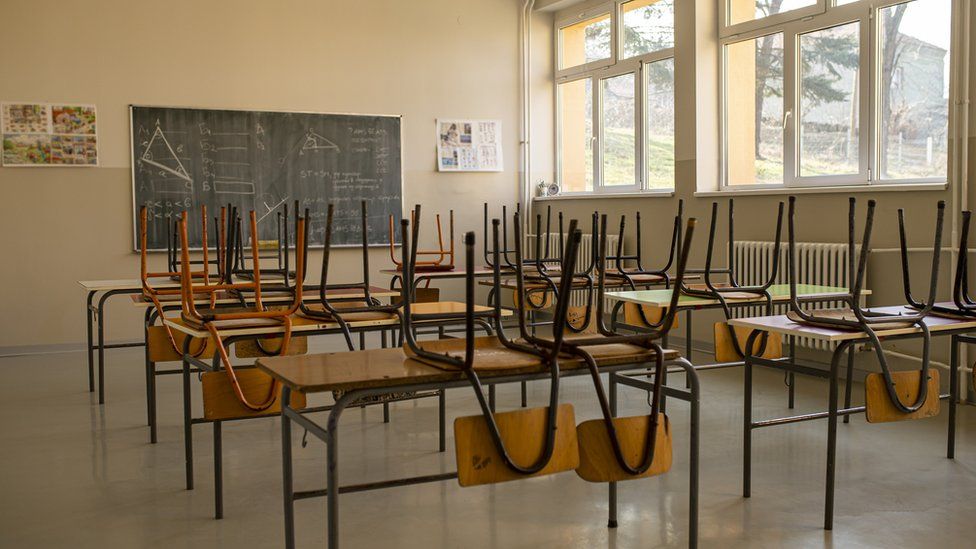
Empty classroomIMAGE SOURCE,GETTY IMAGES
Image caption,

Schools are reopening later than normal after the Christmas break to make plans for online learning

All pupils are due back by 10 January, but some councils announced before Christmas that they were planning to open sooner.

Councils which have said most pupils would be back on 6 January, after two planning days, include Bridgend, Cardiff, Rhondda Cynon Taf, Swansea, Newport, Monmouthshire, Blaenau Gwent and Torfaen.

Pupils are expected back in class on 10 January in Anglesey, Gwynedd, Conwy, Denbighshire and Flintshire.

Ceredigion pupils are set to return on 7 January, while Pembrokeshire council said individual schools would update parents.

Powys is the only local authority so far to confirm there will be remote learning at the start of term.

The council said pupils would be taught online from 7 January before returning on site “dependent on coronavirus levels” on 10 January.

What has the reaction been?

Laura Doel, director of head teachers’ union NAHT Cymru, said: “The availability of staff is the biggest threat to education in January. Without the workforce fit and well, learners cannot go back to the classroom.

“If regular LFTs are to be part of the package of mitigations it is vital that schools have a supply ready for reopening.”

She added remote learning should be a “last resort”.

A headteacher in Carmarthenshire said any decision to fully reopen schools next week or move to online learning would have to be taken “at the last minute”.

Headteacher Dr Llinos Jones, of Ysgol Bro Myrddin in Carmarthen, said she was planning “for the worst while hoping for the best”.

Dr Jones said the biggest challenge was uncertainty over staffing levels: “We won’t know until the morning or the night before if (for example) 10 members of staff have caught Covid.

“It’s really unfortunate… but the decision has to be made at the last minute.”

At the moment, her school is due to reopen on 6 January.

Plaid Cymru Member of the Senedd (MS) Heledd Fychan called for “clear, national guidance and leadership” from the Welsh government on the reopening of schools rather than “the ambiguity and uncertainty that might come” with a case-by-case approach.

“The return of schools in January will be set against a challenging backdrop of rising Covid cases and an already stretched education workforce,” she added.

Lateral flow testIMAGE SOURCE,GETTY IMAGES
Image caption,

Secondary age pupils and all school staff have been urged to use lateral flow tests three times a week in the new term

Welsh Conservative education spokeswoman Laura Jones MS said: “It has been estimated that some students have missed out on up to 12 weeks of learning, with Wales having the most absent days of school during the pandemic in the UK.

“It is essential that the pandemic doesn’t define our young peoples’ futures and that priority is given to ensuring their educational recovery from the devastation of the last 18 months.”

Dr Gareth Evans, director of education policy at the University of Wales Trinity St David, said it was “only sensible” for the Welsh government to implement contingency plans and he was only “surprised it’s taken this long” to announce.

He added that it was nothing new and schools were now in much better place to transition to blended learning if needed, due to the experience they have had over the last two years.

“This has been going on for the past couple of years, when staff have gone down with positive tests they’ve had to isolate and their pupils in very many cases needed to learn from home,” Dr Evans said.

‘A major challenge’

Education Minister Jeremy Miles has previously warned that staffing could be a major challenge for schools, in light of an expected increase in Covid cases.

In the autumn term, some schools moved classes or year groups online for short periods because of staff shortages, and several local authorities switched to remote learning for the final days before Christmas.

He wrote to schools before Christmas saying reintroducing bubbles and “potentially pausing after school/breakfast provision, or team sports where necessary” could be necessary.

Schools were also urged to have “robust plans in place to move to remote learning”, whether it be for individual classes, year groups or the whole school.

Secondary school pupils and all school staff have been urged to take three lateral flow tests a week in the new term.

Updated guidance is due before the start of the new term.

…………………………………………………………


Africa Centre for Health Policy worried over delay in commencing Agenda 111 projects


The Africa Centre for Health Policy (ACeHP) has warned that government may not meet its completion deadline for the construction of health facilities under the Agenda 111 projects.


Executive Director at ACeHP, Ahmed Farhan says checks across the country indicate no sign of progress at the project sites.

The ambitious Agenda 111 project includes 101 district hospitals, six regional hospitals in the newly created regions, two specialised hospitals in the middle and northern belts, as well as a regional hospital in the Western Region and the renovation of the Effia-Nkwanta Regional Hospital.

Its objective is to provide quality healthcare delivery at the district level.

Government has so far secured a $100 million start-up fund through the Ghana Investment Infrastructure Fund (GIIF) for the commencement of the projects.

In August 2021, President Nana Akufo-Addo cut sod in the Ashanti Region to signal the beginning of hospital projects across the country.

However, speaking to Citi News, Ahmed Farhan who believes that the project is well intended for the good of Ghanaians, noted that any delays will further worsen the country’s health care delivery system.

“I doubt if we will be able to meet the set timelines. It will definitely affect the project lifecycle. The 12-month target that has been set, I presume, will not be to be met. Currently, I think they have been faced with certain challenges that will not permit them to kickstart the physical construction of the hospitals, so I think the 12 months they have set will just not be possible.”

He also alleged that financial constraints could be blamed for the delay in the execution of the various projects.

“What the government needs to do is to make the commitment in constructing those hospitals and injecting the seed capital for the works to be done. Most of the contractors we got in touch with do not want to disclose information, but the indication is that, they do not have capital available to move to site and that is what is delaying the start of the project.”

……………………………………………………………


Ugandan author of The Greedy Barbarian detained – lawyer


Ugandan author Kakwenza Rukirabashaija, who won a prestigious prize this year for courageous writing, has been detained, his lawyer has confirmed.

The reason for his arrest is unclear, but he has recently been scathing about President Yoweri Museveni and his son Lt-Gen Muhoozi Kainerugaba on Twitter.

He described the general as “obese” and said “the Musevenis have imposed enormous suffering on this country”.

The BBC has contacted the police for comment.

They have not yet confirmed Rubirabashaija’s arrest but his lawyer Eron Kiiza said he was being held by the police crime intelligence agency in a suburb of the capital, Kampala.

Mr Kiiza added that he has not been able to gain access to the author, and he had not yet been charged.

In his last Facebook post before he was take away on Tuesday, Rubirabashaija wrote: “I’m under house arrest. Men with guns are breaking my door. They say they’re policemen but are not in uniform. I’ve locked myself inside.”

Rukirabashaija won this year’s Pen Pinter Prize’s International Writer of Courage award.

He is best known for The Greedy Barbarian, a satirical novel which describes high-level corruption in a fictional country, and Banana Republic: Where Writing is Treasonous, an account of the torture he was subjected to while in detention in 2020.

President Museveni, 77, has been in power in Uganda since 1986, and there has been long-standing speculation that he was grooming his son – a powerful figure in the military – to succeed him.

The opposition Forum for Democratic Change (FDC) party has condemned Rukirabashaija’s arrest, urging that he be freed.

The author’s handle and the hashtag #FreeKakwenza are trending on Twitter in the East African nation.

………………………………………………………

The 2026 AFRICA EDUCATES HER CAMPAIGN REPORT - ANGOLA 6th Anniversary | 2020–2026

  Meet who's behind this cause     Support us:  https://donate-sofonie.netlify.app/           AFRICA EDUCATES HER CAMPAIGN REPORT — ANGO...