Translate

Tuesday, 23 November 2021

Energy firm Bulb set to go into administration


Bulb Energy, which has 1.7 million customers, has announced that the firm will be put into administration.

It is the largest UK energy company to face difficulties following a sharp rise in wholesale gas prices this year.

Bulb will become the first energy company to be placed into “special administration”, where it is run by the government through the regulator Ofgem.

“Customers of Bulb do not need to worry – Bulb will continue to operate as normal,” Ofgem said.

“Customers will see no disruption to their supply and their account and tariff will continue as normal. Bulb staff will still be available to answer calls and queries.”

The special administration measure is only used if Ofgem is unable to find another company to take over an energy firm’s customers. The regulator said it was planning to apply to a court to appoint an administrator who will run the company.

Bulb said energy supplies were “secure and all credit balances are protected”.

Bulb is the UK’s seventh biggest energy company and has 1,000 staff. It has been trying to shore up its finances for several weeks.

‘Service continues’

Ofgem set up the Special Administrator Regime (SAR) for when an energy company goes bust but is too big to have its customers transferred to another firm.

The aim of the regime is to stop financial failure spreading across the industry.

A Bulb spokesperson said taking this route means the company “will continue to operate with no interruption of service or supply to members”.


2px presentational grey line
Analysis box by Kevin Peachey, Personal finance correspondent

Provision for special administration, owing to the collapse of a major player in the UK energy sector, has been part of the law for 10 years.

It had never been needed until now.

So, this decision will be a hugely significant moment in this gas crisis. But it is one to which customers of Bulb are being urged to respond by remaining calm and essentially doing nothing.

It is written into the rules that a special administrator, unlike an ordinary administrator, has an obligation to consider consumers’ interests as well as those of creditors who are owed money by Bulb.

It means customers have short-term certainty that their supply, their current tariff, their credit balance and their bills will continue as normal. That means switching now would be a bad, and expensive, idea.

Longer-term, some of that certainty diminishes as decisions are made about the future sale or wind-up of the company.

2px presentational grey line

Under the SAR scheme, the government can make grants and loans to the company while its future is sorted out.

It could come in the shape of a takeover by another company, selling parts of its business or customers being transferred to another firm.

Sarah Coles, a personal finance analyst at Hargreaves Lansdown, said that in effect it meant the “taxpayer is likely to take the strain, so we might all end up paying a price”.

Ofgem has not yet applied to the court for the SAR regime to begin – this is likely to happen and be approved in the coming days.

A host of energy companies have gone bust over the last three months as wholesale gas prices have soared, affecting nearly four million customers.

The UK’s energy price cap – which limits what providers can charge – has exacerbated the problem, firms say.
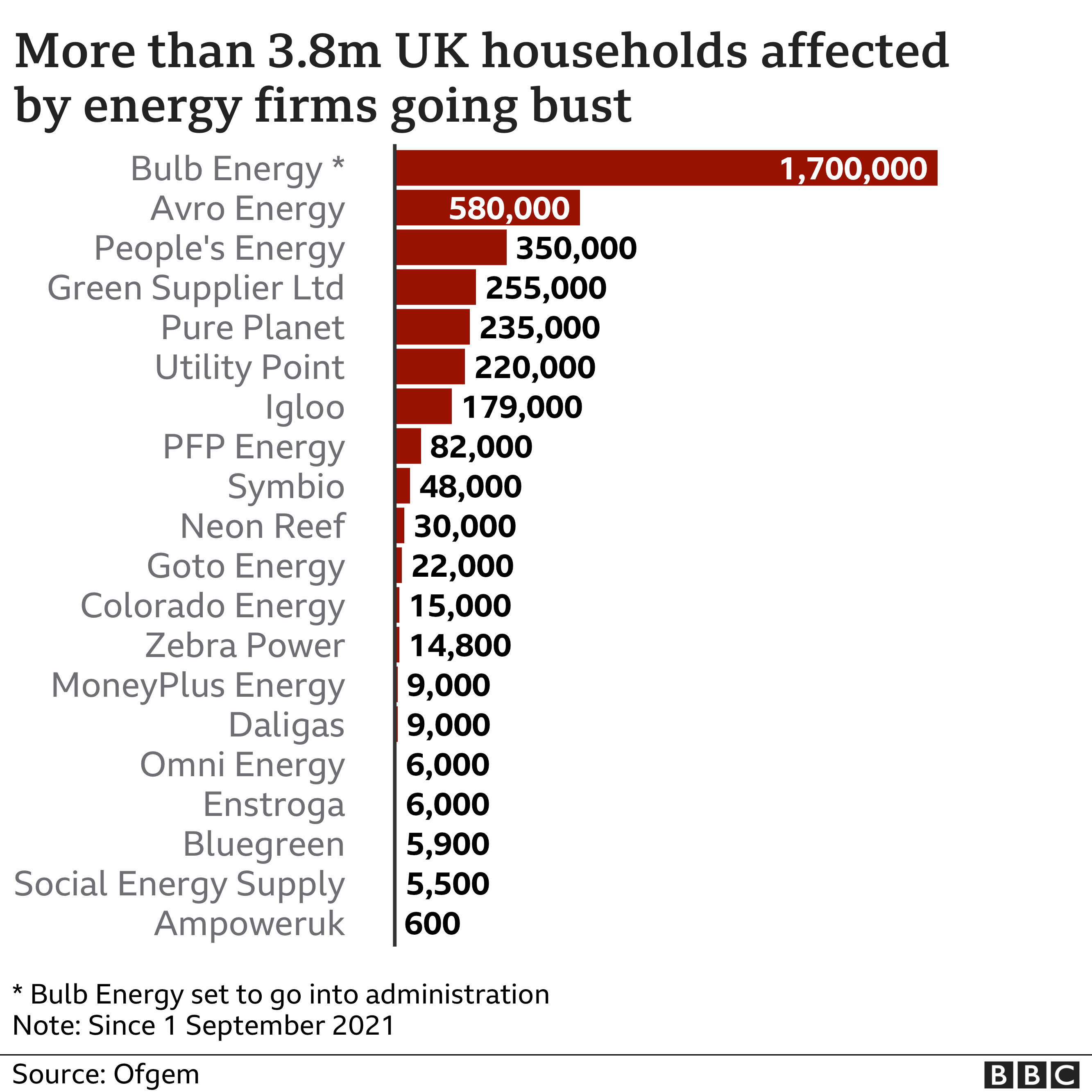
Customers affected by UK energy crisis

On Monday, Ofgem said British Gas would take on customers from Neon Reef and Social Energy Supply, which went bust last week. The two firms had a combined 35,000 customers.

Justina Miltienyte, an energy policy expert at Uswitch, said the failure of Bulb signalled the “tipping point” of the UK energy crisis.

“It’s not just Bulb’s size as the seventh largest supplier that makes this so significant. Unlike some of the smaller suppliers who recently ceased to trade, Bulb operated with a strong business model combined with a competitive offering for consumers,” she said.

“Ultimately this demise wasn’t caused by a badly run business model. Instead, Bulb was choked off by the way the government decided to structure the current energy market with the price cap.”


line
Gas hobIMAGE SOURCE,GETTY IMAGES

What happens if your energy supplier goes bust?

  • Customers will still continue to receive gas or electricity even if the energy supplier goes bust. Ofgem will move your account to a new supplier, but it may take a few weeks. Your new supplier should then contact you to explain what is happening with your account
  • While you wait to hear from your new supplier: check your current balance and – if possible – download any bills; take a photo of your meter reading
  • If you pay by direct debit, there is no need to cancel it straight away, Citizens Advice says. Wait until your new account is set up before you cancel it
  • If you are in credit, your money is protected and you’ll be paid back. If you were in debt to the old supplier, you’ll still have to pay the money back to your new supplier instead
line

Bulb said the crisis meant it was unable to raise the financing it needed from investors to keep on operating.

The London-based firm, which caters to 5-6% of the UK energy market, had been in talks with multiple parties but failed to secure funding.

“The rising energy crisis… has concerned investors who can’t go ahead while wholesale prices are so high and the price cap – designed to protect customers – currently means suppliers provide energy at a significant loss,” Bulb said in a blog on its website.

Bulb was founded in 2015 to compete with the Big Six energy firms and claimed to offer cheaper and greener electricity than its rivals.

It grew quickly and launched divisions in France, Spain and the US, which will continue to trade.

In mid-September the company appointed investment bank Lazard to look into restructuring options, saying: “From time to time we explore various opportunities to fund our business plans and further our mission to lower bills and lower CO2.”

These options reportedly included a joint venture or merger with another firm, and a cash injection from existing shareholders.

……………………………………………………………

Military uniforms now the new dress code for Guinean government officials


New Guinean president and military leader Col. Mamadou Dounbia appointed a new civilian prime Minister today but there is one caveat – he must wear military uniform.


Doumbia made history today by compelling all senior government officials including new Prime Minister Mohamed Beavogui to heed the new dress code of military uniform.

With a previously announcement of a with-us-or-against-us stance with past government officials, it is unclear if those selected to serve in the government have the option of declining the offer.

All new appointees were also compelled to undergo military training prior to assuming office.

Here are some pictures of the new Guinean government officials:


…………………………………………………………

Nine Burkinabe soldiers ambushed and killed by Jihadists


Jihadists in Burkina Faso ambushed and killed nine soldiers of the Burkinabe Army early Monday morning further heightening security situation in the West African country.


According to the Superior Commander of the Burkinabe Army, four soldiers were wounded and as many as eight were still missing at the time of this report.

Burkina Faso has been battling Jihadist insurgency for a few years now and there doesn’t appear to be a solution in sight. It has now become commonplace for Jihadists to ambush and kill soldiers of the Burkinabe Army, and sometimes attack whole villages.

DNT News with Correspondence Reporting from Julius Ouya.

…………………………………………………………


Monday, 22 November 2021

Zane Gbangbola: Landfill concerns raised before flood death

 Concerns were raised in 2010 over a former landfill site which later became the focus of a dispute over a seven-year-old’s death, it has emerged.


Zane Gbangbola died during flooding in 2014. His parents say he was killed by gas washed out of the Chertsey dump.

Spelthorne council recently discussed the concerns raised in a 2010 report, but said it may not be made public.

The council said studies since 2014 showed the site carried “less potential risk” than previously thought.

Zane’s parents, Kye Gbangbola and Nicole Lawler, dispute an inquest which found their son died from carbon monoxide from a pump used to clear flood water, and have always said the pump was not in use.

Zane's parents and campaigners
Image caption,

Zane’s parents (left) and campaigners gathered at Westminster last year

The 2010 report was prepared as part of a planning application by the Environment Agency to rebuild a lock keeper’s hut next door to Zane’s house.

It was not publicly available on Spelthorne Borough Council’s planning portal, but the BBC obtained a copy from the authority.

The document said “potential contaminants of concern” from the historic landfill site included carbon dioxide and methane generated by landfill material, as well as leachable contaminants such as heavy metals.

‘Danger is great’

The BBC showed a copy to environmental expert Paul Mobbs who said it was not based on any specific data but rather information about how the land was used.

He said the land had an unlined landfill site next to five metres of uncemented gravel which was in contact with the Thames, and the landfill would at some point leak.

Mr Mobbs warned: “At some point there will be another flood and then it will happen all over again.”

At a recent council meeting it was revealed several families were taken to hospital on the night Zane died.

Mr Gbangbola said the site was dangerous, adding: “The land has migrating gases and the danger is great to properties during floods.”

Thames floods at ChertseyIMAGE SOURCE,GETTY IMAGES
Image caption,

Chertsey was hit by devastating floods in 2014

A spokesman for Spelthorne council said officers carried out an assessment after Zane’s death to determine whether the landfill site contained “substances and a pathway that could cause significant harm to people and/or the environment”.

He said no evidence was found to suggest this was the case.

The 2010 report was based on information known at the time, when it was assumed the site contained Class 2 waste, the spokesman added.

“Since 2014, further information has been gathered as a result of the council’s work mentioned. The result of this shows that the type of waste accepted at the site was actually Class 1 type waste and not Class 2. Class 1 waste carries less potential risk.”

He said the assumption that there was Class 2 waste in the dump could have led the authors of the 2010 report to be “overly precautionary in their conclusion”.

The BBC has gone back to the council to ask when the new information was gathered, where it came from, whether it followed a desk-top study or site investigation, whether it relates to an existing or historic waste licence and what action followed as a result of the findings.

A spokesman for the coroner said “an independent, full, frank and fearless inquest” concluded in 2016 and heard from more than 70 witnesses over six weeks.

The spokesman added: “Having considered all the evidence that was before the court, the coroner concluded that the cause of Zane’s death was carbon monoxide toxicity. We would like to offer our sincere condolences to Zane’s family and friends.”

An Environment Agency spokesman said: “Our thoughts remain with the Gbangbola family. During the inquest the Environment Agency provided evidence to assist the independent coroner in reaching his conclusions.”

………………………………………………………

13-year-old Burkinabe boy shoots down French drone with slingshot

 A 13-year-old boy from Burkina Faso is being hailed as a hero for using a slingshot to shoot down a French army drone last Saturday near the city of Kaya, which is about 103 kilometers north northeast of Ouagadougou.


It all started with journey by a convoy of the French Army from Abijan in Cote d’Ivoire on its way to the Nigerien capital of Niamey.


After having crossed the border between Cote d’Ivoire and Burkina Faso, all seemed fine as the convoy travelled through the latter country. but at the town called Kaya, the convoy encountered angry protesters who accused the French Army of supplying jihadists who have tormented parts of Burkina Faso for years now.

The fast growing crowd of protesters even demanded to open a container belonging to the French Army but it’s not clear if they found anything to confirm their suspicion according to reports by DNT correspondent.

The situation degenerated into a high tension variety prompting the French Army to fire warning shots into the sky. That didn’t work so they deployed a drone to capture aeriel video to access the situation.

that’s when the 13-year-old boy (name unknown) used his slingshot to shoot down the drone.

The French Army convoy eventually turned back and returned to the capital of Ouagadougou, where they were able to catch a plane and fly to Niamey.

DNT News, with correspondence reports from Julius Ouya, Kaya, Burkina Faso.

……………………………………………………………

When Telecommunications Collapse: What Angola's Mobile Network Crisis Teaches Us About Governance, Justice, and National Security

  The recent disruption of Angola's mobile networks has affected banking, digital payments, businesses, emergency communications, and mi...