Translate

Sunday, 17 October 2021

Sir David Amess: Welsh politicians highlight ‘alarming incidents’


Sir David Amess: Welsh politicians highlight ‘alarming incidents’

A Welsh Labour MP said he has been subjected to “another death threat”.

Rhondda MP Chris Bryant has also raised concerns about MPs’ security in a Guardian article following the killing of Conservative MP Sir David Amess.

Mr Bryant said he received the threat after tweeting that people should be kinder to those they do not agree with.

Welsh Secretary Simon Hart said he had also spoken with other MPs this weekend who had faced “alarming incidents”.

Speaking on the BBC Politics Wales programme, Mr Hart, the MP for Carmarthen West and South Pembrokeshire, said that MPs “pride themselves on the fact that they are open and are available” so any response to Sir David’s killing does not “compromise those basic ambitions that we all have”.

Mr Bryant said it was time to “get serious about MPs’ security away from the parliamentary estate”.

“That starts with the police. My local police have always been great in dealing with threats of violence to me. But I know from colleagues that this is patchy,” he said in the article.

The BBC is not responsible for the content of external sites.View original tweet on Twitter
1px transparent line

Lindsay Hoyle, the Speaker of the House of Commons, has said he is working “at pace” with police and the home secretary to find ways to improve safety for MPs.

Liz Saville-Roberts, Plaid Cymru MP for the rural Dwyfor Meirionnydd, told Politics Wales the size of her constituency meant it was “a real challenge in practical terms to have the police present with us”.

The Senedd Commission has called a meeting to allow Members of the Senedd to discuss security concerns at the Welsh Parliament.
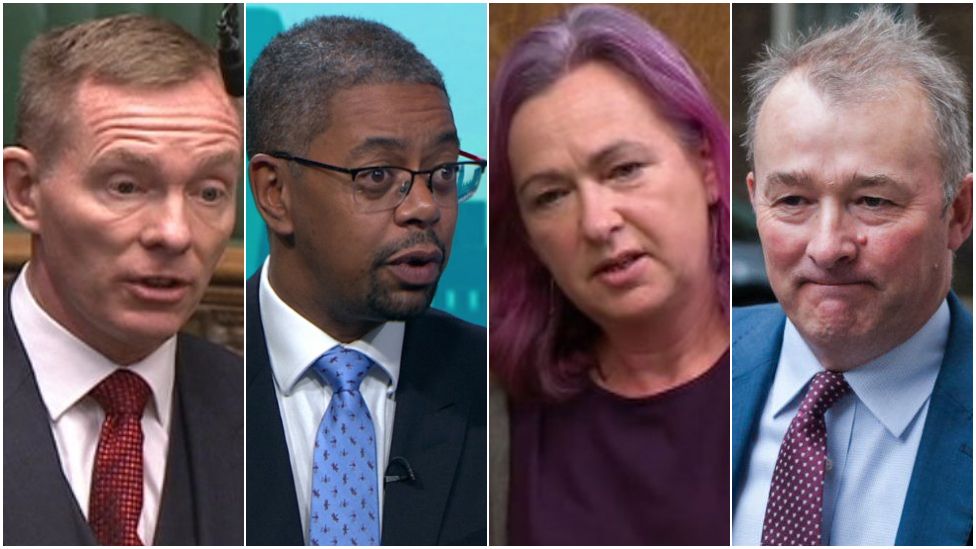
Politicians Chris Bryant, Vaughan Gething, Liz Saville-Roberts and Simon Hart
Image caption,Politicians Chris Bryant, Vaughan Gething, Liz Saville-Roberts and Simon Hart

Economy Minister Vaughan Gething said: “I certainly have thought more about what I do when I’m going about my business not just as an elected representative… but also just in my normal life as well.

“I didn’t have to think about that when I was first elected but I do need to think about it now,” said the Labour Member of the Senedd for Cardiff South and Penarth.

“There’s been a harder edge to some of the language that’s used, both online but also with the recent demonstration outside the Senedd.”

Protesters gathered outside the Senedd’s buildings following a knife-edge vote on Covid passes, chanting “shame on you” following the result.

And in July there was cross-party condemnation after anti-lockdown protestors gathered outside the home of First Minister Mark Drakeford.

………………………………………………………

David Amess death: MPs could get police guards at surgeries

 Giving MPs police guards at local meetings is one of a “range” of steps that could protect politicians, Priti Patel has said after an MP’s killing.

David Amess death: MPs could get police guards at surgeries

The death of Sir David Amess has raised concern over the safety of politicians and the abuse they receive online.

The home secretary said she and Commons Speaker Sir Lindsay Hoyle were working on “practical” measures to protect MPs.

But she stressed action should be “proportionate to the risk” and that MPs should remain “accessible”.

She added that any action against anonymous social media accounts, which could be used for “pro-democracy” reasons, should be “balanced”.

Speaking to the BBC’s Andrew Marr, she said it “wasn’t just about MPs” adding that children had been “subject to the most appalling hate and abuse online”.

She said the government’s Online Harms Bill offered an opportunity for all politicians to come together to close “the corrosive space online where we see just dreadful behaviour”.

Sir David, 69, was stabbed at Belfairs Methodist Church in Leigh-on-Sea on Friday, where he had been meeting members of the public.

A man arrested by police after the killing is Ali Harbi Ali, a 25-year-old British citizen of Somali heritage, Whitehall officials have told the BBC.

Police say he is being held at a London police station under the Terrorism Act 2000.

The BBC has been told that some years ago he was referred to the government’s counter-extremism programme, Prevent which aims to de-radicalised people.

Teachers, members of the public, the NHS and others can refer individuals to a local panel of police, social workers and other experts who decide whether and how to intervene in their lives.

It is believed that Mr Ali was not in the voluntary scheme for long and was not on MI5’s current watch list.

‘Dear friend’

Ms Patel described hearing the news that Sir David had died, saying “frankly our worlds were shattered”.

She said the MP had been a “dear friend” whose “infectious personality” meant that he “touched so many lives”.

The attack has prompted questions about whether MPs should continue to meet constituents face-to-face without police protection – with one Conservative MP suggesting in-person surgeries should be temporarily paused.

Most MPs hold weekly surgeries in their local area, often in public buildings such as libraries where their constituents can seek help or advice.

Speaking to the BBC’s Andrew Marr, Ms Patel said MPs were “here to serve” and to be “accessible to the British public” but that there was “a way to do things differently around surgeries”.

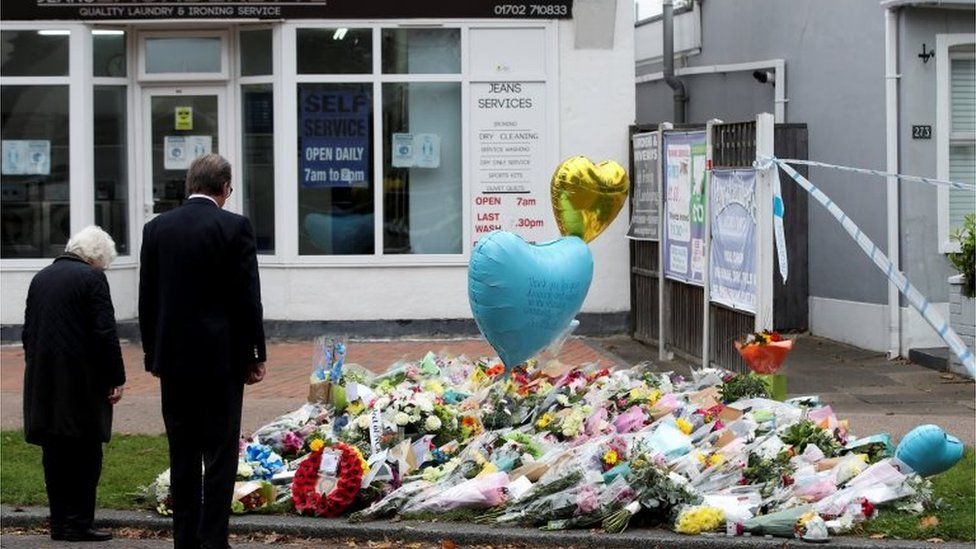
David Amess tributesIMAGE SOURCE,REUTERS
Image caption,Local residents have left tributes Sir David in Leigh-on-Sea

She added that MPs could protect themselves by only seeing constituents who have pre-booked an appointment and making sure to check the backgrounds of the individuals.

Asked about whether MPs should be offered police protection when holding constituency meetings, Ms Patel said there were a “range of measures available” to politicians.

“This isn’t about just saying let’s just go for option A — have bodyguards or security,” she said adding that any action should be “proportionate” to the risk faced by each individual MP following a one-to-one assessment between an MP and the police.

Speaker of the House of Commons Sir Lindsay Hoyle has also said he is working “at pace” to improve the safety of MPs.

Writing in the Observer and the Mail on Sunday, he said he didn’t want MPs to stop meeting their constituents but that it was necessary “to take stock and review whether those measures are adequate to safeguard members, staff and constituents, especially during surgeries”.

He also called for an end to “the hate which drives… attacks” against MPs.

“If anything positive is to come out of this latest awful tragedy,” he said, “it is that the quality of political discourse has to change. The conversation has to be kinder and based on respect,” he said.

What security is currently in place?

Most MPs do not get close protection while in their constituencies, but security was increased following Ms Cox’s killing.

All MPs were offered panic buttons, extra lighting, additional locks and emergency fobs at their homes and constituency offices.

The spending on such measures soared from £170,576 in 2015-16 to £4.5m two years later.

‘Lifesaving’

Asked about the role of social media, Ms Patel said the culture department was leading work into online abuse, but that she was “absolutely vigorous” when speaking to tech companies such as Facebook and Twitter.

She said there had to be a “proportionate” and “balanced” approach to the issue of anonymous use of social media.

Labour’s shadow foreign secretary Lisa Nandy agreed that it was right to be “cautious” about ending anonymity online, arguing that it was “lifesaving” for some campaigners such as whistleblowers or campaigners in Belarus and Hong Kong.

However, she said people should be “held to account for what would be criminal behaviour in the real world if they indulge in it online”.

“The trick is to get the right balance,” she said adding that the government had “dragged its feet on this for years”.

She also said there should be penalties for executives of social media companies who failed to tackle abuse on their platforms.

Both Labour and the Liberal Democrats have said they would not put up candidates against the Conservatives when a by-election is held in Southend West.

……………………………………………………………

Meteorite crashes through home, lands in sleeping woman’s bed


Canada woman Ruth Hamilton narrowly missed getting hit by a meteorite that crashed through her roof and landed between her pillows.

A woman in British Columbia had a cosmically rude awakening earlier this month when a meteorite crashed through her ceiling and landed in her bed.


Ruth Hamilton, 66, told The New York Times that around 11:35 p.m. on Oct. 3, she woke up to her dog barking, then heard what she described as “an explosion.” Flicking on the light, she saw a hole in her ceiling and thought a falling tree must have hit the house. It wasn’t until she called 911 and was talking to an operator that she spotted a 2.8-pound meteorite between her pillows.
   
“I didn’t feel it,” Hamilton, who lives in the town of Golden, told CTV Vancouver. “It never touched me. I had debris on my face from the drywall, but not a single scratch.”


When Hamilton first saw the space rock, though, she didn’t know what it was. Police who responded to the scene first consulted with a nearby construction crew, thinking it could be debris from some kind of blast.
Workers said they hadn’t been blasting, but had seen a “bright ball in the sky,” police told CTV ― suggesting that the rock in Hamilton’s bed may have fallen from space. Researchers at the University of Western Ontario later confirmed the projectile was indeed a meteorite.

“I was shaking and scared when it happened, I thought someone had jumped in or it was a gun or something,” Hamilton told the Pipestone Flyer. “It’s almost a relief when we realized it could only have fallen out of the sky.”

Scientists at Western are asking residents of Golden and the surrounding area to keep an eye out for rocks that could be other meteorites, and to send any footage they have of the passing fireball.
In the meantime, researchers are still studying the meteorite that landed in Hamilton’s bed, but she ultimately plans to keep it.

“My granddaughters can say that their grandmother just almost got killed in her bed by a meteorite,” she told the Times.

……………………………………………………

China launches second crewed mission to build space station

Long March-2F rocket carries three astronauts, including one woman


JIUQUAN, China (Reuters) — China on Saturday launched a rocket carrying three astronauts — two men and one woman — to the core module of a future space station where they will live and work for six months, the longest orbit for Chinese astronauts.


A Long March-2F rocket carrying the Shenzhou-13 spacecraft, which means “Divine Vessel”, blasted off from Jiuquan Satellite Launch Center in the northwestern province of Gansu at 12:23 a.m..

The vessel successfully docked to the port of the space station on at 6:56 a.m., and the astronauts entered the space station’s core module at 10:03 a.m., the China Manned Space Agency said.

China began constructing the space station in April with the launch of Tianhe – the first and largest of the station’s three modules. Slightly bigger than a city bus, Tianhe will be the living quarters of the completed space station.

Shenzhou-13 is the second of four crewed missions needed to complete the space station by the end of 2022. During the first crewed mission that concluded in September, three other astronauts stayed on Tianhe for 90 days.

In the latest mission, astronauts will carry out tests of the key technologies and robotics on Tianhe needed to assemble the space station, verify onboard life support systems and conduct a host of scientific experiments.

The mission commander is Zhai Zhigang, 55, from China’s first batch of astronaut trainees in the late 1990s. Born to a rural family with six children, Zhai carried out China’s first spacewalk in 2008. Shenzhou-13 was his second space mission.

From left, Chinese astronauts Zhai Zhigang, Wang Yaping, and Ye Guangfu, wave before leaving for the Shenzhou-13 crewed space mission at the Jiuquan Satellite Launch Center in northwest China on Oct. 15. © Chinatopix/AP

“The most challenging task will be the long-term stay in orbit for six months,” Zhai told a news conference on Thursday. “It will exact higher demands (on us), both physically and psychologically.”

He was accompanied by Wang Yaping and Ye Guangfu, both 41.

Wang, also born to a rural family, is known among colleagues for her tenacity. The former air force pilot first travelled to space in 2013, to Tiangong-1, a prototype space lab.

She is China’s second female astronaut in space, following Liu Yang in 2012.

Shenzhou-13 is the first space mission for the third astronaut, Ye.

After the crew returns to Earth in April, China plans to deploy six more missions, including deliveries of the second and third space station modules and two final crewed missions.

China, barred by U.S. law from working with NASA and by extension on the International Space Station (ISS), has spent the past decade developing technologies to build its own.

With the ISS set to retire in a few years, China’s space station will become the only one in Earth’s orbit.

China’s space program has come far since late leader Mao Zedong lamented that the country could not even launch a potato into space. China became the third country to put a man in space with its own rocket, in October 2003, following the former Soviet Union and the United States.

…………………………………………………

FESPACO 2021: African film lovers come together in Ouagadougou

Pan-African festival opens in Burkina Faso’s capital months after being delayed by the coronavirus pandemic.


Ouagadougou, Burkina Faso – After an eight-month delay, the biggest festival of African cinema is back.

The 27th edition of the Pan-African Film and Television Festival of Ouagadougou (FESPACO) officially opens on Saturday in Burkina Faso’s capital and will run until October 23. Held every two years, the festival started in 1969 and represents till this day a rare opportunity for African storytellers to showcase their creations on a global stage.

Originally scheduled for February 27 – March 6, the popular event was postponed due to the COVID-19 pandemic, with Burkina Faso also gripped by a six-year war with armed groups linked to ISIL (ISIS) and al-Qaeda and local fighters.

Alex Moussa Sawadogo, the director of FESPACO, says it is a testament to the festival’s strength that it has been able to go ahead this year – despite all the challenges.

“Many festivals on the continent and throughout the world have been cancelled, but we, as a place of pilgrimage for professional cinema … took on the challenge,” he said.

“We’ve been able to give the creators, professionals and film enthusiasts the opportunity to come together to celebrate before the end of the year,” added Sawadogo, conceding, however, that taking care of sanitation has been a sap on their budget.

On the set of Les Trois Lascars [Courtesy of Latif Keïta]

The official selection will see 17 feature-length films compete for the festival’s top prize, the Golden Stallion of Yennenga.

Among is them is Boubacar Diallo’s The Three Lascars, a comedy that follows three male characters on a secret weekend excursion with their mistresses – or tchizas, as they are known in Burkina Faso – just outside Ouagadougou.

Meanwhile, they have told their wives they are attending a seminar in neighbouring Ivory Coast. When the plane they are supposed to have been on crashes, they are left in a conundrum, wondering how they will extricate themselves from the situation.

Diallo explains the inspiration for the film came after he heard about a real air crash in the news.

“It’s a tragic event which gave birth to a comedy, an African parody of married life and the theme of tchiza,” the Burkinabe director said.

Diallo said FESPACO “is a showcase for African cinema. For me, it is a springboard for my films in terms of notoriety.”

A still from Rock the Naaba [Courtesy of Manivelle Productions]

The festival celebrates documentaries, too.

Parate Yameogo and Jean-Claude Frisque have co-directed Jacob Salem – Rock the Naaba, a short documentary that follows the story of Jacob Salem, a page to the king (naaba) of the Mossi, the politically dominant ethnic group in Burkina Faso.

Salem played the lute-like West African instrument, the kora, for the king, but fell in love with rock music and was kicked out of the court as a result.

A meeting with a Swiss musician named André Courbat took Salem to the international stage and also helped him to fall back into favour with the naaba.

“It was the marriage between the two cultures, Burkinabe and Swiss, that interested me. And also the added value of Burkinabe culture in the music created by Jacob,” Yameogo told Al Jazeera.

His co-director, Frisque, pointed out that the celebrated film festival is an essential part of the business side of the African film industry, as well.

“FESPACO is a showcase and a barometer of African cinema. It’s also an opportunity for social interaction and professional meetings. Despite the difficult context, it is also a great opportunity for Burkina Faso to promote the quality of its [film] production,” he said, referring to the pandemic and insecurity.

For the first time this year, FESPACO will also play host to The African International Film & TV Market (MICA), which has been in existence for about 20 years. MICA is an important market for international distributors to purchase African films to be shown outside the continent.

Elise Foniyama Ilboudo Thiombiano, the minister of culture, arts and tourism for Burkina Faso, said keeping the film festival going in the face of adversity is essential for the country and the African continent as a whole.

“FESPACO is very important for Burkina because it has been 50 years since the Burkinabe thought of it and created it, through sweat and blood, to maintain it for 50 years,” she said.

“If you are given a torch, you must make sure that this torch can light up and survive beyond you.”

Final preparations for the festival take place at the FESPACO building in Ouagadougou [Henry Wilkins/Al Jazeera]
SOURCE: AL JAZEERA

………………………………………………………

The 2026 AFRICA EDUCATES HER CAMPAIGN REPORT - ANGOLA 6th Anniversary | 2020–2026

  Meet who's behind this cause     Support us:  https://donate-sofonie.netlify.app/           AFRICA EDUCATES HER CAMPAIGN REPORT — ANGO...