New mutation of the Delta variant could make it more vaccine-resistant; Northern Ireland to relax international travel rules; UK reports 158 deaths and 26,911 new COVID cases; unvaccinated students urged to get a coronavirus vaccine during freshers week.


Which countries will have us – and what are their travel restrictions?
The UK government is relaxing the rules for travel abroad – but many countries continue to impose restrictions on British travellers.
Search for your destination in the grey box below to see entry restrictions and quarantine requirements.
The colour of the country’s name reflects whether it is on the government’s currentgreen, amber or red listfor travel to England. This traffic light system ends on 4 October.
More on the pandemic around the world…
- The capital of the United Arab Emirates, Abu Dhabi, has ended a policy requiring those coming in from other emirates to have a recent negative coronavirus test
- India administered 25 million doses during a special COVID-19 vaccination drive organised on Prime Minister Narendra Modi’s birthday
- Military leaders on Joint Base Elmendorf-Richardson have declared a public health emergency in response to increasing coronavirus cases in Alaska
- A child is among the latest to die from COVID-19 in the US state of Louisiana, according to state health officials
- The White House announced that President Joe Biden will host a virtual summit next week aimed at “calling the world to account” on defeating the pandemic


Italy reports 51 new COVID death and 4,578 new cases
Saturday’s figure is against 66 the day before, the health ministry said, while the daily tally of new infections rose marginally to 4,578 from 4,552.
Italy has registered 130,284 deaths linked to COVID-19 since its outbreak emerged in February last year, the second-highest total in Europe after Britain and the ninth-highest in the world.
The country has reported 4.63 million cases to date.
Patients in hospital with the virus – not including those in intensive care – stood at 3,958 on Saturday, down from 3,989 a day earlier.


COVID art installation draws visitors
People look at white flags that are part of artist Suzanne Brennan Firstenberg’s temporary art installation, In America: Remember, in remembrance of Americans who have died of COVID-19, on the National Mall in Washington.
The installation consists of more than 630,000 flags.



Sean Penn founds disaster relief group to boost vaccine uptake
Actor Sean Penn has founded a disaster relief organisation to boost the US state of Georgia’s drive to vaccinate people against COVID-19 – though some of its pop-up vaccine clinics have struggled to attract people.
The Core (Community Organised Relief Effort) non-profit has offered jabs at hundreds of sites in big and small communities around the state, including schools, farmers’ markets and meat plants.
However, there is a wider scepticism about vaccines in Georgia.
That is reflected in the state’s vaccine stats – with the percentage of people who are fully jabbed in Georgia well below the national average.
This is a big factor in Georgia’s nearly three-month surge in COVID cases and hospital cases.
On a recent weekday, one person came in to get inoculated over six hours at an Atlanta church where Core was offering the Johnson & Johnson and Pfizer vaccines.
State health officials say regardless of how many people show up at each site, the group has been a key partner in their mobile vaccination efforts.
“We feel like every opportunity is not wasted if we can get a shot in an arm,” said Chris Rustin, a senior adviser to the commissioner of the Georgia Department of Public Health.


Two arrests after anti-vaccine march reaches Downing Street
Anti-vaccine protesters marched from Camden to Downing Street in central London this afternoon.
The Metropolitan Police tweeted that two people were arrested for criminal damage and affray following an “incident”.

Protesters hit with huge fines in Australia
There were violent scenes today as anti-lockdown demonstrators clashed with police in Melbourne, Australia.
According to news.com.au, protesters now face police fines worth more than $1 million Australian dollars (£500,000).
A total of 235 people were arrested, with police saying each of them will be slapped with a fine of $5452 Australian dollars (around £2,900).

How the four home nations compare when it comes to daily cases throughout the pandemic
A further 30,144 daily coronavirus infections have been recorded in the UK.
The chart below shows the daily average number of cases in England, Wales, Scotland and Northern Ireland since the start of the pandemic last year.

UK records a further 164 COVID deaths
Figures show 30,144 infections were also recorded in the latest 24-hour period.
Another 19,605 first vaccine doses have also been administered, taking the total to 48,548,506.
This means 89.3% of the population aged 16 and above has had at least one jab.
And a further 59,032 second jabs have been given, which means 81.6% of the population (44,357,108 people aged 16 and over) is now fully vaccinated.

How are the international travel rules for testing changing across the four UK nations?
As we referred to earlier (15.25 post), England and Scotland will have different travel rules when it comes to testing next month.
Up until now, England, Scotland, Wales and Northern Ireland have maintained a ‘four nations’ approach when it comes to travel – but this marks a divergence from that.
Here’s an overview of the current position for each home nation:
- In England, fully vaccinated travellers can replace the day two PCR test on their return with a cheaper lateral flow test, while they will no longer have to take a pre-departure test before returning.
- But Scotland has not made the same changes “at this stage”. People arriving in the country will still have to take the pre-departure test, including from non-red list countries, before returning. The day two test will still have to be a PCR.
- A decision for Northern Ireland has yet to be made, with the executive due to discuss proposed changes to pre-departure and post-arrival testing next week.
- And in Wales, the Welsh government has said it will “carefully consider” whether to adopt the same rules around testing as England.

Watch: professor urges students to take up vaccines as freshers week gets under way
Professor Robert Read, from the University of Southampton and a member of the Joint Committee on Vaccination and Immunisation (JCVI), told Sky News: “By far the best thing to do is for everyone to get vaccinated when they take up the offer because it will bring up the immunity of that community and reduce the ability of the virus to spread.”
PCR tests for travellers are essential to track new variants, expert says
From next month, England and Scotland will have different rules for testing when it comes to international travel.
Double-jabbed travellers won’t have to take a pre-departure test before returning to England, while they can replace the day two PCR test with a lateral flow – unlike Scotland.
Devi Sridhar, a professor of global public health at Edinburgh University, said she supports the Scottish government’s decision not to make the same changes.
She told BBC Radio Scotland: “Letting go of PCR testing is letting go of one of the main ways we would identify new variants, and be able to even know if it was coming in, if it was being seated.
“And secondly, to be able to catch positive cases that we have tried to control and keep the numbers as low as we can and the pressure off the NHS.”
She added: “If we’re not testing for those people coming in, they wouldn’t even know they’re positive and need to isolate, nor would we be able to sequence those to know if there’s a new variant coming in, which is one of the main things we are concerned about going into winter.”

Scotland records 6,116 more coronavirus infections
A further 27 patients who tested positive for COVID-19 have also died, taking the total in Scotland to 8,376.
The latest figures show 99 people were in intensive care yesterday with the virus, while 1,052 were in hospital with it.
So far, 4,151,735 people have received a first vaccine dose in Scotland and 3,802,183 people are fully vaccinated.

Joe Biden says ‘virtually all’ of the COVID deaths and hospitalisations are from unvaccinated people
The US president tweeted: “Get your shot.”
Watch: police pepper spray anti-lockdown protesters in Australia
Thousands of police officers were deployed to counter anti-lockdown protests today in Melbourne and Sydney, in Australia, as the country grapples with a surge in COVID infections.
Melbourne entered its sixth lockdown of the pandemic on 5 August.
In pictures: anti-vaccine protesters march in London
Protesters have been pictured carrying placards during a demonstration against coronavirus vaccines in Camden, north London today.


Airline boss says travel changes are ‘overdue’ as the industry can’t stay locked down forever
Jet2 boss Steve Heapy says the “responsible thing to do” is reopen step by step.
He told Sky News: “We’ve been overdue for this step to be honest. Other areas of the economy are pretty much back to normal – you can go and watch a football match amongst 75,000 people without having a lateral test or prove your vaccinations.”
Being on an aircraft is “extremely safe” due to the air being recycled every three minutes and the filters used, he said.
He added: “I’m in favour of a full return to the old normal but doing it in a phased way seems sensible. This is a good first step.”
Of the £1 billion being spent by holidaymakers on PCR tests only 1% were genomic sequenced for variants of concern, he said, adding: “We still have sufficient capability to detect these.
“I don’t think we can keep travel locked down forever. We have to start a sensible and measured road back to normal and I think this seems like a sensible step.”
COVID infections around the world
Holidaymakers have been frantically booking flights to destinations they haven’t been able to visit in months, after the government eased its international travel restrictions.
And to get an idea of the COVID picture in different countries around the world, you can use the map below to check the two-week infection rate in each nation.
Travel consultancy boss says it’s ‘not the end of the story’ as questions remain after changes unveiled
Paul Charles, the founder and boss of the PC Agency, told Sky News the international travel changes are a “major progress” and will help confidence.
But he warned it’s “not the end of the story by a long way”, as questions remain about the details of the changes and how consumers will be helped by the government.
He questioned why South Africa isn’t being taken off the red list, saying there is “no transparency” around which countries are added on to it.
The travel consultancy chief told Sky News the Foreign Office advice is still different to the traffic light list – creating confusion for holidaymakers.
Referring to new variants, he said: “I am confident the vaccines work, so therefore why can’t we get back to living as normal as we can.”
And on the switch from PCR tests to lateral flows, he added: “You have to move on and find a balance between the health needs and the economic needs of getting the travel sector going again.
“We’ve got to move to a system of individual risk. You can’t have these blanket country risks anymore.”
He added he reckons there’s a “political motive” behind the decision by Scotland not to go the same way as England, which is “putting jobs at risk”.
You’re as likely to get infected from visiting Torquay as Turkey, expert says
Some more reaction now to the government’s decision to ease its travel rules in England, with warnings it runs the risk of importing more infections from abroad.
Simon Clarke, associate professor in cellular microbiology at the University of Reading, said: “The changes to the rules on quarantine and testing for international travellers are a relaxation that will inevitably increase the risk of bringing in more infections from abroad.
“Those who are double vaccinated are less likely to have an infection, but it should be remembered that the risk is not zero.
“Given the fact that community transmission within the UK is still running at a high level, it seems churlish to put high barriers in the way of international travel when the risks of catching COVID at home are relatively high.
“With infection rates as high as they are in the UK, and with vaccines offering good but not perfect protection, you may be as likely to pick up COVID from a trip to Torquay as a trip to Turkey.”
In pictures: musicians play on a violin-shaped boat to commemorate COVID victims
A string quartet plays on board a violin-shaped boat, titled ‘Violin of Noah’, in Venice, Italy.
The ship was built during the pandemic by artist Livio De Marchi in collaboration with Consorzio Venezia Sviluppo and is dedicated to people who have died from COVID-19.


25m jabs delivered to mark Indian PM’s birthday
India says it delivered 25 million jabs in a vaccination drive to mark Prime Minister Narendra Modi’s birthday on Friday.
Health officials said the campaign, to mark him turning 71, meant the country has now administered more than 790 million doses.
Only China, which says it has given more than 2.16 billion jabs, has administered more.

Infection doctor says he’s no longer in favour of lockdowns because of vaccines
Neil Stone, an infection doctor, says he was in favour of strict lockdowns at the start of the pandemic.
But he added “things change” and he’s now “more on the side of opening up and letting people live their lives” now we have effective vaccines.
New mutation of Delta variant identified – reports
Scientists have identified a new mutation of the Delta variant in the UK which could make it more vaccine-resistant, the i newspaper reports.
Public Health England (PHE) says 19 cases of Delta with E484K – associated with immune escape in other strains – have been discovered.
The body has classed it a ‘signal under investigation’, with 17 cases found in England and two in Scotland.
According to the newspaper, the mutation has been dubbed ‘Eeek’ because of its jab-dodging qualities.
PHE says the mutation is “potentially antigenically significant”, which means it could make the coronavirus more resistant to current jabs.
But there is no suggestion it would make them ineffective, and the mutation has not been labelled a variant under investigation or a variant of concern.

Music festival starts in Japan despite state of emergency
Aerial photos show revellers gathering at the music festival Supersonic in ZOZO Marine Stadium in Chiba, near Tokyo, in Japan today.
City officials had asked for a postponement due to the COVID-19 pandemic, but 20,000 people are expected to visit over the weekend.
The festival is also taking place despite a state of emergency having been extended earlier this month.


WHO boss visits Oman and congratulates it on reaching its vaccination target
Tedros Adhanom Ghebreyesus, the director-general of the World Health Organisation, is visiting Oman where he has been meeting vaccinators.
He tweeted his congratulations to the country for reaching a 40% vaccination target.

New employees could be given right to request flexible working from first day – reports
Ministers are looking at giving employees the legal right to request flexible working from their first day in a new job, the Daily Mail reports.
New staff currently must wait 26 weeks before they can apply to have flexible start and finish times, or to work from home.
But the government is reportedly consulting on giving them the right to request it as soon as they start the role.
It comes after working from home became the norm across the UK during the coronavirus pandemic.
Where are the UK’s current hotspots?
Figures show the UK recorded 32,651 new COVID cases and 178 deaths in the latest 24-hour period.
To get an idea of where cases are rising and decreasing, you can search for your area using the map below, which shows the number of new infections confirmed in the last two weeks.
Questions remain around vaccine passports in Wales, industry chief says
David Chapman, UKHospitality’s executive director for Wales, claims the country’s night-time economy in Wales needs “clarity” and “simplicity” when it comes to introducing vaccine passports in the counry.
From next month, people will have to show an NHS COVID Pass proving their vaccine status or a negative test result to enter nightclubs and large events.
Mr Chapman says there are unanswered questions about how it will work, telling BBC Breakfast: “Will they be effective in the long run, compared to the commercial viability impacts that they have?
“I don’t know. Is it possible that people could take other people’s passports and use them? How efficient is this?
“There are so many questions for us to have to try to resolve and, you know, we’ve had months where we’ve been in discussions talking about the impacts of this type of vaccine passport or cards, but we haven’t had any definitions in advance of this to be able to get ourselves ready to incorporate it properly.”
Although the industry will make it work as it is “resilient”, he warned it is already battered and bruised from the pandemic, adding: “This industry has just got to take it on the chin. The problem is, it’s got two black eyes, a broken nose and it’s on the canvas already.”

Scrapping PCR tests for travel could lead to new variant entering country, expert warns
From the end of October, double-jabbed travellers returning to England will be able to replace their day two PCR test with a cheaper lateral flow test.
But Lawrence Young, a professor of molecular oncology at the University of Warwick, says the main concern is what it means for virus genomic sequencing.
This helps identify variants, but can only be done with PCR tests and not lateral flows.
He said: “How will we ensure that those who test positive on a lateral flow test isolate and take a PCR test?
“It is likely that this approach will reduce our ability to efficiently monitor the introduction of new variants into the country.
“We know that fully vaccinated individuals can get infected and spread the virus. We also know that previous waves of infection have been fuelled by returning travellers.
“Letting our guard down runs the risk of bringing a new variant into the country, such as the mu variant first identified in Colombia, which could reduce the effectiveness of current vaccines.”
Fury after Gavin Williamson reportedly tipped for knighthood
According to The Telegraph, former education secretary Gavin Williamson is being tipped for a knighthood.
He was sacked in the reshuffle this week, following heavy criticism during the pandemic of his handling of his brief, including the chaos over exams last year.
But he is reportedly expected to feature in the prime minister’s next honours list, although he insisted to the newspaper he had not heard about it.
Labour’s shadow minister for child poverty Wes Streeting slammed the idea, tweeting: “There should be no rewards for failure.”

Protesters halt traffic in Richmond, Melbourne
More footage from Australia now, where anti-lockdown protests have taken place in Melbourne and Sydney.
As we’ve been reporting, more than 250 people were arrested across the two cities after the demonstrations turned violent.
Olivia Jenkins, a journalist for newspaper The Herald Sun, has shared footage of the protesters gathering in Melbourne.

A recap of the changes to England’s travel rules announced this week
Long-awaited changes to England’s international travel rules were unveiled by Transport Secretary Grant Shapps yesterday.
Travel firms have since seen a surge in bookings as Britons desperate for a holiday arrange foreign jaunts.
Here’s a reminder of the key changes which were announced:
- The traffic light system will be scrapped – with only a red list and a ‘clear’ to travel list
- PCR tests for travel are set to be replaced with lateral flows for double-jabbed people
- Fully vaccinated holidaymakers will not have to take pre-departure tests
- A total of eight destinations are being removed from the red travel list, including Turkey, the Maldives, Pakistan, Egypt and Kenya
- But unvaccinated people will still have to take a pre-departure test, a day two and a day eight PCR test
- They will also have to self-isolate for 10 days if returning from a non-red list country – although there will be the option to test to release
In pictures: Bolivian healthcare workers go from house to house to vaccinate residents
Healthcare workers in El Alto, Bolivia have been making their way through neighbourhoods to vaccinate residents with the AstraZeneca coronavirus jab.
The country has recorded a total of 18,616 COVID deaths and 496,032 confirmed cases, according to data from Johns Hopkins University.


Parents could be stigmatised over whether they vaccinate their children or not, expert fears
Children aged 12 to 15 will be offered a coronavirus vaccine, following a recommendation by the UK’s chief medical officers earlier this week.
But Professor Adam Finn, of the Joint Committee on Vaccination and Immunisation and the University of Bristol, has concerns some parents and children could be stigmatised depending on what they decide to do.
He told Times Radio: “I absolutely do fear that… I’ve had a lot of people contact me with very strong views.
“Either that they insist that they wish their children to be immunised without delay, or that they would rather die than have their children immunised, so there are plenty of people out there with very strong views, and those could easily translate into quite aggressive attitudes, one way, in one direction or the other.”
He urged people to be “tolerant of each other” over whatever they choose.
The professor added the decision on whether to vaccinate them is not black and white, saying it is not “essential” for them to have a jab.
But it is also “perfectly sensible”, as “the benefits do outweigh the risks”, he said.
Watch: protesters clash with police during anti-lockdown protest in Melbourne
David Estcourt, a journalist for The Age, has shared footage from the anti-lockdown protester in Melbourne, Australia.
He said it showed protesters breaking through a police line, with one officer getting assaulted and trampled on by demonstrators.
Police reportedly fired capsicum spray on demonstrators to break up the protests.
Expert admits he’s ‘concerned’ about winter
Professor Adam Finn, of the Joint Committee on Vaccination (JCVI) and Immunisation and the University of Bristol, has urged people to continue taking precautions such as wearing masks over winter, despite them not being mandatory.
He warned of “very uncertain times” during the coming months, telling Times Radio: “I think we’re all concerned. I mean, we’re in a position of uncertainty as we have been from the outset.
“Things are changing all the time and although we have some insight into the future and we’ve learned a lot about the vaccine programme and other things, there is still a high level of uncertainty.
“With people interacting and behaving more normally, we are going to see the circulation of infections that more or less disappeared last winter, and they are going to provide an additional burden.
“We don’t really know what’s going to happen with the trend in cases of COVID but it’s certainly still circulating. So I think we’re entering very uncertain times.”
More than 250 arrests in Australia over anti-lockdown protests
Police arrested 235 people in Melbourne and 32 in Sydney at anti-lockdown protests, with several officers left injured in clashes.
Authorities said several officers were knocked to the ground and trampled in Melbourne, with six officers left needing hospital treatment.
Around 700 demonstrators gathered in parts of Melbourne, as 2,000 officers made the city centre virtually a no-go zone.
Two Strictly dancers refuse COVID jabs – reports
Two professional dancers on Strictly Come Dancing have refused to get coronavirus vaccines, according to The Sun.
They are said to be the only pro dancers out of 18 not to have received a jab for the BBC show, which starts tonight.
The newspaper reported that some of the stars are reluctant to be paired with them, amid concerns from show bosses about COVID cases – but employers can’t force workers to get vaccinated.
Olympic gold medallist Adam Peaty, former Coronation Street actress Katie McGlynn and Peep Show star Robert Webb are among the celebrities appearing this year.
A spokesman for the show said: “We do not comment on speculation of somebody’s COVID vaccination status.
“Strictly Come Dancing production has, and will, continue to follow strict government guidelines to ensure the safety of all on the show.”
Key points:
- Two people arrested following anti-vaxxers protest in central London
- Delighted travel firms see surge in interest after rules eased – with half-term bookings up more than 200%
- New mutation of the Delta variant which could make it more vaccine-resistant identified in the UK (12.19 post)
- Violent anti-lockdown protests break out in Australia
- Life-saving antibody treatment to be rolled out across UK from next week
- UK reports 164 new COVID deaths and 30,144 infections
- Which countries will have us – and what are their travel restrictions?
- Find out what the state of the pandemic is near you with Sky News’ COVID-19 UK daily tracker
- Live updates by Lucia Binding
Half of adults say young people were selfish during COVID pandemic
Nearly half (49%) of adults in the UK feel young people acted selfishly during the pandemic, research suggests.
They say this is because they ignored restrictions on their freedoms because of the lower risk to them.
And different generations tended to all agree, with younger groups more likely than not to think that young people have acted selfishly.
But the study, by New Scientist magazine and the Policy Institute at King’s College London (KCL), found 31% think the majority of youngsters have been selfless in following rules.
KCL’s Professor Bobby Duffy claimed all age groups have been “remarkably compliant”, adding perceptions of selfishness are driven by “fake stereotypes”.
Older people are thought to have suffered the most, but are more likely than younger people to report having experienced no negative effects from the pandemic, the researchers found.
In pictures: Violent anti-lockdown protests break out in Australia
Thousands of police officers were deployed to the streets in Melbourne and Sydney during anti-lockdown protests on Saturday.
Hundreds of protesters gathered in Melbourne and clashes with police broke out.
Demonstrators were reportedly surrounded by officers who drew batons and pepper spray.
Public transport and ride shares into the city was suspended, with road checkpoints, barricades and police patrols set up in a bid to thwart the demonstration.
In Sydney, riot squad police were also deployed to the streets.
Australia has been dealing with an outbreak of the Delta variant since June, with both Sydney and Melbourne, along with the capital Canberra, in strict lockdowns for weeks now.


QCovid tool’s new algorithm identifies those most at-risk from coronavirus after vaccination
A tool to calculate a person’s risk from COVID-19 has been updated to include who could be susceptible to serious complications, even if they have been fully vaccinated.
The QCovid tool found that the elderly, men, and people from certain ethnic minorities were most likely to end up in hospital or die due to COVID-19.
The analysis of 6.9 million people who received two vaccine doses allows for a prediction of who may be more susceptible even after their inoculations.
The University of Oxford team hopes this will help identify those who may need booster shots or other additional treatment.

Unvaccinated students urged to get a jab during freshers week
A top doctor is urging unvaccinated students to get their COVID-19 jabs during freshers week, to protect themselves and their new peers against the virus.
Professor Stephen Powis, national medical director for NHS England, said: “Starting university is a really exciting time and getting your COVID vaccine means you will be armed with maximum protection against the virus.”
It comes amid lagging vaccination rates among young people.
Only 57% of 18 to 29-year-olds have received both doses, compared with 82% of the entire adult population in England.
To combat this, dozens of universities are setting up walk-in vaccine centres for the thousands of students starting university in the coming weeks.
The advocacy group Universities UK says it has been working to combat the misinformation that has led some to become vaccine hesitant.
For more on this story, click here.

Travel firms see surge in bookings after rules eased
There’s been a sharp surge in bookings after the government announced the current traffic light system of red, amber and green countries will be scrapped for England from 4 October.
Thomas Cook book Alan French said customers are “already booking in their droves” following the latest travel changes, with the firm experiencing its second-best day of bookings alone this year on Friday and expecting its “best weekend yet”.
Bookings for October half-term “are up more than 200% compared to August”, he added.
Airlines including British Airways and easyJet also welcomed the major relaxing of travel rules for people coming in and out of England – but increased the pressure on the government to remove testing requirements altogether.
Managing director of TUI UK Andrew Flintham said: “We’ve already seen an uptick in bookings for Turkey in October and a big increase in bookings for those looking to enjoy some winter sun.”
Online travel agency Skyscanner said it saw a 133% spike in traffic in the 30 minutes following the announcement.
But Labour’s shadow transport secretary Jim McMahon has raised concerns over how the monitoring for coronavirus variants will continue amid the plans to scrap PCR test requirements.

Good morning
Welcome to today’s live coronavirus coverage.
We’ll be bringing you all the latest updates throughout the day, after major changes were announced to England’s international travel rules.

That’s it from our coronavirus live blog for tonight
Follow again tomorrow for all the latest news and updates.
Before you go, here’s a reminder of today’s top stories:
- England’s R number remains stable at between 0.9 and 1.1
- One in 80 people in England had COVID last week – a slight decrease on the week before
- Government announces huge overhaul of international travel, with PCR tests to be scrapped for vaccinated people and the traffic light system to go
FDA advisers oppose giving booster jab to people aged 16 and over in the US
A panel of outside advisers to the US Food and Drug Administration has voted against a booster dose of the Pfizer vaccine for Americans. However, it may also vote on a narrower approval for older adults – as the UK is currently doing.
The FDA will now take the panel’s recommendation into consideration when it makes its own decision on boosters.
Experts have been questioning whether a third shot is necessary for most adults, with some arguing the supplies should instead go to poorer countries that have limited access to vaccines.
Most of the committee members said the request for approval for people as young as 16 years old was too broad, although they would mostly support boosters for older adults.
It could put a spanner in the works for the Biden administration’s plans to roll out third shots of the jab as soon as next week.


 Tuareg people dance during the annual festival in Ingall [Michele Cattani / AFP]
 A young woman rides her donkey to attend the annual festival [Michele Cattani / AFP]
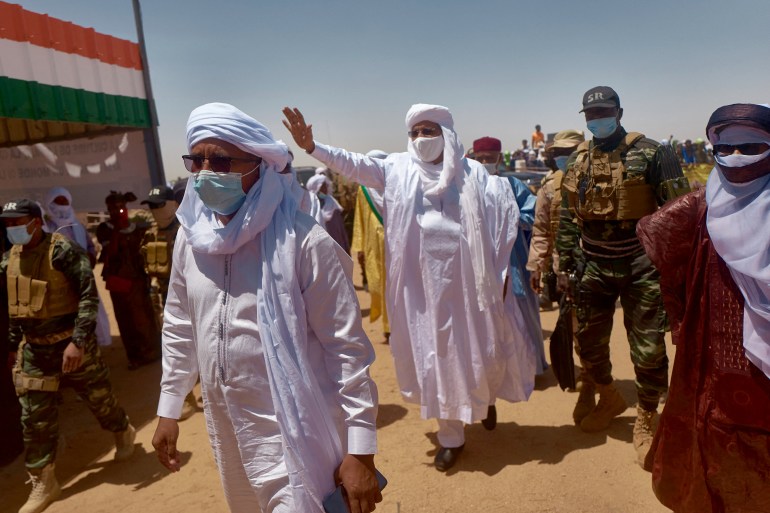 Niger’s President Mohamed Bazoum (centre) waves as he arrives for the festival on Thursday [Michele Cattani/AFP]
 An artist’s impression shows France’s future third-generation nuclear-powered ballistic missile submarine SNLE 3G [Handout/Naval Group via AFP]



COVID infections around the world
Holidaymakers have been frantically booking flights to destinations they haven’t been able to visit in months, after the government eased its international travel restrictions.
And to get an idea of the COVID picture in different countries around the world, you can use the map below to check the two-week infection rate in each nation.